

For most online merchants, payments are often seen as a necessary cost of doing business. Every online order typically involves several intermediaries, card networks, acquiring banks and payment processors. Each layer adds fees, and each card transaction carries the risk of chargebacks and disputes.
Across Europe, a different model has been gaining traction. Open Banking payments allow customers to pay directly from their bank account, using the European banking infrastructure rather than global card networks. The European Union actively supports this development as part of a broader goal: strengthening Europe’s digital payment sovereignty.
For merchants, the implications are immediate and tangible. Open Banking payments can significantly reduce transaction costs and eliminate many of the operational challenges associated with card payments.
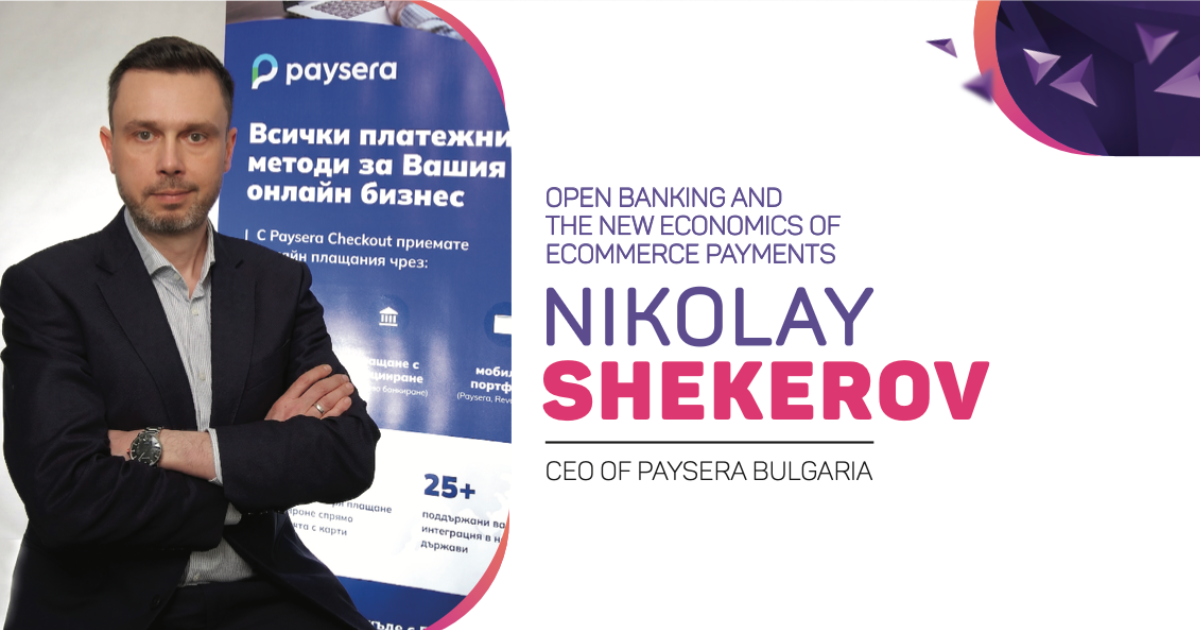
To understand how this model works in practice and what it means for Bulgarian eCommerce businesses, we spoke with Nikolay Shekerov, CEO of Paysera Bulgaria.
Mr. Shekerov, Open Banking is often discussed in connection with “European payment sovereignty”. Why is this important?
The idea behind European payment sovereignty is to ensure that the continent’s digital economy relies on its own financial infrastructure. Today, a large share of online payments in Europe is processed through global card networks. These systems work very well, but they are both more expensive and controlled externally.
Open Banking creates an alternative by allowing payments to move directly between bank accounts using the banking systems that already exist in Europe. The EU supports this development because it increases competition, strengthens the resilience of the payment ecosystem, and reduces the costs for the consumers.
What does this mean in practical terms for eCommerce merchants, particularly when it comes to fees?
For merchants, the most immediate benefit is the cost saving. Open Banking payments are simpler because the payment moves directly from the customer’s bank account to the merchant.
As a result, the transaction fees can be significantly lower, usually a fraction of the cost of a typical card payment.
Another advantage is that account-to-account payments do not involve chargebacks in the same way card payments do. This reduces administrative work for merchants and lowers the risk of disputes.
For many online stores, especially those with high transaction volumes, these differences can translate into meaningful savings.
Some consumers might assume that paying directly from a bank account is more complex than using a card. Is that the case?
That may have been true several years ago, but the user experience has evolved significantly. Nowadays, practically all fintech companies and most banks offer very intuitive digital payment applications.
When a customer chooses an Open Banking payment at checkout, they simply confirm the transaction through their mobile app or online payment interface.
The process is quick and familiar because it uses the same environment the customer already uses for their daily banking.
What about merchants? Is Open Banking more complex to implement in an online store?
From a technical perspective, it is no more complicated than integrating any other online payment method.
Paysera provides an all-in-one payment gateway for e-commerce businesses. Through a single integration, merchants can accept card payments, Open
Banking payments, as well as mobile wallet options such as Google Pay and Apple Pay.
Paysera developers and engineers works directly with merchants to support the integration process in Bulgaria and Romania free of charge. In most cases, however, implementation is straightforward and can be completed quickly using the plugins available for major e-commerce platforms.
What is the cost for merchants to start accepting Open Banking payments?
There are no additional costs for merchants to implement Open Banking within the Paysera payment gateway.
The transaction fees themselves are also significantly lower than card payments, in our case about one third of the equivalent card processing fees.
Because we want to accelerate the adoption of Open Banking in, Paysera is currently offering zero transaction fees for Bulgarian and Romanian merchants during the first year when they start accepting Open Banking payments. This allows businesses to test the solution and experience the benefits without any financial risk.
Some merchants might wonder whether Open Banking is as reliable as traditional card payments. How would you address that concern?
Open Banking is built on the infrastructure of European banks and regulated financial institutions, so reliability and security are fundamental to the system.
The EU has been actively supporting this ecosystem through regulation and initiatives designed to encourage innovation and competition in payments, as well as reinforce European payment sovereignty. As more fintech companies and banks develop services based on Open Banking, the infrastructure continues to become stronger and more widely adopted.
From the merchant’s perspective, this means they are using a payment method that is supported by European financial institutions and integrated directly with the banking system.
The Outlook for Balkan eCommerce
As online commerce continues to grow, merchants are increasingly looking for payment solutions that combine convenience, reliability and cost efficiency.
Open Banking offers a compelling proposition: lower fees, fewer disputes and a payment infrastructure that is closely aligned with Europe’s broader digital strategy.
For eCommerce businesses willing to offer their clients new payment options, it represents not just a technological innovation, but a practical opportunity to improve margins and streamline operations.