


Jesse Weltevreden is CEO of RankmyAI, the world’s largest independent AI tools directory, tracking over 60,000 AI tools and companies globally and benchmarking AI ecosystems using transparent, data driven metrics. He is also Professor of Digital Commerce at the Amsterdam University of Applied Sciences, where he leads research on AI, eCommerce and data driven market insights.
Artificial intelligence is becoming part of the operational core of eCommerce. It is used in marketing, pricing, logistics, customer interaction, and increasingly in decision-making. At the same time, the number of available AI solutions is expanding rapidly. This creates a paradox. There is more AI technology available than ever, yet many companies struggle to translate that into real competitive advantage.
“There is more AI technology available than ever, yet many companies struggle to translate it into real competitive advantage.”
A key reason is that AI adoption often starts at the wrong place. Many eCommerce companies begin with solutions. They explore what is available, experiment with applications such as content generation or chatbots, and implement isolated use cases. These initiatives can deliver quick results, but are unlikely to create long-term value if they are not anchored in a broader strategy. A more effective starting point is to identify where AI can create measurable value within the business.
In eCommerce, this typically lies in areas where data, scale, and decision-making come together. Pricing directly affects margins. Demand forecasting influences inventory and working capital. Recommendation systems impact conversion and basket size. Fraud detection reduces losses. Supply chain optimisation improves efficiency and service levels. These domains receive far less attention in media and online discussions than applications such as content generation, but they are often far more relevant from a strategic perspective. An AI strategy that focuses primarily on applications such as content generation risks missing where the real impact is created.
“An AI strategy that focuses primarily on applications such as content generation risks missing where the real impact is created.”
The next step is to decide how these capabilities should be organised. Larger eCommerce companies may develop parts of their AI capabilities in-house to maintain control and build differentiation, although even they rely on external providers for a significant share of functionality. For most small and medium-sized companies, developing AI in-house at scale is not realistic. They depend largely on external solutions to access AI capabilities. This makes choosing the right solutions and providers even more critical, as these decisions directly affect performance, flexibility and long term dependency. Once it is clear where AI creates value and what to develop in-house versus externally, the question becomes how to make informed choices between the available AI solutions.
For almost every use case in eCommerce, there are now dozens or even hundreds of AI solutions available. Many offer similar functionality and rely on the same underlying technologies. New providers enter the market continuously, while others quickly lose traction to competing solutions as user attention shifts. In this environment, selecting the right AI solution is not straightforward.
Decisions are often influenced by visibility rather than by structured comparison. Hype, strong marketing and viral examples shape perception. In addition, a large share of available information comes from parties with commercial incentives, including vendors, ‘AI experts’ and platforms that benefit from promoting specific solutions.
As a result, independent and comparable information is limited. This is precisely one of the reasons why we developed RankmyAI: to provide independent, data-driven clarity in a market that is characterised by hype, marketing narratives and sponsored promotion of AI solutions. The platform operates without paid placements and sponsored content and is designed to offer a more objective view of how the global AI market actually develops.
At the same time, the speed of development creates a constant fear of missing out. Companies feel pressure to adopt AI quickly, even when the strategic relevance is not fully clear. This often leads to fragmented adoption and short-term decisions. What makes this even more complex is that visibility does not equal value. Some AI solutions gain rapid attention but fail to sustain usage. Others grow more steadily and build a strong position in specific niches. Without insight into how solutions develop over time, it is difficult to distinguish between temporary momentum and durable traction.
“Without insight into how solutions develop over time, it is difficult to distinguish between temporary momentum and durable traction.”
At RankmyAI, we analyse more than 62,000 AI solutions and companies worldwide to bring structure to this landscape, using observable indicators such as web traffic, investment data and user reviews to measure traction.
The data shows that the market is both fragmented and concentrated. The number of solutions is growing rapidly, but a relatively small group captures most of the usage and attention. Many solutions show volatile development patterns, while others demonstrate more stable growth.
By comparing solutions within specific eCommerce use cases and tracking their development over time, it becomes possible to see which are gaining traction, which remain relevant and which are losing ground. This makes it possible to move beyond isolated examples and marketing claims, and to understand where measurable traction is emerging.
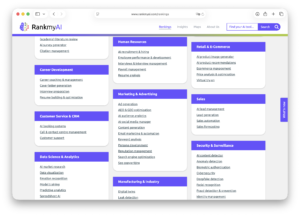
At the core of RankmyAI are monthly updated, data driven rankings of leading AI solutions within specific use cases. These rankings provide a structured overview of which solutions show the strongest traction based on indicators such as web traffic, investment data and user reviews. The rankings are not intended to define which solution is ‘best’, but to offer a clear starting point for comparing alternatives. RankmyAI also provides detailed profiles with information on company background, categories and performance over time, based on historical ranking data and underlying metrics. New use case rankings can be requested free of charge, allowing the platform to continuously expand based on market and AI community needs.
“The rankings are not intended to define which solution is ‘best’, but to offer a clear starting point for comparing alternatives.”
This allows companies to move beyond isolated examples and marketing claims, and to base decisions on observable patterns derived from RankmyAI data. In addition, these data provide insight into broader trends. They show which categories are expanding, where innovation is accelerating, and how different types of AI applications are developing. This helps companies not only to select solutions, but also to determine where to focus strategically.
A further dimension is geography. AI development is global, but not evenly distributed. Certain regions specialise in specific domains, often driven by local expertise, industry structure and policy support. These patterns become visible through RankmyAI ecosystem maps, which show where AI solutions and companies are located.

For policymakers, this provides a basis to strengthen regional ecosystems and stimulate domestic innovation. In the current geopolitical context, this is increasingly important. Dependence on a limited number of large technology providers, particularly from the United States and China, raises questions about control, data governance and long-term autonomy. Strengthening domestic and regional AI capabilities can help reduce these dependencies and create new opportunities for companies to build and use locally anchored solutions.
For eCommerce companies in the Balkans and the wider Central and Eastern European region, the challenge is not the availability of AI solutions, but how to navigate a large and complex set of options in a global market. The data shows that a relatively small number of providers capture a large share of attention and usage, while at the same time many specialised solutions continue to emerge, including in specific regions and niches.
This creates a more complex choice set. Companies need to decide which solutions to rely on, how these fit within their technology stack, and to what extent they want to depend on a limited number of dominant providers. In many cases, even specialised or niche solutions build on underlying models or infrastructure from larger technology providers, which means that dependencies are not always visible at first sight. At the same time, regional and specialised players can offer relevant alternatives in specific use cases. Making these trade-offs becomes an important part of AI strategy.
“The broader conclusion is that AI should not be approached as a collection of individual solutions, but as a strategic capability.”
The broader conclusion is that AI should not be approached as a collection of individual solutions, but as a strategic capability. That starts with identifying where value is created, making clear choices about what to develop in-house and what to source externally, and navigating a complex and fast-moving market in an informed way based on independent and data-driven insights.
More information and the latest AI rankings are available at www.rankmyai.com.