

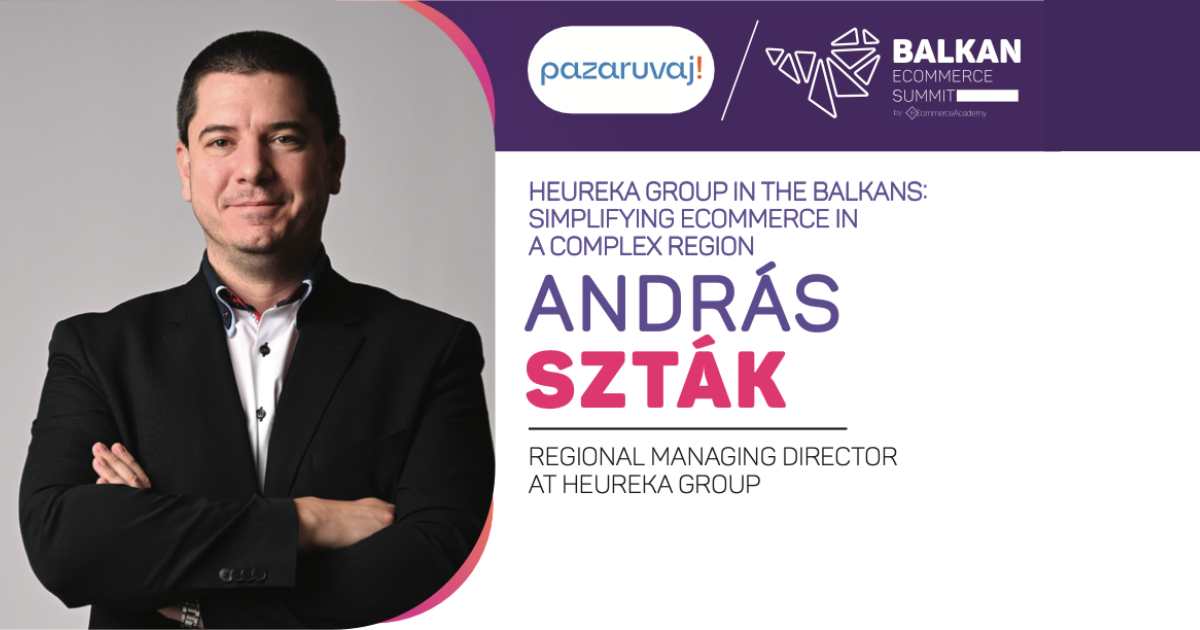
András Szták, Regional Managing Director at Heureka Group, on building trust, navigating diverse markets, and enabling smarter, value-driven shopping across the Balkan eCommerce landscape
As eCommerce continues to grow across the Balkans and Central and Eastern Europe, the region is becoming increasingly interconnectedl, but also more complex. From Romania and Bulgaria to the Adriatic markets of Croatia, Slovenia, and Serbia, consumer expectations are rising, competition is intensifying, and shoppers are becoming not only more cautious, but also more conscious in how they spend.
Heureka Group is active across multiple markets in the region. How would you describe your role in the Balkan eCommerce ecosystem?
Our role is to simplify decision-making in a very fragmented market. Across the Balkans, whether we talk about Romania, Bulgaria, or the Adriatic countries like Croatia, Slovenia, and Serbia, consumers are faced with an overwhelming number of choices. But today, it’s not just about choice, it’s about making the right choice.
We help structure that decision process by combining transparent pricing, reliable product information, and verified shop feedback. This allows users not just to find products, but to understand their real value and make confident, conscious purchasing decisions.
Platforms like Compari.ro and Pazaruvaj.com are becoming increasingly important locally. What makes them relevant in their respective markets?
Relevance comes from localization and from understanding how people think about value. Romania and Bulgaria may seem similar at first glance, but their shopping behaviors differ. Romanian consumers are highly engaged in comparing products and actively looking for the best value for money, not just the lowest price. In Bulgaria, price sensitivity is still very strong, but trust and quality are becoming equally important factors. Compari.ro and Pazaruvaj.com reflect this shift.
They are not just about price comparison anymore, They are about helping users balance price, quality, and reliability, because that’s how real decisions are made today.
The Adriatic region is also part of your responsibility. How does it fit into Heureka’s broader strategy?
The Adriatic region, specifically Croatia, Slovenia, and Serbia, is a very dynamic and fast-evolving part of our portfolio. These markets are seeing rapid digital adoption, and consumers are becoming more open to cross-border shopping. At the same time, they are also becoming more selective: comparing more, evaluating more, and paying closer attention to whether a purchase is truly worth it.
From a strategic perspective, these countries are essential to building a connected regional ecosystem where users can make smarter decisions regardless of where they shop.
The region is often treated as one block. How do you balance similarities and differences across markets?
This is one of the biggest challenges and opportunities. There are clear similarities across the region: strong price sensitivity, a growing focus on value, and increasingly conscious shopping behavior. These allow us to think regionally and scale certain solutions.
But the differences are just as important. Consumer expectations, trust levels, and even definitions of “good value” vary significantly between countries. You need to operate on two levels at the same time, leverage similarities to scale, but respect differences to stay relevant. That balance is what allows Heureka Group to build platforms that feel local, while benefiting from regional knowledge and shared technology.
Trust is clearly important, but how does it connect to this more conscious shopping behavior?
They are closely linked. In this region, consumers are not just careful, they are increasingly deliberate. They think more about what they buy, why they buy it, and whether it’s worth the price. Value is defined not by the price, but what a specific price and a specific product mean to the consumer. Trust is what enables that decision.
If users don’t trust the shop or the information, they can’t evaluate value properly. That is why transparency is so important. By providing verified reviews, reliable shop ratings, and clear price comparisons, Heureka helps users move beyond impulsive decisions toward more informed, rational purchases.
What value does Heureka Group bring to online retailers in these markets?
We help retailers connect with smarter shoppers. Users coming to our platforms are not just browsing, they are comparing, evaluating, and actively looking for the best option. That means they are more informed, but also more demanding.
For retailers, this also creates both a challenge and an opportunity. They are not competing only on price anymore, but on value, trust, service, and overall experience. This ultimately leads to better-quality customers, stronger conversions, and more sustainable growth.
How do trends like AI and international competition affect your markets?
We are entering what I would call a decade of uncertainty. On one side, global players, especially large international and Chinese platforms, are reshaping the competitive landscape with aggressive pricing, scale, and logistics advantages. This creates significant pressure on local and regional SMEs, who often cannot compete on price alone.
At the same time, generative AI is lowering the barrier to entry across the board. It has never been easier to create a webshop, generate content, or even imitate a legitimate business. That creates not only competition, but also confusion and risk. This is where platforms like Heureka play a critical role: not just for consumers, but for merchants as well.
We help trusted, legitimate businesses stand out. In a market flooded with offers, visibility is no longer enough as credibility becomes the real differentiator. Our ecosystem supports SMEs in being not only seen, but also trusted and competitive, even against much larger international or domestic players.
With AI-driven shopping and content overload on the rise, what will define success in the future?
The biggest challenge is no longer access, it’s reliability. With AI generating massive amounts of content, offers, and even entire eCommerce experiences, users are increasingly exposed to misleading information, fake deals, or low-quality sources. This makes trusted platforms and verified data more important than ever.
In the age of AI, the value of credible data increases dramatically for the entire ecosystem, including future AI-driven shopping assistants. Platforms like Heureka, built on structured product data, verified reviews, and trusted merchant networks, are uniquely positioned to serve as reliable sources in this new environment.
At the same time, broader economic and geopolitical uncertainty is pushing consumers toward more conscious and security-driven behavior. When people feel uncertainty, they don’t stop shopping, but they do become more careful. They want to be sure they are making the right decision. This is where comparison platforms are seeing a renewed rise.
By helping users navigate complexity, verify information, and clearly understand value, they are becoming essential tools, not just for finding products, but for making sense of the market itself.
You joined Heureka Group after building eMAG in Hungary. How does that experience shape your approach today?
It gave me a deep understanding of how eCommerce works in this region, especially when it comes to performance, marketplaces, and scaling operations. At Heureka, I can apply that knowledge on a broader, regional level.
But one thing hasn’t changed: success always comes down to execution and people. You need strong local teams who understand their markets and can respond quickly to changing consumer expectations.
What advice would you give to companies looking to expand in the Balkan region?
First, take the time to understand your customers. This is a region where people think carefully about their purchases. Price matters, but value matters even more. If you don’t understand that balance, it’s very difficult to succeed. Second, don’t oversimplify the region. It may look like one market from the outside, but it’s not, and a such, local insight is critical.
Finally, be consistent. Building trust, credibility, and brand recognition takes time, especially with increasingly conscious consumers who don’t make decisions lightly.
What is your outlook for eCommerce in the Balkans over the next few years?
Growth will continue, but shopping behavior will keep evolving. Consumers will become even more selective, more value-driven, and more conscious of their decisions. At the same time, the number of options will keep increasing. The biggest challenge will be complexity, especially with new players arriving. The winners will be those who simplify, Those who help users cut through the noise and clearly see what’s worth their money.
What drives you as a leader in such a fast-changing industry?
For me, it’s about mindset and responsibility. We are not just building platforms, we are shaping how people make decisions. I strongly believe that dedication and faith can be the difference between success and failure. And in a region where every purchase is more considered than ever, that mindset matters more than ever.