

Balkan eCommerce is growing: more than half of companies in the region increased online sales in 2025. However, behind these numbers lies a concerning statistic: 58.5% of companies name customer acquisition as their main challenge. Businesses are spending more and more on marketing, which is becoming increasingly expensive each year, creating a vicious cycle.
In an interview with Alex Danchenko, co-founder and COO of Yespo CDP – a platform that works with eCommerce companies across Europe – we explored why the “more traffic” strategy no longer guarantees profit, why retention is becoming more important than acquisition, and where exactly retailers are losing money every day.
Alex Danchenko is developing Yespo Omnichannel CDP, a platform currently used by 4,000+ companies across European and global markets. For over 13 years, he has been helping eCommerce brands scale sales by implementing automation, personalization, and artificial intelligence tools. He is a recognized expert in AI marketing and predictive analytics, and a regular speaker at leading international conferences, including E-commerce Berlin Expo, MailCon Las Vegas, Ecommerce.pl Event 4.0, Balkan eCommerce Summit, Digital4Sofia, E-commerce Talks, 5F Conf and others.
Companies are spending more on marketing than ever before, and the number of tools has also increased. But growth does not match these investments. Why is this happening?
Because the model most eCommerce businesses have relied on for growth over the past 10 years – “more acquisition budget = more customers” – is running out of steam. The market has matured. According to the Balkan eCommerce Survey, only one in seven Bulgarian companies (14.2%) grew by more than 20% in 2025. The rest are either stagnating or growing slowly.
eCommerce companies most often evaluate marketing by the number of new customers, but no one calculates how much it costs to reacquire a customer they already had.
Most local companies (75.6%) build growth exclusively on paid acquisition, which is becoming more expensive every year. At the same time, global players – Temu, Shein, Trendyol – are entering the market and driving up advertising auction prices.
In such an environment, the ability to work with customers who have already purchased is no longer just a good practice – it becomes the only way to maintain margins.
Retaining an existing customer costs 5–25 times less than acquiring a new one, yet businesses continue to buy expensive traffic. This is the paradox: future revenue is already embedded in the customer base, but businesses do not see it – or do not know how to unlock it.

Where is the money going? Where are these invisible holes in the system?
There are points where eCommerce loses money every day. These are five hidden revenue leaks.
1. Anonymous traffic. Between 70% and 90% of visitors leave the site without leaving any contact details. Businesses pay to acquire them and then simply let them go.
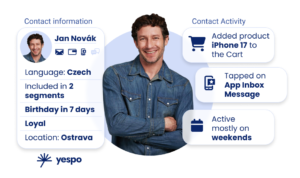
Simple but effective tools help here – properly configured pop-ups and widgets for collecting contacts. A modern customer data platform (CDP) can track visitor actions from the very first visit to the site. If a person browses products and then subscribes via a pop-up, the system automatically combines their entire previous history into a single customer profile.
This allows businesses to apply personalization instantly: for example, you can send recommendations based on behavior that occurred even before the user left their data.
2. Offline traffic. For many retailers, it is even larger than online — hundreds of people enter stores every day, make purchases, and leave without any further communication. Businesses spend their budgets acquiring new users on ad platforms, unaware they already have an audience that hasn’t been added to the database.
Solutions like CDP allow businesses to identify offline customers and unify all data into a complete 360° customer profile. From there, the platform automatically guides the customer through the funnel to the next purchase. It takes into account purchases, website behavior, app activity, and interactions in direct channels, and delivers personalized product recommendations through the right channel at the right time.
3. Unrealized purchase intent. A customer viewed a product, added it to the cart – and disappeared. According to Yespo research, 7 out of 10 carts are abandoned, yet in most companies, this signal is not processed – there is neither a timely reminder nor a personalized offer.
The solution is to implement triggers such as “Abandoned Cart” and “Abandoned Browse.” In these workflows, the system detects the moment when the purchase is interrupted and automatically sends the user a reminder with relevant products. According to Yespo statistics, the “Abandoned Cart” trigger recovers up to 27% of such customers and increases sales by an average of 10%.
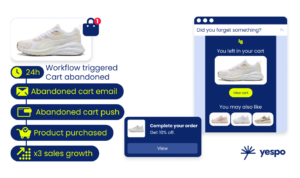
4. Reactive marketing and low retention. Most companies react only when the customer has already effectively moved to a competitor, trying to win them back through complex reactivation campaigns. It is far more effective to work with the customer while they are still with you. Businesses can stimulate repeat purchases on autopilot using triggers. For example, a “Replenishment Reminder” automatically sends a message exactly when a regularly used product is about to run out, while Next Best Offer provides personalized recommendations based on the customer’s previous behavior. This creates a continuous engagement cycle where the customer keeps coming back without even considering competitors’ offers.
5. Poor data exchange between channels. A customer receives an email with product recommendations for items they have already purchased in the app, while a push notification duplicates information from an SMS, leading them to unsubscribe or ignore messages altogether. At the same time, the business cannot accurately attribute, does not understand the true impact of each channel, and cannot precisely calculate ROI and ROMI. As a result, companies often invest in what does not work and underinvest in what can be scaled.
When all customer data is unified into a single profile, a marketer does not simply send messages, but creates a seamless customer experience where each step logically continues the previous one.
Seems like businesses need even more tools to close these revenue leaks. But many already have large stacks: CRM, email services, analytics. Adding another tool often feels like a risky investment.
Businesses tend to count the number of tools, while the real problem lies in the connectivity of data between them. When channels and systems are fragmented, you are operating blindly. Due to unsynchronized data, businesses not only lose around one-third of revenue from each channel every day, but also fail to reach up to 40% of their actual audience, which remains invisible to the CRM.
CRM is a record of transactions: what was purchased, when, and for how much – a tool for the sales team. This is not enough for real-time marketing.
CDP is about monetizing behavior. The platform sees not only the purchase itself, but the entire journey: what the customer viewed, which filters they applied, and at what stage they left the site. CDP tracks the behavior of even anonymous visitors and enables businesses to start personalized communication as soon as the user is identified. For example, when a person visits the site from an email, the system recognizes them and links the current session to their previous interaction history – even without authorization.
Addressing a customer by name is not yet personalization. True personalization with a CDP is when the system identifies customers who are ready to buy even without a discount – and does not waste your margin on them.
What specific benefits does a CDP provide in addition to the tools a company already has? What becomes possible after implementation?
In most companies, marketing is an endless list of tasks performed manually: prepare a segment, launch a campaign, check results, repeat. Teams are constantly occupied with operations – and have little time for what actually drives the business: analytics, hypothesis testing, and strategy.
CDP changes this logic. You set up workflows once – and the system runs them automatically. Marketing no longer depends on team size or working hours.
Omnichannel workflows cover the entire customer lifecycle and operate without manual management of each campaign. The customer receives the right message, in the right channel, at the right time.
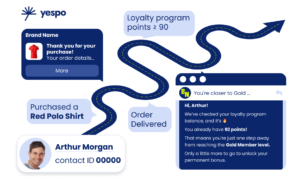
Yespo CDP provides a library of over 20 ready-made workflows that have already proven effective in eCommerce, while the customer success team helps adapt them to your business. As shown by our clients’ campaign results, triggered campaigns generate 7 times more revenue than bulk campaigns – with significantly lower team resource costs.
With a CDP, marketing stops being a resource-intensive process and becomes a managed system for revenue growth from the existing customer base. Marketers finally have time for analytics and strategy, as operational tasks run automatically.
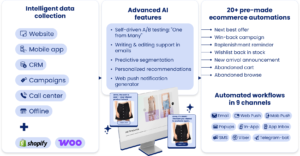
Today, many talk about AI, although it is often just a marketing buzzword. How exactly does AI work within Yespo CDP, and what practical value does it bring to businesses?
At Yespo, we use both generative and predictive AI – from content creation and optimization to precise audience targeting.
Generative AI is built directly into the message editor, helping generate copy, subject lines, and CTAs without switching between tools. It is also worth mentioning the “One of Many” block – the system creates multiple content variations, automatically tests them in real time, and determines which performs best for a specific segment.
The Promova app, with an audience of 17 million users, tested AI-generated push notifications against manually written ones – AI-driven variants delivered 82% higher CTR and 68% higher conversion.
Predictive AI operates in two directions:
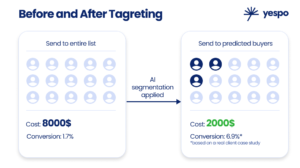
- Predictive segmentation. Instead of relying on intuition, the algorithm analyzes behavioral patterns and identifies who is likely to make a purchase in the coming days and who is at risk of churn. Companies that adopt predictive segmentation reduce channel costs by up to 50% – by stopping the same messages from reaching everyone and instead focusing on users who are ready to act. The clothing brand O.TAJE saw a 300% increase in conversion and a 310% increase in campaign ROMI after implementing predictive segments.
- AI-powered recommendations based on transformer models and LLMs. Traditional recommendation systems rely on individual purchases and build simple correlations: those who bought X also buy Y. A transformer model works differently – it analyzes the entire sequence of customer behavior, understands context, and predicts the next step.
Even if a customer has no purchase history yet, the algorithm selects relevant products based on descriptions and semantic relationships. As a result, AI-powered recommendation blocks generate around 20% of a store’s sales, while ROI can reach up to x10.
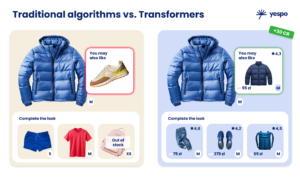
For example, the brand PUMA saw a x10x increase in the share of orders driven by AI-powered product recommendations over 14 months.
The high performance we see in the PUMA case and across other Yespo clients is achieved because recommendations are not limited to a single channel. The system uses all actual data from the user profile in real time to deliver consistent, personalized product selections at every touchpoint with the brand. Recommendations adapt to the customer across the website, in the app, in email, messengers, and mobile and web push notifications.
You mentioned channels. How does a CDP help manage interactions when there are too many of them?
Yespo CDP brings together 9 communication channels in a single system: Email, Viber, SMS, Web Push, Mobile Push, In-App, App Inbox, Telegram bot, and widgets.
All channels have real-time access to the customer profile. This means messages do not appear randomly – each interaction logically follows the previous one, creating a seamless experience. For example, the system knows that a customer has already seen a message in the app, so it will not duplicate it in a more expensive channel like Viber.
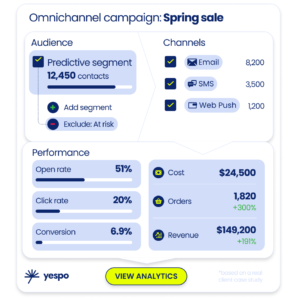
To keep this approach financially efficient, businesses can build cascading flows: from the lowest-cost channels to more expensive ones. The system automatically selects the most appropriate and cost-effective path – for example, it first sends a free message via App Inbox, and only if there is no response does it use Viber or SMS.
What does this look like in practice? What results can businesses expect?
There is one key KPI I recommend focusing on first: the share of revenue from retention channels. In most companies, before implementing a CDP, it is around 10–15%. After implementation, retention-driven revenue grows to 30–40% and higher. This means marketing starts working with the audience it has already acquired instead of spending the budget only on new users.
Let me share three Yespo client cases – different industries, different goals, but the same outcome: increased revenue from the existing customer base.
Foxtrot – a major electronics retailer and a member of the international Euronics association (34 countries). The goal was to increase sales of complementary products through personalized recommendations on the website. After implementing AI-powered recommendations, accessory sales increased by 16% with the same level of traffic. This result was achieved without additional acquisition costs – purely by enabling the system to understand semantic relationships between products and offer the right items at the right time.
Liki24 – a European marketplace for medicines and health products operating in 10 countries, including Romania and Poland. The goal was to increase conversion in email campaigns. After integrating AI-powered recommendations into bulk emails, conversion increased by 71%, and clicks on the AI block exceeded those of the standard recommendation block by 106%.
A children’s goods retailer with around 1 million monthly users aimed to unify the customer experience across the app, website, and offline stores into a single path to purchase. To achieve this, the company implemented 360° customer profiles, orchestrated communications across five channels, introduced 25 trigger workflows, and used AI recommendations that helped identify customers even offline and bring them back through personalized offers. As a result, the CDP generated 14% of the network’s total revenue.
These are not exceptional cases, but typical results when businesses stop distributing budgets across the entire base and start working precisely with those who are ready to act.

For which businesses is a CDP a must-have right now, and for which is it still too early? How can a business owner understand which category they fall into?
Website traffic of 30,000 users per month or more is already a sufficient reason to implement a CDP. If your site attracts that level of audience and you do not recognize them or respond to their behavior in real time, you are already losing money.
The real need for a CDP arises when a business realizes that to generate more revenue, it needs to work more deeply with its audience. You may already have enough data in your CRM or Google Analytics, but without the right tool, you cannot turn that knowledge into profit.

To understand whether your business needs a CDP today, answer four questions:
- What percentage of customers made a repeat purchase in the last 90 days? If it is below 20%, you have a significant churn that cannot be offset by new traffic.
- Are your channels synchronized with each other? If email does not know that a customer has already responded to a push notification, you are wasting budget on duplication.
- Have you implemented basic trigger workflows – abandoned cart, welcome series, reactivation? If even one is missing, you are literally leaving money on the table, as these messages generate 24 times more revenue than bulk campaigns.
- Do you want to generate more revenue from the customer base you have already built?
Many businesses are concerned about the technical complexity of implementation. How difficult is it to integrate a CDP into existing processes?
Timelines depend on the scale and goals of the business: the first trigger workflows – birthday greetings, a welcome series, and abandoned cart reminders – can be launched within a week. Fully deploying the platform and seeing the first return on investment takes a few months.
At the same time, the technical entry barrier is low. If a store runs on Shopify, WooCommerce, or OpenCart, Yespo offers ready-made plugins that can be connected without developers and start collecting data immediately. For more complex systems, there is a flexible API; for mobile apps – a ready-to-use SDK. More than 300 services can be integrated via Zapier.
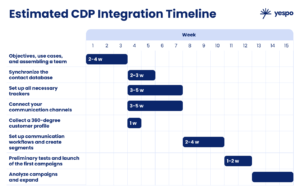
We understand that for large businesses, switching from one tool to another can risk interrupting workflows and losing revenue. That is why our integration and Customer Success teams help develop a personalized, step-by-step transition plan to ensure that no revenue-generating workflow is disrupted. And if you prefer to delegate everything, our in-house marketing agency can set up both the strategy and the entire CDP for you.
If you want to understand where your business has growth opportunities, take advantage of a consultation with Yespo experts. Our team has been building revenue-driven marketing for eCommerce businesses for over 13 years. We will analyze your data, identify specific revenue leaks, and calculate the additional profit a CDP implementation can deliver to your company ➡ get the consultation.