

 What key trends do you currently observe in the local eCommerce market, and how do you see them evolving in the next few years?
Recently, the eCommerce sector in the Balkans has seen a notable upsurge, mostly due to a consumer shift towards online platforms, triggered by the epidemic and by a global boom in eCommerce penetration.
Some considerable patterns that reflect global trends and provide informative data are:
Growing eCommerce Adoption: The Balkan region witnesses a consistent rise in eCommerce adoption driven by factors such as convenience, diverse product selection, and competitive pricing. This trajectory is expected to continue with improved internet penetration and digital literacy.
Mobile Commerce: The growth of mobile commerce (m-commerce) in the Balkans is fueled by the widespread use of smartphones and mobile internet connectivity. As mobile technology progresses, retailers are making calculated investments in mobile-friendly platforms to meet the growing demand for smartphone and tablet purchasing.
Cross-Border eCommerce: The Balkans exhibit a rising trend in cross-border eCommerce, with consumers increasingly engaging with international online retailers. This is propelled by access to global brands, competitive pricing, and the ease of purchasing from foreign websites. Retailers in the region are anticipated to expand their offerings to meet this growing demand.
Payment Innovation: Digital wallets, buy now, pay later (BNPL), and cryptocurrency possibilities are just a few of the payment methods that are constantly evolving in the Balkan eCommerce environment. With the advancement of technology, consumers will continue to benefit from these alternatives’ flexibility and ease while transacting online.
Logistics and Delivery: Effective delivery and logistics strategies continue to be essential for Balkan eCommerce success. Businesses are spending money on improving their infrastructure to guarantee prompt order fulfillment. In order to satisfy customer expectations for quick and easy shipment, innovations like click-and-collect alternatives and same-day or next-day delivery are becoming more and more important.
It is anticipated that these trends will continue to change in the future due to changes in consumer behavior, technology improvements, and legislative changes. The online shopping experience may alter as a result of the adoption of cutting-edge technologies like virtual reality, augmented reality, and artificial intelligence. Additionally, legal changes pertaining to cybersecurity and data protection may have an effect on eCommerce operations.
The Greek eCommerce market’s shift
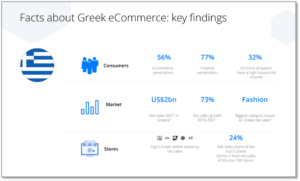
 The Greek eCommerce market, which is now the 34th largest market globally, is expected to see significant changes and strengthen its position, with a value of €8,582.20 million in 2023.
According to a study by McKinsey & Company, e-commerce can boost the gross value added (GVA) of the retail trade and tourist sectors by 20%. This might result in an increase in Greece’s GDP by 2.5%, or 4.6 billion euros, by 2030.
This shift demonstrates the market’s growth as well as businesses’ adaptability to previously unnoticed challenges. New delivery methods and developing business models—rapid commerce, or q-commerce, in particular—are gaining traction. Rapid commerce, which delivers goods in less than an hour and satisfies consumer demands for timely delivery, easy purchase processes, and round-the-clock help, has become more prevalent in Greece.
This measured response is consistent with global trends and highlights the industry’s capacity to adjust to shifting market conditions. CEOs and other executives need to pay close attention to these changes because of the potential they hold for both our company and the industry as a whole.
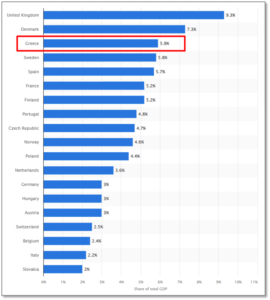
E-commerce as share of total GDP in Europe 2022, by country
Greece’s e-commerce turnover is predicted to exceed €17 billion this year, up from €5 billion six years ago and €15.8 billion last year. This is a more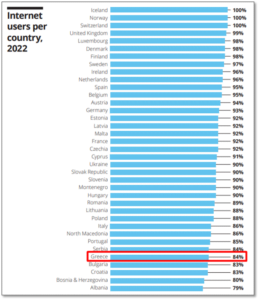 than threefold increase over 2017. The Hellenic E-Commerce Association and E-commerce Europe released the European E-Commerce Report for 2023, which includes data indicating that e-commerce sales will account for 7.9% of GDP in 2023, with a growth rate of 9–10%, as opposed to 10% in 2022.
Greece is positioned in the middle of the Balkan countries in terms of development. Compared to Bosnia & Herzegovina (80%) and Albania (79%), it has a larger number of internet users, but still falls short of Slovenia (90%). Greece’s 84% internet usage percentage is comparable to that of Serbia.
Remarkably, Greece’s internet usage is comparable to that of Bulgaria and Croatia.Greece’s location within the Balkans indicates that it is comparatively well-connected, yet there is still room for growth to catch up to some of its neighbors’ faster rates.
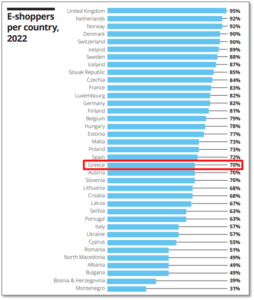 Greece’s e-commerce adoption is higher than that of several other Balkan countries, including Serbia, North Macedonia, Albania, Bulgaria, Bosnia & Herzegovina, and Montenegro. Although a sizable portion of Greece’s population shops online, there is still room for growth to achieve the highest levels of e-commerce engagement observed in other European countries.
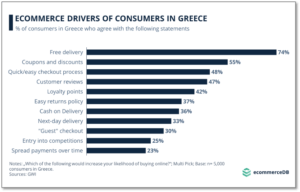
When given the opportunity to purchase things online and save money on delivery, 74% of users believe they would be more likely to do so. In a similar vein, 55% of users said that discounts encourage them to shop online.
Loyalty points are another factor that influences affordability (42%). But only 23% of consumers state that they use installment plans when they shop online, suggesting that Buy Now, Pay Later (BNPL) services are not very important in Greece.
For Greek consumers, the ease of online shopping is further enhanced by the ability to return products (37%) and check out (48%) and the lack of account registration (30%). Furthermore, 47% of consumers think that customer reviews are significant, highlighting the importance of determining the quality of a product before making a purchase.
Can you discuss any specific initiatives or policies aimed at fostering eCommerce growth within the community?
Upon examining Balkan eCommerce, we observe a number of significant initiatives and legislation that propel expansion. Our dedication to promoting regional cooperation and economic integration is demonstrated by the Common Regional Market Action Plan (2020–2024). This calculated move prepares the ground for a more globalized economy.
In addition, the EU Growth Plan for the Western Balkans, which was published in 2023, offers a proactive strategy meant to promote economic expansion. We expect a more favorable atmosphere for businesses to flourish, therefore the potential knock-on effect on eCommerce expansion is important.
Against this backdrop, the upcoming Balkan eCommerce Summit 2024 holds significance as a joint endeavor to explore the nuances of the eCommerce environment in the region. As industry leaders, we value the opportunity to contribute to these discussions, fostering a deeper understanding and collectively enhancing the future of eCommerce in the Balkans.
Can you point out any regional characteristics in terms of payments, logistics, customer behavior, shopping habits, etc?
Generation A’s consumption and purchase patterns have a significant impact on expectations for the caliber of goods and services. This tendency is particularly noticeable in Greece, where buyers clearly favor products made locally and emphasize a strong dedication to excellence, fitting in well with wider regional trends.
At the same time, Greece is going through a revolutionary change in its digital payment environment, which is expected to increase significantly. The incorporation of digital payment methods is becoming an essential part of the total consumer experience in e-commerce. As an illustration of the growing acceptability and use of digital payment methods, the Digital Payments industry in Greece is projected to increase by 5.04% between 2024 and 2028, reaching a market volume of US$14.62 billion by that time. Aligned with the region’s commitment to sustainable practices, the significance of sustainable transport and logistics is gaining prominence. Acknowledged as indispensable for the region’s sustained growth, strategic investments and policy adjustments are imperative to meet heightened expectations from both consumers and stakeholders.
Through their navigation of this ever-changing landscape, Greek e-businesses are actively influencing the future of commerce in the Balkans, rather than just reacting to changing customer dynamics. A strategic alignment with the changing demands of the market is indicated by the dedication to local production, the focus on quality, and the shift to digital payments.
Beyond these calculated moves, a number of other reasons support Greece’s growing e-commerce industry. These include changes in customer behavior, developments in technology, and general economic trends that are influencing the eCommerce industry:
Digital Transformation: Greece is focused on digital transformation initiatives, enhancing digital infrastructure, such as broadband access, and encouraging businesses to adopt digital technologies.
Financial Support for SMEs: Small and medium-sized enterprises (SMEs) are pivotal for eCommerce growth, and Greece provides financial support programs, grants, and incentives to help SMEs establish and expand their online presence.
E-commerce Taxation Regulation: Greece is currently developing laws pertaining to eCommerce taxes in order to guarantee equitable taxation and level the playing field for traditional and online merchants.
Digital Skills Training: Building a skilled workforce is crucial for eCommerce growth, and Greece invests in digital skills training programs to equip workers with competencies for online commerce.
Cross-Border Trade Facilitation: By lowering trade barriers, expediting customs processes, and enhancing logistical infrastructure, facilitating cross-border eCommerce opens up new markets for Greek companies.
Consumer Protection Regulations: Greece has strengthened its legislation pertaining to consumer protection, specifically addressing online purchases. These policies encompass privacy, data security, product quality, and dispute resolution systems.
Promotion of Digital Payments: To increase the ease and security of online transactions, Greece supports electronic payment systems, which in turn encourages the adoption of digital payment methods.
Public-Private Partnerships: Government, business, and trade groups work together to promote best practices, build infrastructure, and jointly handle industry-specific issues. These collaborations fuel the expansion of eCommerce.
Greece’s determination to harness eCommerce’s potential for economic expansion, job creation, and improved competitiveness in the digital era is exemplified by these programs and policies. In order to maintain the pace of eCommerce and take advantage of new opportunities, policymakers must keep an eye on developments, modify rules, and encourage innovation.
Can you share examples of successfully positioned companies on your market in different verticals?
Prominent Greek ScaleUps, such as market titans Viva Wallet, Blueground, and FreeNow, are making a significant impact. In addition, the tech  industry has seen the emergence of powerful companies, such as JP Morgan, Meta, and Delivery Hero, all of which have made notable advancements. Greece was pleased to celebrate the launch of People Cert, its first tech unicorn and evidence of the growing IT sector.
HotelBrain Group stands out as the leading player in the hospitality industry and is the largest hotelier. Furthermore, Shein.com is at the forefront of the constantly changing online fashion business, setting the bar for success. This environment highlights the strong and varied fabric of Greek e-businesses, showcasing the nation’s ability and promise.
How do organizations approach innovation in eCommerce, and what role does technology play in the picture?
Businesses actively drive innovation in the fast-paced Greek eCommerce market by adopting cutting-edge technologies like virtual reality (VR), augmented reality (AR), machine learning (ML), and mostly artificial intelligence (AI). Sustainable development is given priority, and blockchain technology is strategically integrated to ensure ethical and transparent corporate practices.
Our approach to innovation is comprehensive and aims to improve different facets of the eCommerce industry. This entails bolstering our internet presence, judiciously cutting operating expenses, and utilizing real-time analytics and data to make quick decisions. We maintain our leadership position in the eCommerce industry and guarantee operational efficiency by staying on the cutting edge of technical innovations.
Numerous significant innovations are transforming the Greek eCommerce sector, and businesses are implementing a range of tactics, all of which heavily rely on technology:
Using data-driven insights
To predict trends, identify customer preferences, and customize the shopping experience, big data analytics and artificial intelligence are used. These insights provide optimal resource allocation for maximum impact in product development, marketing initiatives, and website updates. Furthermore, real-time location-based mobile selling is a flexible strategy that lets businesses speak with clients immediately. AI-driven customization enhances the customer experience by tailoring services to the individual tastes of each client. The rise of social commerce and voice-activated buying are two more instances of our commitment to bringing innovative solutions to market in response to shifting consumer demands.
Agility and experimentation
Businesses are aggressively embracing experimentation to improve their offers and adjust to changing consumer expectations. Examples of this include incorporating AR/VR product visualization and testing new payment methods. Agile development approaches provide quick testing and iteration, allowing for real-time adjustments based on data analysis and client feedback.
Using technology to its advantage
Chatbots driven by AI personalize consumer encounters, while automation technologies optimize internal procedures. Designing with mobile in mind first guarantees consistent user experiences across platforms, and utilizing social commerce sites leads to creative marketing opportunities. These technical developments strengthen fundamental eCommerce capabilities by enabling strategic innovation and streamlining operations.
Our constant focus on innovation in this ever-changing world is evidence of our commitment to not just meeting but exceeding consumer expectations. Using strategic methods and revolutionary technologies enables us to prosper in a time where innovation will play a major role in determining the direction Greek eCommerce will take.
What rating from 1 to 10 do you give to the local logistic companies and their role in delivery efficiency and customer satisfaction?
Given the research findings, local logistics companies play a crucial role in Greece, as seen by the impressive 94% of Greeks who have used courier services. Nonetheless, the existing 54% satisfaction level indicates that strategic improvements are required to keep up with changing market demands and technological advancements. It goes without saying that improving logistics customer service should be the key priority as it is essential to keeping a competitive advantage. It is crucial to keep improving in this area since logistics is becoming a crucial differentiator in Greece’s changing e-business environment.
In the context of increased interest in cross-border sales, how well prepared are the logistics companies from your country?
As we examine Greek logistics companies’ readiness for the growing demand for international sales, I can say with confidence that our sector is well-prepared. With the current infrastructure and a great deal of potential, we are in a good position. However, our dedication to success in this dynamic environment is based on our unflinching adherence to regulatory requirements and constant adaptation to global standards. Our logistics companies must be nimble in negotiating the complexities of international trade while adhering to global standards. In this fast-paced industry, this strategic approach is critical to guaranteeing not only success but also long-term, profitable operations.
How do eCommerce businesses leverage data analytics to make informed business decisions?To improve decision-making processes, businesses are integrating cutting-edge technology, most notably artificial intelligence (AI), with traditional data analytics. As we look ahead to 2024, the strategic use of AI, especially generative AI, is poised to revolutionize the way eCommerce companies use data and bring in a new era of competitive advantages:
- Advanced Analytics with Generative AI:
eCommerce companies are investigating the revolutionary potential of generative AI in data analytics, much as B2C advertisers have realized the technology’s potential in the creation of creative content. Beyond the creative industries, generative AI is being used to create new material by using machine learning models.
eCommerce companies may track important parameters and produce insights beyond traditional analysis by integrating generative AI into their data analytics operations. Decision-making processes can be greatly improved by this technology’s capacity to automate operations like inventory forecasting, trend recognition, and customer segmentation.
- Streamlining Inventory Management with AI:
eCommerce companies can use AI to improve inventory management by building on the knowledge gathered from B2C advertisers that are having difficulty producing creative assets. Businesses can reduce the risk of stockouts and overstocking by optimizing inventory levels by utilizing generative AI’s forecasting and trend analysis skills. This guarantees an inventory management system that is more responsive and effective.
- Personalized Customer Experiences with AI:
eCommerce organizations can use AI to enhance tailored consumer experiences by taking a cue from the difficulties advertising has when personalizing creative material for various platforms. Using real-time analysis of customer demographics, preferences, and purchase history, generative AI can assist in dynamically customizing marketing efforts. This strategy guarantees distinctive and customized purchasing experiences, encouraging patron happiness and loyalty.
- Embracing the AI Revolution:
Similar to the 96% of respondents in the advertising industry who have already embraced and invested in generative AI, eCommerce businesses can position themselves at the forefront of innovation. Over the next several years, it’s possible that adding generative AI to your data analytics framework may become standard procedure for the 4% of people who show interest in this technology but haven’t made any investments yet. This change aims to transform the entire decision-making process, not only measure metrics.
- Through Marketing Effectiveness:
Data analytics are used by e-commerce companies to assess the success of their marketing initiatives and platforms. Businesses may determine which marketing methods work best by monitoring key performance indicators (KPIs) including click-through rates, conversion rates, and return on investment (ROI). With those insights, a company can not only spend its money more wisely but can also decide whether to increase its expenditures on particular campaigns, goods, personnel, and activities that could ultimately alter its direction in that particular market.
In conclusion, the marriage of data analytics and generative AI will present eCommerce enterprises with a breakthrough possibility in 2024. By utilizing these technologies, businesses may improve their competitiveness, expedite procedures, and provide unrivaled customer experiences in the rapidly evolving world of eCommerce.
Where do you see the future of eCommerce heading, and what role does your organization play in shaping that future in your country?
Analyzing the Greek eCommerce industry’s growth trajectory reveals substantial growth potential. Even with an expected growth rate of 8%—which is just below other European averages—the situation is remarkable, as 70% of Greeks actively engage in online shopping.
Important industry participants that have significantly influenced the eCommerce environment in 2022 include zara.com, hm.com, plaisio.gr, public.gr, and shein.com. Shein.com is in a unique position that indicates significant momentum in the Greek eCommerce market. In addition to showcasing diversity, this landscape also shows upward trends, highlighting the clear possibility for more growth.
Retailers must develop unique brand experiences amid the Human-Centric Fifth Industrial Revolution, which is centered on improving human experiences. Retailers need to stand out from the competition currently of elevated customer expectations for frictionless transactions. It is critical to create a deep brand experience that goes beyond traditional advertising to include emotional resonance and service excellence. Retailers need to be skilled storytellers for their brand, and conversational marketing abilities are becoming more and more important. However, in contrast to the manufacturers whose products they distribute, many retailers fall behind in creating the desired brand experience, even in this transforming context.
Having worked in the industry for 24 years, Generation Y is a leading digital agency in Greece that is actively shaping the future of the country. With 8 business units, the top e-commerce company blends academic knowledge with real-world experience. Renowned for crafting imaginative brand experiences grounded in human-centered concepts, Generation Y cultivates robust relationships between businesses and consumers, amplifying engagement and allegiance. The company sets industry standards for excellence and makes a substantial contribution to Greece’s booming digital ecosystem with its state-of-the-art digital solutions. With export activity in 24 countries, Generation Y’s influence is seen worldwide, and their track record of successful e-commerce cases is impressive. As a member of the GPA group, it leverages collective wisdom, making its knowledge translation into technology even more effective.
With a diverse portfolio, Generation Y has played a pivotal role in leading sectors such as pharmaceuticals, retail, and heavy industry, promoting market growth, wealth, and abundance in Greece.
Which are the key companies and organizations in your region helping the ecosystem grow?
Greece’s e-business ecosystem is flourishing, thanks to the efforts of companies that play a pivotal role in its growth and development. Although Generation Y is a major center for e-business, there are other important players in our sector, including Relevance, RoiMat, Elegento, Atcom, Sleed, Mediacube, Net Steps, and Netstudio.
Also, a wide range of businesses, including Apifon, Contact Pigeon, and Moosend, are among the most significant and rapidly expanding entities in the field of technology tools and platforms.
Are there any cultural or regional nuances that should be considered in brand messaging?
It is clear that digital marketing strategies play a crucial role in strengthening market presence and promoting consumer interaction. Initiatives that are successful focus on using tailored interactions and well-crafted brand messaging to address the fundamental goals of the consumer.
The most important of these criteria is the emphasis on affordability and ease of use. Notably, free delivery is a key distinction, as indicated by the overwhelming preference of 74% of Greek customers for this service. This strategy not only raises customer satisfaction levels but also smoothly fits in with changing consumer expectations.
Loyalty programs are effective and resonate with 42% of consumers. Tailoring these applications to specific user profiles and preferences is a powerful way to build long-lasting client relationships, which strengthens the position of Greek e-businesses in the market.
On the other hand, although they are available, installment choices are not as important in the broader consumer landscape as reported by 23% of respondents. This observation highlights the importance of having a variety of payment choices and the role that other factors play in the purchasing process.
About 48% of Greek customers prioritize the effectiveness of the streamlined checkout procedure, making it a crucial component of the user experience domain. The checkout process can be made even more enjoyable and ultimately more satisfying by implementing hyper-personalization.
Furthermore, a significant 37% of customers place a high value on easy returns of products, highlighting the necessity for e-businesses to set up efficient return procedures. Taking care of this component fits with the larger story of customer-centricity and also promotes consumer trust.
Unexpectedly, 30% of customers would rather not create an account while making a purchase, underscoring the careful balance e-businesses need to maintain between customer data collection and user-friendly interfaces.
To sum up, the efficacy of digital marketing tactics in the Greek market is contingent upon a sophisticated comprehension of consumer inclinations, very tailored interactions, and a flexible reaction to changing circumstances. Online businesses can get clear of the pack and achieve long-term success and recognition in the Greek e-commerce market by matching their goals with those of their customers.