

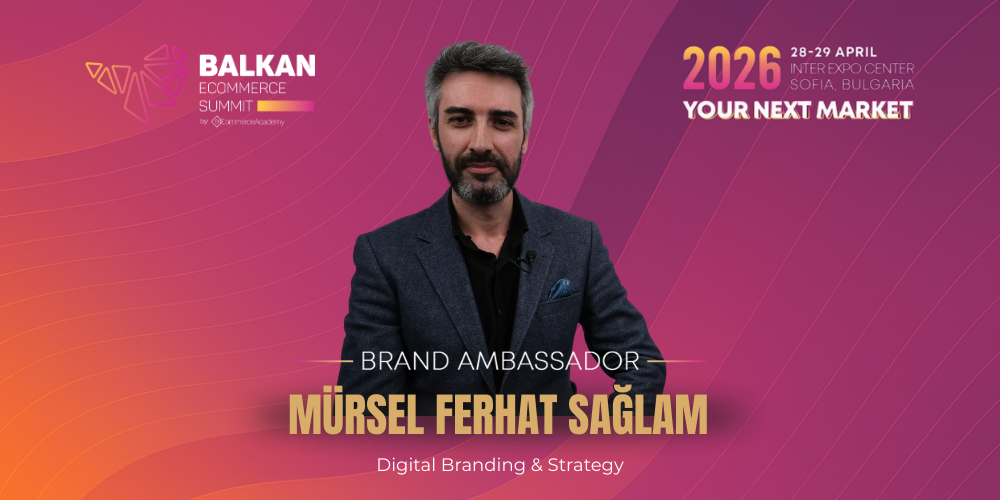
Mürsel Ferhat Sağlam has spent the last decade studying and building brands in the digital era from three angles at once: academia, consulting, and media. As a university lecturer, co-founder of a digital branding agency, and founder and CEO of a digital media platform, Mürsel sees the gap between theory and execution up close.
In this interview, Mürsel explains the core idea that separates strong brands from invisible ones: digital branding awareness. They also unpack when content becomes a strategic asset, why events like Balkan eCommerce Summit matter for cross-border growth, and what mindset shift eCommerce leaders must adopt to stay relevant over the next few years.
In today’s crowded digital environment, what truly differentiates strong brands from those that remain invisible?
 Almost a quarter of a century has passed since the conceptualization of Web 2.0, representing the second phase of the internet. During this time, all terms and concepts in marketing and communication literature have been redefined with the digital prefix. However, these efforts were not sufficiently effective. A conceptualization was needed.
Through my work over the past 10 years, I have conceptualized and introduced the phenomenon of “digital branding” into the literature. I have taken this into account when answering your question. In summary, today, brands are divided into two categories: those that possess digital branding awareness and strategy, and those that do not.
You’ve worked across academia, consulting, and media. How should eCommerce brands balance theory, data, and real-world execution when building long-term brand value?
Yes, I pursue both an academic and a business career simultaneously. To be more precise, I am a lecturer at a university, and at the same time, I am the co-founder of a digital branding agency. I am also the founder and CEO of a digital media platform. Therefore, I have the opportunity to observe both the business world and academia at the same time.
I can say openly that there is a disconnect between academia and the business world. The main reason for this is the low number of professionals with academic careers among the top executives of brands. On the other hand, academics are not very keen on pursuing careers in the business world. In my opinion, digital agencies have a great responsibility in achieving this balance.
Content is often treated as a tactical marketing tool. When does content become a strategic branding asset rather than just promotion?
 Content is one of the few fundamental concepts that has evolved, transformed, and changed alongside humanity from ancient times to the present day. Today, with technological advancements, content has gained a new dimension. This is not a disadvantage; on the contrary, it’s a great advantage for brands and content creators.
To answer your question, content becomes a strategic asset when it transcends being merely a promotional material used during campaigns and begins to explain not what the brand sells, but what it represents. In short, if content becomes a responsibility that must continue to be produced even without any sales action, then content is no longer a tactic, but the fundamental motivation of the strategy.
As a Brand Ambassador of the Balkan eCommerce Summit, why do you believe regional events like this matter for the development of eCommerce brands?
This year, I became the brand ambassador for the Balkan E-Commerce Summit for the third time, representing Türkiye. First of all, I would like to thank you for this.
As you know, Turkey has managed to create many leading brands that can compete in global e-commerce. For Turkish brands to maintain their effectiveness in the global market, they need to increase their connections with both B2B and B2C consumers. Organizations like the Balkan E-Commerce Summit are a great opportunity for this purpose.
Thousands of professional business people and industry representatives from many countries around the world, especially from Europe and the Balkan countries, visit the Balkan E-Commerce Summit. Could there be a better opportunity for the e-commerce ecosystem?
If eCommerce leaders take away one branding principle from the Summit, what mindset shift is most critical for the next few years?
In answering this question, I want to reiterate what I said at the beginning of the interview: digital branding. Yes, digital branding represents much more than a luxury for both startups and businesses; it’s now a necessity.
However, I’m not talking about a temporary strategy here. I’m talking about a natural process integrated into the company’s corporate culture. Accordingly, businesses must now establish digital branding departments. Agencies must categorize themselves as digital branding agencies. Specializations must be redesigned in line with digital branding. And finally, courses, departments, and graduate programs on digital branding must be established in academia.
Meet Mürsel at Balkan eCommerce Summit 2026
If you are building a brand in a market that is louder than ever, and you want to be remembered for what you represent (not just what you sell), connect with Mürsel on-site to explore how digital branding becomes a long-term advantage.
🎟️ Grab your ticket at balkanecommerce.com and be part of building stronger connections across the Balkans.