

In a region where users are increasingly impatient, selective, and surrounded by information, simply being visible is no longer enough. Brands have to earn every scroll, every click, and every purchase. Few companies see this shift as clearly as InternetCorp, which operates some of the most influential digital platforms in Central and Eastern Europe.
From news and lifestyle to niche communities and performance products, Raluca Mateiu and the InternetCorp team sit at the intersection of audiences, advertisers, and technology. Their vantage point reveals early signals about how people discover products, which platforms really drive decisions, and where trust is quietly won or lost.
In this conversation, Raluca shares how user behavior is changing across the region, what eCommerce leaders should be tracking in 2026, and why “useful beats loud” in every channel that matters.
InternetCorp operates some of the most influential digital platforms in the region. From your experience this year, what major trends in user behavior or digital media should eCommerce leaders pay close attention to in 2026?
Two things stand out. First, users are far less patient and far more intentional. They move quickly, compare instinctively, and expect relevance from the first interaction. Discovery is no longer linear; it happens through short formats, social feeds, search, newsletters, and recommendations that blend content with commerce.
What we’re seeing across our platforms is that people increasingly arrive with a job to be done: solve a problem, validate a decision, or find the “right-for-me” option. They skim more, but they also read more deeply once they feel they are in a trusted environment. This is why formats like product comparison guides, expert roundups, and user-generated reviews perform so well – they reduce cognitive load and help users make a faster, safer choice.
Second, trust has become a hard filter. Users pay attention to transparency, delivery reliability, and how brands handle data. They are quick to reward brands that communicate clearly about pricing, returns, and sustainability, and equally quick to ignore those that feel vague or pushy. The context in which a brand appears also matters: quality editorial environments, respected local media, and creators with real authority are outperforming generic performance-only placements.
In 2026, eCommerce leaders should focus less on volume and more on context, speed, and credibility. The brands that win are the ones that feel useful, not loud – the ones that show up with the right message, in the right moment, in an environment users already trust.
You’re known for making fast, data-informed decisions while keeping teams motivated and creative. Can you share a moment when this leadership style helped turn a challenge into a success?
I try to avoid framing leadership around isolated “hero moments,” because in reality it shows up in patterns. One recurring challenge is deciding when data is enough and when it is time to act. In digital media, waiting for the perfect dataset often means missing the window of opportunity.
A good example is how we approach new product or format launches. When we see a clear signal – for instance, sustained interest in a new vertical, or repeated demand from advertisers for a specific type of integration – we move fast with a minimum lovable version, not a perfect final product. We define 2–3 core metrics up front (for example: user engagement, scroll depth, and campaign completion rates), agree on the risk we are willing to take, and align everyone on a clear timeline.
My role is to create clarity and pace: what we’re solving, how we’ll measure it, and where teams have freedom to experiment. We then communicate decisions transparently, including what we don’t yet know. When people understand the direction and feel trusted to execute, they bring better ideas to the table and take ownership of the outcome.
What helps is creating an environment where feedback flows quickly – both from users and from clients – and where it’s safe to iterate. When teams are not slowed down by fear or excessive validation loops, decisions land better and results tend to follow. Over time, this rhythm of “data → decision → fast learning” becomes a culture, not a one-off reaction.
Innovation is a constant theme in your work. What new projects, technologies, or strategic shifts at InternetCorp are you most excited to bring to the region this year?
I am most excited about how we are using first-party data and automation to simplify decisions for brands. Not more dashboards, but clearer signals.
We are investing in three main directions:
- Smarter audience understanding
Instead of talking about “women 25–45” or “tech enthusiasts,” we’re building segments around real behaviors and needs: repeat buyers, comparison shoppers, new parents, people actively researching a category for the first time. By combining content consumption patterns with campaign performance and on-site interactions, we can help brands reach people at moments when they are genuinely open to discovering something new. - Commerce-ready content formats
We are expanding formats that shorten the distance between inspiration and action: shoppable editorials, curated lists, native reviews, and interactive guides where users can compare options side by side. The goal is that a user can go from reading to buying in a few clicks, without feeling like they’ve left the content experience. This kind of integration works particularly well in verticals such as fashion, home, tech, and services where trust and context are essential. - From standalone platforms to ecosystems
Strategically, we are shifting from isolated platforms to ecosystems that work together. That means aligning data, formats, and measurement across multiple brands in our portfolio so that advertisers can run more coherent, multi-touch campaigns. For users, it translates into a smoother journey: discovering a topic in one brand, going deeper in another, and finally making a purchase decision with full information and confidence.
Innovation is not just about adding more features. It’s about reducing friction – for users, for clients, and for our own teams – so that good decisions become easier and faster for everyone involved.
When companies plan to expand or strengthen their presence in Balkan markets, what early indicators tell you they’re on the right path, and which mistakes do you see repeated most often?
The strongest early signal is curiosity. Teams that invest time in understanding local behaviour, pricing sensitivity, and media habits usually adapt well. They don’t assume, they ask. They test small, listen carefully, and adjust quickly.
A few positive indicators we see:
- They work with local partners – media, creators, agencies – who know how people actually discover products and make decisions.
- They allow local teams to adapt messaging, instead of copy-pasting global assets.
- They are realistic about pace: the Balkans can grow fast, but trust and awareness still need time.
The most common mistake is copying strategies that worked elsewhere and assuming the region will follow. The Balkans are digitally sophisticated but culturally specific. Users compare prices and delivery terms across borders, but they also value local references, language nuances, and brands that “get” their reality. Ignoring that leads to wasted spend and slow traction.
Another repeated mistake is treating the region as one homogenous block. Romania is not Bulgaria, Serbia is not Greece, and user behaviour in capital cities often looks very different from secondary cities. The brands that win respect these nuances, test country by country, and are prepared to localise more than just language – from payment methods and delivery promises to content tone and partnerships.
In short, the combination of local partnerships, tailored messaging, and patient testing makes a real difference. It is less glamorous than a big launch campaign, but it is how sustainable market presence is actually built.
As a Brand Ambassador for the Balkan eCommerce Summit, where do you see yourself contributing most in 2026, and how do you hope to support the community of brands, retailers, and digital professionals?
 I see my role as a connector, bringing together operators, founders, and decision-makers who are dealing with the same questions, often in isolation.
In 2026, I want to do three concrete things through the Balkan eCommerce Summit community:
Create more honest conversations
Not just success stories, but also the “behind the scenes” of what didn’t work: campaigns that underperformed, markets that were slower than expected, partnerships that had to be restructured. When people hear real stories, they make better decisions and avoid repeating the same mistakes.
Bridge media, technology, and commerce
Many brands still see these as separate worlds. My daily work at InternetCorp shows me how powerful it is when they come together: content that answers real user questions, data that respects privacy but still reveals valuable patterns, and commerce journeys that are actually enjoyable. I want to bring that perspective to the stage and to smaller roundtables.
Support practical, next-week actions
If people leave the Summit with one practical insight they can apply the next week, or one connection that changes how they think, then I consider that a success. That might be a new media approach, an idea for creator partnerships, a localisation tactic, or a way to measure trust beyond last-click attribution.
Ultimately, I hope to support a community where brands, retailers, and digital professionals feel less alone in their challenges and more connected in their ambitions. The region has the talent, the platforms, and the appetite for growth. My contribution is to help those pieces meet each other faster.
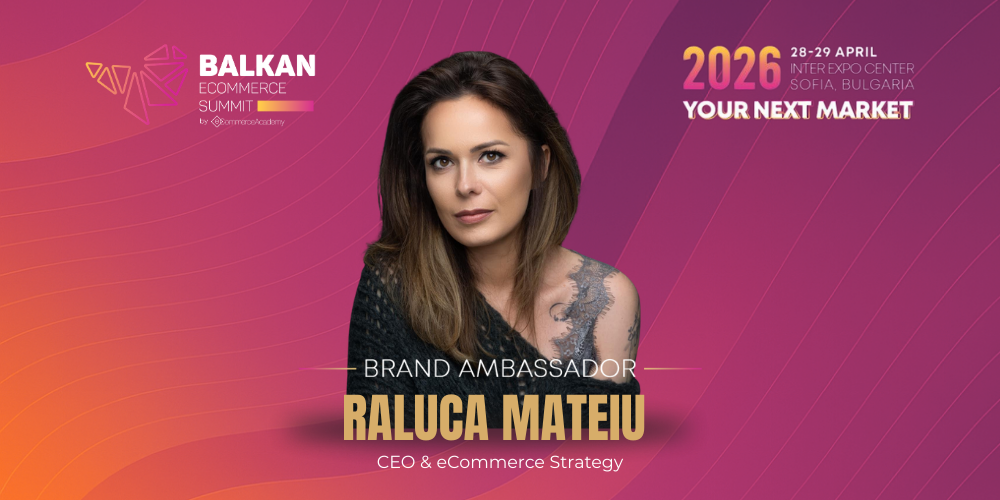
Want to get some actual practical advice out of Raluca Mateiu? Meet her in person at Balkan eCommerce Summit 2026. As Brand Ambassador of the event, she’ll be there to connect with and share insights from her vast experience to all attending entrepreneurs and help you practically bridge the gap between audiences, advertisers, and technology. Get your tickets today!