

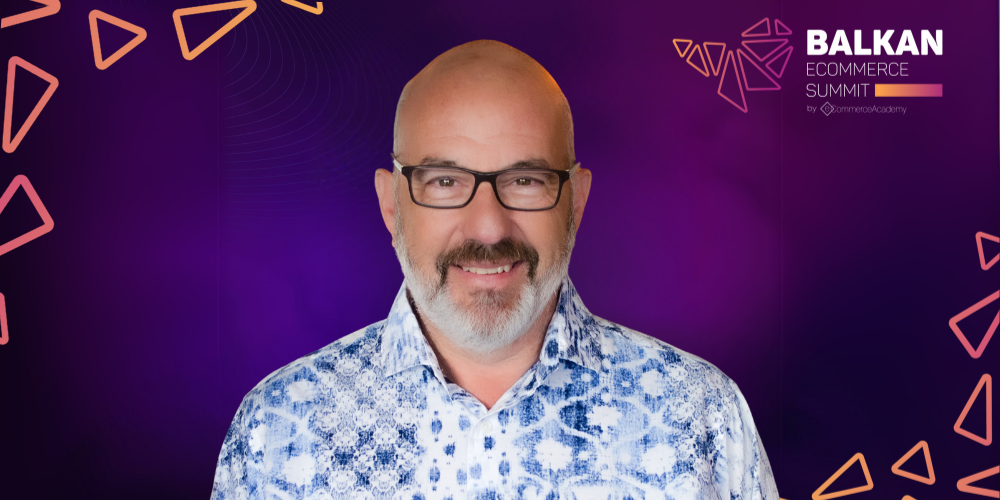
 Jeff Hoffman, a global icon of entrepreneurship and innovation, will headline the second day of the Balkan eCommerce Summit 2025 as a keynote speaker. A founding figure behind Priceline.com (Booking.com) and a driving force in multiple billion-dollar startups, Jeff has built a legendary career across tech, travel, media, and music.
More than just a serial entrepreneur, Jeff is a bestselling author, Emmy and Grammy-winning producer, and a passionate philanthropist. His journey – marked by bold decisions, relentless curiosity, and an unshakable commitment to solving real-world problems – is packed with lessons for those building in fast-changing, high-potential markets like the Balkans.
Prepare to be inspired as Jeff shares stories, strategies, and hard-earned wisdom to help you think bigger, act bolder, and scale smarter in the future of eCommerce.
What are the key opportunities and challenges for online entrepreneurs in the Balkans, and how can they stay competitive and scale globally?
The key to succeeding globally is understanding product/market fit – do new regions have the same needs and expectations as your current markets? Are there regulatory or logistical barriers that could slow you down? For example, we skipped Japan when expanding in Asia because the business requirements were too complex and would have hindered our growth. The Balkans, however, are a large and diverse enough region to prove out a concept and build a strong business foundation. Once you succeed there, look for international markets that mirror your local conditions.
At the same time, staying competitive means staying curious. AI is currently the most impactful trend in product development – study it, test it, and understand how it could benefit your business or your customers. But don’t stop at AI. Explore technologies like Virtual Reality, Augmented Reality, or even Holography. Ask yourself, “What could this do for me or my customers?” and aim to be the first in your industry to apply new tools to established challenges.
You’ve said curiosity is key to success. Do you think it’s something you’re born with, or can it be developed? How can online entrepreneurs stay curious and innovative in a fast-changing world?
I think a big part of curiosity is innate, and comes from your DNA. Some people are just naturally curious about the world around them. But I do believe entrepreneurs and innovators can cultivate their curiosity by developing the same habits as curious people have. For example, I challenge myself to spend just a few minutes to learn one new thing everyday. I allow my curiosity to lead me to one new article to read, video to watch, or person to meet, and then I write a one sentence summary of the new thing my curiosity led me to that day. Over time those dots connect and I discover new trends and knowledge.
You’ve called yourself a “serial entrepreneur” who focuses on one venture at a time. In fast-moving eCommerce, how do you know when it’s time to move on? What advice would you give Balkan entrepreneurs on staying focused while still spotting new opportunities?
I have been able to achieve a lot of my career and business goals because even though I have failed multiple times, I failed FAST. I also succeeded fast. This is because I know when to quit, when an idea is just not working. The way to decide when to move on is to start every year on January 1 by writing down what you want your company to look like on December 31, when that year is over. Make the list as measurable and quantifiable as possible. Then write down a second list. Write down what you would consider failure to look like. Along the way you can make adjustments, but if the end of the year comes and your numbers look like your definition of failure, it’s time to move on and do something else with your life.
You’ve had success with several startups. Can you share a story where things went wrong but you turned it around? What lesson from that experience would you share with aspiring entrepreneurs?
The lesson is to start small, and start local. Stop trying to go global and save the world right from the start. My first startup was creating the check-in kiosks that are in airports today, where you check yourself in and get your own boarding pass. When I started, I talked about changing travel everywhere, and automating airports worldwide. That was too much. Too big and too broad. People, especially the airlines and airports, doubted my ability to achieve that. So I changed my goal to just installing one single machine in one airport location to show people what I could do. That goal seemed reasonable to people, and airports gave me a chance. Lesson learned, and the rest is history.
You’ve achieved success across various industries, from technology startups to entertainment and music production. How has working in such diverse fields influenced your entrepreneurial approach, and what can eCommerce entrepreneurs learn from applying cross-industry insights to drive innovation?
Too often we look at the competitors in our industry to evaluate trends and competitive issues. We don’t think that non-related industries can teach us anything. And so we miss a big opportunity. Some of the world’s most innovative ideas came from people combining ideas from different industries into a new innovation in their own industry. I stepped out of tech for a while to go into media and entertainment for exactly that reason. To improve my marketing skills by studying the entertainment industry, not my own tech industry, to learn new things I would not learn otherwise.
You’ve met entrepreneurs from over 200 countries through the Global Entrepreneurship Network. What unique traits have you seen worldwide, and how can Balkan entrepreneurs use those insights to compete globally?
Some of my favorite entrepreneurs in the world are in the Balkans. Hard working, dedicated and passionate, and some of them came from more difficult environments which made them have to be even more innovative and resourceful. So I have two pieces of advice for Balkan entrepreneurs. First, get online and study what works in other parts of the world, and apply those best practices to your work in the Balkans. And second, use your differences as an advantage. For example, instead of saying things might be more difficult to do in some countries than others, turn that negative into a positive and say that you are much more creative than other entrepreneurs because you had to be.
In your experience scaling businesses rapidly, have you employed any unconventional strategies or mindsets that defy traditional business wisdom?
We have definitely used unconventional strategies and mindsets both to accelerate growth and scale faster. We have made unconventional cool graphics with adhesive backgrounds that we knew people would want to take home and display, we have delivered free food to college students just to get them to come and see our demo, we have driven around with wrapped vehicles and stopped them in public places, and so much more.
Having successfully navigated both corporate and creative industries, how do you foster an environment that balances analytical thinking with creativity and innovation? What advice would you give e-commerce entrepreneurs to cultivate this balance for sustained success?
Make sure you are building a balanced team, with representatives from every functional area. I brought an artist into the mix to look at our check-in kiosks, and she completely changed our design. This change made them more inviting to consumers and less intimidating. It took a creative artist to see that, not my tech team.
From failing fast to thinking globally, Jeff Hoffman’s insights remind us that innovation starts local, curiosity drives breakthroughs, and resilience turns challenges into wins. His journey proves that with the right mindset, even the Balkans can launch the world’s next big idea.
📅 Don’t miss Jeff live at the Balkan eCommerce Summit 2025 – where bold strategies and fresh perspectives meet. Get your ticket at balkanecommerce.com.