

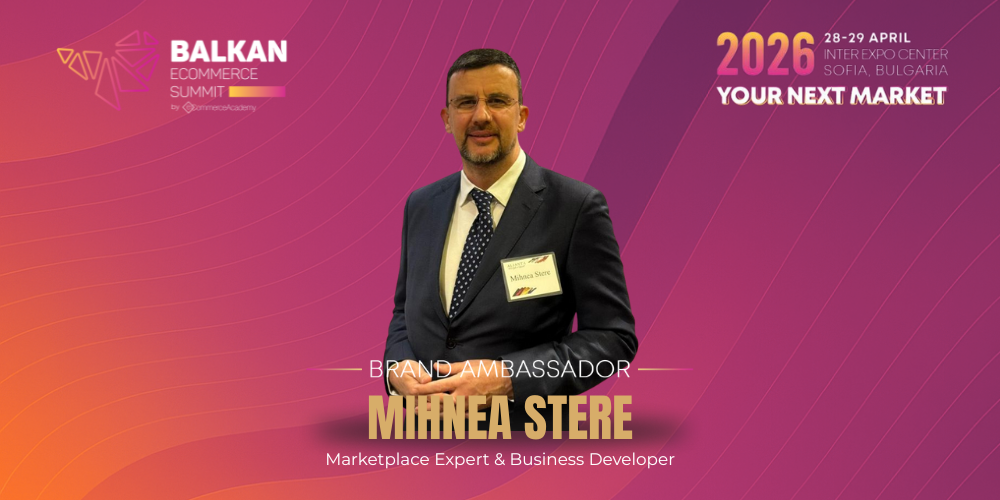
With more than 20 years of experience across retail, marketplaces, and digital transformation, Mihnea Stere has become one of the key architects shaping modern commerce in Central & Eastern Europe. As Founder & CEO of Brandslandia and Strategic Advisor to Octopia, he helps global brands, regional marketplaces, and fast-scaling retailers navigate the complexity of CEU & SEU through clear, data-driven expansion frameworks. His background at eMAG, Kaufland, and Selgros gives him a rare 360° perspective combining operational depth with strategic vision.
As a Brand Ambassador for the Balkan eCommerce Summit, Mihnea brings not only expertise, but a mission: to bridge Western European brands with the high-growth Balkan ecosystem and to turn regional fragmentation into structured opportunity. In this interview, he shares where companies should focus in 2026, how to choose between marketplaces and D2C, the mistakes that slow down expansion, and why the Balkans are no longer an “emerging region” but one of Europe’s most dynamic engines for eCommerce growth.
As a Brand Ambassador for the Balkan eCommerce Summit, how do you see your role in the community – and where do you think you can add the most value for brands, marketplaces, and retailers in 2026?
As a Brand Ambassador, I see my role as a bridge-builder: between Western European brands and Far East Brands, producers and Traders, on one side, and Central & South-Eastern Europe (CEU & SEU), on the other side, between ambition and execution, and between marketplaces, platforms, and retailers that are in accelerated search to grow their sales and extend their offers, catalogue and services and most often need to find the solution to convert their plans into practice.
Coming from:
- building Brandslandia Group as a CEU-focused eCommerce and marketplace operator,
- advising Octopia, Europe’s leading Marketplace-as-a-Service platform, and
- leading eMAG Marketplace development across RO, BG, and HU, in the past
I can add the most value by supporting brands and companies to focus on the most important growth drivers with our current Brandslandia turnkey solution and scale with clarity, realism, and speed.
By 2026, my focus within the Summit community will be:
- Helping brands design marketplace-first or marketplace-smart strategies for the Balkans
- Supporting marketplaces, retailers and major middleware enablers in attracting the right – highly qualitative sellers, not just more sellers
- Translating CEU & SEU regional complexity into clear go-to-market playbooks, as well as
- Offering expansion solutions for our CEU&SEU Brands expanding into the mature WEU market, via the regionally leading marketplaces
The Balkan eCommerce Summit is not just an event, it is The Event and operating system for regional eCommerce thinking, and I’m committed to strengthening that role.
What’s new in your world right now that you’re most excited to bring to the region this year?
What excites me most is the maturity shift we are seeing.
Our discussion with more than 100 Western European brands & partners on different verticals in 2025, shifted from just asking “Should we enter the CEU Balkans?” to “How do we do it right?”
Specifically, with Brandslandia & Octopia we are bringing:
- Marketplace-led expansion strategy & frameworks proven across CEU
- Practical insights from Octopia’s pan-European marketplace infrastructure, especially around cross-border seller enablement
- A stronger narrative that CEU & SEU are not “emerging markets” anymore – but high-growth, under-optimized ecosystems
Together with Nikola Ilchev, a good friend of mine who I consider one of the true catalysts of Balkan eCommerce, we are helping position the region not as a secondary option, but as a strategic growth pillar for the coming years for all eCommerce players & brands major looking for scaling opportunities across the fastest growing region in Europe.
How should companies decide between marketplaces, D2C, or a hybrid model when expanding across borders – and what early signals show they picked the right route?

The decision is less about ideology and more about speed, risk, and learning curves.
My rule of thumb:
- Marketplaces = fastest validation, lowest upfront risk
- D2C = strongest brand control, highest operational complexity
- Hybrid = best long-term model, after product-market fit is proven
For CEU & SEU, marketplaces are often the smartest first step, especially for Western brands.
Early signals they chose correctly:
- Massive, concentrated customer traffic & visibility
- Strong conversion without heavy discounting
- Organic demand across multiple cities – not just capitals
- Marketplace algorithms “rewarding” the brand with visibility
- Logistics and returns staying predictable
Our experience tells that If CAC explodes early in D2C or marketplace performance stalls despite traffic, it’s usually a model mismatch, not a product issue.
From your experience at eMAG and major retailers, what are the most common mistakes companies make when scaling on marketplaces and can you share one example of how a team corrected course?
The most common mistake is treating marketplaces like just another sales channel, instead of a highly prioritized scaling ecosystem.
Typical errors:
- Copy-pasting Western pricing and assortment
- Ignoring local delivery expectations
- Underestimating content, reviews, and seller KPIs
- Un-customized scaling with no clear before operational stability
One real example from my Brandslan with simplified collaboration terms, in recent years:
A Western European brand aggregator entered eMAG aggressively with significant assortment and upper medium pricing but sales stagnated and declined. We have taken it over the relationship with Brandslandia, simplifying the operational engagement for our partners and taking it over completely at the operational level.
The correction:
- Reduced SKU count to top performers
- Localized pricing and campaign activation
- Invested heavily in reviews and delivery SLAs
- Used marketplace data and tools to guide expansion
Within three quarters, revenue tripled – not because the product changed, but because the marketplace logic was respected and actively engaged with by a dedicated team of marketplace specialist.
Looking ahead, what one prediction do you have for the platform economy in our region over the next two years and how can attendees use the Balkan eCommerce Summit to prepare for it?
My prediction is clear:
The Balkans will shift from only being marketplace “consumers” to marketplace “builders and exporters.”
We will see:
- More local retailers launching marketplaces
- More regional sellers going pan-European
- Platforms replacing pure retailers as growth engines
The Balkan eCommerce Summit is the best place to prepare because it:
- Connects decision-makers, not just observers
- Shares real case studies, solutions – not just theory
- Creates partnerships on the ground floor that shorten years into months & weeks
Attendees who use the Summit to learn, connect, and act immediately will be the ones shaping, not reacting to, the next phase of the platform economy.
The Balkans are no longer the future of European eCommerce.
They are the present and accelerating fast.
Meet Mihnea at Balkan eCommerce Summit 2026
Thinking about expanding your brand or marketplace into CEU & SEU? Wondering whether to go marketplace-first, D2C, or hybrid – or simply curious how to turn regional fragmentation into a clear go-to-market playbook?
Mihnea will be on-site, ready to share what 20+ years across eMAG, Kaufland, Brandslandia, and Octopia have taught him – from practical expansion frameworks and marketplace logic to the early signals that show you’ve chosen the right route.
Whether you’re a Western brand exploring the Balkans for the first time, a regional marketplace looking to attract high-quality sellers, or a retailer ready to shift from consumer to builder – come find him. These conversations often turn into partnerships.
🎟️ Grab your ticket at balkanecommerce.com and be part of building stronger connections across the region.