

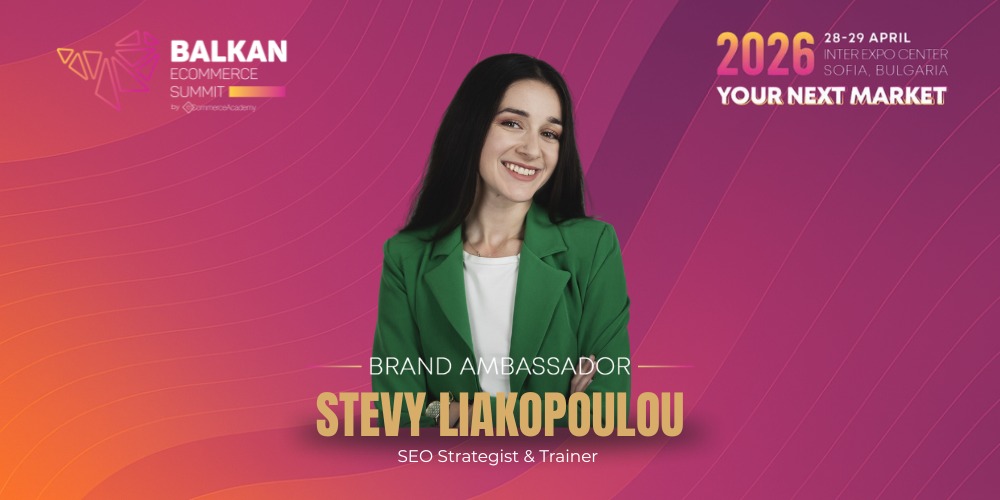
With a strong track record of helping D2C and B2B brands grow through data-driven SEO, Stevy Liakopoulou has become one of the most practical and trusted voices in organic eCommerce growth.
Her work focuses on simplifying complex topics, turning search intent into revenue, and helping teams build sustainable visibility without shortcuts. As a Brand Ambassador for the Balkan eCommerce Summit 2026, Stevy brings a grounded, experience-based perspective to a region hungry for actionable knowledge. In this interview, she shares the fundamentals every eCommerce brand must master, the common mistakes she sees in audits, and how SEO, CRO, and AI can work together to fuel smarter, more strategic growth in 2026.
As a Brand Ambassador for the Balkan eCommerce Summit 2026, what motivated you to join this initiative, and what perspective do you want to bring to the regional eCommerce community?
 I joined the Balkan eCommerce Summit as a Brand Ambassador because the region is growing fast and there’s a real hunger for practical knowledge. Many eCommerce brands want to scale internationally, but they often lack clear, actionable guidance on sustainable growth. My background in working with all sizes of ecommerce brands has shown me what actually works for them. I want to bring a practical, data-driven SEO perspective to the community and help founders and marketers understand how to grow organically without shortcuts. My goal is to support the regional eCommerce ecosystem by sharing real experience, simplifying complex topics like SEO and AI, and helping brands grow in a sustainable way.
You’ve helped D2C and B2B eCommerce brands grow with data-driven SEO strategies. What are the 2-3 most important SEO fundamentals an eCommerce business should get right before moving to advanced tactics?
First, solid technical foundations. That means a crawlable site, clean site structure, correct indexing, and no major issues with page speed or duplicates. If search engines can’t properly access your site, nothing else will work. Second, clear search intent and site architecture. Category and product pages should be built around real user intent, not keywords. A logical structure helps both users and search engines understand what you sell and how pages relate to each other. Third, content that supports buying decisions. Product and category pages need unique, useful content that answers real questions and removes friction. If these fundamentals aren’t in place, advanced tactics won’t deliver sustainable results.
When you audit eCommerce websites, what are the most common SEO mistakes you see and what simple, actionable fixes usually bring the fastest improvement in traffic or conversions?
The most common SEO mistakes I see in eCommerce audits are still very basic. First, indexation and technical issues. Important category pages are often not properly indexed, while low-value pages are. Fixing indexation, improving internal linking, and cleaning up technical errors usually brings quick SEO wins. Second, underperforming category pages. Many of them rank but don’t convert. Simple CRO improvements make a big difference e.g. clear H1s, short helpful copy, trust signals, FAQs, better filters, and internal links that guide users to the right products. These changes help push users further down the funnel. Third, search intent mismatches. Pages attract traffic but don’t meet user expectations. Adjusting content, layout, and CTAs to match intent often improves both traffic quality and conversions.In eCommerce, SEO and CRO work best together. When category pages are built for both search engines and users, results come much faster.
You’ve trained over 30 professionals through your VIP SEO Training and built programs like SEO Mastermind. What skills or mindset shifts do SEO specialists and freelancers in the Balkans need most to become truly in-demand in 2026 and beyond?
The biggest shift SEO specialists and freelancers in the Balkans need is moving from task-based SEO to business-focused SEO. First, they need to understand how SEO impacts revenue, not just rankings. Clients care about growth, not keywords. Being able to link SEO work to business results makes you instantly more valuable. Second, strategic thinking is key. Knowing how to prioritize, audit properly, and explain why something matters separates in-demand professionals from the rest. Third, they need to use AI as a support tool, not a shortcut. AI should speed up research and decision-making, while strategy and judgment stay human. Finally, they need to start sharing what they know. Building a personal brand through content, speaking, or community involvement creates visibility, trust, and better opportunities. The best SEO work has little impact if no one knows you do it. The mindset shift is simple: stop thinking like an SEO executor and start acting like a growth partner with a visible voice in the industry.
You’re exploring new ways to integrate AI into your SEO work. How do you currently use AI in your workflows, and where do you see the biggest opportunities and risks for eCommerce brands in the AI-driven search landscape?
I use AI mainly as a support tool, not as a replacement for strategy. It helps me speed up research, audits, content outlines, internal linking ideas, and quality checks, so I can focus more on decision-making. For eCommerce brands, the biggest opportunity is efficiency and scale, finding gaps faster, improving category and product pages, and testing ideas more quickly. The biggest risk is over-automation. Relying too much on AI-generated content will hurt trust, brand quality, and search performance. In AI-driven search, the winners will be brands that combine AI with strong SEO fundamentals and human judgment, not shortcuts.
For founders, marketers, and freelancers who will meet you at the Balkan eCommerce Summit 2026, what kinds of questions do you hope they will ask you and what can they expect to take away from a conversation with you?
 I hope people ask search marketing questions tied to revenue, not just SEO tactics, but how search actually drives growth today. Things like where to invest in content in 2026, how to adapt to multi-search environments, and how visibility works across Google, marketplaces, and AI-powered search. I also like questions about prioritization: which content formats deserve investment, how to balance category pages, product pages, and informational content, and how SEO fits with CRO and paid search. From a conversation with me, they can expect a clear direction. I focus on helping them understand where search is heading, what still works, and what to stop doing, so their efforts translate into real business impact. My goal is that they leave with a clearer view of how to win in search in 2026.
Meet Stevy at Balkan eCommerce Summit 2026
Thinking about growing your eCommerce brand through search in 2026? Wondering how to fix the fundamentals, prioritize what actually drives revenue, or use AI without sacrificing quality and trust?
Stevy will be on-site, ready to share what years of auditing, training, and growing D2C and B2B brands have taught her – from SEO and CRO fundamentals to strategic thinking, AI integration, and the mindset shifts that separate task-based specialists from in-demand growth partners.
Whether you’re a founder looking to build sustainable visibility, a marketer exploring multi-search environments, or an SEO specialist ready to level up and become more strategic – come find her. These conversations often turn into partnerships.
🎟️ Grab your ticket at balkanecommerce.com and be part of building stronger connections across the region.