

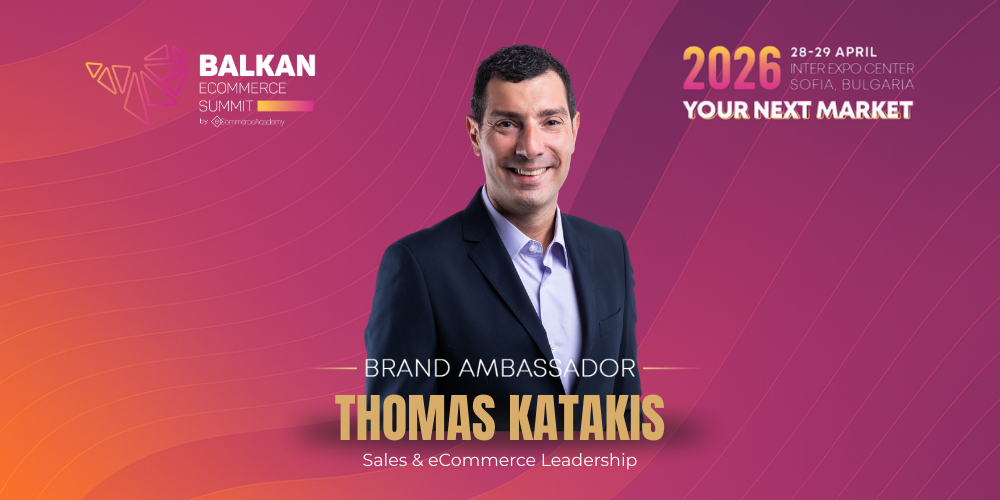
Thomas Katakis is an Outbound Sales Expert, GTM strategist, and author of The Timeless Leaders, with more than 20 years of experience leading commercial teams across North America, Europe, and Australia. He specializes in building predictable, data-driven revenue systems that help eCommerce SaaS and B2B companies enter new markets with clarity, confidence, and speed.
His expertise lies in turning underutilized assets – dormant inbound leads, existing customer profiles, and competitor audiences – into precision-targeted outbound engines that open doors, shorten sales cycles, and scale revenue without guesswork. He combines deep commercial intuition with modern automation, strategic storytelling rooted in ancient leadership principles, and a relentless focus on what actually converts.
As a Brand Ambassador for the Balkan eCommerce Summit 2026, Thomas brings a sharp perspective on how Balkan SaaS founders can compete globally – not by outspending larger players, but by outthinking them. In this interview, we explore what truly drives high-performing sales organizations, the most common misconceptions about outbound, and the three principles every founder must master to build a scalable go-to-market system in 2026.
As a Brand Ambassador for the Balkan eCommerce Summit 2026, what made you want to join this community, and how do you see your experience in outbound sales and GTM strategy contributing to the region’s growth?
 The Balkan region has seen remarkable momentum in the SaaS space over the past few years. A growing number of companies are not only innovating rapidly but also delivering products that can stand shoulder-to-shoulder with leading European solutions. As this ecosystem matures, outbound sales and a well-structured go-to-market strategy act as force multipliers: they accelerate visibility, shorten sales cycles, and help teams polish their value proposition in bigger markets, not just locally, but internationally.
If your product introduces something genuinely new, solves a problem more efficiently, or delivers a standout user experience, outbound becomes an especially powerful lever. It puts you in front of highly qualified prospects who are open to adopting emerging tools and who appreciate a fresh, differentiated offering. Used consistently, outbound can significantly expand your client base, both within the Balkans and well beyond, unlocking new verticals, geographies, and opportunities that might otherwise take years to reach organically.
You’ve built predictable, data-driven outbound systems for eCommerce brands. What are the key components of an outbound engine that reliably opens new markets and accelerates customer acquisition?
The key components of an outbound engine that reliably opens new markets and accelerates customer acquisition come down to four interconnected pillars.
a) Strong infrastructure of tools and automations.
A scalable outbound motion needs a solid operational backbone – systems that enrich data, sequence outreach, track engagement, and automate repetitive tasks. When your infrastructure is well-designed, your team can focus on strategy, messaging, and conversations instead of admin work. This is where platforms like Instantly, Clay, and modern CRMs create real leverage.
b) Targeting the right ICP.
This is both the most difficult and the most important part of the entire “cocktail.” Despite the explosion of sales tools, identifying and refining the right ideal customer profile remains a human-driven discipline. AI can accelerate research, but it hasn’t yet reached the point where it can reliably interpret nuance, internal politics, buying triggers, or the subtle signs of a good fit. A misaligned ICP makes even the best outbound engine ineffective; a well-defined ICP, on the other hand, makes everything else fall into place.
c) Intent and behavioral signaling.
Beyond demographics and firmographics, the real magic comes from identifying people who act in ways that indicate potential interest, what we call intent signals. These could be hiring patterns, technology changes, content consumption, funding rounds, or workflow inefficiencies visible from the outside. Understanding which signals matter, and how to interpret them, requires deep commercial intuition. This is where a true GTM strategist is invaluable: they bridge product knowledge with market behavior and know how to uncover buyers before those buyers even begin their search.
d) High-level copywriting and messaging.
Finally, great outbound cuts through the noise. That means moving beyond feature lists and speaking directly to the core problem your product solves. Effective messaging simplifies complex value propositions, resonates with the prospect’s day-to-day reality, and builds curiosity rather than fatigue. Strong copywriting is what transforms outreach from generic noise into conversations that matter.
When these four components work together, they form an outbound engine that doesn’t just generate leads, it systematically opens new markets and accelerates customer acquisition with precision and predictability.
In your 20-year career leading commercial teams across North America, Europe, and Australia, what patterns have you observed that separate high-performing sales organizations from those that struggle to scale?
High-performing sales organizations consistently excel because they operate around three foundational components:
a) Competent people who actually know what they’re doing.
Nothing replaces experience, judgment, and the instinct that comes from spending real time in the field. If your core team doesn’t yet have that expertise, adding more headcount, especially for support roles, won’t fix the problem. In fact, it often makes things worse. More people without the right skills simply create more noise, more misalignment, and more managerial burden. I learned this the hard way: I assumed that hiring more people meant faster growth. In reality, unqualified hires slowed everything down, and any progress they made depended entirely on my time and direction. Training is important, but it’s also expensive. Your time becomes the bottleneck. Without a skilled core team, scaling is an illusion.
b) A proven gameplan and process that has been tested in the real world.
People are creative, and that’s a huge advantage, but creativity without structure is chaos. A strong sales process acts as the stabilizing spine of the organization. It gives the team a clear path to follow, creates consistency, and ensures that success is repeatable rather than accidental. You can, and should, leave room for personal style, but the backbone must be a tested sequence of steps, checkpoints, and best practices that you know produce outcomes. Without process, you’re just reinventing the wheel every week.
c) Automation and tools that remove friction and enable scale.
Modern sales teams rely heavily on tools for a reason: they multiply output. Data enrichment, outreach sequencing, lead scoring, reporting, analytics – these are all tasks that can be automated or semi-automated. And while tools alone don’t build a great team, they dramatically increase the effectiveness of the people using them. The tools make the craftsman more powerful, but only if the craftsman knows how to use them. Mastering your automation stack is essential if you want to grow without proportional increases in headcount. The more you can automate, the more scalable your operation becomes.
When these three components: skilled people, a proven process, and the right automations come together, they create a sales organization that doesn’t just perform well; it performs reliably, sustainably, and at scale.
Many eCommerce founders rely heavily on inbound traffic and paid ads. What are the most common misunderstandings about outbound sales and how can a strong outbound strategy transform their revenue model?
Let me first clarify that outbound is fundamentally a B2B acquisition channel, not a consumer-facing one. That’s why it’s not suitable for e-commerce brands, but it’s incredibly effective for e-commerce SaaS, where you’re selling software to businesses rather than products to individual consumers.
A common misconception is that outbound equals “spray and pray”, sending mass, generic messages and hoping something sticks. In reality, high-performing outbound is the exact opposite. The goal is to make your outreach so relevant, personal, and context-aware that it almost feels like inbound to the recipient. When someone reads a message that speaks directly to their situation, pain points, or recent activity, it lands with the precision of a warm introduction rather than a cold email.
This level of resonance only happens through laser-sharp targeting and well-identified intent signals – the behavioral cues that indicate a prospect is likely to care about what you’re offering. Signals and targeting work together to shape a message that doesn’t feel random, but rather timely and tailored.
A robust outbound system can be transformational when entering a new market, especially a new country where you have little or no existing traction. Instead of waiting months for inbound channels to ramp up, outbound lets you proactively put your solution in front of exactly the companies that match your ideal customer profile. Done right, it becomes one of the fastest and most controlled ways to validate demand, gain early adopters, and build momentum in unfamiliar territory.
As the author of “The Timeless Leaders”, you combine strategic storytelling with performance execution. How can eCommerce brands use storytelling not just for branding, but as a practical tool to convert and retain customers?
“The Timeless Leaders” is a book that bridges the wisdom of ancient Greece with the leadership challenges we face today. It shows how human nature, decision-making, conflict, ego, and influence have remained remarkably consistent across thousands of years. What makes the book powerful is not just the historical references, but the way it uses storytelling as the connective tissue between past and present.
Storytelling has been humanity’s primary communication tool since prehistoric times, long before writing existed. Early humans carved narratives into cave walls to teach, persuade, warn, or inspire. That instinct hasn’t changed. Our brains are wired for stories: they help us make sense of information, remember it, and assign meaning to it.
In modern business and leadership, the same principle applies. If you don’t use a story, one that implicitly carries your positioning, values, and point of view, you simply blend into the noise inside the consumer’s mind. People won’t remember you, and they won’t know why they should choose you over someone else.
And when there is no clear positioning, one thing becomes the default decision-maker: price. If you don’t stand for something, if you don’t claim a distinct role in your customer’s world, you end up competing on cost rather than value.
That’s why clear positioning, robust storytelling, and consistent, persistent delivery of that story are fundamental to lasting success. Positioning tells your audience what you stand for. Storytelling makes them feel it. Consistency makes them believe it. When all three align, you build a narrative that not only differentiates you but also endures-just like the lessons passed down from ancient Greece to today’s leaders.
For founders and sales leaders from the Balkans who want to build a predictable, scalable go-to-market system, what are the top three principles they must master in 2026?
For founders and sales leaders from the Balkans who want to build a predictable and scalable go-to-market system, there are three core principles they must truly master by 2026. These principles are not about chasing the newest tools, but about using data, leverage, and market intelligence more intelligently.
a) Fully leverage your inbound data inside the CRM.
Every inbound lead that didn’t convert is not a failure, it’s a data asset. When enriched dynamically, these prospects become a goldmine for outbound. Their original interest already tells you what problem they cared about, when, and why. By layering in new data points, company growth, tech stack changes, hiring activity, funding, or role changes, you unlock powerful new angles for re-engagement. This allows you to reconnect at scale with messaging that’s contextual, relevant, and timely, turning dormant inbound traffic into a highly efficient outbound channel.
b) Use your existing customers to build lookalike company lists.
Your current clients are proof of value. They represent companies that have already validated your product, pricing, and positioning. By analyzing their firmographics and behaviors, you can create lookalike lists of companies that share similar traits: size, industry, maturity, or operating model. From there, enrich these accounts with the right decision-makers and influencers and deploy targeted outbound campaigns. This approach dramatically increases conversion probability because you’re no longer guessing. You’re replicating what already works.
c) Target the audiences of larger, more established competitors.
Bigger players have already done the heavy lifting of market education. Their followers, users, and audience are aware of the problem space and actively consuming content related to it. By scraping and analyzing the followers of competitive solutions, especially those larger than you, you gain access to a warm, problem-aware audience. Outbound then becomes a vehicle for differentiation: you present your unique value proposition, your sharper focus, or your more modern approach to buyers who already understand why a solution is needed.
When executed together, these three principles turn outbound into a precision-driven growth engine. They allow Balkan SaaS teams to compete globally, not by outspending larger players, but by outthinking them-using smarter data, sharper positioning, and highly intentional go-to-market execution.
Meet Thomas at Balkan eCommerce Summit 2026
Thinking about building a predictable outbound engine to enter new markets? Wondering how to turn dormant inbound leads into revenue, or curious how storytelling can become a practical conversion tool-not just a branding exercise?
Thomas will be on-site, ready to share what 20 years of leading commercial teams across three continents have taught him-from the four pillars of a scalable outbound system and the patterns that separate high-performing sales orgs from those that stagnate, to how Balkan SaaS founders can leverage lookalike audiences, competitor followers, and CRM data to compete globally.
Whether you’re a founder preparing to scale beyond your home market, a sales leader building your first GTM system, or simply want to understand how ancient Greek leadership principles apply to modern revenue execution-come find him. These conversations often turn into partnerships.
🎟️ Grab your ticket at balkanecommerce.com and be part of building stronger connections across the region.