

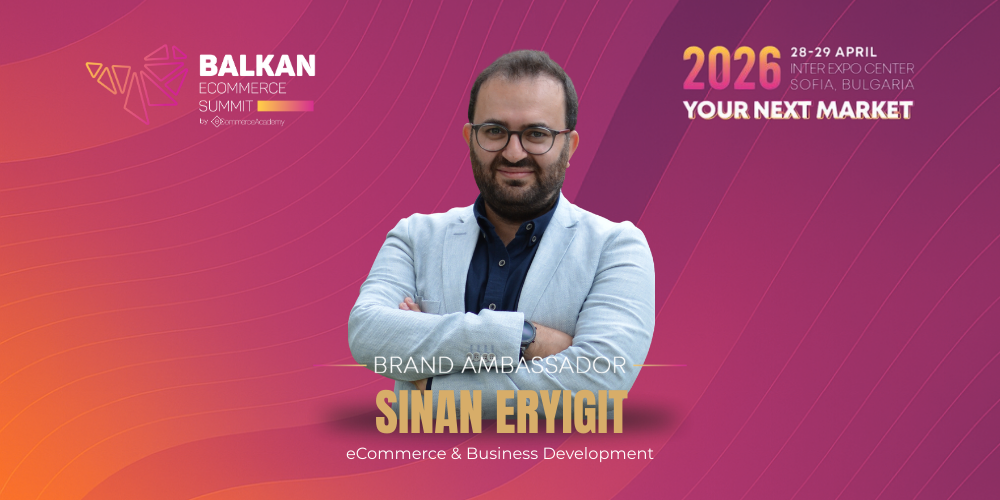
With years of hands-on experience in cross-border eCommerce, public-private partnerships, and community building, Sinan Eryigit has become one of the key voices connecting Turkish sellers with international markets. As a long-standing Brand Ambassador and the official representative of Türkiye for the Balkan eCommerce Summit, he has witnessed firsthand how meaningful connections, the right platforms, and practical support can turn regional events into global business opportunities.
In this interview, Sinan shares real stories from the Summit floor, practical guidance for Turkish merchants expanding into the Balkans, and lessons learned from nearly a decade of building e-export ecosystems. From marketplaces and logistics to state incentives and community-driven growth, his insights offer a clear, experience-based roadmap for founders looking to scale beyond borders in 2026 and beyond.
From your perspective, what does being a Brand Ambassador and Turkey representative for the Balkan eCommerce Summit enable you to do for the community and how do you hope to contribute in 2026?
 This is my 3rd year as a Brand Ambassador and Turkiye (It’s officially Turkiye now) representative for Balkan eCommerce Summit. And as a person who attends so many events outside my country, I had the warmest, friendliest cross-border event experience for those first two years at Sofia. You always think about everything, every minute through for your guests. Arrivals, accommodation recommendations, in-venue snacks, drinks, meals and a perfect party with a special Balkan twist. So, it’s a pleasure to just attend as a visitor let alone being a Brand Ambassador.
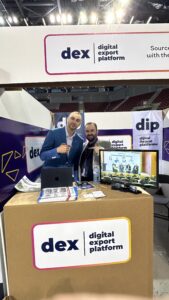
Besides these personal experiences, we managed to create a lot of business opportunities for both our DEX suppliers and Balkan eCommerce Summit exhibitors, visitors etc. We were also an exhibitor for Balkan eCommerce Summit 2025 and I was with our members from DEX. One of them builds small holiday homes for people. And they have a lot of Balkan customers. After the event, they say they experienced at least a 50% increase for example.
But I think the peak story was this: After a long trip around other booths in the Arena; I finally found the time to be present at our own booth. And while I was there, a Bulgarian origin American friend came to visit us. We talked about what each of our companies do, and in the end, we almost landed a deal, right at that very table, on supplying Turkish made products to his e-commerce store in the USA! We certainly didn’t expect to land a potential US sales deal on a Balkan event.
Also, as a result of our joint efforts, there were a lot of Turkish visitors from famous Turkish businesses like Turkish Airlines, Asset Logistics, Widect, Exporgin etc. I feel like this year will mark a record in that regard. I’ll explain why in a minute.
What’s new on your side this year – DEX (Digital Export Platform), Upista, or other initiatives and how will these support Turkish sellers exporting to the Balkans (and vice versa)?
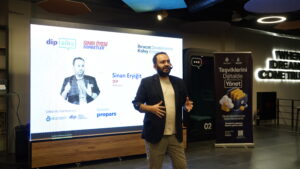
Actually, there are a lot of major developments on the DEX side! We started international trade tours (the last one was to Romania) for our suppliers. We’re going country to country, region to region to develop new partnerships, new sales agreements for both Turkish and global sellers & suppliers. We’ve just launched our online partners platform which we provide perfect deals (as discounts and campaigns) from a wide range of service providers to our members. It’s in the beta phase for now. Also we’ve started two new event series called “Anadolu’dan Dünya’ya (From Anatolia to World)” – a large scale summit for Anatolian suppliers to meet with global commerce leaders; and dipTALKS – a 3-hour flash event for the technical topics of export businesses. And most of all, we’re launching DEX so soon. It’ll be a closed beta version which only selected suppliers can take part in. It’s a platform which suppliers and buyers meet in a very innovative, easy going way. That’s all I can say for now.
All these efforts are for removing the barriers between international businesses.
For a Turkish merchant planning cross-border expansion to the Balkans in 2026, what’s a practical 30-day playbook they can follow?
Turkish merchants have a lot of tools and channels for cross-border trade. Of course the right way varies depending on the business model. If you’re a manufacturer that merchandises your own brand and products; you can use both B2B (like DEX or Alibaba) and B2C platforms like your own e-commerce web site (Shopify) and B2C marketplaces. If you’re a reseller, you should be on all marketplaces fitting for your industry. If you’re a small atelier and producing small scale, hand made and customizable products, you should use Etsy, Amazon Hand Made and again your own web site.
As I said, even if it differs from case to case, I think the most common way is creating your own platform and being on marketplaces at the same time. For example, Trendyol offers a solid channel for both domestic and cross-border sales. You can use the same listing to sell your products cross-border if your listings are eligible for export. This way, you can sell globally like you ship from Istanbul to Ankara. Trendyol operates successfully in Romania, Greece and Bulgaria. And marketplaces are very good to test your products’ demand. When you catch a hero product, you can spend some marketing budget to sell it cross-border to every country. Not just the ones your preferred marketplace operates.
Turkiye has a lot of cross-border logistics service providers and payment solutions. Regarding customs, our Trade Ministry is doing everything they can to ease the way sellers operate globally regarding e-exports. We have BGB for example. This translates into “Simplified Customs Declarations”. This way, sellers can ship individual packages easily over shipping companies.
You’ve worked with the Ministry of Trade, chambers of commerce, and major platforms. What partnerships or programs most effectively reduce friction for SMEs doing e-export, and what KPIs should merchants track to know it’s working?

For SMEs in Turkey, reducing friction in cross-border trade requires a hybrid approach: leveraging State-Sponsored Incentives for financial relief and utilizing Specialized Service Providers for operational efficiency.
To effectively reduce friction in cross-border trade, Turkish SMEs should adopt a hybrid strategy that combines state support with specialized private sector technology. The most significant advantage comes from the Turkish Ministry of Trade, which offers aggressive incentives covering costs like digital marketing, fulfillment fees, and platform commissions, acting as a financial safety net against market entry risks. On the operational side, friction is best managed through automation and delegation. Using integration tools like Propars allows merchants to manage multiple global marketplaces from a single panel, while logistics partners like ShipEntegra automate the complex shipping and customs processes. For businesses seeking a completely hands-off approach, E-Export Consortiums such as Exporgin or Mega Merchant act as the “Seller of Record,” handling the entire operation from legal compliance to sales management.
Regarding Key Performance Indicators (KPIs), the primary focus must be on unit economics rather than just top-line revenue, given the variable costs of international trade. The “Golden Rule” is maintaining a Net Unit Profitability of over 50% after deducting the cost of goods sold, shipping, marketing, and platform commissions. Beyond profitability, it is crucial to monitor operational metrics like return rates—which can destroy margins through reverse logistics costs—and review scores that dictate organic visibility. Uniquely for Turkish merchants, the Return on Investment (ROI) should be calculated as an “Incentive-Adjusted” figure; since the state reimburses a significant portion of marketing and commission expenses, the effective cost of acquisition is often much lower than the upfront spend suggests.
In summary, a successful e-export operation relies on mitigating risk through government grants while streamlining operations through partners like Propars and ShipEntegra. If a merchant can leverage these tools to automate workflow and utilize state incentives to subsidize costs, maintaining a net profit margin above 50% confirms the business model is working effectively.
On a personal note: what’s the biggest lesson you’ve learned since 2015 as an eCommerce seller and community builder and what mindset do you recommend to founders starting cross-border today?
Wow, 2015 feels like a lifetime ago in e-commerce years! If I have to pick one major lesson, it is that “Isolation is the enemy of growth.”
In the early days, sellers used to guard their strategies like state secrets. They thought if they shared their logistics partner or marketing trick, they would lose their edge. But as a community builder, I learned that the global market is simply too big for petty competition. When we share knowledge – whether it’s at a BES after-party in Sofia or during a technical dipTALKS session – we don’t divide the cake; we make the cake bigger for everyone. The collective intelligence of a community always moves faster than a lone wolf. That’s why we are building platforms like DEX; to institutionalize this collaboration.
For the mindset, my advice to founders is simple: “Be stubborn about your destination, but flexible about your path.”
Cross-border trade is not a straight line. You will face customs issues, listing suspensions, or cultural misunderstandings. If you are rigid, you will break. But if you have an agile mindset, you’ll pivot. If Germany doesn’t work, you’ll try Romania. If a product fails on Amazon, you’ll re-list it more fit to Amazon standards. No luck? Then try it on your own site if you completely trust it. The founders who succeed aren’t necessarily the smartest; they are the ones who can endure the friction and adapt the fastest.
So, don’t be afraid to launch imperfectly, ask for help from the community, and keep moving forward. The world is waiting for your products!
Meet Sinan at Balkan eCommerce Summit 2026
Thinking about expanding from Türkiye to the Balkans – or connecting with Turkish suppliers and sellers? Wondering how to leverage state incentives, navigate cross-border logistics, or turn a booth conversation into a real business deal?
Sinan will be on-site, ready to share what nearly a decade of building e-export ecosystems has taught him – from practical 30-day playbooks and marketplace strategies to the partnerships, tools, and mindset shifts that actually move the needle for SMEs going global.
Whether you’re a Turkish merchant exploring Romania, Greece, or Bulgaria, a Balkan founder curious about sourcing or partnerships with Türkiye, or simply want to connect with someone who’s turned Summit conversations into US deals – come find him. These conversations often turn into partnerships.
🎟️ Grab your ticket at balkanecommerce.com and be part of building stronger connections across the region.