

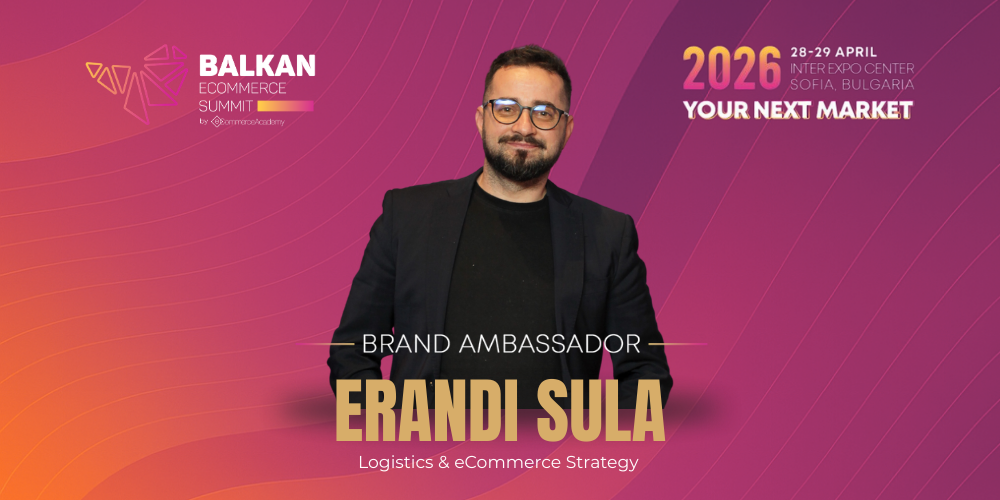
In most boardrooms, logistics still shows up as a line under “costs.” For Erandi Sula, Chief Commercial Officer at Ultra C.E.P., it belongs under growth.
With more than 14 years of experience across courier, postal, and cross‑border logistics in the Western Balkans, Erandi has helped build networks that quietly power thousands of online orders every day. From last‑mile delivery and international routes to returns, customs, and cash‑on‑delivery reconciliation, his work sits at the point where customer expectations and operational reality collide.
In this interview, he explains how logistics in the region has evolved from basic transportation to a strategic enabler, why “every promise made online is fulfilled offline,” and what brands need to get right if they want to scale across borders without breaking their customer experience.
How has the role of logistics evolved alongside the growth of eCommerce in the Western Balkans?
Logistics in the Balkans has evolved from a basic transportation function into a strategic growth enabler for eCommerce.
In the early days, it was mostly about “pick up the parcel here, deliver there.” Today, logistics touches every step of the customer journey: fulfillment, customs, last‑mile delivery, payments, returns, and digital communication.
 At Ultra C.E.P., we see logistics as a core part of the brand promise and customer experience, not just a back‑office operation. When a customer judges your brand, they don’t separate the website from the courier – for them, it’s one experience. That’s why our work is no longer just moving boxes; it’s managing expectations, time, and trust across multiple countries.
Why do you describe logistics as the backbone of eCommerce?
Because every promise made online is fulfilled offline.
Price and marketing can attract the first order, but delivery quality decides whether the customer comes back. If a parcel arrives late, damaged, or without clear communication, it doesn’t matter how good your campaign was.
Reliability, transparency, and speed in last‑mile and cross‑border operations are what transform trust into loyalty. Logistics is where your brand either proves that it means what it says – or loses credibility.
Which operational elements most influence customer trust and repeat purchases?
A few elements consistently make the difference:
- First‑attempt delivery success – if you get it right the first time, you immediately reduce frustration and cost.
- Real‑time tracking – customers want to know where their parcel is and when it will arrive, without having to call support.
- Fast cash‑on‑delivery (COD) reconciliation – in the Balkans, COD is still dominant. Merchants need to see their money quickly and clearly.
- An easy, predictable returns process – if returns are painful, customers hesitate to order again.
In our region, financial transparency and predictable delivery are critical. When customers and merchants feel they can rely on both, repeat purchases follow.
What are the biggest mistakes eCommerce companies make when scaling last-mile delivery?
The biggest mistake is scaling volume without scaling systems.
Many companies:
- Focus only on cost per parcel and ignore data quality or customer experience.
- Underestimate the importance of customer support during delivery issues.
- Rely on manual processes that break as soon as volumes spike (for example, Black Friday or seasonal peaks).
Last‑mile is not only a fleet business; it is a technology and process business. If your systems, data flows, and procedures are not prepared for scale, adding more vehicles will not solve your problems – it will just expose them faster.
How is digitalization transforming logistics networks in the region?
Digitalization is changing logistics at every layer:
- API integrations between merchants, marketplaces, and carriers
- Automated sorting and scanning in hubs
- Route optimization to reduce time and fuel
- Digital customs clearance for faster cross‑border flows
- Real‑time visibility for both merchants and end customers
Data is becoming the main asset of logistics. Without digital infrastructure, true scale is impossible. The operators who invest in technology and data today will be the ones who can support regional growth tomorrow.
What technologies are most critical for sustainable growth?
Several technologies stand out as essential:
- End‑to‑end tracking across borders and partners
- Fulfillment automation in warehouses and hubs
- Customs pre‑declaration to avoid delays at borders
- Urban micro‑hubs to support faster deliveries in cities
- Parcel lockers to give customers flexible pickup options
- Electric fleets and greener last‑mile models
These are not “nice‑to‑have” innovations. They reduce cost, increase speed, and support environmental goals that customers and regulators care about more every year.
How important is fulfillment for cross-border eCommerce in the Balkans?
Regional fulfillment centers are game‑changers.
They:
- Reduce delivery times by placing stock closer to the customer
- Simplify customs by centralising processes and documentation
- Make cross‑border shopping feel almost domestic from the customer’s perspective
For the Western Balkans, this will be one of the strongest growth drivers in the next five years. Brands that place inventory strategically in regional hubs will win on speed, reliability, and cost.
What advice would you give to brands planning regional expansion?
Think in terms of a single Balkan market, not separate, disconnected countries.
That means:
- Harmonising logistics, payments, customer service, and returns across borders
- Choosing partners with regional infrastructure and regulatory expertise, not just local coverage in one country
- Designing processes that work across multiple currencies, languages, and delivery preferences
If you build your operations market by market, you’ll accumulate complexity. If you design from the start for a regional footprint, you can scale more efficiently and offer a more consistent customer experience.
How do you see the future of same-day and next-day delivery?
Same‑day delivery will remain urban and niche – useful for specific categories and use cases, but not the default everywhere.
Next‑day delivery, however, will become the standard across main corridors in the Balkans. Achieving that consistently requires:
- Dense and well‑planned networks
- Automation in sorting and routing
- Strong forecasting to match capacity with demand
Customers will quickly get used to next‑day as “normal,” and that will raise expectations for everyone.
Why are regional events like the Balkan eCommerce Summit so important?
Because they align the entire ecosystem: merchants, logistics providers, technology companies, financial institutions, and regulators.
In a fragmented region like ours, where markets are relatively small and regulations differ, collaboration is the fastest path to scale. Regional events create:
- Shared standards and language
- New partnerships and joint projects
- A common long‑term vision for where Balkan eCommerce should go
Without this kind of alignment, everyone optimizes locally and we miss the bigger opportunity.
What is the strategic role of logistics leaders in this transformation?
The role of logistics leaders is to think beyond assets and focus on:
- Systems and data – building platforms, not just routes
- People and processes – training teams who can manage complexity and change
- Partnerships – integrating tightly with merchants, marketplaces, fintechs, and regulators
Logistics today is a technology‑driven service platform, not only a transport operation. Our job is to make sure that as eCommerce grows, the infrastructure behind it is ready – not one year later, but exactly when the market needs it.
Meet Erandi at Balkan eCommerce Summit 2026
Thinking about scaling eCommerce across the Western Balkans – and turning cross-border delivery into a competitive advantage, not a bottleneck? Want a setup that keeps the customer experience consistent while handling COD, returns, customs, and last‑mile complexity?
Erandi will be on-site, ready to share what 14+ years in courier, postal, and cross‑border logistics have taught him – from improving first‑attempt delivery success and COD reconciliation speed, to building tracking visibility through integrations and designing operations that stay stable during peak volumes.
If you’re a brand expanding regionally, a marketplace optimizing delivery performance, or an operator upgrading systems with the right tech and data – come say hi. Because in eCommerce, every promise made online is fulfilled offline.
🎟️ Grab your ticket at balkanecommerce.com and be part of building a more connected Balkan eCommerce ecosystem.