

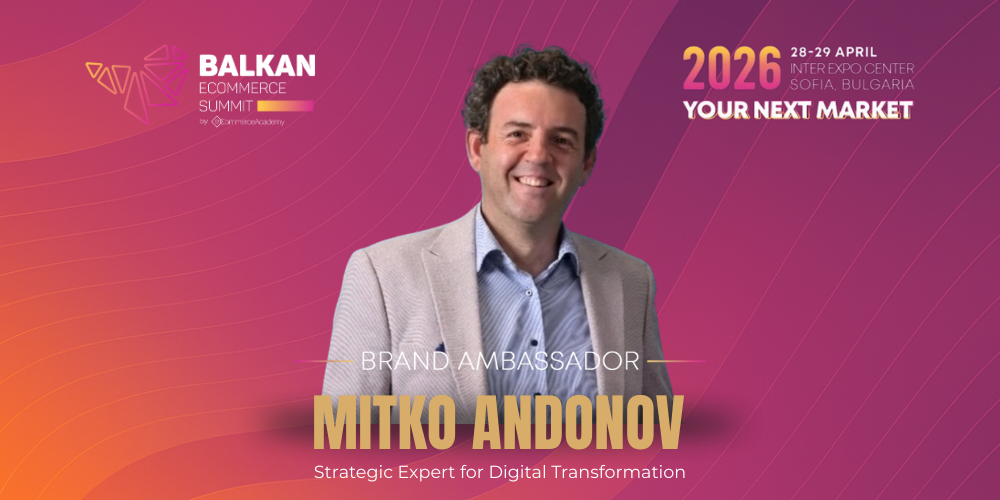
Mitko Andonov works at the intersection of strategy, performance marketing, and execution, helping founders and CEOs turn “digital activity” into real business momentum. His work focuses on the fundamentals that most companies skip: clarity on who they serve, a web presence that converts, and a roadmap that is built around learning and iteration, not random tactics.
In this interview, Mitko explains what a “Strategic Gap” looks like in day-to-day leadership, why so much digital budget gets wasted, and what an effective digital roadmap must include if it is meant to drive outcomes instead of vanity metrics. As a Brand Ambassador for the Balkan eCommerce Summit 2026, he shares why the Balkans are entering a rare window of opportunity, and why collaboration across borders will decide who scales next.
You often say that most companies don’t have a digital problem, but a “Strategic Gap.” How can a CEO quickly recognize if this is the real issue in their business?
It usually starts with a very specific kind of frustration. You recognize it when you look at your competitors in the region – businesses that launched after you – and you see them moving faster than you thought possible. You find yourself wondering, ‘How have they cracked the code while I still haven’t?’
 You know you have a Strategic Gap when you’re stuck in the ‘Daily Loop.’ You’re doing everything yourself instead of leading, and each brings a new tactic or trend you think you have to follow, hoping it will finally make the difference.
As the saying goes, ‘Insanity is doing the same thing over and over again and expecting different results.’ If you use the same outdated tools and recycle the same fragmented approach, your goals will always stay just out of reach. Your effort will go up, your results won’t. That’s the Gap. A lot of motion, but very little momentum. It’s the noise and chaos that keeps you running on a treadmill. You spend all your energy but you never actually change the scenery. This is when you discover that you don’t have a digital problem, but a ‘how’ problem that is keeping you far away from your ‘why’.
You’ve mentioned that 40–50% of digital budgets are often wasted. Where does this waste usually happen, and how can companies stop it within the first 90 days?
The waste usually comes from investing just for the sake of ‘trying.’ Many companies want to appear proactive, so they spread their budget across too many channels in what I like to call ‘wide and thin’ advertising. ‘Wide and thin’ advertising is promoting fishing gear in a fashion magazine or running expensive TV spots for a product meant for Gen Z that never even watches TV. It’s loud, it’s expensive, and it’s hitting all the wrong ears.
I see business owners hitting that ‘Boost Post’ button and throwing thousands of euros into the wind without a real plan. Money goes out before the fundamentals are in place.
To stop this waste in 90 days, you have to stop building on sand. First, you need a solid base, and that means a high-converting website that isn’t just a brochure, but a place to gather people, understand them, and learn from them. When you understand who’s coming and why, you stop chasing strangers and start building a gold mine of returning customers based on your own first-party data that nobody can take away, ever.
Once that base is ready, you move away from hoping and into precision. You perform a deep analysis of your Ideal Customer Profile (ICP) to find exactly where they are. Then, you invest in campaigns with a real strategy that guides you to reach that exact target in the exact volume, with constant daily tweaking. You stop trying to be everywhere for everyone and start being the only choice for the right someone.
What does a truly effective Digital Roadmap look like? One that connects marketing activities to real business outcomes, not just clicks and traffic.
A truly effective roadmap isn’t just a list of tasks. The roadmap is a commitment to a specific strategic direction. Many companies waste a fortune because they choose the wrong channels for the wrong reasons. A real roadmap starts with Strategic Research – having an expert tell you exactly where your audience is and how to talk to them.
Here’s a rough blueprint for a roadmap that actually produces results:
- The Strategic Entry (Bringing the people): You can’t sell to people who aren’t there. A roadmap defines the exact routes that will bring high-quality traffic to the website. This is where most CEOs get lost – they don’t know which channel to trust or how to reach their target without overspending. That’s where an experienced partner helps – a professional agency like Eon Eden can engineer that flow of people so we can actually start the process of measuring and selling.
- The Learning Foundation: Once people arrive, your website needs to capture insight. A high-performing site should be connected to proper analytics and should show you who your visitors are, what they care about, and where they hesitate. If your website isn’t teaching you about your potential clients, it’s failing you.
- Product Evolution: Instead of forcing a fixed offer, you now need to adapt based on real data gathered from your customers. We won’t just sell what you have; we’ll use the insights to evolve the product and the messaging to match how customers think, what they need, and what they’re ready to buy. Your clarity needs to be unmatched so that the resistance drops and the offer aligns with the market reality.
- Active Leadership: A roadmap is only useful if someone is accountable for it. You need someone to guide and lead the journey with you. You don’t need another task executor. In the end, you need to build trust, which is why I often work on a performance-based model. I don’t just give you a plan and disappear. I stay involved and share responsibility for the outcome.
In short, it’s a move from ‘guessing’ to ‘building a system’ that learns, adapts, and compounds – and creating a partnership where results matter as much to the strategist as they do to the CEO.
Which elements of “old-school” business thinking must be preserved to ensure a sustainable and successful digital transformation?
In the rush to digitalize, many companies lose the soul of their business. To make a transformation actually work, we have to preserve three ‘old-school’ pillars:
- Trust: In our region, there are so many digital liars (scammers and low-quality sellers) that people have become afraid to buy online. A strong digital presence has to clearly signal that there’s a real business and real people behind it. If trust is missing, no amount of automation or AI will compensate for it.
- Relationships: Old-school owners noticed everything: a dusty shelf, a confused customer, etc. You still need that obsession and mindset, but now it’s repackaged as ‘User Experience’ on your site. Digital tools should help you understand behavior, remember preferences, and serve existing customers better, not only chase new ones. After all, long-term growth comes from retention and loyalty.
- Confidence: In the past, good merchants knew their products inside out and could explain the price without hesitation. That discipline is easy to lose online, especially with today’s price competition. It’s very easy to fall into the ‘race to the bottom,’ where everyone is just trying to be the cheapest to get a quick click. But you can’t build a real business on being the cheapest. Business sustainability depends on communicating clear value. When you preserve that old-school depth of knowledge, you start competing on relevance instead of price.
Digital transformation doesn’t mean you should abandon every old principle, but upgrade on them. Keep your grit, keep your integrity, but build a bridge that carries those things to a much larger audience online.
As a Brand Ambassador for the Balkan eCommerce Summit, what do you see as the biggest opportunity for Balkan eCommerce right now, and why is regional collaboration becoming essential for brands that want to scale beyond their home markets?
The opportunity right now is historically strong. While many of the world’s major markets are struggling with complexity and stagnation, the Balkans are just waking up. I believe we have the potential to become Europe’s China and Silicon Valley.
 This region has two major advantages. First, we can produce high-quality, European-standard products at far more competitive costs than Western Europe. Second, we have deep technical and creative talent that’s capable of building systems and tools. Instead of just adopting what others have made, we can build a specific Balkan way of working – using AI and automation to ‘leapfrog’ over the old ways of doing business.
But we can only do this if we stop working in silos. We have incredibly hardworking, stubborn people who stayed here because they want to prove we can make a difference. We also have a massive, patriotic diaspora – people who left but still have that fire inside and a network across the world.
Regional collaboration is the only way to attack the wider European market where the real buyers are. We don’t need to copy America or China; we need to have the faith and dedication to build our own integrated ecosystem that plays to our own strengths. If we marry our talent, infrastructure, and strategy across borders, the Balkans can become a serious driver of European eCommerce growth, not just a peripheral market. But that’s only if we start trusting ourselves and building for the future.
Meet Mitko at Balkan eCommerce Summit 2026
If you want to close the Strategic Gap in your business, make smarter decisions with digital budgets, and build a roadmap that actually compounds results, make sure to connect with Mitko on-site.
🎟️ Grab your ticket at balkanecommerce.com and be part of building stronger connections across the Balkans.