

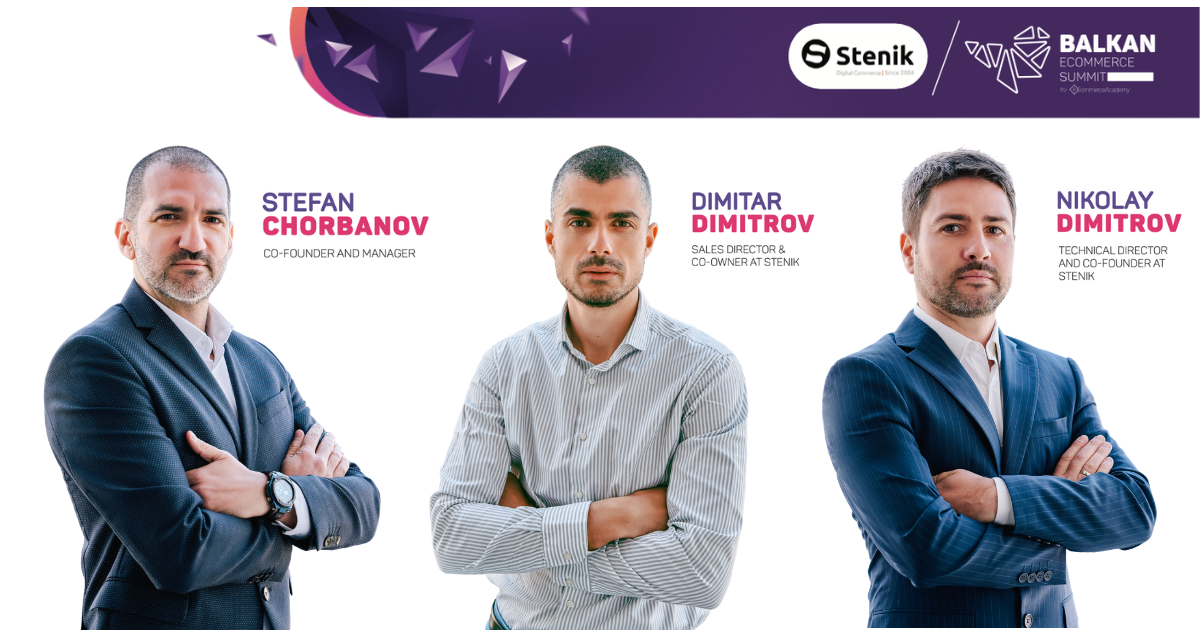
In 2026, globalisation in eCommerce is more tangible than ever. While major international players are aggressively expanding with massive marketing budgets, local merchants in the Balkans face the challenge of not only retaining their market share but also growing abroad.
Are local merchants in the Balkans catching up with international players on the eCommerce scene?
Dimitar Dimitrov: They are definitely closing the gap, but in their own unique way rather than competing purely on scale. The European market is both open and highly fragmented. This gives impetus to merchants from large Western economies, who first build scale locally and then expand aggressively, including via acquisitions. In this context, joining the Eurozone can be a strong catalyst for Bulgarian companies to think more boldly about international expansion, building on their positions on home soil. The hidden advantage of Balkan merchants lies in local expertise and physical presence – assets that global players do not have in their markets.
Stefan Chorbanov: To truly catch up, they must stop trying to beat global giants at their own game and focus on where they are strongest. Successful local businesses today are built on three pillars: impeccable customer service, a narrow niche focus, and a strong physical presence. As the EU still finds it difficult to regulate unfair practices on some Asian platforms, local businesses need to be very aware of their unique advantages and use them wisely and strategically.
Give an example of a “local advantage” that merchants can use?
Stefan Chorbanov: A frequently undervalued asset is physical presence. Global players enter the market with massive marketing budgets, but they lack a local presence and are not as close to customers as local merchants are. Physical stores, showrooms, and all points of contact can be integrated into an omnichannel strategy and create an experience that competitors find difficult to replicate. The problem is that many merchants are not fully leveraging this asset, whether by neglecting to integrate their online and offline channels or by undervaluing the role of physical presence.
Nikolay Dimitrov: The businesses that succeed are those that focus on delivering an exceptional customer experience and defining a clear niche rather than competing on price with larger players. The most effective strategy is to build your business around the market’s specific dynamics and convert them into a competitive edge against Asian and global competitors.
Dimitar Dimitrov: Cash on delivery is a good example. While many merchants view it as a drawback in our market, I see it as an advantage. Consumer behaviour in the Balkans is not the same as in Western Europe. In Bulgaria, for example, card payment figures are frequently misunderstood because they include all card transactions rather than only online payments. This often leads to the perception that the market is “behind,” when in reality, it simply operates under different conditions.
Instead of trying to eliminate cash on delivery, successful merchants in Bulgaria build their processes around it and use it strategically compared to international competitors, which are often not adapted to these local peculiarities.
So, is the omnichannel model still an advantage today?
Stefan Chorbanov: Absolutely. The omnichannel model is gaining strong traction, even among smaller niche brands across Europe. Even for products that are seldom purchased online, the data is telling – nearly 88% of consumer journeys begin with an online search, even when the final purchase happens in a physical store. This is the ROPO effect: research online, purchase offline.
Many merchants continue to lag behind because they don’t prioritize their online channel, as their offline operations currently feel more familiar and profitable to them.
What is the role of artificial intelligence (AI) in helping local merchants enter international markets?
Dimitar Dimitrov: In the past, entering a new market required significant resources, especially native speakers for customer service. Today, AI allows a large part of these processes to be automated. Customer support in international sales is critical – if you rely on a single person, you’re exposed to risk. AI addresses this by handling routine inquiries automatically and directing human resources toward more complex cases.
The same applies to product content for businesses with extensive catalogues. Creating and maintaining product descriptions for large assortments is a serious challenge, and AI greatly simplifies this task.
Stefan Chorbanov: AI is no longer a “nice to have” – it is a competitive necessity. In 2026, the businesses that succeed are those that use AI strategically and automate intelligently. They don’t just adopt tools; they integrate them deeply into their processes.
We are seeing strong results in areas such as customer service automation (chatbot-based support), personalised marketing campaigns and automation, product content management, and price and margin optimization. The outcomes are clear: higher conversion rates, higher average order values, and optimized costs.
AI does not replace humans. It frees up resources, accelerates processes, and enables teams to operate at a higher level. It is becoming increasingly “invisible,” working beneath the surface of many tools and systems.
Where does technology fit into all of this?
Nikolay Dimitrov: Technology is the foundation at every level. Without a strong technological core, it becomes difficult to synchronize online and offline channels or fully implement AI. If your eCommerce platform restricts you or relies on closed technology, you lose access to global solutions and innovations.
This is why, at Stenik, we have worked with several software ecosystems over the years – those that currently serve both our needs and the needs of our clients best. Our technology stack includes Magento, Shopify, and Hyvä, which allow fast localization, easy integration with local partners, and adaptation to the specific requirements of different markets.
We are not afraid to make mistakes, because in the age of AI, it is not the most mature who win, but the most adaptable.
What advice would you give to Bulgarian and Balkan merchants planning to expand abroad?
Dimitar Dimitrov: My advice is not to wait for the perfect moment and not to be afraid of making mistakes. It is important for businesses to manage their online investments wisely and clearly distinguish between cost and investment – whether we’re talking about software, platform functionalities, digital assets, or marketing activities.
Nikolay Dimitrov: They should choose their partners carefully, as these partners play a key role in their digital development and long-term success. It’s important that partners bring not only technological expertise but also an understanding of the specific market and business model. Good communication, flexibility, and the ability to adapt are just as important as the technology itself. In a dynamic environment like eCommerce, the right partner can accelerate growth, while the wrong one can slow development and lead to missed opportunities.
Stefan Chorbanov: The biggest threat is not competition – it’s falling behind. Competition pushes you to grow and to build. But lagging in digitalization forces you into risky “big leaps” later, which not everyone can make. Merchants need to be proactive: testing new markets, innovating, and seeking opportunities to set the rules of the market, not merely catch up to them.
Company presentation
Since 2004, Stenik has been helping businesses succeed online. As a technology partner, the company provides a full-cycle approach to the implementation, development, and support of B2C online stores and B2B platforms, tailored to the needs of manufacturers, retailers, brands, and digital merchants. Their mission is to help local businesses become more competitive in the digital economy by applying international technologies and know-how.
As a full-service development agency, Stenik supports merchants across the entire digital commerce lifecycle, covering the full spectrum of services required by modern eCommerce businesses – architecture design, development, UI/UX, consulting, and technical support.
The company is an Adobe Silver Solution Partner (certified for Magento Open Source and Adobe Commerce), a Hyvä Silver Partner, and a Shopify Partner.