

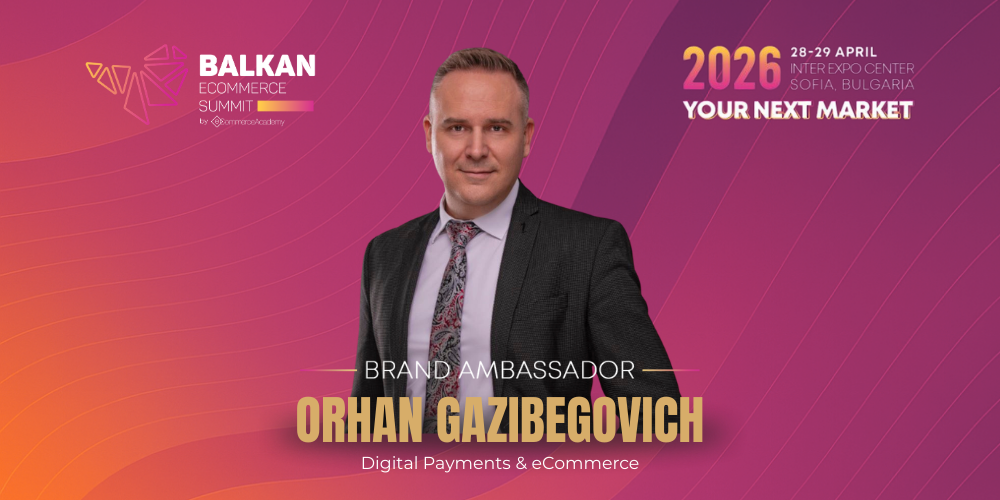
In every developing eCommerce market, there is a moment when digital payments stop being a “nice‑to‑have” and become the infrastructure that growth depends on. For Orhan Gazibegović, that moment has been unfolding in Bosnia and Herzegovina and the wider Western Balkans for more than a decade.
As President of the eCommerce Association in Bosnia and Herzegovina and Head of Sales for Monri Payments across Bosnia, Montenegro, and North Macedonia, Orhan has been at the centre of this transformation. From working with first‑time online sellers during the pandemic boom to partnering with banks, regulators, and global providers, he has seen both the hesitation and the momentum behind payment digitalisation in the region.
In this interview, he shares the biggest misconceptions merchants still have about online payments, the reforms that could unlock faster digital trade, and how evolving customer expectations and payment innovations will shape conversion rates and cross‑border growth in the years ahead.
You’ve spent more than a decade shaping the payment ecosystem in Bosnia and Herzegovina. What is the single biggest misconception merchants still have about online payments in the region?
Over the past decade, especially during the rapid expansion of eCommerce triggered by the pandemic, I’ve had the opportunity to speak with hundreds of merchants in Bosnia and Herzegovina – from first‑time online sellers to well‑established companies entering digital channels for the first time.
The single biggest misconception I still encounter is the belief that online payments are inherently expensive and overly complicated. Many merchants assume that accepting online payments requires:
- Heavy upfront investment
- Complex technical integration
- Ongoing operational burden
In reality, the ecosystem has matured significantly. Today’s payment solutions are far more accessible, scalable, and aligned with the needs of businesses of all sizes. Integration is simpler, pricing models are more transparent, and support is much more robust than it was even five years ago.
Through the work of the eCommerce Association in Bosnia and Herzegovina, we’ve focused strongly on education and direct communication, not only with merchants, but also with consumers, payment providers, and other key market stakeholders. Once merchants understand the true cost structure, security standards, and practical benefits of online payments, hesitation very quickly turns into confidence.
Removing this misconception is essential, because online payments are no longer a “nice‑to‑have.” They are a foundational component of sustainable growth in modern commerce.
As President of the eCommerce Association of B&H, where do you see the most urgent opportunities for improving digital trade and which reforms or innovations would immediately accelerate market growth?
Bosnia and Herzegovina has several strong – and still underutilised – opportunities when it comes to accelerating digital trade. From my perspective, the most urgent priorities sit at the intersection of legislation, infrastructure, and trust.
First, there is a clear need to modernise parts of the regulatory framework, particularly around online onboarding and faster bank account opening. Simplifying and digitising these processes would significantly lower the barrier to entry for new eCommerce businesses and enable existing companies to scale more quickly and efficiently.
Second, one of the most impactful actions would be legislative amendments enabling the wider adoption of parcel lockers and automated parcel machines (APMs). This would dramatically improve last‑mile delivery in terms of cost, speed, and convenience for both merchants and consumers. In many European markets, parcel lockers have become a standard logistics solution; Bosnia and Herzegovina has the potential to benefit in exactly the same way.
Finally, sustainable market growth requires stronger and clearer legal protection for both merchants and consumers. By further clarifying laws and regulations related to digital trade – especially around payments, delivery, and dispute resolution – we can build higher levels of trust across the ecosystem.
Together, these reforms would not only accelerate growth, but also create a more transparent, competitive, and resilient eCommerce market in Bosnia and Herzegovina.
You also lead sales in Monri Payments across Bosnia, Montenegro, and North Macedonia. What differences do you observe between these three markets, and how do payment preferences shape eCommerce performance?
Leading Sales in Monri Payments across Bosnia and Herzegovina, Montenegro, and North Macedonia has reinforced one key insight: while these markets share regional similarities, each has its own specific dynamics and requires a highly personalised approach.
- North Macedonia is relatively advanced in terms of digital adoption and legislative readiness. New payment solutions can be implemented more quickly and at scale, creating a favourable environment for faster eCommerce development and experimentation with innovative payment models.
- Montenegro is a highly seasonal and tourism‑driven market. While this brings operational challenges – for example, strong peaks in volume and a diverse customer base – it also represents significant potential, especially for cross‑border eCommerce and digital payment solutions that cater to international customers during peak seasons.
- Bosnia and Herzegovina sits somewhere in between, with strong growth momentum and a market that is increasingly open to digital payments, yet still influenced by structural and regulatory complexities that need to be addressed.
Across all three markets, the common trend is clear: customers are becoming more demanding. They expect payment experiences that are:
- Seamless
- Fast
- Secure
As a result, payment preferences play a critical role in eCommerce performance. Businesses that offer the right mix of local payment methods, a smooth user experience, and visible trust‑building mechanisms consistently outperform those that do not.
Ultimately, the region is moving decisively toward payment digitalisation, and those who adapt early to evolving customer expectations will be best positioned to lead the next phase of eCommerce growth.
Looking into 2026, which payment innovations or customer expectations will have the strongest impact on merchant conversion rates in the Balkans?
Looking toward 2026, the strongest impact on merchant conversion rates in the Balkans will come from simplicity, speed, and intelligence in the payment experience.
We will see a continued shift away from traditional card entry toward digital wallets on smartphones, with solutions like Apple Pay and Google Pay becoming standard rather than optional. These wallets significantly reduce friction at checkout:
- Fewer steps
- Faster authorisation
- Built‑in security
All of this directly translates into higher conversion rates, especially on mobile.
At the same time, the rise of AI‑driven eCommerce will reshape customer expectations. AI will enable:
- Smarter checkout flows
- Personalised payment options
- Real‑time fraud prevention
- More accurate risk assessment
For merchants, this means fewer declined transactions, lower friction, and more tailored user journeys.
By 2026, customers in the Balkans will expect payments to be almost invisible – fast, secure, and seamlessly embedded into the shopping experience. Merchants who adopt wallet‑based payments and leverage AI to optimise the checkout process will have a clear competitive advantage in driving conversions and long‑term customer loyalty.
As a Brand Ambassador for the Balkan eCommerce Summit, how do you plan to help merchants, payment providers, and policymakers better understand the region’s payment realities and unlock cross-border potential?
 As a Brand Ambassador for the Balkan eCommerce Summit, the mission is to connect perspectives and turn dialogue into actionable insight.
Events like BES are incredibly powerful because they bring the entire region together in one place: merchants, payment providers, technology partners, and policymakers. That mix creates an environment that naturally inspires new ideas and collaboration.
The exchange of knowledge with global experts and more advanced markets is especially valuable. It provides clarity, challenges local assumptions, and helps all stakeholders better understand where the region stands today and where it can realistically go next. These conversations often become the foundation for:
- Smarter strategies
- Better investment decisions
- Stronger regulatory approaches
At the same time, I see my role as helping to translate best practices from mature eCommerce and payment markets into solutions that actually work in Bosnia and Herzegovina and the wider region, taking into account local consumer behaviour, legislation, and infrastructure.
Unlocking cross‑border potential starts with understanding these realities and aligning them with proven models. Through open dialogue, sharing real‑world experience, and encouraging cooperation across borders, the Summit becomes not just an event, but a catalyst for sustainable growth across the entire Balkan eCommerce ecosystem.
Meet Orhan at Balkan eCommerce Summit 2026
Thinking about improving your payment strategy, increasing conversion rates, or expanding your eCommerce business across the Western Balkans? Curious how trust, regulation, and new technologies are reshaping digital payments in the region?
Orhan will be on-site, ready to share what over a decade of hands-on experience in building payment ecosystems has taught him – from overcoming merchant misconceptions to implementing solutions that actually drive measurable growth.
Whether you’re a merchant exploring new markets, a payment provider looking for regional insights, or a policymaker aiming to unlock digital trade potential – come meet him and turn insight into action.
🎟️ Grab your ticket at balkanecommerce.com and be part of building a more connected and trusted eCommerce ecosystem in the Balkans.