


Expanding into Central and Eastern European (CEE) eCommerce markets requires more than simple translation – it demands crafting resonant brand experiences for discerning consumers who expect localized payment methods, cultural understanding, and authentic customer service. Companies implementing comprehensive localization strategies typically achieve up to 40% conversion rate improvements compared to generic international approaches.
Table of Contents
- Understanding eCommerce Localization for CEE Markets
- Key Characteristics of CEE Markets for International Strategy
- Essential Localization Elements for Success
- Payment Methods and Pricing Strategies
- Building a Multilingual Platform
- Implementation Roadmap
- Frequently Asked Questions
As you consider your CEE markets strategy, remember that these markets demand more than simple language conversion. This guide provides a field-tested approach to eCommerce localization, focusing on cultural nuances, payment preferences, and shopping behaviors that drive ROI. For more insights on optimizing global expansion, consider the expertise shared by Silvi Nunez at the Balkan eCommerce Summit. By understanding these key elements, you can achieve conversion rate improvements of up to 40% compared to generic international approaches. Let’s dive into what actually works in practice.
Understanding eCommerce Localization for CEE Markets
What is eCommerce Localization for CEE Markets?
eCommerce localization for Central and Eastern European markets is the comprehensive process of adapting your entire business approach to connect with diverse, sophisticated consumers who have specific expectations and preferences. This goes far beyond language conversion to include cultural context, payment habits, and shopping behaviors that resonate with local markets.
The Eastern European market represents one of the fastest-growing digital commerce regions globally, with countries like Poland, Czech Republic, and Hungary leading significant growth trajectories. To delve deeper into where the eCommerce opportunities are in the Balkans, especially looking towards 2026, explore further insights. What makes these markets unique is their combination of high digital adoption rates with strong preferences for localized experiences. Unlike Western markets where English-language sites might suffice, CEE consumers actively seek out brands that demonstrate genuine understanding of their local context.
- Cultural Adaptation: Each CEE country has distinct characteristics requiring country-specific customization beyond regional insights
- Payment Preferences: Polish consumers show different payment preferences than Czech counterparts, while Hungarian shoppers have unique customer service expectations
- Trust Factors: CEE consumers prioritize fundamental trust elements that differ significantly from Western market expectations
- Performance Impact: Proper localization delivers up to 40% conversion rate improvements compared to generic international approaches
Many Balkan brands are successfully going global with platforms like Shopify, demonstrating the potential for expansion. This complexity requires a strategic approach that balances regional insights with country-specific customization.
The investment in proper localization pays dividends quickly. Companies that implement comprehensive localizationstrategies in Eastern Europe typically see conversion rate improvements of 40% compared to their generic international approaches. This dramatic improvement stems from addressing fundamental trust factors that CEE consumers prioritize when making online purchases.
Now that you understand the importance of localization, let’s explore the specific characteristics that define these unique markets and how they impact your international eCommerce strategy.
Key Characteristics of CEE Markets for International eCommerce Strategy

Your international eCommerce strategy must account for several defining characteristics that make CEE marketsdistinct from both Western European and global markets. For more comprehensive best practices and strategies, insights from events like the Balkan eCommerce Summit can be invaluable. Understanding these nuances will determine whether your expansion succeeds or struggles against local competition.
Market-Specific Consumer Behaviors
- Poland Ecommerce Market: Over 20 million active online shoppers demonstrate high engagement with price comparison tools and marketplace platforms, particularly Allegro which shapes expectations around fast delivery and buyer protection
- Czech Republic Ecommerce: Consumers favor direct brand relationships over marketplace purchases, showing higher tolerance for premium pricing when brands provide exceptional customer service in Czech language
- Hungary Ecommerce Market: Combines elements from neighboring countries with strong preferences for local payment methods and expectations for rapid customer service responses
- Bulgaria’s transition to the euro in January 2026 represents a significant shift for the regional e-commerce landscape. International merchants no longer need to support the Bulgarian lev, simplifying pricing, reducing payment processing complexity, and making Bulgaria a more accessible market for eurozone-based businesses expanding into CEE.
Price sensitivity remains a dominant factor across the region, but it’s sophisticated price consciousness rather than simple bargain hunting. CEE consumers actively research products across multiple platforms, compare prices using dedicated comparison engines, and expect transparent pricing without hidden fees. They’re willing to pay premium prices for products that deliver clear value, but they’ll abandon purchases quickly if they perceive pricing manipulation or unclear cost structures.
Mobile commerce adoption across all CEE markets has accelerated dramatically, with mobile traffic representing 60-70% of total e-commerce visits. Conversion rates on mobile remain lower than desktop, indicating opportunities for businesses that optimize mobile experiences specifically for CEE user behaviors and preferences.
Customer service expectations in these markets exceed typical international standards. CEE consumers expect rapid response times, native language support, and personalized assistance. To understand what will transform the eCommerce landscape with key predictions for 2026-2027, further analysis is available. They view customer service quality as a primary differentiator between brands and will switch to competitors based solely on service experience quality.
Given these key characteristics, what specific localization elements are essential for capturing the attention and trust of CEE consumers?
Essential Localization Elements for CEE eCommerce Success
Successful eCommerce localization in CEE markets requires attention to specific elements that directly impact customer trust and conversion rates. Your approach should prioritize these core areas to maximize your investment in market expansion.
Core Localization Components
- Content Adaptation: Adapt content beyond translation to include cultural context, local references, and communication styles that resonate with each market
- Product Presentation: Account for local shopping behaviors with comprehensive information, high-quality images, and clear specification tables for easy comparison
- Visual Design Elements: Consider cultural preferences for color schemes, layout patterns, and navigation structures that align with local usability expectations
- Search Engine Optimization: Understand local search behaviors and keyword patterns specific to each language and market
- Technical Infrastructure: Support multiple currencies, tax calculations, and shipping options that align with local expectations
Content adaptation represents your first critical touchpoint with potential customers. This goes beyond translation to include cultural context, local references, and communication styles that resonate with each market. Polish consumers respond well to detailed technical specifications and comprehensive product comparisons, while Czech customers prefer concise, benefit-focused descriptions that highlight practical applications.
Your product presentation must account for local shopping behaviors and decision-making processes. CEE consumers typically spend more time researching purchases than their Western counterparts, reading reviews extensively and comparing options across multiple sites. This means your product pages need comprehensive information, high-quality images from multiple angles, and clear specification tables that facilitate easy comparison.
| Localization Element | Poland | Czech Republic | Hungary |
|---|---|---|---|
| Content Style | Detailed, technical focus | Concise, benefit-driven | Structured, formal tone |
| Visual Preferences | Product-focused imagery | Lifestyle integration | Clean, organized layouts |
| Navigation Style | Category-based browsing | Search-driven discovery | Hierarchical structure |
| Information Depth | Comprehensive specs | Key benefits highlighted | Balanced detail level |
Visual design elements require careful consideration of cultural preferences and usability expectations. Color schemes, layout patterns, and navigation structures that work in Western markets may not translate effectively to CEE audiences. Hungarian consumers prefer more structured, hierarchical navigation systems, while Polish users respond better to visual product categorization approaches.
Search engine optimization for CEE markets demands understanding of local search behaviors and keyword patterns. Each language has unique search query structures, and direct translation of English keywords rarely captures actual search intent. Polish users might search for “buty sportowe damskie” rather than direct translations of “women’s athletic shoes,” requiring keyword research specific to each market.
Technical infrastructure must support multiple currencies, tax calculations, and shipping options that align with local expectations. CEE consumers expect to see prices in their local currency with all taxes included, and they want shipping options that reflect local delivery standards and timeframes.
Customer support localization extends beyond language translation to include cultural communication styles and service level expectations. CEE customers expect prompt, knowledgeable responses that demonstrate understanding of local context and regulations. Your support team needs training on local consumer protection laws, return policies, and cultural communication norms that vary significantly across the region.
With these localization elements in mind, let’s examine the payment methods and pricing strategies that resonate most effectively with CEE consumers.
Payment Methods and Pricing Strategies for CEE Markets
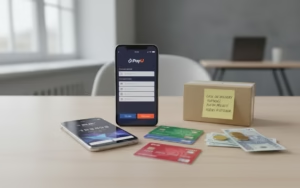
Your payment strategy in CEE markets can make or break your expansion success. These regions show distinct payment preferences that differ significantly from Western European or North American patterns, and accommodating these preferences directly impacts your conversion rates and customer acquisition costs.
Essential Payment Methods by Market
- Cash-on-Delivery: Remains popular across many CEE countries, particularly Romania and Bulgaria where it represents 50-65% of online transactions, despite increasing operational complexity. In Bulgaria, the January 2026 euro adoption has already begun shifting payment dynamics – removing currency conversion friction for cross-border shoppers and aligning the checkout experience with the eurozone, which accelerates the transition from COD to digital payments.
- BLIK (Poland): Preferred domestic payment method allowing customers to make payments directly from banking apps using six-digit codes, increasing Polish conversion rates by 25-40%
- Local Payment Providers: PayU dominates in Poland while similar regional providers serve other CEE marketswith better local integration and customer trust levels
- Traditional Cards: Still important but must be integrated alongside local methods for optimal conversion performance
Cash-on-delivery remains surprisingly popular across many CEE countries, particularly in Romania and Bulgaria where it represents 60-80% of online transactions. While this payment method increases operational complexity and return rates, offering it can double your conversion rates in these markets. The preference stems from historical banking system distrust and represents a transitional phase as digital payment adoption accelerates.
Poland demonstrates more advanced payment digitization, with BLIK emerging as the preferred domestic payment method. BLIK allows customers to make payments directly from their banking apps using six-digit codes, providing security and convenience that resonates with Polish consumers. Integrating BLIK alongside traditional card payments can increase Polish conversion rates by 25-40%.
Local payment service providers offer significant advantages over international alternatives. PayU dominates in Poland, while similar regional providers serve other CEE markets with better local integration and customer trust levels. These providers understand local banking relationships, regulatory requirements, and customer service expectations that international payment processors often miss.
Pricing transparency becomes crucial in price-sensitive CEE markets. Customers expect to see final prices including all taxes, fees, and shipping costs before beginning checkout processes. Hidden fees or surprise charges at checkout result in immediate cart abandonment rates that exceed 80% in these markets. Your pricing display should show local currency prices with clear breakdowns of any additional costs.
Dynamic pricing strategies work effectively in CEE markets when implemented transparently. These consumers actively use price comparison tools and expect competitive pricing, but they also understand that prices fluctuate based on demand, seasonality, and availability. The key is maintaining consistency across channels and providing clear explanations for any price variations they might encounter.
Now that you’re equipped with payment and pricing insights, let’s explore how to build a multilingual ecommerce platform that caters to the diverse linguistic landscape of Eastern Europe.
Building a Multilingual eCommerce Platform for Eastern Europe
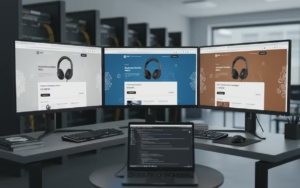
Creating an effective multilingual eCommerce platform for Eastern European markets requires technical infrastructure that supports diverse languages while maintaining performance and user experience standards. Your platform architecture decisions will impact everything from SEO performance to customer satisfaction levels.
Technical Implementation Requirements
- Language Support: Implement proper character encoding and text direction support with templates that accommodate 20-30% text expansion for Slavic languages
- URL Structure: Choose between country-specific domains (.pl, .cz, .hu) for strongest local search signals or subdirectories with proper hreflang implementation
- Content Management: Support efficient translation workflows while maintaining content quality and consistency across all language versions
- Search Functionality: Optimize for language-specific search patterns and query structures with local search suggestions and auto-complete features
- Performance Optimization: Implement efficient caching strategies and content delivery networks with regional servers for optimal load times
Language implementation goes beyond simple translation management to include proper character encoding, text direction support, and dynamic content adaptation. Slavic languages often require 20-30% more space than English text, meaning your design templates must accommodate text expansion without breaking layouts or compromising visual hierarchy.
URL structure decisions significantly impact your SEO performance in CEE markets. Using country-specific domains (.pl, .cz, .hu) provides the strongest local search signals, but subdirectories with proper hreflang implementation can achieve similar results with lower maintenance overhead. Your choice should align with your long-term expansion plans and technical resource availability.
Content management systems must support efficient translation workflows while maintaining content quality and consistency. Professional translation services specializing in e-commerce terminology deliver better results than generic translation tools, particularly for product descriptions, legal terms, and customer service content that directly impact purchase decisions.
Search functionality requires language-specific optimization to handle local search patterns and query structures. Czech users might search using different word orders than Polish users, and your search algorithm must accommodate these variations while delivering relevant results. Implementing local search suggestions and auto-complete features improves user experience and reduces bounce rates.
Performance optimization becomes more complex with multiple language versions, but it’s crucial for CEE marketswhere mobile usage dominates. Your platform should implement efficient caching strategies, content delivery networks with regional servers, and image optimization that maintains quality while reducing load times across different connection speeds common in the region.
With your multilingual eCommerce platform in place, let’s outline a practical implementation roadmap to guide your CEE eCommerce localization strategy.
Implementation Roadmap for CEE eCommerce Localization Strategy

Your implementation approach should follow a structured timeline that prioritizes high-impact activities while building sustainable foundations for long-term success. This roadmap balances speed-to-market considerations with quality standards that CEE consumers expect.
Step-by-Step Implementation Process
- Market Validation and Technical Preparation: Conduct comprehensive market research for target countries while preparing technical infrastructure to support multiple languages, currencies, and payment methods
- Content Localization and Platform Adaptation: Begin with highest-traffic pages and most popular products, implementing local payment methods and establishing regional service provider relationships
- Launch and Optimization: Launch with limited product ranges in each market, gather customer feedback, and iterate based on actual user behavior data
- Scale and Expand: Establish KPI tracking systems and monitor performance metrics to guide resource allocation and identify expansion opportunities
Phase one focuses on market validation and technical preparation. Conduct comprehensive market research for your target countries, analyzing competitor strategies, pricing benchmarks, and customer behavior patterns. Simultaneously, prepare your technical infrastructure to support multiple languages, currencies, and payment methods. This parallel approach reduces time-to-market while ensuring quality implementation.
Phase two involves content localization and platform adaptation. Begin with your highest-traffic pages and most popular products, ensuring quality translation and cultural adaptation before expanding to your full catalog. Implement local payment methods and establish relationships with regional service providers during this phase to avoid delays in customer acquisition.
Phase three emphasizes optimization and expansion. Launch with limited product ranges in each market, gather customer feedback, and iterate based on actual user behavior data. This approach allows you to refine your localization strategy using real market insights rather than assumptions, leading to better long-term performance.
| Implementation Phase | Timeline | Key Activities | Success Metrics |
|---|---|---|---|
| Market Preparation | Weeks 1-4 | Research, technical setup, payment integration | Platform readiness, payment testing |
| Content Localization | Weeks 5-8 | Translation, cultural adaptation, SEO optimization | Content quality scores, search rankings |
| Launch & Optimization | Weeks 9-12 | Soft launch, feedback collection, iteration | Conversion rates, customer satisfaction |
| Scale & Expand | Ongoing | Full catalog, marketing campaigns, optimization | Revenue growth, market share |
Ongoing optimization requires establishing KPI tracking systems that measure localization effectiveness across different markets. Monitor conversion rates, average order values, customer acquisition costs, and customer lifetime values for each country separately. These metrics will guide your resource allocation and help identify opportunities for improvement or expansion into additional CEE markets.
Ready to put these strategies into action? Let’s address some frequently asked questions to ensure you’re well-prepared for your CEE e-commerce journey.
Frequently Asked Questions
- Which CEE markets should I prioritize for initial expansion? Start with Poland due to its large market size and advanced eCommerce infrastructure, followed by Czech Republic for its high purchasing power, then Hungary for its strategic location. These three markets offer the best balance of opportunity and manageable complexity for initial expansion.
- How much should I budget for CEE localization implementation? Plan for 15-25% of your annual revenue from target markets. This includes translation costs ($5,000-15,000 per language), payment integration ($10,000-25,000), platform modifications ($15,000-40,000), and ongoing optimization resources. ROI typically breaks even within 6-12 months.
- What’s the most critical mistake to avoid in CEE localization? Don’t treat CEE as a single market. Each country has distinct preferences, regulations, and competitive landscapes. Polish consumers behave differently from Czech or Hungarian customers, requiring tailored approaches rather than one-size-fits-all strategies.
- How long does full CEE localization implementation typically take? Expect 3-6 months for comprehensive implementation across three markets. This includes 4-6 weeks for technical setup, 6-8 weeks for content localization, and 4-6 weeks for testing and optimization. Rushing this timeline often results in quality issues that hurt long-term performance.
- Which payment methods are absolutely essential for each market? Poland requires BLIK and PayU integration alongside standard cards. Czech Republic needs local bank transfers and Česká spořitelna integration. Hungary requires OTP bank integration and cash-on-delivery options. All markets benefit from PayPal as a trust signal for international brands. Note that Bulgaria now uses the euro as of January 2026, eliminating the need for BGN currency support and simplifying cross-border transactions for EU-based merchants.
- How do I measure localization success effectively? Track conversion rates by country (target 2-4% improvement), average order value increases (15-30% typical), customer acquisition cost reductions (20-40%), and customer satisfaction scores above 4.2/5. Monitor these monthly and adjust strategies based on performance trends.
- Should I use local hosting and CDN services for better performance? Yes, implement CDN nodes in Warsaw, Prague, and Budapest for better performance. Local hosting isn’t required but CDN implementation typically improves page load speeds by 30-50%, directly impacting conversion rates and SEO rankings in local search results.
- What customer service standards do CEE consumers expect? Provide native language support with response times under 4 hours for email and under 2 minutes for chat. Offer phone support during local business hours. CEEconsumers expect higher service levels than Western markets and will switch brands based solely on service quality.
- How important is mobile optimization for CEE markets? Critical – mobile represents 60-70% of traffic but often shows lower conversion rates. Focus on mobile-first design, simplified checkout processes, and local payment method integration designed for mobile devices. Mobile conversion rate improvements of 25-40% are achievable with proper optimization.
- What ongoing optimization activities provide the best ROI? Prioritize A/B testing checkout processes, refining product page layouts for local preferences, and improving customer service workflows. These activities typically generate 10-20% quarterly improvements in key metrics while requiring minimal additional investment beyond staff time.
References
- https://poeditor.com/blog/localization-statistics/
- https://emplicit.co/how-language-impacts-ecommerce-conversion-rates/
- https://ecommerce-europe.eu/press-item/new-growth-in-european-e-commerce-indicates-sectors-ability-to-adapt-and-reinvent/
- https://www.cep-research.com/2025/09/30/eastern-europe-leads-e-commerce-growth/
- https://www.mordorintelligence.com/industry-reports/poland-ecommerce-market
- https://ecommercegermany.com/blog/european-ecommerce-overview-poland
- https://www.mordorintelligence.com/industry-reports/hungary-ecommerce-market
- https://ecommercegermany.com/blog/european-ecommerce-overview-hungary/
- https://thepaypers.com/payments/expert-views/romania-2025-analysis-of-payments-and-ecommerce-trends
- https://ecommercegermany.com/blog/european-ecommerce-overview-romania/
- https://business-review.eu/business/e-commerce/romanias-peak-e-commerce-season-starts-early-in-2025-with-processed-volumes-up-over-70-291638
- https://www.mordorintelligence.com/industry-reports/romania-ecommerce-market
- https://ecommerce-europe.eu/news-item/bea-announces-the-8th-edition-of-passport-2025-of-the-e-commerce-industry-in-bulgaria/
- https://ecommercegermany.com/blog/european-ecommerce-overview-bulgaria/
- https://www.weglot.com/guides/multilingual-website-stats-and-localization-trends
- https://sqmagazine.co.uk/e-commerce-conversion-rate-statistics/