

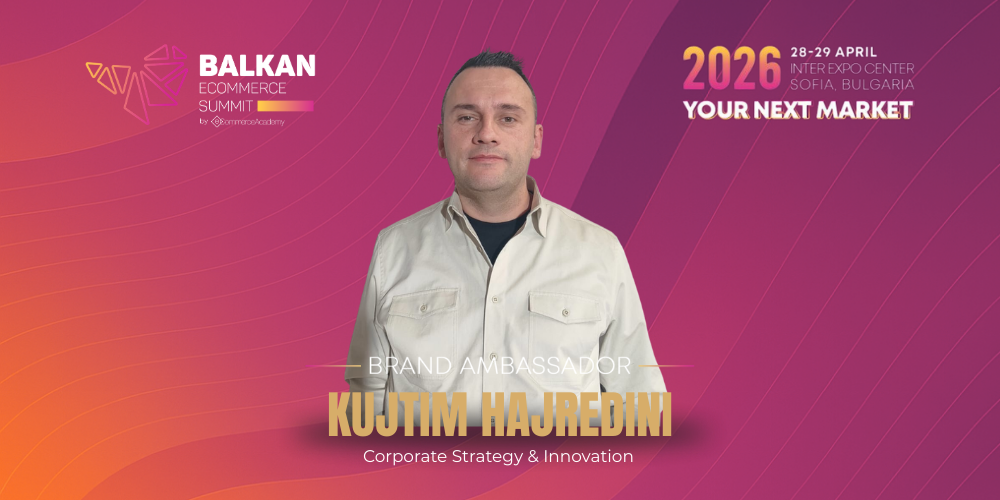
Kujtim Hajredini is an entrepreneur operating across Kosovo, Albania, Hungary, and North Macedonia, with businesses focused on logistics, eCommerce infrastructure, mobility, and international trade. He is the founder and driving force behind several companies that aim to build the physical and digital backbone of the regional eCommerce ecosystem.
NPOST is the largest courier company in Kosovo and widely recognized as the most trusted operator in the market. It holds 100% of the market share in bank card delivery services, operating under the highest security standards required by the financial sector. At the same time, NPOST is one of the largest contractors for globally known eCommerce players entering or operating in the region.
In parallel, WEMOBILITY has become the number one importer of electric vehicles in Kosovo, bringing in more than 70% of all EVs entering the country last year. Building on this position, the company is now developing a nationwide EV charging network, supporting both the green transition and the future of sustainable logistics.
What motivated you to join as a Brand Ambassador, and what value do you hope to bring in 2026?
When it comes to the Balkan region, especially the countries that are still outside the unified European Union market, the unavoidable question is always: what are we doing to create a real connection between the market of Kosovo and the rest of the region and beyond? This has been my main motivation for joining the initiative as a Brand Ambassador, because I see this role as an opportunity to actively contribute to building those bridges for cross-border eCommerce.
In 2026, NPOST will complete the process of obtaining the necessary authorizations from Kosovo Customs to offer simplified customs clearance procedures and pre-arrival declarations for B2C postal shipments. This is a major step forward, as it will create the legal and operational framework needed for more structured and transparent international eCommerce flows.
 With these authorizations and system integrations in place, we expect to enable global eCommerce players to enter the Kosovo market more easily. At the same time, we aim to open the door for regional merchants who, until now, have not had a proper channel to send goods and establish their platforms in Kosovo. In many cases, the lack of structured procedures has pushed the market toward informal or inefficient solutions.
The steps we are taking will bring full transparency to the entire process, both for buyers and institutions in Kosovo. Serious merchants will be able to sell their products in a compliant and reliable way, while customers will benefit from safer transactions and a reduced risk of fraud.
The biggest bottleneck holding back cross-border eCommerce in the Balkans, and the fastest way to fix it?
Unfortunately, all WB6 countries operate with different fiscal policies, regulatory frameworks, and physical borders. This makes the region’s development path slower and creates a complex environment for eCommerce. Cross-border B2C trade, in particular, faces many challenges that could easily fill entire books.
From my personal experience in international trade across different industries, from automotive to general goods import/export, the processes may look similar on paper. However, when it comes to B2C, there are still real barriers to moving goods efficiently between WB6 countries, as well as between WB6 and the EU, China, or the United States.
In the case of Kosovo, we are a young country with a very young population that is highly advanced in technology adoption and among the most active in the region in terms of digital usage. As a leader in innovation in the postal and last-mile sector, NPOST is taking concrete steps to improve the situation. In addition to the customs authorizations we expect to receive this year, we are working on a major project to expand out-of-home delivery.
A key strategic decision has been to separate the Out-of-Home network (parcel lockers and drop points) from NPOST and transition it into an Open Access model. This means that the infrastructure owned by the parent company will also be available to other competing operators, allowing the entire ecosystem to grow faster.
We are planning an investment of around €1,000,000, including approximately 250 drop point locations and 70 self-service parcel locker sites. Once implemented, this network will significantly support the growth of eCommerce in Kosovo by improving delivery quality, increasing convenience, and creating better infrastructure for the market to scale.
What decisions let you scale a parcel-locker model so quickly in a market with no prior infrastructure?
Even in the broader Balkan region, we were among the early adopters of parcel lockers, and in Kosovo we remain the only operator with such a network. However, we recognize that the development could have moved faster in the early stages.
The year 2026 will be a key strategic turning point for us. We are shifting from a primarily “direct-to-home” model toward a stronger “out-of-home” delivery approach, with a goal to move at least 20% of our NPOST traffic into parcel lockers and drop points.
One of the most important decisions we made was to transform the network into an Open Access platform, now known as INBOX. This allows not only us, but also other operators, to use the infrastructure. We have serious and concrete plans, a dedicated budget, and an aggressive expansion strategy for increasing the number of INBOX locations.
There is also strong market pressure driven by the growth of eCommerce and the expected entry of global players into Kosovo. This is pushing us to move faster and build an infrastructure that can support future demand.
At the same time, we are building a completely new software foundation to support this opening. The system is designed as an omnichannel platform where multiple courier operators can use the same infrastructure in different delivery scenarios: as a direct delivery point, as a rerouted address, as a failed delivery option, as a second-attempt delivery location, or even as a return address. This approach ensures flexibility, scalability, and full interoperability between different operators and eCommerce platforms.
What will accelerate the shift away from cash-on-delivery, and who must lead?
There are several factors that must work together to reduce the use of cash-on-delivery. As a main logistics contractor for the banking sector in Kosovo, we have very close cooperation with banks and financial institutions.
However, it is not only about banks or digital payment solutions. Merchants also need to build strategies to gradually reduce their dependence on cash. Cash is a challenge not only for postal and logistics companies but also for merchants themselves. COD shipments have significantly higher refusal rates, which creates operational inefficiencies and additional costs.
The more refusals there are, the more problems are created across the entire value chain. This is why a joint effort is needed. Banks, payment providers, logistics companies, and merchants all need to work together to build trust in digital payments and create incentives that encourage customers to pay in advance.
How do logistics, fulfillment, EV mobility, and cross-border supply chains fit into one vision?
We are active in multiple businesses, and even though some of them may look like completely different industries at first glance, we always try to find the connection points and create synergies between them.
For example, one of our strategic decisions in NPOST is that we no longer purchase vehicles that are not electric. This directly connects logistics with electric mobility and supports a more sustainable last-mile delivery model.
Another complementary aspect is the co-sharing of infrastructure. Many of our parcel locker locations are also being used as points for our EV charging network. This allows us to create a connected ecosystem where logistics, mobility, and infrastructure support each other.
So yes, there is a unified vision. Even though the businesses operate in different sectors, they all fit together as pieces of the same long-term mission: building the physical and digital infrastructure needed for the future of eCommerce in the Balkans.
Top lessons on execution, partnerships, and resilience?
The relationship between execution and resilience is best described by one of my favorite sayings: the fastest beats the slowest. When you combine speed with resilience, you create the perfect foundation for achieving long-term goals.
My advice is simple: move fast, be first, and execute with simplicity. Don’t overcomplicate things and don’t overanalyze every detail. Focus on building the right team and the right structure from the beginning.
Problems will always appear along the way. That is where resilience comes in. You need to stay strong, adaptable, and smart in decision-making. If you can combine fast execution with long-term resilience, success is much more likely to follow.
Meet Kujtim at Balkan eCommerce Summit 2026
If you are building cross-border operations, scaling last-mile logistics, or looking for partners that can help you expand across the region, make sure to connect with Kujtim on-site. Conversations like these often turn into partnerships.
🎟️ Grab your ticket at balkanecommerce.com and be part of building stronger connections across the Balkans.