

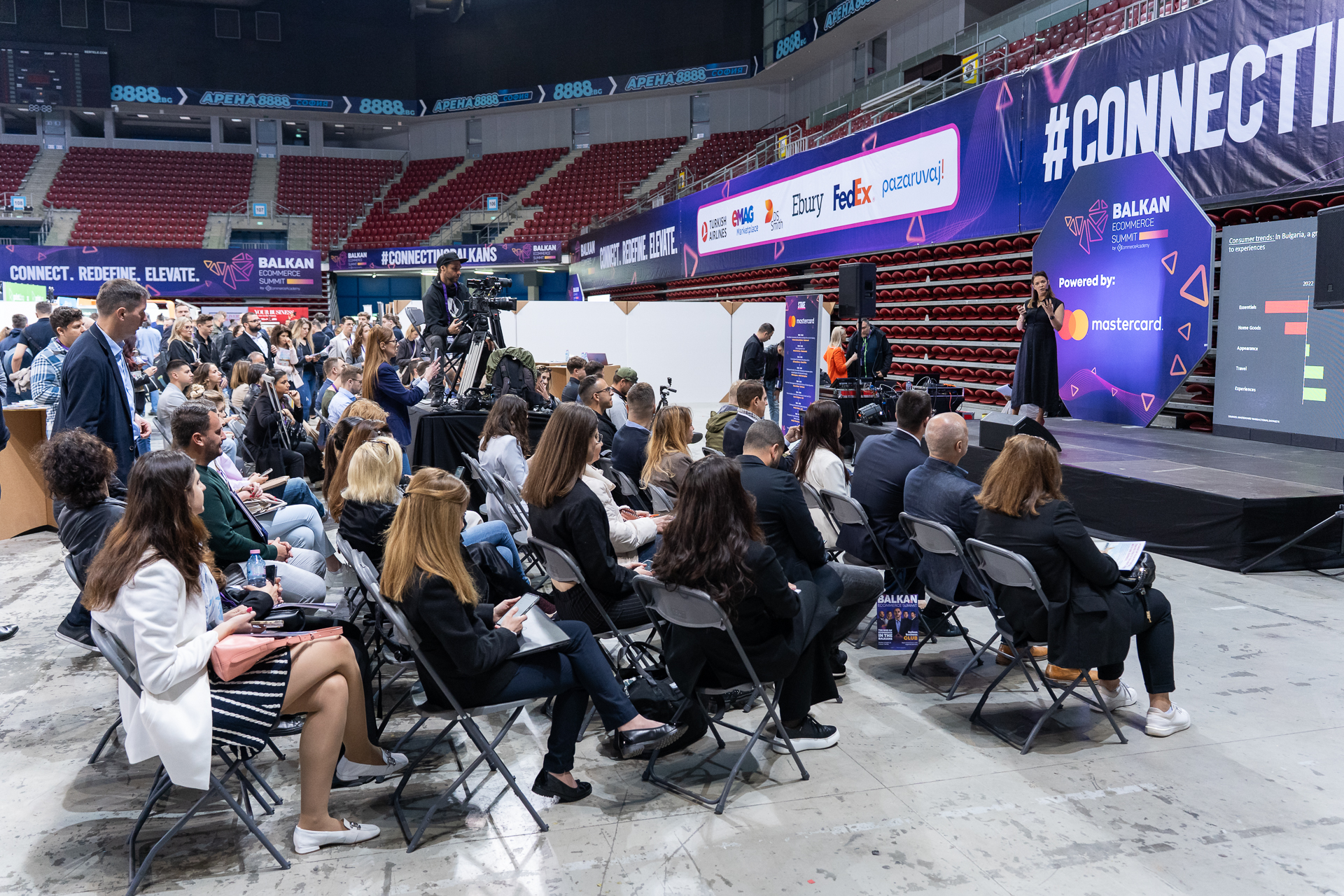
From shifting consumer habits and cross-border logistics to hyper-personalized marketing and AI-powered customer journeys – the 4 stages at Day 1 of the Balkan eCommerce Summit 2025 delivered actionable insights for every online seller and digital leader in the region.
We listened carefully and compiled for you a guidebook of the most impactful trends and best practices that will define the future of eCommerce in the Balkans and beyond.
Consumers Are Budget-Conscious but Still Crave Experiences
Balkan consumers are becoming more disciplined with spending. Corina Bulimar from Mastercard revealed that consumers are opting for more frequent, lower-value purchases, while increasing spending in experiential categories like travel, entertainment, and premium dining.
Best practices for merchants:
- Focus on value-based product offerings that feel “worth it.”
- Use micro-transactions and bundled deals to capture frequent shoppers.
Highlight experiential value – what your product helps the customer feel or do.
Hyper-Personalization Is No Longer Optional
Whether it’s Mastercard’s AffinityML or AI tools from Shutterstock, personalization was a dominant theme. Companies like Mastercard, represented by Corina Bulimar, and Shutterstock showcased how deep data, behavioral signals, and machine learning are driving tailored eCommerce journeys that increase lifetime value.

Best practices for growth:
- Use propensity models to target lookalike audiences with precision.
Deliver personalized homepage experiences even for anonymous visitors. - Optimize campaigns via Test & Learn frameworks to ensure every change drives ROI.
Marketplaces Are Powering Regional eCommerce
eMAG, one of the region’s strongest players, shared how its infrastructure and tools are empowering sellers in Bulgaria, Romania, and Hungary. Their team presented innovations like Fulfillment by eMAG, the Genius loyalty program, and cross-border selling made easy with auto-translation and synced inventory.
Best practices for marketplace sellers:
- Use marketplace fulfillment to gain speed and credibility.
- Join programs like eMAG Genius to boost conversions and repeat purchases.
- Customize campaigns with smart deals and badges to increase visibility.

Digital Wallets and Frictionless Checkout Are Winning the Checkout Battle
With 25% of all card transactions in Bulgaria now done via Apple Pay or Google Pay, according to DSK Bank, it’s clear digital wallets are here to stay. Their upcoming launch of Click to Pay promises even faster, more secure checkouts, without the need for 3DS verification.
Best practices to increase checkout conversions:
- Enable one-click payment options and digital wallets on mobile and desktop.
- Reduce friction at checkout – especially for impulse or “emotional” purchases.
- Monitor transaction drop-off rates and optimize for speed and security.
Conversational Commerce Is Reshaping Customer Service
BST, a Google Cloud partner in the region, demonstrated how AI-powered conversational commerce is making customer interactions more human-like, contextual, and profitable. Their session showed how brands can combine chat, voice, and AI assistants to create sales-ready conversations across the entire funnel.
Best practices to implement today:
- Integrate AI chat tools into your storefront for 24/7 support.
- Train your assistants with real product data and FAQs for relevance.
- Use conversation data to inform product development and marketing.
Loyalty Programs Need to Be Smarter, Not Just Bigger
PwC’s Norbert Madar presented a regional deep-dive into data-driven loyalty strategies, highlighting that frequent buyers drive 75% of parcel volume. His team broke down what makes programs like eMAG Genius, IKEA Family, and Best Buy Total successful – emotional engagement, app-based access, and personalized rewards.
Best practices for loyalty strategy:
- Offer free trials or entry rewards to increase sign-ups (eMAG’s 6-month trial led to 40% adoption).
- Combine monetary and emotional rewards – like priority access, exclusive content, or free delivery.
- Use mobile apps to manage engagement, but don’t ignore digital cards and SMS as fallback channels.
Open Banking Is the Next Leap in Payment Innovation
Marijus Plančiūnas, CEO of Paysera, made a compelling case for Payment Initiation Services (PIS), showcasing the Baltic region where 80% of eCommerce payments now bypass traditional card rails. He outlined how Bulgaria can follow suit – if merchants, fintechs, and regulators work together.
Best practices for future-ready payments:
- Stay informed on PIS adoption and regulation in your country.
- Consider integrating PIS providers that offer lower fees and faster settlements
- Educate customers on the benefits of alternative payment methods.
AI and Ethical Content Are Driving the Creative Edge
Shutterstock took the stage to explore how ethically trained AI is revolutionizing content creation in eCommerce. From product photography to 3D modeling, AI tools can now deliver production-ready visuals in minutes – all while compensating creators and maintaining compliance.
- Start using AI tools for rapid iteration in visuals and product pages.
- Ensure your tools are ethically trained and respect creator rights.
- Explore generative design workflows for faster campaign rollouts.

eCommerce in the Balkans Is Growing Smarter – and More Connected
What stood out across all talks was this: success in 2025 and beyond won’t just come from great products, but from smart systems, personalization, regional partnerships, and adaptive infrastructure.
If you’re an eCommerce founder, marketer, or operator – now is the time to level up.
The tools are here.
The insights are clear.
The momentum is Balkan-born.
Visit balkanecommerce.com to be the first to learn everything about the upcoming edition of the Balkan eCommerce Summit.