

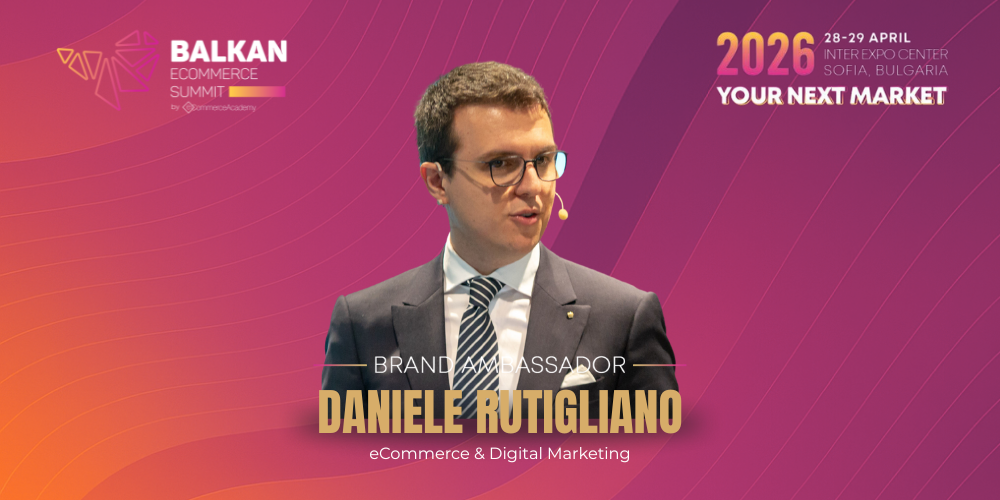
With over two decades of hands-on experience in eCommerce, education, and digital entrepreneurship, Daniele Rutigliano is one of the key figures actively shaping the eCommerce ecosystem across Southern and Eastern Europe. As co-founder and President of Assecomm, Albania’s first eCommerce association, and Brand Ambassador for the Balkan eCommerce Summit, he works at the intersection of business, education, and community building.
In this interview, Daniele shares insights from building and advising online stores, teaching eCommerce at universities in Italy and Albania, and supporting emerging markets. He reflects on common misconceptions about the Albanian and Balkan eCommerce landscape, the role of education in ecosystem growth, and the mindset founders need to succeed in cross-border expansion in 2026.
From your perspective, what does serving as a Brand Ambassador and President of Assecomm, the first Albanian eCommerce association, enable you to do for the Balkan eCommerce Summit community and how do you hope to contribute in 2026?
The Balkan eCommerce Summit is objectively one of the most important events related to the digital world in Eastern Europe. For this reason, Assecomm – the association I co-founded and represent as President – and I, believe it is essential to support this fourth edition as well. The work that Nikola Ilchev and his team have been carrying out for years, is fundamental for the entire Balkan region. Albania is growing rapidly, and many government initiatives are supporting the digital sector. Therefore, we will strive to promote the summit among all Albanian companies that are already selling online or are planning to launch an e-shop.
What’s new on your side this year that the Balkan audience should know about?

2025 has been a year full of collaborations with strategic partners across Europe.Assecomm acted as a media partner for many events in different countries: from Italy to Greece, from Turkey to North Macedonia.
On the agency side, for the third consecutive year, my agency Aproweb was mentioned by Casaleggio Associati in the report “I Partner delle aziende Ecommerce 2025” (“Ecommerce Companies’ Partners 2025”) in Italy. Akkountweb, my second digital agency specialized in marketplaces, was confirmed as an Amazon SPN and Amazon Ads partner, and a few months ago I was appointed “Amazon Ads Official Educator”.
While 2025 once again saw me involved in many hours of classroom teaching in bachelor’s and master’s degree programs in web marketing at two Italian universities (LUM and SSML Bona Sforza) as an adjunct university professor, in 2026 I will also be a lecturer in an Albanian master’s program organized by Tirana Business University (TBU), part of the Balfin Group.
At the same time, I was an ecommerce mentor for two Albanian startups during The Challenge Fund organized by “Partners Albania for Change and Development” and I was selected by the Chamber of Commerce of Treviso (Italy) and the Estonian Chamber of Commerce to deliver ecommerce courses as an ecommerce lecturer. Finally, I also took part as a speaker on stage at Digital 1to1 in Alicante (Spain) and Baveno (Italy), as well as at Shoptoberfest in Milan (Italy), organized by Shopware, the number one eCommerce platform in Germany.
Drawing on 20 years in eCommerce and three books, what’s one misconception about the Albanian market you’d like to correct and what’s a concrete example that proves the opposite?
Unfortunately, only a few big tech companies have invested in and truly believe in the Balkans so far. While in Europe we find common ecommerce partners in every country (from digital payments to logistics providers, from marketplaces to CMS platforms), in the Balkans I notice the absence of clear market leaders and, consequently, a fragmentation into small, national solutions.
On the one hand, Balkan associations (such as Assecomm) are trying to collaborate with each other to join forces; on the other hand, bringing together such different partners remains complex.
Even digital marketing strategies for ecommerce in the Balkans are challenging, especially considering the absence of Google Ads (and Google Shopping) and the TikTok Shop in many countries.
Nevertheless, vertical initiatives such as the Balkan eCommerce Summit (BES26) are beneficial for the entire region and for the online ecosystem as a whole.
Assecomm aims to professionalize the ecosystem. Which programs most effectively raise merchant capabilities and how should success be measured?
We strongly believe in information and education as key drivers of growth and innovation. Generation Z will soon play an active role in society, both as consumers and as startup founders. Therefore, they need to understand how to launch their own online projects and how to effectively leverage social media channels.
On the other hand, we have Albanian entrepreneurs who still lack the right skills to manage a complex ecommerce project. As a result, they rely solely on social media to promote their products, but then complete transactions in physical stores or through asynchronous payment methods (bank transfers, cash on delivery, and other money transfer solutions).
According to INSTAT (the Albanian Institute of Statistics), in 2025 28% of Albanian companies sold products or services online through a website, a dedicated app, or a marketplace, marking an increase of 3.5% compared to 2024. Therefore, there is significant growth potential for 2026.
On a personal note: which achievement are you most proud of, and what lesson from that story would you pass to founders planning cross-border expansion in 2026?
On the web and on social media, we read countless ecommerce success stories. However, it is complex, if not impossible, to replicate them and draw clear lessons, because every case has its own unique story, shaped by coincidences, connections, and circumstances that make it one of a kind.
How many times have we read about Amazon’s story and the huge investments it made over the years, which resulted in losses of around 8.6 billion dollars in the first six years (1995–2000)? Those were different times, and we are talking about the United States. But Jeff Bezos was not just in the right place at the right time. His charisma, skills, and network of investors all played a role in his success, yet these factors are often difficult to notice, understand, and study in depth.
In my agencies, we celebrate the individual successes of each company, especially micro-enterprises, which have limited investment budgets and few resources. Seeing their websites grow month by month on Google, or analyzing the daily growth in revenue and profits, represents a source of pride for us and these are, in their own way, incredible success stories.
Today, competition has intensified, and market dynamics are changing rapidly once again – just think of TikTok live streams, where people can purchase with a single tap thanks to the TikTok Shop marketplace feature. In my view, the real “secret” lies in a medium-to-long-term strategy, well-planned investments, and a great deal of patience.
Meet Daniele at Balkan eCommerce Summit 2026
Thinking about entering the Albanian market or expanding across the Balkans? Wondering how to improve your eCommerce operation, navigate fragmented infrastructure, or build a strategy that actually works with limited budgets and resources?
Daniele will be on-site, ready to share what 20 years of building, teaching, and advising eCommerce businesses have taught him – from practical growth strategies for micro-enterprises to ecosystem-building insights across Italy, Albania, and the wider Balkan region.
Whether you’re an Albanian entrepreneur looking to scale online, an EU merchant exploring Southern and Eastern Europe, or simply curious about the role of education and patience in sustainable eCommerce growth – come find him. These conversations often turn into partnerships.
🎟️ Grab your ticket at balkanecommerce.com and be part of building stronger connections across the region.