


The Central and Eastern European (CEE) eCommerce landscape presents a unique blend of opportunity and disruption. While powerhouses like Poland, Romania, and the Czech Republic often steal the spotlight, a comprehensive strategy must encompass the entire 12-country bloc – including Albania, Bulgaria, Croatia, Estonia, Hungary, Latvia, Lithuania, Slovakia, and Slovenia. With the region generating €124 billion in eCommerce revenue and growing at 12% year-over-year in 2024, this guide provides field-tested insights into these diverse markets, offering a practical roadmap for scalable, ROI-driven success across the region’s rapidly evolving digital commerce environment.
Table of Contents
- Understanding the CEE markets – regional overview and economic foundations
- Poland eCommerce market – the undisputed regional powerhouse
- Romania & Bulgaria online shopping – the high-growth southeastern corridor
- Czech Republic, Slovakia & Hungary – central european maturity and logistics
- The Baltic Digital Pioneers – Estonia, Latvia, and Lithuania
- The Adriatic & Emerging Balkans – Croatia, Slovenia, and Albania
- Cross-border commerce trends across CEE markets
- Payment solutions and logistics infrastructure in the CEE eCommerce landscape
- The Chinese platform disruption: Temu, Shein, and the regulatory response
- Frequently Asked Questions
Understanding the CEE markets – regional overview and economic foundations
What defines the Central and Eastern European eCommerce region?
The Central and Eastern European region represents one of the most compelling growth stories in global digital commerce today. Moving beyond the legacy of their post-Soviet economic transitions, these 12 nations have created unique market conditions that now fuel exceptional eCommerce growth. With the total European eCommerce market hitting €819 billion in 2024, CEE’s €124 billion share now represents a strategically significant slice of the pie – and one that continues to outpace its Western counterparts. Significant eCommerce opportunities in the Balkans and CEE are projected for 2026, as the region rapidly catches up to Western European spending levels.
Key economic indicators driving digital commerce growth
- Growth Rate Advantage: The CEE region consistently outpaces Western Europe, with countries like Romania and Bulgaria frequently posting double-digit year-over-year ecommerce growth. In 2023, the value of the CEE eCommerce market surged by 29%, reaching EUR 104 billion, before growing another 12% in 2024.
- Market Maturity & Nuance: The bloc contains highly mature digital states (Estonia, Czech Republic), massive volume leaders (Poland at nearly $25 billion in market value), and high-potential emerging frontiers (Albania), requiring a tailored approach rather than a blanket strategy.
- The Parcel Locker Revolution: Out-of-home (OOH) delivery networks have fundamentally reshaped the CEE last mile. InPost operates 25,000+ lockers in Poland; Sameday has surpassed 7,700 easybox points in Romania; Omniva dominates the Baltic parcel locker market with over 1,240 machines across three countries. This infrastructure is a structural advantage over Western Europe.
- Economic Fundamentals: Rising GDP per capita (Polish online spend per capita hit $705 in 2025), near-universal internet penetration, and a growing middle class support sustained eCommerce expansion. Four CEE countries – Slovakia, Czech Republic, Hungary, and Estonia – now exceed the EU average for online shopping penetration.
What makes these markets particularly attractive is the competitive landscape. It remains surprisingly open compared to saturated Western markets like the UK or Germany, where Amazon dominates. In CEE, local champions – Allegro, eMAG, Heureka – have built deep moats through logistics integration and local payment solutions. Initiatives like the CEE Digital Alliance further support this growth by fostering collaboration and innovation across the region. As you consider your next strategic move, remember that understanding these economic foundations is the first step toward unlocking the CEE region’s immense potential.
Poland eCommerce market – the undisputed regional powerhouse
Why is Poland the anchor of the CEE eCommerce strategy?
Poland stands as the CEE region’s largest and most advanced eCommerce market. With over 40 million people, 78% of whom shop online, and a market projected to reach €49.7 billion by 2028, it acts as the central hub for many international brands entering the region. Polish ecommerce grew 9.6% in 2024, with marketplaces now handling 50-60% of all online sales.
Factors contributing to Poland’s eCommerce success
- Allegro’s Unshakeable Dominance: Allegro commands over 30% market share with 22 million+ active users and 200 million+ monthly visits. In 2024, 86% of Polish shoppers made purchases through marketplaces, and Allegro is where the majority of product searches begin – not Google. The platform’s 2022 acquisition of Mall Group extended its reach into the Czech Republic, Slovakia, Hungary, Slovenia, and Croatia, signaling a pan-CEE ambition.
- The Parcel Locker Revolution: InPost’s network now exceeds 25,000 Paczkomat lockers nationwide, processing over 1 billion parcels in 2024 alone (a 22% year-over-year increase). Out-of-home delivery is now the preferred shipping method for the vast majority of Polish online shoppers. InPost has introduced 12-hour delivery across 15 major cities at PLN 9.99 (~$2.50), undercutting traditional couriers by roughly 30%. Amazon, lacking similar locker assets, is forced to lease third-party capacity – significantly diluting Prime’s value proposition.
- BLIK’s Payment Revolution: BLIK dominates online and in-store payments, with 76% of Polish consumers preferring it for online transactions. In H1 2025 alone, Poles made approximately 1.4 billion BLIK transactions, and nearly half of in-store payments were contactless BLIK. Credit cards have dropped to just 19% usage. This is a global success story in homegrown payment innovation.
- Social Commerce Acceleration: Social commerce in Poland is projected to reach $3.68 billion in 2025 and double by 2030, creating a powerful new channel for brands willing to invest in localized content.
Romania & Bulgaria online shopping – the high-growth southeastern corridor
How are Romania and Bulgaria’s online shopping markets evolving?
Romania and Bulgaria form a highly interconnected ecommerce corridor with massive momentum. Romania, valued at $7.98 billion in 2025 and projected to hit $11.65 billion by 2030, is the second-largest market in CEE by population. It boasts exceptional internet speeds and a rapidly expanding digital middle class – 74.3% of internet users aged 16-74 bought goods or services online in 2025. Bulgaria is on an even steeper growth curve, expected to expand from $2.9 billion in 2025 at a blistering CAGR of over 23% through 2030.
Key consumer preferences and purchasing patterns
- eMAG’s Expanding Ecosystem: Romania’s marketplace giant Dante International (eMAG) posted RON 7.72 billion (~$1.7 billion) in 2024 sales, now hosting 36,000+ third-party merchants with 120 million+ monthly visits and 7.4 million+ active customers. Its dominance extends to Bulgaria and Hungary, offering a vital multi-country entry point. The ecosystem now integrates HeyBlu consumer finance and Tazz last-mile delivery.
- The COD-to-Digital Transition: Cash on Delivery still accounts for 60-65% of orders in Romania, especially in rural areas. However, the transformation is accelerating. Sameday invested over €80 million in 2025 in technology and network expansion, growing its easybox network past 7,700 active points (one locker per 3,500 residents, with an average 6-minute walk nationwide). Its app surpassed 4 million downloads in 2025. FAN Courier invested an additional €40 million in 2025, with €20 million directed toward its own locker network. BNPL options from TBI Bank and Salt Bank’s fully digital play (targeting 1 million users) are rapidly shifting the payment landscape.
- Trendyol’s Aggressive Entry: Turkey’s Trendyol reached 500,000 Romanian clients in just eight months and is investing €250 million in warehousing and technology, including a new warehouse in Ștefănești within a two-hour radius of Bucharest. This signals serious long-term competitive intent.
- Bulgaria’s Eurozone Milestone: Bulgaria officially joined the Eurozone on January 1, 2026 – a transformative event that eliminates currency friction for cross-border sellers and simplifies checkout for the country’s 4.5 million social media users. Speedy leads as the dominant shipping provider, and COD remains the #1 payment method, but digital wallet usage is growing rapidly.
- High Cross-Border Appetite: Bulgarian and Romanian consumers frequently buy from each other and from broader EU merchants. Countries like Romania and Bulgaria rely heavily on domestic sellers (96% and 95% respectively), but cross-border purchasing is growing, especially through marketplace rails.
Czech Republic, Slovakia & Hungary – central european maturity and logistics
What makes the Czech Republic’s online shopping environment unique?
The Czech Republic represents the most mature, hyper-competitive eCommerce market per capita in Europe – boasting the highest number of e-shops per 1,000 inhabitants and the highest share of consumers spending €500-1,000 online in the CEE region. When grouped with neighboring Slovakia and Hungary, this cluster forms a highly integrated logistics zone with exceptional warehouse and fulfillment connectivity.
Market opportunities across Central Europe
- Logistics Hubs: The Czech Republic’s central location makes it the ideal warehousing hub for serving Germany, Slovakia, Poland, and Hungary. Packeta (Zásilkovna) dominates cross-border deliveries here, handling millions of parcels across its pick-up point and locker network. CBRE forecasts that online shopping in the Czech Republic and Poland could reach 24% and 23% of total retail sales respectively by 2026.
- Price Comparison Engines: Czechs and Slovaks are highly price-sensitive and analytical. Heureka plays a massive role in the customer journey, functioning as the starting point for product research for a significant portion of consumers. Ceneo.pl serves a similar role in Poland.
- Hungary’s Unique Dynamic: Hungary experiences high cross-border purchasing due to historical domestic inflation, with consumers frequently buying from Czech, Slovak, and Romanian webshops (like Alza, Mall, and eMAG) to find better prices. Barion dominates local digital payments, and Sameday launched its Hungarian operations in July 2025, bringing the easybox experience into the market.
The Baltic Digital Pioneers – Estonia, Latvia, and Lithuania
Why do they punch above their weight class?
Though small in population (around 6 million combined), the Baltic states are Europe’s digital natives. Estonia, famously the home of e-Residency and advanced digital government, leads the charge in consumer tech readiness – with the highest average online spending per capita in CEE at over $1,527. Tallinn and Tartu alone generate more than 70% of Estonia’s online GMV.
- Bank Link Dominance: Unlike the rest of Europe, Baltic consumers heavily prefer direct bank links over credit cards or digital wallets. Montonio, now powering 6,000+ online stores across the Baltics, Poland, Germany, and Finland, has emerged as the critical payment infrastructure layer. Kevin provides complementary Open Banking APIs across the region.
- Omniva’s Expanding Empire: Omniva, the Estonian postal company’s parcel brand, has completely revolutionized Baltic logistics. In 2025, it invested $3.96 million to deploy 135 additional parcel machines, pushing its Baltic locker count above 1,240. Monthly locker usage exceeds 50% of Baltic consumers, surging during Black Friday events. The landmark 2025 deal with Zalando to handle all Baltic last-mile deliveries – including Saturday service and label-less returns – cemented Omniva as the region’s dominant logistics partner. Venipak operates a complementary network of nearly 1,000 parcel lockers, with up to 90% of parcels in Lithuania delivered to parcel terminals.
- Cross-Border Champions: Due to their small domestic manufacturing bases, Baltic consumers are highly accustomed to shopping cross-border from Poland, Germany, and the Nordics. Latvia (25%) and Malta lead the EU in purchases from outside the bloc. Lithuanian-born Vinted surpassed €1 billion in revenue in 2025 with 40% growth, demonstrating the region’s ability to export globally competitive platforms.
The Adriatic & Emerging Balkans – Croatia, Slovenia, and Albania
Navigating the varying levels of Adriatic maturity
This sub-region features a stark contrast between highly integrated EU markets and emerging non-EU frontiers.
- Croatia & Slovenia: Both are fully integrated into the Eurozone and Schengen area, removing currency friction and customs delays. Their populations have high purchasing power and expect premium shopping experiences. Croatia’s adoption of search-engine-driven shopping habits (Google at 97%) reveals a digital-first approach. Zalando’s 2021 launch in these markets, followed by its expansion of Lounge by Zalando, has raised the bar for fashion ecommerce. Allegro’s acquisition of Mall Group also brought marketplace infrastructure into Croatia and Slovenia.
- Albania’s Untapped Potential: Albania represents a true emerging frontier with the steepest growth trajectory. The market is valued at approximately $0.72 billion in 2026, projected to reach $1.33 billion by 2031 at a 13% CAGR. Mobile devices generate over 71% of orders, and 1.2 million Instagram users actively track fashion trends. Cash on Delivery still dominates, but card payments at POS surged 42% year-over-year in H1 2025, signaling a shift. Fixed median broadband speeds reached 76 Mbps in 2025 following infrastructure upgrades, and more than 10% of total retail turnover was generated online. However, being outside the EU means customs challenges persist – early movers who solve local logistics and lean into social commerce on Instagram, WhatsApp, and TikTok are capturing significant market share with very low competition.
Cross-border commerce trends across CEE markets
How do cross-border shopping patterns work across 12 CEE countries?
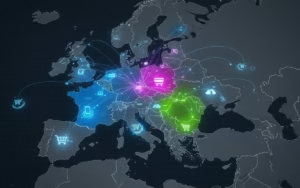
Cross-border eCommerce across Central and Eastern Europe reveals an increasingly dynamic landscape. Despite varied currencies and languages, the CEE region’s cross-border commerce shows no signs of slowing. European cross-border eCommerce reached a record €358.7 billion in 2024/2025 – a 10% year-over-year increase – with 70% generated through online marketplaces.
Emerging trends in regional commerce
- Localization Requirements: A Polish customer wants to pay in PLN via BLIK; a Hungarian wants to pay in HUF via Barion; a Croatian now pays in EUR. Multicurrency architecture is mandatory. Countries like Romania (96%) and Poland (94%) shop overwhelmingly from domestic sellers, meaning trust requires native languages, local payment methods, and regional return addresses.
- Customs & Regulatory Shifts: While 11 of these 12 countries are in the EU (Albania being the exception), localizing VAT via the EU OSS scheme is critical for seamless operations. The EU’s forthcoming removal of the €150 duty-free threshold starting July 2026 (introducing a fixed €3 customs duty on small parcels) will fundamentally reshape cross-border economics, particularly for Chinese platforms.
- Marketplace Expansion as Cross-Border Rails: Allegro’s acquisition of Mall Group extends its marketplace infrastructure into the Czech Republic, Slovakia, Hungary, Slovenia, and Croatia. eMAG is deepening its hold in Bulgaria and Hungary, and Sameday launched parcel shipment services to any EU country in 2025. These platforms create ready-made cross-border rails for merchants, dramatically reducing the complexity of multi-market entry.
Payment solutions and logistics infrastructure in CEE eCommerce
What payment methods dominate across CEE markets?
The payment and logistics ecosystem across CEE markets requires deep localization. You cannot apply a “Western European” checkout template here and expect high conversion rates.
| Market Sub-Region | Dominant Delivery Method | Preferred Payments | Key Local Players |
|---|---|---|---|
| Poland | Parcel Lockers (25,000+ InPost network) | BLIK (76%), PayU, Przelewy24 | InPost, Allegro, Ceneo |
| Czech Republic, Slovakia, Hungary | Pick-up points & Lockers (Packeta network) | Cards, Bank Transfers, COD, GoPay, Barion | Packeta, Heureka, Alza |
| Romania, Bulgaria, Albania | Lockers growing rapidly (7,700+ easybox, Econt, Speedy) | High COD (60-65% in RO), growing Card, BNPL & Digital Wallets | Sameday, FAN Courier, Econt, TBI Bank |
| Baltics (Estonia, Latvia, Lithuania) | Parcel Lockers (Omniva 1,240+, Venipak 1,000) | Direct Bank Links / Open Banking (Montonio, Kevin) | Omniva, Montonio, Venipak, Vinted |
| Adriatic (Croatia, Slovenia) | Courier + Growing Locker Networks | EUR payments, Cards, Digital Wallets | GLS, DPD, Packeta |
The Chinese platform disruption: Temu, Shein, and the regulatory response
How are Chinese platforms reshaping competition in CEE?
No analysis of the CEE eCommerce landscape in 2026 is complete without addressing the elephant in the room: the aggressive expansion of Chinese platforms like Temu, Shein, and AliExpress. Temu has seen a 200% surge in European users within a single year, and the combined impact is staggering – an estimated 4.6 billion low-value parcels entered the EU in 2024, with projections exceeding six billion in 2025. Over 90% originate from China.
For CEE merchants, this creates both pressure and opportunity:
- Competitive Pressure: Ultra-low pricing and free shipping from Chinese platforms capture budget-conscious CEE consumers, particularly in price-sensitive markets like Hungary and Bulgaria. Local retailers can no longer compete on price alone – differentiation through brand trust, local fulfillment speed, and after-sales service becomes critical.
- Regulatory Tailwinds: The EU is fighting back. The European Council agreed to a fixed €3 customs duty on all parcels under €150 from July 2026. Formal investigations into Temu (under the Digital Services Act since October 2024) and Shein (since February 2025) are underway, targeting non-compliance with product safety, consumer protection, and environmental standards. These measures will progressively level the playing field for compliant local and regional sellers.
- The CEE Advantage: Local platforms like Allegro, eMAG, and the parcel locker networks have structural advantages that Chinese platforms cannot easily replicate: same-day delivery via lockers, local trust, integrated BNPL, and deep marketplace-logistics integration.
Frequently Asked Questions
- Which CEE market offers the best entry opportunity? Poland provides the absolute largest volume ($25 billion+ market) and world-class infrastructure. However, for brands seeking lower competition and higher ROAS, the Romania-Bulgaria corridor offers explosive growth potential, with Bulgaria’s 23%+ CAGR making it particularly attractive post-Eurozone accession.
- Is Cash on Delivery still relevant in CEE? Yes, but it varies wildly. It is practically non-existent in Estonia and Poland (where BLIK and bank links dominate), but remains a vital trust mechanism in Bulgaria, Romania (60-65% of orders), and Albania. You must support it in the Balkans to maximize conversions, while preparing for the rapid transition to digital payments.
- How do I handle shipping across 12 different countries? Utilize regional aggregators and leverage marketplace logistics. Packeta is excellent for Central Europe (CZ, SK, HU). Sameday now ships to any EU country from Romania. Omniva dominates the Baltics with a single integration. Fulfillment hubs in Romania can efficiently serve Bulgaria, Hungary, and Greece.
- Do I need to translate my website into 12 languages? Yes. English proficiency varies, but trust requires native languages. Even translating Czech to Slovak is necessary; treating them as identical alienates consumers. Romania and Poland rely on domestic sellers for 94-96% of online purchases, reinforcing the importance of local-language, local-currency experiences.
- What is the impact of Euro adoption in Croatia, Slovenia, and now Bulgaria? Croatia and Slovenia’s Eurozone integration vastly simplified cross-border pricing and accounting. Bulgaria’s January 2026 Eurozone entry is equally transformative – eliminating exchange rate friction and making the entire southeastern corridor (RO, BG, HR, SI) accessible through a single EUR pricing strategy.
- How do I handle non-EU markets like Albania? Albania requires specialized logistics partners who can navigate customs clearance on behalf of the customer (DDP shipping) so the buyer isn’t surprised by import duties. Social commerce (Instagram, WhatsApp, TikTok) is the primary discovery channel. Mobile-first design is non-negotiable, as 71%+ of orders come from smartphones.
- How important are marketplaces vs. Direct-to-Consumer (D2C)? Marketplaces are the fastest entry vector and now handle 50-60% of all online sales in Poland. Allegro (PL, CZ, SK, HU, HR, SI), eMAG (RO, BG, HU), and Pigu (Baltics) already have the local trust and logistics networks you need to test product-market fit. Build D2C once you’ve validated demand.
- What payment methods are crucial in the Baltics? You must integrate Open Banking APIs – Montonio (6,000+ stores) or Kevin – to allow Estonian, Latvian, and Lithuanian customers to pay directly from their bank accounts. This is not optional; it’s the default payment behavior, representing the majority of online transactions.
- How do I price competitively in varied economies? You cannot have uniform EU pricing. Adjust pricing based on local purchasing power parity. Estonia’s average online spend exceeds $1,500 per capita; Bulgaria’s is significantly lower. A product priced for Slovenia or Estonia may need a 10-15% reduction to move volume in Bulgaria or Hungary.
- What metrics should I track to measure CEE market success? Track out-of-home (OOH) delivery adoption rates, the COD-to-Card payment ratio (the clearest signal of market maturation), return rates (which vary heavily by country), local Return on Ad Spend (ROAS, often much healthier in CEE than in the West), and cross-border share of revenue. Monitor Chinese platform penetration as a competitive benchmark.
References
- eCommerce Europe – European eCommerce Reports (incl. 2025 Edition)
- Statista – eCommerce in Central and Eastern Europe (CEE) Dossier
- Eurostat – eCommerce statistics for individuals in the EU
- ZPP Report – EU Digital Single Market: A Catalyst for Business Growth in the CEE Region (2024)
- Cross-Border Commerce Europe – TOP 100 Cross-Border Marketplaces Europe Report (6th Edition, 2025)
- European Commission – A Comprehensive EU Toolbox for Safe and Sustainable eCommerce (Feb 2025)
- Mordor Intelligence – Poland, Romania, Bulgaria, Estonia eCommerce Market Reports (2025)
- eCommerce News Europe – Country Profiles: Poland, Bulgaria, Baltics (2025)
- Balkan eCommerce Summit & CEE Digital Alliance Insights
- eCommerce Germany News – European eCommerce Overviews: Romania, Bulgaria, Albania (2026)