

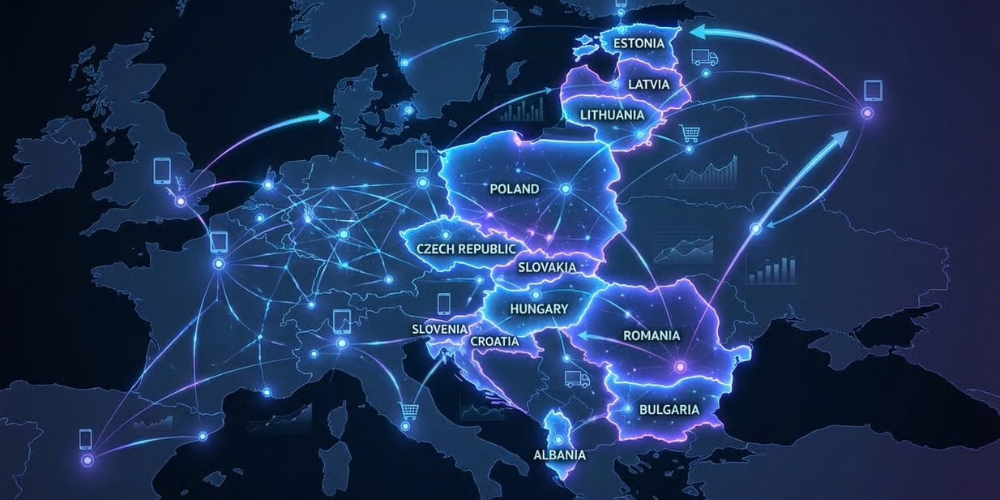
The Central and Eastern European region represents one of the most dynamic opportunities in global digital commerce today, combining the purchasing power of over 120 million consumers with growth trajectories that consistently outpace Western European averages across twelve distinct markets – from the tech-forward Baltic states through established Central European economies to rapidly evolving Southeastern markets and Adriatic frontier nations.
Spanning twelve distinct markets – from the tech-forward Baltic states of Estonia, Latvia, and Lithuania through the established Central European economies of Poland, Czech Republic, Slovakia, and Hungary, down to the rapidly evolving Southeastern markets of Romania and Bulgaria, and extending to the Adriatic frontier nations of Slovenia, Croatia, and Albania – this bloc combines the purchasing power of over 120 million consumers with growth trajectories that consistently outpace Western European averages.
Table of Contents
- Poland, Czech Republic, Slovakia & Hungary – Market maturity and central hubs
- Romania & Bulgaria eCommerce – The high-growth southeastern corridor
- The Baltics & Adriatic Frontiers – Digital pioneers and untapped opportunities
- Emerging markets eCommerce – Infrastructure, OOH delivery, and logistics evolution
- AI-powered personalization reshaping multi-lingual CEE shopping experiences
- Social commerce and regional marketplace dominance in CEE
- Payment innovation: From Cash on Delivery to Open Banking across CEE
- Preparing for success across 12 CEE countries – Strategic recommendations
- Frequently Asked Questions
What makes the CEE region unique for eCommerce growth in 2026?
What makes this region compelling for 2026 is the convergence of transformative factors. Digital infrastructure has matured dramatically, mobile penetration exceeds 90% across most markets, and a generation of digitally native consumers is entering their peak earning years.[1] Unlike saturated Western markets where incremental gains require massive investment, the CEE bloc offers genuine expansion potential with double-digit growth rates still achievable in multiple categories. Eastern Europe recorded 18% eCommerce growth in 2025, the fastest rate in Europe and more than triple the Western European average of 4–5%.[2] The region’s geographic position as a bridge between Western Europe and emerging Eastern markets creates natural logistics advantages, while EU membership for most countries provides regulatory stability and access to common frameworks. A notable structural shift occurred on January 1, 2026, when Bulgaria adopted the euro, further reducing cross-border friction within the bloc.
For businesses evaluating where to deploy resources in 2026, understanding the nuanced differences between these twelve markets – and the common threads that unite them – will determine who captures market share and who watches from the sidelines. This requires robust global eCommerce strategies that account for these regional specificities.
Poland, Czech Republic, Slovakia & Hungary – Market maturity and central hubs
How are established powerhouses leading eCommerce adoption?
The Visegrád Four nations form the commercial backbone of the region, combining market sophistication with scale. Poland stands as the undisputed heavyweight, with its 38–40 million consumers generating online retail revenues that rival some Western European nations. The Polish eCommerce market is projected to reach approximately €50 billion by 2028, growing at 10.48% annually.[3] The Polish market has evolved beyond early adoption into genuine maturity – you’ll find sophisticated omnichannel strategies, advanced fulfillment networks, and consumers who expect the same service levels they’d receive in Germany or France. The dominance of Allegro as a homegrown marketplace champion demonstrates how local platforms can successfully compete against global giants when they understand regional preferences.[4]
- Poland: 38–40 million consumers; Allegro with 21.1M active buyers group-wide (15.2M in Poland), 45–50% market share; eCommerce projected at €50B by 2028
- Czech Republic: Highly educated, affluent consumer base with premium quality preferences; 70% mobile transaction share; central logistics hub positioning
- Slovakia: Euro adoption creating Western Europe-like market behavior with high delivery and service expectations
- Hungary: $4.85B ecommerce market (2025), projected $7.36B by 2030; Budapest serving as regional fulfillment center for Balkan expansion
Czech Republic brings a different value proposition: a highly educated, affluent consumer base with one of the highest internet penetration rates in the entire bloc.[5] Czech shoppers exhibit strong preferences for quality over price, making the market attractive for premium brands. The country’s central location and excellent logistics infrastructure make it an ideal distribution hub for serving neighboring markets. Prague has emerged as a regional tech center, fostering innovation in payment solutions and delivery technologies that often spread to other CEE markets. Notably, Czech payment preferences are evolving – while cash-on-delivery was historically dominant, card and bank transfer payments are steadily gaining ground, especially among mobile-native younger buyers.
Slovakia and Hungary, while smaller in absolute terms, punch above their weight in specific categories. Slovakia’s proximity to Austria and its Euro adoption have created a market that behaves more like Western Europe in many respects, with high expectations for delivery speed and customer service. The Hungarian ecommerce market is valued at $4.85 billion in 2025, projected to grow to $7.36 billion by 2030, with mobile devices accounting for 60.82% of transactions and BNPL growing at a 12.06% CAGR.[6] Budapest serves as a growing fulfillment center for brands looking to serve the Balkans without the complexity of establishing operations in less developed markets.
What unites these four markets is their role as testing grounds for regional expansion. Success here validates your approach before you scale to more challenging markets. They offer established payment infrastructure, reliable logistics partners, and consumer behavior patterns that are well-documented. The cross-border shopping behavior is noteworthy – consumers regularly purchase from neighboring countries when they find better selection or pricing, creating natural expansion pathways for merchants who start in one market and gradually extend their reach across the quartet.
Having a solid foundation in these Central European hubs sets the stage for further expansion. For those looking to master scaling eCommerce across the Balkans & CEE, understanding these initial markets is crucial. Next, we’ll explore the high-growth potential of the Southeastern corridor.
Romania & Bulgaria eCommerce – The high-growth southeastern corridor
What factors are accelerating double-digit eCommerce growth in Romania and Bulgaria?
Romania and Bulgaria represent the growth engines of the CEE bloc, consistently posting expansion rates that make mature markets envious. Romania’s trajectory is impressive – the market has evolved from cash-dominated transactions to sophisticated digital commerce in less than a decade. With 19 million consumers and a young, tech-savvy population concentrated in urban centers like Bucharest, Cluj-Napoca, and Timișoara, Romania offers the rare combination of scale and growth velocity. Romania’s ecommerce sector hit 3.5% of GDP in 2025, ranking 3rd in CEE after Poland and the Czech Republic, with a market projected to reach approximately $9.7 billion by 2029.[7] The success of eMAG, which started as a Romanian marketplace before expanding regionally, demonstrates the market’s capacity to nurture significant digital commerce players – with 56,000+ sellers, 120 million+ monthly visits, and 7.4 million+ active customers.[8]
- Rising Disposable Incomes: Economic growth creating new middle-class consumers with digital purchasing power
- Infrastructure Improvements: Logistics networks expanding from capitals to secondary cities, reducing delivery times; over 60% of Romanian customers in major cities now choose pick-up points or lockers
- Digital-First Generation: 74.3% of internet users (16–74) bought online in 2025; mobile devices account for 73.85% of eCommerce transactions
- Marketplace Trust: eMAG building consumer confidence through reliable service, buyer protection, and regional expansion to Hungary and Bulgaria
What drives Romanian growth is a perfect storm of favorable conditions: rising disposable incomes, improving logistics infrastructure, and a generation that skipped traditional retail entirely in favor of digital channels. Romania is also a major destination market for cross-border deliveries – approximately 95% of international parcels in Romania’s Packeta network originate from other European countries, primarily from Germany, Poland, and the Czech Republic.[9] Romanian consumers show strong preferences for marketplaces over individual brand sites, seeking the security and convenience of established platforms. This creates opportunities for brands willing to work within marketplace ecosystems rather than insisting on direct-to-consumer models that work better in Western markets.
Bulgaria presents a complementary opportunity with its 7 million consumers and strategic position as a gateway to both the Balkans and Turkey. A landmark development for the Bulgarian market is its adoption of the euro on January 1, 2026, which eliminates currency conversion friction for eurozone-based merchants and aligns Bulgaria with the broader EU payment ecosystem. The Bulgarian ecommerce market is valued at $2.9 billion in 2025 and is projected to reach $8.2 billion by 2030, growing at a 23.09% CAGR – with a notable shift from cash-on-delivery toward digital wallets accelerating checkout conversion rates.[10] Bulgarian shoppers demonstrate pragmatic purchasing behavior – they research extensively, compare prices across multiple sites, and show strong responsiveness to promotions and loyalty programs. Sofia’s emergence as a tech outsourcing hub has created a sophisticated consumer segment with high digital expectations and purchasing power.
Both markets share characteristics that distinguish them from their Central European neighbors: higher price sensitivity, stronger preference for cash alternatives in payment methods (Romania’s COD remains at approximately 51% of orders in 2025[9]), and greater importance placed on customer reviews and social proof before purchase. These aren’t limitations – they’re market realities that smart operators leverage. Brands that adapt their pricing strategies, offer flexible payment options, and invest in building trust through transparent policies and responsive customer service consistently outperform those that simply replicate Western European approaches.
While Romania and Bulgaria offer rapid growth, the Baltic and Adriatic regions present unique opportunities for digital innovation and untapped potential. Let’s delve into these diverse markets.
The Baltics & Adriatic Frontiers – Digital pioneers and untapped opportunities
How do the highly digital Baltic states contrast with evolving Adriatic markets?
The Baltic states – Estonia, Latvia, and Lithuania – represent the digital vanguard of the entire region. Estonia’s reputation as a digital society isn’t marketing hyperbole; it’s operational reality. With e-governance, digital identity, and cashless transactions deeply embedded in daily life, Estonian consumers expect seamless digital experiences as baseline requirements. This small market of 1.3 million people serves as an innovation laboratory where new technologies and business models get stress-tested before regional rollout.[11] Latvia and Lithuania, with their combined 4.7 million consumers, share similar digital sophistication while offering slightly larger scale.
| Region | Digital Readiness | Market Characteristics | Strategic Value |
|---|---|---|---|
| Baltic States | Highest in CEE | Early adopters, open banking leaders, cashless-first | Technology validation and trend indication |
| Slovenia | High | Euro adopted, quality preferences, Austria-like behavior | Bridge to Central Europe |
| Croatia | Moderate–High | Euro adopted (Jan 2023), tourism-driven peaks, regional loyalty | Seasonal opportunity and Euro benefits |
| Bulgaria | Moderate (rising) | Euro adopted (Jan 2026), $2.9B market, 23% CAGR to 2030 | Newly accessible eurozone market; gateway to Turkey/Balkans |
| Albania | Developing | Young demographics, rapid growth, non-EU | Frontier market with first-mover advantage |
What makes the Baltics valuable isn’t their size – it’s their role as early adopters and trend indicators. Technologies that gain traction in Tallinn or Vilnius often spread southward through the bloc within 12–18 months. The region’s embrace of open banking, instant payment systems, and sophisticated delivery networks provides a preview of where the entire CEE bloc is heading. For brands testing new approaches to customer experience, personalization, or fulfillment innovation, the Baltics offer a receptive, digitally literate audience that provides high-quality feedback.
The Adriatic markets – Slovenia, Croatia, and Albania – present a different opportunity set. Slovenia, with its 2.1 million consumers and Euro adoption, bridges Central Europe and the Balkans both geographically and commercially. Slovenian consumers exhibit purchasing behavior similar to Austria or Northern Italy, with strong preferences for quality and sustainability. The market’s small size is offset by high per-capita spending and sophisticated logistics infrastructure that makes it an efficient market to serve.
Croatia’s 4 million consumers and stunning Adriatic coastline create unique seasonal dynamics, with tourism-driven peaks that smart operators leverage for customer acquisition. The country’s Euro adoption in January 2023 removed currency risk and simplified pricing strategies. Croatian consumers show strong regional loyalty and respond well to brands that invest in local partnerships and culturally relevant marketing. Albania represents the frontier opportunity – 3 million consumers in a rapidly developing market where early movers can establish dominant positions before competition intensifies. While infrastructure challenges remain, the market’s youth demographics and accelerating digital adoption create compelling long-term potential for patient investors.
Underpinning the growth in all these regions is the rapid evolution of infrastructure and logistics. Let’s examine how these advancements are transforming the CEE eCommerce landscape.

Emerging markets eCommerce – Infrastructure, OOH delivery, and logistics evolution
How are infrastructure improvements enabling seamless cross-border eCommerce expansion?
The logistics revolution transforming the CEE bloc deserves your attention because it’s removing the primary barrier that historically limited regional expansion. The explosive growth of out-of-home delivery networks – particularly automated parcel lockers – has fundamentally changed the economics and customer experience of last-mile delivery. InPost’s network of over 25,000 parcel lockers across Poland alone demonstrates the scale of this transformation – the company handled over one billion parcels in 2024, a 22% increase year-on-year.[12] Similar networks are rapidly expanding across Czech Republic, Romania, and the Baltics. In Romania, eMAG’s Sameday courier operates 8,500+ proximity delivery points across Romania, Hungary, and Bulgaria.
Why parcel lockers are transforming CEE eCommerce
- Solve urban delivery challenges: Dense apartment buildings lack secure delivery locations and working consumers aren’t home during delivery windows
- Provide 24/7 accessibility: Customers can retrieve packages at their convenience, eliminating delivery timing constraints
- Create efficient rural consolidation: In smaller cities where traditional courier networks struggle with economics, lockers provide viable service points
- Reduce merchant costs: Failed delivery costs and return rates decrease while customer satisfaction improves
- Boost conversion rates: In Romania’s major cities, over 60% of customers now choose pick-up points or lockers over home delivery
Beyond lockers, the broader logistics infrastructure has evolved dramatically. Warehouse networks have expanded from capital cities into secondary urban centers, reducing delivery times and costs. Cross-border fulfillment has become genuinely viable, with specialized providers offering pan-CEE distribution from strategic hubs. The integration of real-time tracking, flexible delivery options, and seamless returns processing has reached levels that match or exceed Western European standards in major urban markets.
For your expansion strategy, this infrastructure evolution means you can now serve multiple CEE markets from centralized operations rather than establishing separate logistics in each country. The key is selecting partners who understand regional nuances – delivery expectations in Tallinn differ from those in Sofia, and your logistics strategy needs to flex accordingly while maintaining operational efficiency.
As logistics become more streamlined, AI-powered personalization is emerging as a key differentiator in creating compelling shopping experiences. Let’s explore how AI is reshaping the multi-lingual CEE landscape.
AI-powered personalization reshaping multi-lingual CEE shopping experiences
How are CEE eCommerce businesses implementing AI for localized shopping experiences?
The linguistic diversity of the CEE bloc – twelve countries speaking ten different languages across three language families – historically created massive localization challenges. Artificial intelligence is transforming this complexity from a barrier into a competitive advantage for operators who deploy it effectively. The technology enables you to deliver genuinely personalized experiences at scale across multiple languages without proportionally scaling your content and customer service teams.
- Advanced Product Recommendations: AI analyzes browsing behavior, purchase history, seasonal patterns, and local cultural events to create individualized shopping experiences
- Natural Language Processing: Translation maintains context and cultural nuance rather than producing awkward, literal translations
- Multilingual Customer Service: Chatbots handle inquiries in local languages with 85%+ accuracy rates while escalating complex cases to native speakers
- Semantic Search Understanding: Systems understand intent and surface relevant results even when customers use local terminology that doesn’t directly translate
Modern AI-driven personalization in the region goes far beyond simple product recommendations. Advanced systems now analyze browsing behavior, purchase history, seasonal patterns, and even local cultural events to create individualized shopping experiences that feel native to each market. A Polish customer browsing winter sports equipment sees different product selections, pricing strategies, and promotional messaging than a Bulgarian customer in the same category – not because you’ve manually configured twelve different experiences, but because machine learning algorithms optimize for conversion based on market-specific data. Allegro, for example, reports that AI-powered ads show a 16% larger click-through ratio year-over-year, contributing to a 29% increase in advertising revenue.[4]
The real breakthrough comes in natural language processing capabilities that handle the region’s linguistic complexity. AI-powered translation now maintains context and cultural nuance rather than producing the awkward, literal translations that plagued earlier systems. Customer service chatbots can handle inquiries in local languages with accuracy rates exceeding 85%, resolving common issues without human intervention while seamlessly escalating complex cases to native speakers.[13] This dramatically improves response times and customer satisfaction while controlling support costs as you scale across markets.
Search functionality powered by semantic understanding rather than keyword matching has proven impactful in CEE markets. When a Czech customer searches using local terminology that doesn’t directly translate to your product catalog’s base language, intelligent systems understand intent and surface relevant results. This seemingly technical improvement drives measurable revenue impact – operators implementing advanced search typically see 20–30% increases in search-to-purchase conversion rates.[14]
The strategic implication for 2026 is clear: AI-powered personalization is shifting from competitive advantage to baseline expectation. Consumers increasingly expect experiences that feel locally relevant, and the technology now exists to deliver this at reasonable cost. Your implementation roadmap should prioritize markets where you’re seeing the strongest growth, using AI to accelerate expansion rather than trying to achieve perfect coverage across all twelve markets simultaneously.
In addition to AI-driven personalization, social commerce and the dominance of regional marketplaces are significantly shaping consumer behavior in the CEE region. Let’s examine these trends and their implications for your channel strategy.
Social commerce and regional marketplace dominance in CEE
Which regional marketplaces and social commerce platforms are gaining traction across CEE?
The convergence of social media and commerce is reshaping how consumers discover and purchase products across the CEE region, but the dynamics differ significantly from Western markets. Rather than Instagram and TikTok dominating commerce integration, you’ll find Facebook Marketplace maintaining surprisingly strong traction, particularly in Southeastern markets where it serves as a primary channel for both new and used goods. Understanding these platform preferences and how they intersect with regional marketplace dominance is essential for your channel strategy.
| Platform | Primary Markets | Key Stats (2025) | Key Strengths |
|---|---|---|---|
| Allegro | Poland (+ CZ, SK, HU) | 21.1M active buyers; 45–50% Polish ecommerce market share; €12.8B GMV (2024); 150,000+ merchants | BLIK integration, Smart! loyalty (7M subscribers), Allegro Pay, own parcel lockers |
| eMAG | Romania, Bulgaria, Hungary | 56,000+ sellers; 120M+ monthly visits; 7.4M active customers; RON 5.98B turnover (2023) | Buyer protection, easybox lockers via Sameday, Genius membership, cross-border program |
| Heureka | Czech Republic, Slovakia, Hungary, Romania, Slovenia, Croatia | €1.6B GMV (2024); largest CEE product search engine turned marketplace | Price comparison heritage, cross-border reach, consumer trust |
| Facebook Marketplace | Southeastern CEE | Primary discovery channel in RO, BG, HR | Peer recommendations, local community trust, zero fees |
| Trendyol | Czech Republic, Romania, Greece | Expanding; €57M GMV in Greece (2024) | Turkish fast-fashion, competitive pricing |
Allegro’s position in Poland exemplifies how regional marketplace champions can successfully defend against global competitors. With 21.1 million active buyers across the group (15.2 million in Poland) and an estimated 45–50% share of Polish eCommerce, Allegro isn’t just a shopping platform – it’s where Polish consumers start their product search.[4] The platform’s deep integration with local payment methods like BLIK, its over 7 million Smart! subscribers in Poland, its Allegro Pay fintech service (which financed 15.3% of Polish GMV in Q2 2025), and its understanding of Polish consumer preferences create network effects that make it nearly impossible for competitors to displace. Allegro has also expanded to Czech Republic, Slovakia, and Hungary, reaching 4.2 million active buyers in these markets with GMV growth of 50–80% year-on-year. For brands entering Poland, the question isn’t whether to sell on Allegro, but how to optimize your presence there while building complementary channels.
eMAG plays a similar role across Romania, Bulgaria, and increasingly Hungary. eMAG built its dominance by solving trust issues in markets where consumers were skeptical of online transactions. Its investment in customer service, generous return policies, and reliable delivery through the easybox parcel locker network created a reputation that transcends individual transactions. Romanian consumers often search for products on Google but complete purchases on eMAG because they trust the platform’s buyer protection and fulfillment reliability. This behavior pattern means your SEO strategy needs to account for research happening off-platform while conversion occurs within marketplace ecosystems.
Social commerce integration is evolving differently across the bloc. Baltic consumers show strong engagement with Instagram Shopping and are early adopters of new social commerce features, making these markets ideal for testing social-first strategies. Central European markets demonstrate more conservative adoption, with social platforms serving primarily for discovery and brand building while purchases happen on established ecommerce sites. Southeastern markets show the highest engagement with Facebook-based commerce, including Marketplace and Shop features, reflecting both platform preferences and the importance of peer recommendations in purchase decisions. Romania had 12.9 million social media user identities in late 2025, making social a major channel for product discovery.
Your multi-channel strategy for 2026 should recognize that marketplace dominance and social commerce aren’t competing trends – they’re complementary forces that require integrated approaches. Use social platforms for awareness and consideration, leverage marketplaces for conversion and fulfillment, and maintain owned channels for customer relationship building and data collection. The specific mix will vary by market, but the principle of meeting customers where they naturally shop remains constant.
The final piece of the puzzle is understanding the diverse payment preferences across the CEE region. From cash on delivery to open banking, payment innovation is crucial for driving eCommerce accessibility. Let’s explore this evolving landscape.
Payment innovation: From Cash on Delivery to Open Banking across CEE
What payment innovations are driving eCommerce accessibility across the CEE bloc?
The payment landscape across the CEE bloc tells the story of markets at different stages of digital transformation, creating both challenges and opportunities for merchants who understand how to navigate this complexity. The spectrum runs from Estonia, where cash transactions have nearly disappeared, to parts of Albania where cash on delivery remains the dominant eCommerce payment method. Your payment strategy needs to accommodate this diversity while positioning for the rapid evolution happening across all markets.
CEE payment methods: market-by-market overview (2025–2026)
| Country | Dominant method | Key stats | Merchant action |
|---|---|---|---|
| Poland | BLIK (mobile) | 2.4B transactions (2024); ~20M active users; 50%+ ecommerce share; 1.2% of GDP | BLIK integration essential; BLIK Pay Later for BNPL |
| Romania | COD + cards | COD ≈ 51% of orders (2025); cards 45.6%; BNPL at 11.68% CAGR | COD for acquisition → migrate to cards with incentives |
| Czech Republic | Cards + bank transfers | COD historically ~33%, declining; 70% mobile; Heureka dominant | Cards, bank transfers; COD as option, not priority |
| Hungary | Cards + COD | Cards 51.78%; mobile 60.82%; BNPL 12.06% CAGR | Cards, COD for first purchases, BNPL for electronics |
| Bulgaria | COD → digital wallets | COD penetration 80.3% of stores; EUR adopted Jan 2026; BNPL at 28.5% CAGR | EUR pricing now; COD + digital wallets; sunset BGN |
| Baltics | Digital/open banking | Near-cashless; Lithuania = EU fintech hub | Open banking, Apple/Google Pay, cards |
How merchants balance traditional and digital payment methods
- Accept cash on delivery as customer acquisition tool: Use higher-cost COD for first-time purchases in Southeastern markets, then migrate customers to digital payments through incentives
- Implement essential local payment methods: BLIK in Poland (non-negotiable – 50%+ of eCommerce), installment options via PayU across multiple markets, open banking solutions in the Baltics
- Leverage buy now, pay later services: Increase average order values by 20–40% in electronics and home goods categories through installment options like Allegro Pay, Twisto, and BLIK Pay Later
- Monitor adoption trends closely: Payment preferences shift faster than other consumer behaviors, requiring agile implementation strategies
- Optimize for mobile payments: Apple Pay and Google Pay adoption accelerating across all markets, particularly among younger demographics; mobile accounts for 60–74% of transactions across the region
Cash on delivery persists in Southeastern markets not because consumers lack access to digital payment methods, but because trust in online transactions is still building. Romanian consumers who happily use debit cards at physical stores often prefer cash on delivery for online purchases, particularly for first-time transactions with unfamiliar merchants – COD remains at approximately 51% of total Romanian online orders as of 2025.[9] Rather than viewing this as a limitation, successful operators treat it as a customer acquisition tool – accepting the higher costs and logistics complexity of cash on delivery for initial purchases, then using excellent service and targeted incentives to migrate customers toward digital payment methods for repeat purchases.
The rise of buy now, pay later services is reshaping purchasing behavior across all CEE markets, but particularly in Central Europe where consumer credit is more established. Services like Twisto in Czech Republic and PayU’s installment options across multiple markets remove price barriers for higher-value purchases while maintaining healthy conversion rates. Allegro Pay originated PLN 2.8 billion (approximately $745 million) in loans in Q1 2025 alone, financing 15.3% of Polish GMV.[4] The data shows that offering installment options can increase average order values by 20–40% in categories like electronics and home goods, making the transaction fees worthwhile for merchants with appropriate margins.
Poland’s BLIK system deserves special attention as a case study in successful local payment innovation. With nearly 20 million active users and over 2.4 billion transactions in 2024, BLIK enables instant bank transfers using a six-digit code generated in banking apps. Its market share in Polish e-commerce exceeds 50%, and by some estimates approaches 70%. Poles make approximately three times more online payments with BLIK than with cards.[15] BLIK’s contribution to the Polish economy is substantial – an EY report estimated it supported the generation of 1.2% of Poland’s GDP in 2024.[16]For merchants operating in Poland, BLIK integration isn’t optional – it’s essential for optimizing conversion rates, particularly among younger consumers who’ve adopted it as their primary payment method.
Bulgaria’s euro adoption on January 1, 2026, represents a significant practical shift for the payment landscape. Merchants already selling in eurozone countries can now reach Bulgarian consumers without supporting the Bulgarian lev (BGN), simplifying checkout and pricing. Bulgaria’s BNPL segment is growing at a 28.5% CAGR through 2030, the fastest of any payment type in the country.[10] Combined with the shift from COD toward digital wallets, Bulgaria’s payment ecosystem is evolving rapidly.
Open banking initiatives are gaining momentum across the region, enabled by EU payment services directives that require banks to provide third-party access to customer accounts. This technology enables account-to-account payments that bypass card networks, reducing transaction costs while improving security. The Baltics are leading adoption, with Lithuania positioning itself as a European fintech hub and Estonian consumers readily embracing open banking-powered payment solutions. As this technology matures and spreads southward through the bloc, it will fundamentally reshape payment economics and customer experience.
Your payment strategy for 2026 should prioritize flexibility and localization. Implement core methods that work across markets – major card networks, PayPal, and increasingly Apple Pay and Google Pay. Layer in essential local methods for your priority markets – BLIK in Poland, cash on delivery in Romania and Bulgaria, and emerging open banking solutions in the Baltics. Monitor adoption trends closely, because payment preferences shift faster than most other consumer behaviors, and being early to support emerging methods creates competitive advantage.
With a comprehensive understanding of the CEE region’s diverse markets, infrastructure, personalization trends, social commerce dynamics, and payment innovations, let’s outline some strategic recommendations for achieving success across these twelve countries.
Preparing for success across 12 CEE countries – Strategic recommendations
What actionable steps should businesses take to successfully navigate the CEE landscape?
Successfully navigating the twelve-country CEE bloc requires a strategic framework that balances standardization with localization, ultimately helping businesses unlock global market access and international business expansion. Start by segmenting markets into tiers based on your specific business model and resources. Tier one typically includes Polandand Czech Republic for their scale and infrastructure maturity. Tier two encompasses Romania, Hungary, and potentially the Baltics depending on your product category. Tier three includes the remaining markets, which you approach opportunistically as resources allow and market conditions warrant.
Essential steps for CEE market entry and scaling
- Implement tiered market segmentation: Prioritize Poland and Czech Republic as tier one markets, followed by Romania, Hungary, and select Baltic states based on your product category
- Build scalable localization capabilities: Create ongoing optimization processes based on market feedback rather than one-time translation projects
- Select pan-regional partners: Choose logistics providers, payment processors, and marketing agencies with genuine multi-market expertise and capabilities
- Deploy multi-market technology stack: Prioritize platforms that handle multiple languages, currencies, and tax regimes natively without separate implementations
- Commit to long-term investment: Focus on building brand awareness systematically with realistic payback expectations rather than opportunistic market entry
Localization goes far beyond translation. You need local payment methods, culturally appropriate imagery, market-specific pricing strategies that account for purchasing power differences, and customer service capabilities in local languages. The mistake many operators make is treating localization as a one-time project rather than an ongoing process of optimization based on market feedback and performance data. Build localization capabilities that can scale as you expand rather than creating custom solutions for each market that become impossible to maintain.
Partnership strategy is critical in this region. Identify logistics providers with pan-regional capabilities, payment processors who understand local methods, and marketing agencies with genuine market expertise rather than just language capabilities. The right partners accelerate your learning curve and help you avoid expensive mistakes that come from misunderstanding local market dynamics. Invest time in partner selection – the cost of switching providers after you’ve scaled is far higher than getting it right initially.
Your technology stack needs to support multi-market operations without requiring separate implementations for each country. Prioritize platforms and tools that handle multiple languages, currencies (noting that with Bulgaria’s euro adoption, the CEE region now uses five currencies: EUR, PLN, CZK, HUF, and RON), and tax regimes natively. Build data infrastructure that gives you visibility across markets while enabling market-specific analysis. The goal is operational efficiency that lets you manage twelve markets without requiring twelve times the resources.
Commit to the region for the long term. The CEE bloc rewards patient, consistent investment rather than opportunistic market entry and exit. Build brand awareness systematically, invest in customer acquisition with realistic payback expectations, and focus on creating excellent experiences that generate word-of-mouth and repeat purchases. The markets are still developing, which means early movers who execute well can establish positions that become difficult for later entrants to challenge.
Frequently Asked Questions
Which CEE market should I enter first for eCommerce expansion?
Poland offers the best combination of scale, infrastructure maturity, and growth potential for most businesses. With 38–40 million consumers, Allegro’s 21.1 million active buyers, established logistics networks (including InPost’s 25,000+ parcel lockers), and a sophisticated digital commerce ecosystem, it provides the volume needed to justify localization investments while offering a relatively forgiving environment for learning regional dynamics. Czech Republic works well as a second market, particularly for premium products.
How much should I budget for localization per CEE market?
Plan for €15,000–30,000 in initial localization costs per market, covering translation, payment integration, legal compliance, and market-specific platform configuration. Ongoing costs run 10–15% of revenue for customer service, content updates, and local marketing. These figures scale down as you develop reusable assets and processes across markets.
Do I need separate legal entities in each CEE country?
Not necessarily. Many operators successfully serve multiple CEE markets from a single EU entity, typically established in Poland or Czech Republic. However, you’ll need local VAT registration in markets where you exceed distance selling thresholds or store inventory locally. The EU’s One-Stop Shop (OSS) simplifies VAT reporting across member states. Consult with a tax advisor familiar with EU cross-border commerce regulations to optimize your structure.
What conversion rates should I expect in CEE markets?
Mature markets like Poland and Czech Republic typically see conversion rates of 2–3% for new traffic, comparable to Western Europe. Emerging markets like Romania and Bulgaria often start lower at 1–2% but improve rapidly as you optimize for local preferences. Mobile conversion rates run 20–30% below desktop across the region, making mobile optimization critical – especially given that mobile accounts for 60–74% of transactions.
How important is marketplace presence versus owned channels in CEE?
In Poland, Romania, and Bulgaria, marketplace presence is essential – these platforms drive 40–60% of online retail volume. Allegro holds 45–50% of Polish ecommerce; eMAG dominates Romania, Bulgaria, and Hungary. In other markets, the balance shifts more toward owned channels, but marketplace presence still provides valuable customer acquisition and credibility. Plan for a hybrid strategy that leverages marketplaces for reach while building owned channels for customer relationships and margin protection.
What delivery timeframes do CEE consumers expect?
Urban consumers in major cities expect 1–2 day delivery as standard, with same-day options increasingly common in capitals. Secondary cities and rural areas accept 2–4 day delivery. The key is setting accurate expectations and meeting them consistently – reliability matters more than speed. Offering parcel locker delivery significantly improves satisfaction by giving customers control over pickup timing. In Romania, over 60% of urban customers already prefer lockers/pick-up points over home delivery.
What changed with Bulgaria adopting the euro in January 2026?
Bulgaria adopted the euro on January 1, 2026, replacing the Bulgarian lev (BGN). For eCommerce merchants, this means: no more BGN currency support needed in checkout, simplified pricing for eurozone-based businesses, reduced payment processing complexity, and easier VAT reporting through OSS. The Bulgarian eCommerce market is projected to grow from $2.9 billion (2025) to $8.2 billion by 2030. With BNPL growing at 28.5% CAGR and a shift from COD to digital wallets, Bulgaria is increasingly accessible for cross-border expansion.
What marketing channels deliver the best ROI in CEE markets?
Google Shopping and search ads consistently deliver strong ROI across all markets, with CPCs 30–50% lower than Western Europe. Facebook and Instagram work well for awareness and consideration, particularly in younger demographics. Marketplace advertising (Allegro Ads, eMAG Ads) drives efficient conversion in markets where these platforms dominate – Allegro’s advertising revenue grew 30% year-on-year in 2025. Email marketing shows surprisingly strong engagement, particularly in Central European markets.
How do I handle customer service across multiple CEE languages?
Start with email support in local languages using native speakers or high-quality translation services with native review. Add chatbots for common inquiries as volume grows – AI-powered chatbots now handle 85%+ of routine inquiries accurately in local languages. For phone support, consider outsourcing to regional contact centers that provide multi-language capabilities. Most operators find that 70–80% of inquiries can be handled through automated or email channels, making phone support optional in early stages.
How long does it take to achieve profitability in a new CEE market?
Plan for 12–18 months to market-level profitability in established markets like Poland or Czech Republic, 18–24 months in developing markets like Romania or Bulgaria. Focus on market-specific metrics: customer acquisition cost by country, repeat purchase rates, average order value, and contribution margin after local costs. Track operational metrics like delivery success rates, return rates, and customer service inquiry volume by market. Allegro’s own international expansions target break-even within four years of launch.
Seize the CEE eCommerce opportunity in 2026
The CEE region presents a lucrative, yet complex, landscape for eCommerce businesses. With Eastern Europe growing at 18% – triple the Western European rate – and structural shifts like Bulgaria’s euro adoption making cross-border expansion increasingly accessible, the window for strategic entry is open. Allegro’s 21 million active buyers in Poland, eMAG’s regional dominance in Romania and Bulgaria, BLIK’s 2.4 billion annual transactions, and InPost’s 25,000+ parcel lockers demonstrate that the infrastructure for scale is already in place. By understanding the nuances of each market, leveraging technological advancements like AI-powered localization, and implementing market-specific payment and logistics strategies, you can unlock significant growth potential across twelve countries and 120 million consumers.
References
- Global outlook: predictions for eCommerce in 2026 – eCommerce Germany News, Dec 2025. Mobile penetration, Latin America at 12.4% growth, marketplace dominance at 87% of global eCommerce revenues.
- European eCommerce Report 2025 – eCommerce Europe & EuroCommerce. Eastern Europe recorded 18% nominal growth, the fastest in Europe. Total European eCommerce turnover: €842 billion.
- European eCommerce Overview: Poland – eCommerce Germany News. Market projected at €50B by 2028; InPost 25,000+ lockers; 72,000 registered online stores.
- Allegro explained: 150,000+ merchants – eCommerce Germany News, Dec 2025. 21.1M active buyers; 45–50% Polish market share; Allegro Pay 15.3% of GMV; Ad revenue +30% YoY; AI ads +16% CTR.
- European eCommerce Overview: Czech Republic – eCommerce Germany News, Dec 2025. COD declining; 70% mobile transactions; cards and bank transfers gaining ground.
- Hungary eCommerce Market – Mordor Intelligence 2025. Market $4.85B (2025), projected $7.36B by 2030. Mobile 60.82%; cards 51.78%; BNPL 12.06% CAGR.
- European eCommerce Overview: Romania – eCommerce Germany News. eCommerce = 3.5% of GDP; 74.3% online shopping rate; mobile 73.85%; COD ~51%.
- Romania’s peak eCommerce season 2025 – Business Review. eMAG: 56,000+ sellers, 120M+ monthly visits. Packeta: 95% of international parcels to Romania from other EU countries.
- Romania COD & cross-border data – Business Review, Dec 2025. COD ≈ 51% of orders; 60%+ urban customers choose pick-up points or lockers.
- Bulgaria eCommerce Market – Mordor Intelligence 2025. $2.90B (2025), projected $8.21B by 2030 (23.09% CAGR). BNPL at 28.5% CAGR. Shift from COD to digital wallets.
- e-Estonia – Digital Society. Estonia’s e-governance, digital identity, and cashless transaction infrastructure.
- InPost parcel lockers – via eCommerce Germany News Poland overview. 25,000+ lockers across Poland; 1+ billion parcels handled in 2024 (+22% YoY).
- AI in eCommerce trends 2025 – eCommerce Germany News. Multilingual chatbot accuracy 85%+; AI-powered personalization driving conversion improvements.
- Semantic search conversion impact – Algolia. Advanced search implementation driving 20–30% increases in search-to-purchase conversion.
- BLIK Q3 2025 statistics – BLIK official. 743.9M transactions in Q3 2025; 19.9M active users; 8M payments/day average; record 11M in single day.
- BLIK economic impact – BLIK/EY Report, March 2025. 2.4B transactions (2024); 50%+ ecommerce share; 1.2% of Poland’s GDP; projected 2.1% by 2027.