

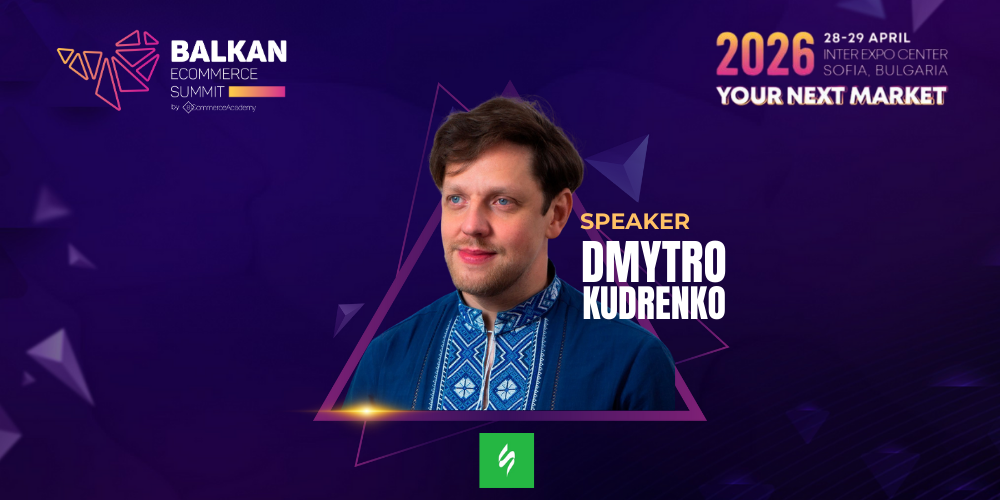
Dmytro Kudrenko brings two decades of engineering thinking into marketing execution, with 25+ years in software development and 15+ years in email marketing founding Stripo, Claspo, and Ardas. Their focus is not “fun for fun’s sake,” but building interactive email experiences that increase engagement in a measurable way and stay reliable across real-world email client limitations as well as pop-ups and other SaaS solutions.
In this interview, Dmytro breaks down how email gamification connects directly to revenue, the most common mistakes brands make when trying to “make emails more engaging,” and how Lean thinking helps teams test faster and scale what works. You will also get a preview of what attendees can expect from Dmytro’s session at Balkan eCommerce Summit in Sofia on April 28–29.
You’ll be joining Balkan eCommerce Summit in Sofia on April 28–29. What can attendees expect to learn from your session on Email Gamification in eCommerce?
My session is very practical. I’ll show real email gamification campaigns, the kind that can genuinely change your perception of what’s even possible inside an email. And I’ll show how many of those experiences can be built without deep technical knowledge.
Attendees will learn how to choose the right game mechanic for a specific eCommerce goal (sales, data collection, retention, reactivation), which mechanics work best in email (from luck & chance to quizzes, puzzles, and challenges), and how to implement gamification in a way that stays reliable across email clients, using a progressive approach: interactive where possible, and smart fallbacks where it isn’t.
Gamification in email marketing sounds creative. How does it translate into measurable revenue growth for eCommerce brands?
For me, gamification isn’t “fun for fun’s sake.” It’s a measurable way to increase interaction, and interaction turns into clicks, conversions, and revenue.
In eCommerce the chain is pretty direct: a good game mechanic gives people a reason to take action inside the email instead of scrolling past another promotion. That action increases click-through, improves conversion, and can lift average order value because the customer is more engaged and more willing to complete the journey.
With 25+ years in software development and 15+ years in email marketing, what common mistakes do brands make when trying to “make emails more engaging”?
I see three classic mistakes.
First, brands confuse decoration with gamification. A wheel or a scratch card is not a strategy by itself. Real gamification has a clear goal, simple rules, and immediate feedback. Without that, it’s just a visual gimmick.
Second, they overcomplicate it. Email is not a gaming console. The best gamified emails are short, focused, and designed around one action.
Third, they ignore email client reality. If an interactive element only works in one environment, it will frustrate a big part of the audience. Email gamification should be designed with progressive enhancement and fallbacks from the start.
You are a strong advocate of Lean principles. How does Lean thinking apply to email gamification and marketing automation?
Lean thinking is simple: reduce waste, learn faster, scale what works.
Applied to gamification, it means you don’t start with a big creative masterpiece. You start with a small measurable gamified MVP, validate the impact, then scale it through repeatable modules and patterns instead of one-off creative stunts.
Gamification becomes even more powerful when it’s not a one-time trick, but part of automation: welcome flows, retention, reactivation, seasonal campaigns. That’s where you reuse proven mechanics and keep improving them incrementally.
For eCommerce teams with limited technical resources, how can they implement gamified email campaigns without complex development?
This is one of the biggest myths: that gamification requires heavy development.
Many mechanics can be implemented with smart structure, copy, and design. And when you do want real interactivity, the right approach is progressive: interactive experiences where supported, plus safe fallbacks (and a web version if needed) so nobody is left behind.
At Stripo, we’ve been focused on making this accessible. Marketers can launch interactive gamified modules without deep technical knowledge, while still keeping campaigns reliable across email clients.
Why should eCommerce professionals attend Balkan eCommerce Summit this April in Sofia? What makes live industry events strategically important today?
We’re drowning in online content. But what’s missing is context, and honest conversations about what actually works.
Live industry events are strategically important because they compress learning. You see real examples, ask direct questions, compare approaches with peers, and leave with decisions you can implement. For eCommerce teams, that speed matters. The winners are usually the teams that test faster, learn faster, and scale faster.
Meet Dmytro at Balkan eCommerce Summit 2026
If you want practical examples of email gamification that work in the real world, plus frameworks for testing and scaling engagement without overengineering, connect with Dmytro on-site.
🎟️ Grab your ticket at balkanecommerce.com and be part of building stronger connections across the Balkans.