


Most eCommerce businesses focus on acquiring new customers, but the real leverage lies in retaining the ones you already have. Customer retention isn’t just about repeat purchases; it’s about building lasting relationships that drive revenue, reduce marketing costs, and create brand advocates. This guide provides field-tested strategies to maximize customer lifetime value and minimize churn, turning your existing customer base into a growth engine.
Table of Contents
- Understanding eCommerce customer retention and its impact on business growth
- Customer lifetime value – The foundation of retention strategy
- Customer loyalty programs that drive repeat purchases
- Creating personalized customer experiences across touchpoints
- Email marketing retention strategies for ongoing engagement
- Optimizing the customer onboarding process for long-term retention
- Proactive customer churn reduction techniques
- Measuring and optimizing retention performance
- Building a comprehensive retention strategy framework
- Frequently Asked Questions
Understanding eCommerce customer retention and its impact on business growth
What is eCommerce customer retention?
Customer retention in eCommerce refers to your ability to keep customers coming back for repeat purchases over time. It’s measured by tracking how many customers make additional purchases within specific timeframes, typically 30, 60, or 90 days after their initial transaction. But retention goes beyond just repeat purchases – it encompasses the entire relationship you build with customers that keeps them engaged with your brand.
Here’s a reality check that might surprise you: acquiring a new customer costs 5 to 25 times more than keeping an existing one.[1] Yet most eCommerce businesses still pour 80% of their marketing budget into acquisition while their existing customers quietly slip away.
Why customer retention matters more than acquisition
- Revenue Growth: Companies with strong retention strategies see 2.5 times higher revenue growth compared to those focused solely on acquisition.[2]
- Increased Spending: Retained customers spend 67% more in their third year with a brand compared to their first year.[3]
- Profit Impact: Improving your retention rate by just 5% can increase profits by 25% to 95%.[4]
- Lower Marketing Costs: Retained customers require less marketing spend to convert and often become brand advocates who drive organic growth through referrals.
The impact on business growth is dramatic. When you retain customers effectively, you’re not just maintaining revenue – you’re amplifying it. That’s because retained customers have higher average order values, require less marketing spend to convert, and often become brand advocates who drive organic growth through referrals.
The shift from acquisition-focused to retention-focused thinking represents a fundamental change in how you view your business model. Instead of constantly filling a leaky bucket with new customers, you’re building a sustainable engine that compounds growth over time. This approach creates predictable revenue streams, improves cash flow, and builds the kind of customer relationships that weather competitive pressures and market fluctuations, especially as eCommerce trends are changing across various regions.
I’ve seen businesses transform their economics by making this shift. One mid-sized apparel retailer I worked with reduced their customer acquisition cost by 40% simply by reallocating budget toward retention initiatives. Their existing customers became their best acquisition channel through word-of-mouth referrals, creating a virtuous cycle that accelerated growth while improving margins.
Now that you understand the power of retention, let’s dive into how to quantify its value and use that to drive your strategy.
Customer lifetime value – The foundation of retention strategy
How to calculate customer lifetime value
Customer lifetime value serves as your North Star for retention investment decisions. Without understanding CLV, you’re essentially flying blind – spending money on retention tactics without knowing if they’ll generate positive returns.
The basic CLV calculation is straightforward: Average Order Value × Purchase Frequency × Customer Lifespan. The real power comes from using CLV to segment customers and allocate retention resources strategically. Your high-value customers deserve different treatment than one-time bargain hunters.

Steps to calculate and apply CLV effectively
- Analyze historical data: Review customer data over the past 12-24 months to identify patterns in purchasing behavior.
- Calculate average order value: Determine the average amount customers spend per transaction across all customers.
- Determine purchase frequency: Calculate how often customers purchase within specific timeframes (monthly, quarterly, annually).
- Identify customer lifespan: Track how long customers remain active before churning by analyzing when they stop making purchases.
- Apply the formula: Multiply average order value by purchase frequency by customer lifespan to get your CLV.
- Create customer tiers: Use CLV to segment customers and allocate retention investments strategically.
For example, if your average order value is $75, customers purchase 4 times per year, and the average customer stays active for 3 years, your CLV is $900. This means you can justify spending up to $900 on retention activities for each customer while maintaining profitability – though you’ll want to target a much lower cost to ensure healthy margins.
Use CLV to create customer tiers that guide your retention investments. Customers with CLV above $500 might receive personalized outreach and premium support, while those between $200-$500 get automated email sequences and standard loyalty rewards. This tiered approach ensures you’re investing retention dollars where they’ll generate the highest returns.
The key insight is that increasing repeat purchase rates has a compounding effect on CLV. When you move a customer from purchasing twice per year to three times per year, you’re not just adding one transaction – you’re potentially adding multiple years of additional purchases. This is why even small improvements in retention can create massive increases in overall business value.
Track CLV trends monthly to identify whether your retention efforts are working. Rising CLV indicates successful retention strategies, while declining CLV signals the need for immediate intervention. Use this data to justify retentioninvestments to stakeholders and guide strategic decisions about customer acquisition costs and retention spending.
One beauty brand I consulted for discovered their top 10% of customers generated 45% of total revenue. By creating a VIP program specifically for this segment, they increased the average CLV of these customers from $850 to $1,240 within eight months. The program cost less than $50 per customer to operate, delivering a 780% return on investment.
With a solid understanding of CLV, you can now design loyalty programs that truly resonate with your customers and drive repeat purchases.
Customer loyalty programs that drive repeat purchases
What makes loyalty programs effective?
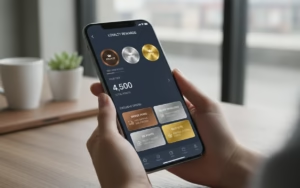
Loyalty programs work when they’re designed around customer psychology, not just discounts. The most effective programs tap into three core motivations: progress (moving toward a goal), exclusivity (feeling special), and value (getting more than expected). Generic point systems that offer 1% cash back rarely create the emotional connection needed for true loyalty.
How to structure loyalty programs for maximum engagement
- Research customer preferences: Conduct surveys and analyze purchase behavior to identify whether your audience prefers immediate gratification (instant discounts) or delayed rewards (points toward larger benefits).
- Design tiered structures: Create clear, achievable milestones that encourage customers to reach the next level using loss aversion and status psychology.
- Differentiate tier benefits: Provide meaningful differences between tiers, such as Bronze members getting 5% back, Silver members getting 8% plus free shipping, and Gold members getting 12% plus exclusive products and priority support.
- Integrate technology systems: Connect your loyalty program with email marketing platforms, customer service systems, and analytics tools for seamless customer experiences.
- Customize for business model: Adapt programs for subscription businesses by focusing on usage-based rewards that encourage deeper platform engagement rather than traditional point systems.
The foundation of any successful loyalty program is understanding what your customers actually value. B2B customers often value exclusive access to new products or educational content, while B2C customers might prefer experiential rewards or early access to sales.
I worked with a home goods retailer who restructured their flat loyalty program into three tiers. Within six months, 34% of Bronze members had upgraded to Silver, and their average order value increased by 28%. The psychological pull of reaching the next tier drove customers to consolidate purchases and shop more frequently.
Subscription-based businesses need specialized retention approaches within their loyalty frameworks. Instead of traditional point systems, focus on usage-based rewards that encourage deeper engagement with your platform. Offer bonus features, extended trial periods for premium services, or exclusive content that increases switching costs and creates habit formation.
| Program Type | Best For | Key Benefits | Implementation Complexity |
|---|---|---|---|
| Points-Based | High-frequency purchases | Simple to understand, flexible redemption | Low |
| Tiered Membership | Diverse customer segments | Status motivation, progressive rewards | Medium |
| Paid VIP Programs | High-value customers | Immediate benefits, exclusivity | Medium |
| Experiential Rewards | Lifestyle brands | Emotional connection, social sharing | High |
Technology integration makes or breaks loyalty program success. Your program should seamlessly connect with your email marketing platform, customer service system, and analytics tools. Customers should see their point balances and tier status throughout their shopping experience, and your team should have real-time access to loyalty data during customer interactions.
Measure program success through engagement metrics, not just enrollment numbers. Track active participation rates, redemption frequency, and the incremental lift in purchase behavior among program members versus non-members. Successful programs typically see 15-25% higher purchase frequency among active members, with the top-performing programs achieving 40%+ increases in customer lifetime value.
Beyond loyalty programs, personalization is key to making customers feel valued and understood. Let’s explore how to create personalized customer experiences across all touchpoints.
Creating personalized customer experiences across touchpoints
How to deliver personalized customer experiences
Personalization at scale requires moving beyond basic demographic segmentation to behavioral and predictive modeling. The goal isn’t just to use someone’s first name in emails – it’s to anticipate their needs and deliver relevant experiences that feel individually crafted.
- Develop comprehensive data collection: Track browsing behavior, purchase history, email engagement, customer service interactions, and social media activity across all customer touchpoints.
- Implement dynamic content systems: Create website experiences that show different product recommendations, promotional offers, and content based on individual customer profiles.
- Design progressive onboarding: Use interactive quizzes or preference centers to gather customer data gradually rather than overwhelming new customers with lengthy forms.
- Ensure cross-channel consistency: Make sure customers see related recommendations when they move between mobile and desktop, and that email campaigns reflect recent website activity.
- Deploy predictive personalization: Use machine learning algorithms to identify patterns that predict future purchases, churn risk, or support needs.
Start with data collection strategy across all customer touchpoints. Be transparent about data collection and provide clear value in exchange for customer information.
The onboarding process sets the foundation for long-term personalization success. Ask about communication preferences, product interests, and shopping motivations through interactive quizzes or preference centers that feel engaging rather than intrusive.
Cross-channel consistency ensures personalization doesn’t feel disjointed. A customer who browses products on mobile should see related recommendations when they visit your website on desktop. Email campaigns should reflect recent website activity, and customer service representatives should understand the customer’s journey across all touchpoints.
Predictive personalization takes customer experience to the next level by anticipating needs before customers express them. This approach, alongside flexibility, AI, and sustainability, are key ways to transform your eCommerce business. Send proactive communications about reorder timing, suggest complementary products, or offer assistance before customers encounter problems.
A pet supply company I advised implemented predictive reorder reminders based on typical consumption patterns for different products. Dog food buyers received reminders 5 days before they’d likely run out, while supplement customers got reminders based on bottle sizes and dosage. This simple personalization increased repeat purchase rates by 31% and reduced customer service inquiries about reordering by 22%.
Measure personalization effectiveness through engagement lift and conversion improvements. Track how personalized customer experiences perform compared to generic alternatives across email open rates, click-through rates, conversion rates, and average order values. Successfulpersonalizationtypically improves email engagement by 20-30% and increases conversion rates by 10-15%.
One of the most effective channels for delivering personalized customer experiences is email. Let’s explore how to use email marketing to foster ongoing engagement and drive retention.
Email marketing retention strategies for ongoing engagement
Email marketing tactics for customer retention
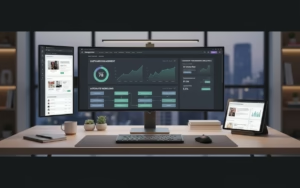
Email remains the highest ROI channel for customer retention, generating $36 for every dollar spent when executed strategically.[5] The key is shifting from promotional broadcasts to value-driven relationship building that keeps your brand top-of-mind between purchases.
Best practices for email retention campaigns
- Automated Sequences: Develop behavior-triggered emails including welcome series, post-purchase follow-ups, re-engagement campaigns, and win back customers sequences for consistent communication.
- Strategic Segmentation: Create segments based on purchase behavior, engagement levels, customer lifetime value, and lifecycle stage to deliver relevant messaging.
- Content Variety: Mix promotional emails with educational content, behind-the-scenes stories, customer spotlights, and industry insights using the 80/20 rule (80% value-driven content, 20% direct promotions).
- Win-Back Campaigns: Target customers who haven’t purchased recently with a series of increasingly compelling offers over 30-60 days, including feedback surveys to understand churn reasons.
- Timing Optimization: Analyze customer data to identify optimal send times for different segments, potentially improving email performance by 20-30%.
Develop automated email sequences triggered by customer behavior rather than relying solely on scheduled campaigns. These automated touchpoints ensure consistent communication without overwhelming your team or customers.
Segmentation drives email performance more than any other factor. High-value customers should receive exclusive offers and early access to new products, while at-risk customers need re-engagement campaigns with compelling incentives to return.
Content variety keeps subscribers engaged over time. This approach builds trust and positions your brand as a valuable resource rather than just another sales channel.
Win-back campaigns target customers who haven’t purchased recently but haven’t unsubscribed from your emails. Create a series of increasingly compelling offers over 30-60 days, starting with gentle reminders and escalating to significant discounts or exclusive products. Include feedback surveys to understand why customers stopped purchasing and address common concerns.
One electronics retailer I worked with discovered their customers fell into three distinct engagement patterns: morning browsers (6-9 AM), lunch scrollers (11 AM-1 PM), and evening shoppers (7-10 PM). By segmenting their list and sending at these times, they increased email revenue by 43% without changing any content or offers.
The customer journey begins the moment someone makes a purchase. Let’s look at how to optimize the customer onboarding process to set the stage for long-term retention.
Optimizing the customer onboarding process for long-term retention
How to structure customer onboarding for retention
The first 30 days after purchase determine whether customers become loyal advocates or one-time buyers. Effective onboarding creates early wins that build confidence in their purchase decision while setting expectations for ongoing value.
- Map the complete customer journey: Identify potential friction points, questions customers might have, and opportunities to demonstrate additional value from purchase confirmation through first repeat purchase.
- Create milestone-based communication: Celebrate customer progress and encourage continued engagement through delivery notifications, unboxing tips, setup guides, and usage tutorials for physical products.
- Provide educational content: Build product confidence and increase usage frequency with tutorials, best practices, and creative use cases that help customers maximize value from their purchase.
- Implement proactive support: Monitor customer behavior for signs of confusion or disengagement, then reach out with helpful resources or personal assistance.
- Measure onboarding success: Track email open rates, tutorial completion, support ticket volume, and time to second purchase to optimize the process.
Your onboarding sequence should address these proactively rather than waiting for customers to reach out with problems.
For physical products, this might include delivery notifications, unboxing tips, setup guides, and usage tutorials. For digital products, focus on feature adoption, achievement recognition, and advanced functionality introduction.
Educational content during onboarding builds product confidence and increases usage frequency. Customers who fully understand product capabilities are more likely to become repeat purchasers and brand advocates.
Proactive support during onboarding prevents early churn. This might include follow-up calls for high-value purchases, chat support for complex products, or educational email series for new customer segments.
A skincare brand I consulted for implemented a 14-day onboarding sequence that included product usage tips, skin health education, and progress check-ins. Customers who completed the full sequence had a 68% repeat purchase rate within 90 days, compared to 23% for customers who only received transactional emails.
Successful onboarding typically results in 60%+ email engagement rates and 25-40% repeat purchase rates within 90 days.
Despite your best efforts, some customers will inevitably churn. The key is to identify those at risk and intervene proactively. Here’s how.
Proactive customer churn reduction techniques
How to identify and prevent customer churn
Preventing churn requires identifying at-risk customers before they decide to leave and intervening with targeted retention efforts. The most effective approach combines predictive analytics with human touchpoints to address customer concerns proactively.
- Develop churn prediction models: Use customer behavior data including declining purchase frequency, reduced email engagement, increased support tickets, and changes in order patterns to create scoring systems.
- Implement automated triggers: Activate retention campaigns when customers exhibit at-risk behavior through special offers, re-engagement emails, or proactive support outreach.
- Create personalized retention offers: Analyze individual customer preferences and purchase history to create compelling win back customers incentives rather than generic discounts.
- Collect exit feedback: Use surveys and follow-up calls to understand churn reasons and address systemic issues that cause future churn.
- Track intervention success rates: Monitor which retention tactics work best for different customer segments and risk levels to continuously refine your approach.
Key indicators include declining purchase frequency, reduced email engagement, increased support tickets, and changes in order patterns. Create scoring systems that flag customers when multiple risk factors align, enabling early intervention before churn occurs.
Implement automated triggers that activate retention campaigns when customers exhibit at-risk behavior. This might include special offers for customers who haven’t purchased in their typical timeframe, re-engagement emails for declining email engagement, or proactive support outreach for customers with recent service issues.
Personalized retention offers work better than generic discounts. A customer who typically buys premium products might respond better to exclusive access than price discounts, while price-sensitive customers need compelling financial incentives.
Exit surveys and feedback collection provide insights into churn reasons that inform broader retention strategies. When customers do churn, understand why through brief surveys or follow-up calls. Common reasons include pricing concerns, product dissatisfaction, poor customer service, or competitive alternatives. Address systemic issues to prevent future churn.
| Churn Risk Level | Intervention Strategy | Timeline | Success Rate |
|---|---|---|---|
| Low Risk | Automated email nurturing | 30-60 days | 70-80% |
| Medium Risk | Personalized offers + outreach | 14-30 days | 40-60% |
| High Risk | Direct contact + premium incentives | 7-14 days | 20-40% |
| Critical Risk | Executive intervention + custom solutions | 1-7 days | 10-30% |
Successful churn reduction programs typically save 20-40% of at-risk customers, with the highest success rates coming from early intervention with low-risk customers.
A subscription box company I worked with built a simple churn prediction model using just three data points: days since last login, customer service contacts in past 30 days, and email engagement score. This basic model identified 73% of customers who would churn within the next 60 days, allowing them to intervene early and save 35% of those relationships.
To ensure your retention efforts are paying off, you need to track the right metrics and optimize your approach accordingly. Here’s how to measure and improve retention performance.
Measuring and optimizing retention performance
Key metrics for tracking retention success
Effective retention measurement requires tracking leading indicators that predict future performance, not just lagging indicators that report past results. Focus on metrics that enable proactive optimization rather than reactive reporting.

Essential retention metrics to monitor
- Repeat Purchase Rate: The percentage of customers who make a second purchase within specific timeframes (30, 60, 90 days) – strong eCommerce businesses typically see 20-30% repeat purchase rates within 90 days.
- Customer Lifetime Value Trends: Track CLV by customer cohort to understand how retention strategies impact different customer segments over time.
- Engagement Metrics: Monitor email open rates, website visit frequency, social media engagement, and customer service interactions as early warning signals for retention issues.
- Cohort Analysis: Track how customer behavior changes over time and identify which acquisition channels, product categories, or customer segments have the highest retention rates.
- Net Promoter Score (NPS): Measure customer satisfaction and predict future retention – customers rating 9-10 are likely to remain loyal and refer others.
Repeat purchase rate serves as your primary retention health metric. Calculate this as the percentage of customers who make a second purchase within specific timeframes (30, 60, 90 days). Industry benchmarks vary widely, but strong ecommerce businesses typically see 20-30% repeat purchase rates within 90 days.
Customer lifetime value trends indicate whether retention efforts are creating long-term value. Rising CLV trends suggest successful retention, while declining trends signal the need for strategy adjustments.
Engagement metrics provide early warning signals for retention issues. Declining engagement often precedes churn, making these metrics valuable for proactive intervention.
Cohort analysis reveals retention patterns across different customer groups and time periods. Use these insights to optimize acquisition strategies and retention investments.
Net Promoter Score (NPS) measures customer satisfaction and predicts future retention. Track NPS trends and follow up with detractors to address concerns before they churn.
Create retention dashboards that provide real-time visibility into key metrics. Include retention rate trends, churnpredictions, campaign performance, and customer lifetime value by segment. Update dashboards weekly and review monthly to identify optimization opportunities and track progress toward retention goals.
All these tactics need to be integrated into a cohesive framework to drive measurable results. Let’s explore how to build a comprehensive retention strategy.
Building a comprehensive retention strategy framework
How to integrate retention tactics into a cohesive strategy
Successful retention requires integrating all tactics into a cohesive strategy that aligns with business objectives and customer needs. This framework should be scalable, measurable, and adaptable as your business grows and customer preferences evolve.
- Define clear retention objectives: Set specific targets for repeat purchase rates, customer lifetime value, churn reduction, and revenue from existing customers with quarterly milestones.
- Develop customer journey maps: Identify all touchpoints where retention can be influenced, from pre-purchase research through win back customers opportunities.
- Create integrated technology systems: Connect customer data platforms with email marketing, loyalty programs, customer service, and analytics tools for seamless retention execution.
- Establish team responsibilities: Assign ownership for different retention tactics and create escalation procedures for at-risk customers.
- Implement continuous testing: Regularly test different retention tactics, messaging approaches, and customer segments to identify what works best.
- Plan for scalability: Use automated systems for routine retention tasks while focusing human intervention on high-value customers and complex situations.
Start with clear retention objectives tied to business outcomes. These goals should be ambitious but achievable, with quarterly milestones that enable course correction.
Each touchpoint should have defined objectives and success metrics.
This integration enables personalized customer experiences and provides comprehensive customer insights for retention optimization.
Clear accountability ensures consistent execution and prevents customers from falling through cracks.
Use A/B testing for email campaigns, loyalty program features, and onboarding processes to continuously improve performance.
This approach maintains personalization while enabling efficient resource allocation as you scale.
By implementing these strategies, you can transform your eCommerce business into a customer-centric growth engine. Here are some frequently asked questions to help you along the way.
Frequently Asked Questions
- What’s the most important metric for measuring customer retention success? Repeat purchase rate within 90 days is the most actionable metric for eCommerce businesses. It’s easy to calculate, directly tied to revenue, and provides clear benchmarks for improvement. Track this alongside customer lifetime value for a complete picture of retention performance.
- How much should I invest in retention versus acquisition? Aim for a 60/40 split favoring acquisition initially, then shift toward 40/60 favoring retention as your customer base matures. High-growth businesses might maintain higher acquisition spending, while established businesses should prioritize retention for sustainable growth.
- What’s the best loyalty program structure for ecommerce businesses? Tiered point systems work best for most ecommerce businesses because they’re easy to understand and create progression motivation. Offer 5-10% value back at entry level, with increasing benefits and exclusive perks at higher tiers. Focus on achievable tier requirements that encourage repeat purchases.
- How quickly should I expect to see results from retention strategies? Email marketing and loyalty programstypically show results within 30-60 days. Comprehensive retention strategies need 3-6 months to demonstrate full impact on customer lifetime value and churn reduction. Set quarterly goals with monthly check-ins to track progress.
- Which customer segments should I prioritize for retention efforts? Focus on customers with 2+ purchases first—they’ve demonstrated buying intent and have higher retention potential. Next, target high-value first-time customers who match your ideal customer profile. Avoid over-investing in bargain hunters who are unlikely to become loyal customers.
- What tools do I need to implement effective retention strategies? Essential tools include email marketing platform (Klaviyo, Mailchimp), customer data platform (Segment, Amplitude), loyalty program software (Smile.io, LoyaltyLion), and analytics tools (Google Analytics, Mixpanel). Start with email marketing and add other tools as your retention program matures.
- How do I identify customers at risk of churning? Monitor declining purchase frequency, reduced email engagement, increased support tickets, and changes in order patterns. Create scoring systems that flag customers when multiple risk factors align. Most churn prediction models achieve 70-80% accuracy with basic behavioral data.
- What’s the best way to win back customers? Start with a gentle re-engagement email series over 30-60 days, escalating from soft reminders to compelling offers. Include feedback surveys to understand churn reasons. Successful win-back campaigns typically recover 10-20% of churned customers with personalized incentives.
- How do I personalize customer experiences without being creepy? Be transparent about data collection, provide clear value in exchange for information, and focus on helpful recommendations rather than invasive tracking. Use preference centers to let customers control their experience, and always provide easy opt-out options for communications.
- What’s the ROI of customer retention compared to acquisition? Retention typically generates 3-5x higher ROI than acquisition because existing customers have lower marketing costs and higher conversion rates. Increasing retention rates by 5% can boost profits by 25-95%, making retention one of the highest-impact growth strategies for ecommerce businesses.
References
- https://hbr.org/2014/10/the-value-of-keeping-the-right-customers
- https://visionedgemarketing.com/7-success-factors-facilitate-customer-centric-organic-growth/
- https://www.invespcro.com/blog/customer-acquisition-retention/
- https://hbr.org/2014/10/the-value-of-keeping-the-right-customers
- https://www.litmus.com/resources/email-marketing-roi