

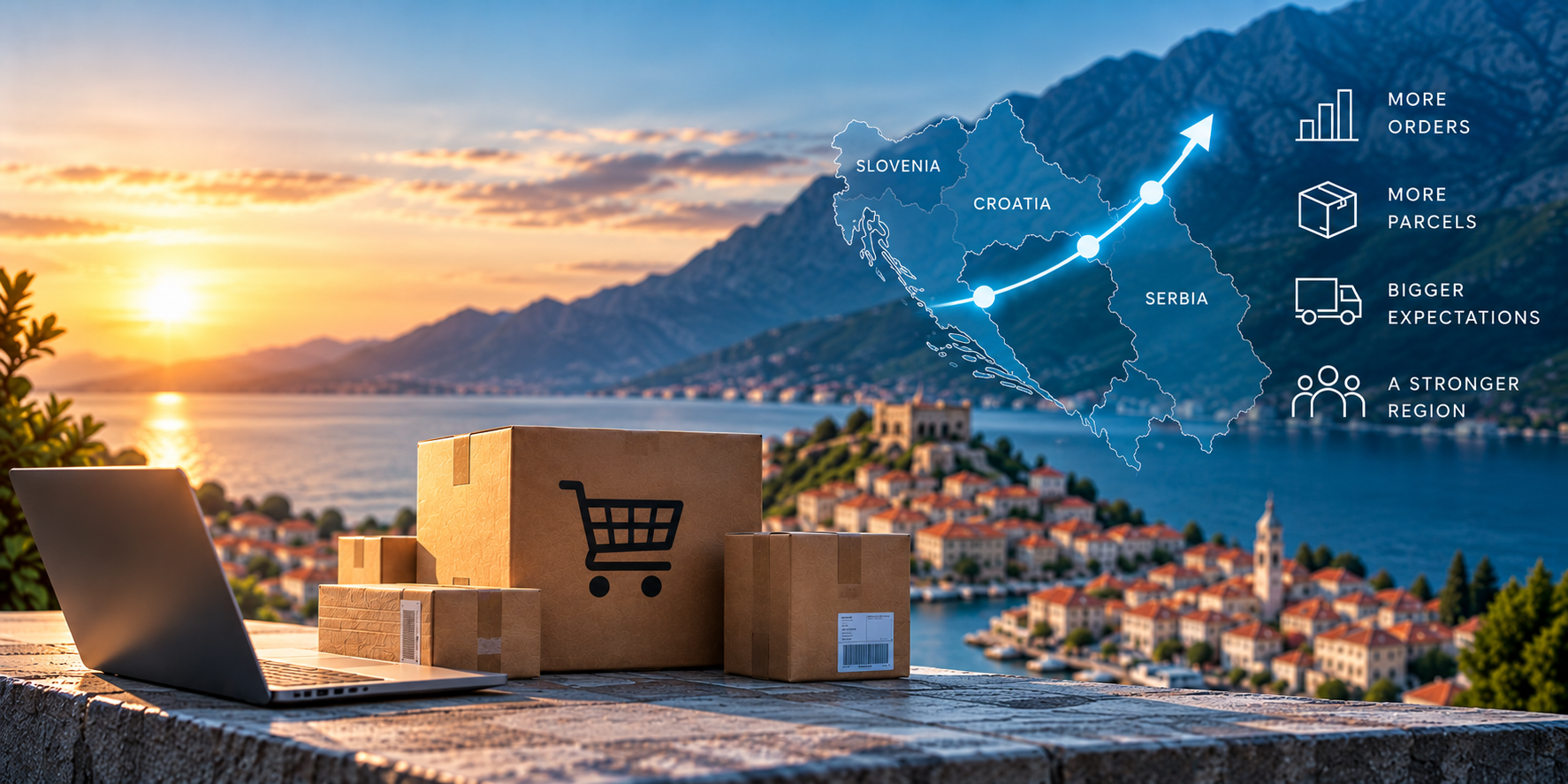
Online sales in the region have posted double-digit growth for years, but the change is felt most strongly where it’s least visible: on the last mile, in distribution centers, and at customs. Where logistics really comes under strain will be among the key topics at this year’s Logistics Market.
When we talk about eCommerce, it’s easy to get stuck on turnover figures. But behind every order stands a parcel that someone must store, sort, and deliver – most often to a home address, within a timeframe that just a few years ago was unimaginable.
It’s precisely here, at the junction of digital sales and physical delivery, that logistics in the Adria region is today going through its biggest transformation.
The numbers behind eCommerce growth
The numbers confirm it.
According to market estimates, the value of eCommerce in Serbia reached around 3.6 billion dollars in 2025, with continued growth expected toward five and a half billion by 2031.
Even more telling is the figure from delivery itself: more than 60 million parcels passed through the Serbian network in 2025, compared to 56 million a year earlier.
The Croatian market, though smaller in absolute value – around 1.05 billion dollars – is growing the fastest in the region, at a rate close to 14 percent per year.
In Slovenia, online shopping has long since become an everyday habit: nearly 67 percent of the population has ordered goods or services over the internet, and almost three quarters of that traffic comes from mobile devices.
Cross-border growth means more parcels, more complexity
Growth, however, doesn’t come only from within. It also comes from outside.
Chinese platforms such as Temu and Shein have multiplied their number of users in Europe over the past year, and it’s estimated that in 2024 alone more than 4.6 billion low-value parcels entered the EU, predominantly from China.
For logistics, that means two things at once: an enormous additional volume of small shipments and increasingly stringent customs and regulatory control over them.
Cross-border shopping in Europe is already worth more than 350 billion dollars, and around 70 percent of that trade goes through marketplace platforms – which shifts the center of gravity further toward fast, fragmented delivery of many small parcels.
Last mile: where the pressure is highest
The greatest pressure at the end of the chain is felt in the last mile.
It is at once the most expensive and the most operationally demanding part of delivery, and it has also been one of the most discussed topics on the Logistics Market portal in recent months – from questions of profitability that depend on innovation, through the evolution of out-of-home delivery, to the testing of delivery robots in Ljubljana.
The trend is clear: customers increasingly choose parcel lockers and out-of-home pickup, while cash on delivery remains the dominant payment method across much of the region, meaning the courier takes on the role of collecting payment in addition to delivery.
Electrification of vehicle fleets, smart routing, and a denser network of pickup points are ceasing to be a competitive advantage and are becoming a condition for survival.
Before the last mile comes the warehouse
The pressure, of course, doesn’t end at the customer’s door – it begins much earlier, in the warehouse.
For delivery to be fast, goods have to be close to the customer and processed at high speed, so the growth of eCommerce directly drives demand for modern distribution centers and for automation within them.
A region that until recently imported almost all of its logistics capacity is now building its own, and the question has shifted from whether to automate to how much, where, and when.
Where eCommerce growth meets logistics
These challenges are not just reflected in market data – they are part of the everyday reality of companies across the region and among the key topics shaping the future of logistics.
At this year’s Logistics Market, the final and most demanding phase of delivery will be addressed in the panel “Last Mile Delivery – new solutions for the final and most demanding phase of delivery,” bringing together representatives of FedEx, X-express Srbija, Smartivo, tpsX, and CIAK Auto – companies directly involved in getting parcels to their final destination.
What happens one step earlier, at the heart of the network, will be explored through the panels “Smart planning, construction, and equipping of distribution centers” and “Top-level automation and robotization in distribution centers.”
The program will also address the digital maturity of companies – without which none of these processes can work as they should – in a dedicated panel on the challenges of enterprise digitalization.
Continue the conversation at Logistics Market
As a partner of Balkan eCommerce Summit, Logistics Market brings these conversations together on October 6 in Hall 5 of the Belgrade Fair.
Across more than 2,000 m² of exhibition space, Logistics Market Conference & Expo will bring together professionals from the logistics, manufacturing, retail, and technology sectors for a conference program, organized B2B meetings, and an exhibition area.
For eCommerce businesses, the event is an opportunity to explore the logistics infrastructure, technologies, and processes behind the growing volume of online orders across the region.
Sources:
Express dostava – logisticsmarket.rs
Croatia eCommerce market (Mordor)