

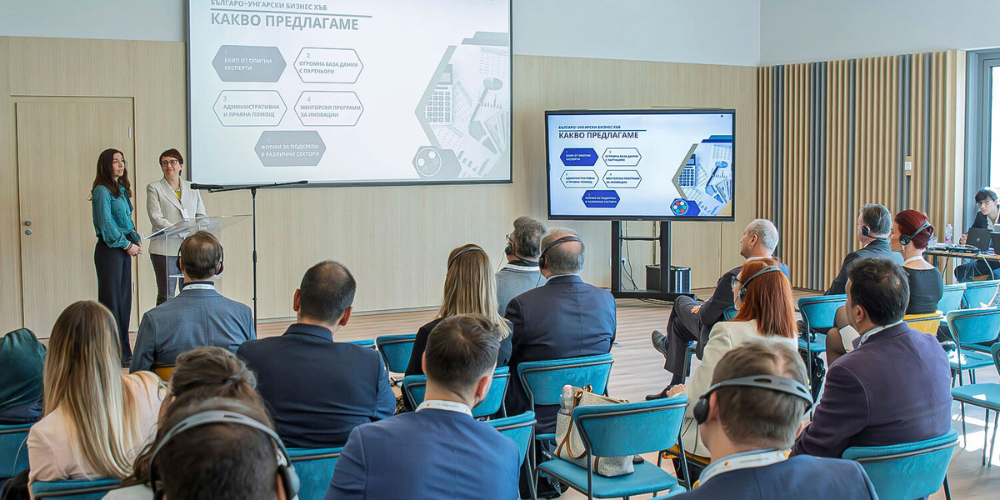
An in-depth interview exploring opportunities, risks, and proven strategies for Bulgarian companies looking to expand into Hungary’s dynamic business landscape.
Hungary presents compelling opportunities for Bulgarian businesses – from its 9% corporate tax rate (the lowest in the EU) to its well-developed industrial ecosystem and strategic location. But successful market entry requires more than competitive advantages; it demands understanding of local compliance, building trust through transparency, and choosing the right entry strategy.
In this interview, the Bulgarian-Hungarian Business Hub (BHBH) shares practical insights on navigating the Hungarian market: which sectors offer the best potential, how to avoid common pitfalls, and what lean steps can help companies test the market quickly and effectively.
What’s the current business climate in Hungary for new entrants: two strengths and two watch-outs?
Strengths
- Low corporate tax rate (9%) – the lowest in the EU, making the country an attractive destination for investors and for establishing regional hubs.
- Well-developed industrial and logistics ecosystem – strong value chains in automotive manufacturing, electronics, ICT, and logistics; convenient access to Western Europe and major export corridors.
Risks
- Regulatory and political uncertainty – there are ongoing criticisms from the EU and international institutions, which may complicate public procurement, subsidies, and administrative procedures.
- Macroeconomic volatility and pressure on consumption – inflation, currency fluctuations (HUF), more sensitive B2C demand, and shrinking margins in the mass market segment.
Which sectors are most attractive right now in Hungary and why ?
The leading and most attractive sectors are:
- Automotive, batteries, and the electric mobility value chain
- Large-scale investments, expanding manufacturing base, and strong export potential.
- High B2B margins for specialized components and industrial services.
- Competition: strong, but with real niches for Bulgarian subcontractors.
- Life Sciences, pharmaceuticals, and medtech
- A sector with growing exports and investments.
- Higher margins for innovative products.
- Strict regulations, but the market pays for quality.
- ICT and software solutions (cybersecurity, AI, B2B systems)
- Accelerated digitalization in industry and the public sector.
- Low entry costs and opportunities for remote services.
- Strong competition, but high demand for niche and innovative solutions.
- eCommerce and logistics for online trade
- Growing online consumption.
- Demand for localized platforms, fulfillment services, and last-mile solutions.
- Margins in mass retail are lower, but value-added services generate profit.
Where do Bulgarian products/services already win in Hungary?
Bulgarian companies are already successfully present on the Hungarian mass market through major retail chains – in the sectors of fast-moving consumer goods (FMCG), the glass industry, veterinary pharmaceutical products, and raw materials for the food industry.
What’s the fastest, lowest-risk market-entry route you recommend and when does each make sense?
- Distributor / distribution model
- The fastest and most balanced in terms of risk.
- Suitable for physical products (B2C and B2B) when there is no local structure and immediate access to sales channels is needed.
- The distributor takes over: warehousing, logistics, access to retail chains, and part of the marketing.
- Mandatory: clearly defined KPIs, territory, exclusivity, and control over pricing and margins.
- Online platforms / marketplace + localized e-shop
- A fast and low-risk model for consumer goods.
- Allows demand testing without major investments.
- Requires: localization (language, payments), advertising, and fast logistics.
- Local representative (agent)
- Suitable for B2B services, IT solutions, industrial products, and complex sales.
- Low risk, relatively fast market entry, highly personalized approach.
- The selection of the agent and clearly defined commission structure are crucial.
- Establishment of a local company
- The slowest, most expensive, and riskiest option.
- Suitable only in cases of:
✓ long-term investments
✓ need for a local team
✓ brand control
✓ requirements for warranty and after-sales service - Requires: local lawyers, accountants, certified translations, and administrative support.
Typical timeline (60 days from first contact to validation)
Days 1-14: Market validation, initial contacts, discussions with distributors, verification of pricing and competitors.
Days 15-35: Pilot phase – first sales through a distributor / first meetings with corporate clients; localization of materials.
Days 36-60: Analysis:
- if results are positive → scaling, contracts, potential company registration;
- if not → repositioning or selection of a new partner.
Key risks that must be closely monitored:
• Regulatory risk: changes in legislation; protective clauses in contracts are required; periodic reviews by local legal experts.
• HUF currency risk: exchange rate volatility – short-term contracts and the possibility for indexation/repricing in case of inflation are recommended.
Compliance essentials in a nutshell: VAT, invoicing, labeling, and certifications, what are the most common pitfalls for newcomers?
Each individual compliance aspect can become a pitfall. It is strongly recommended to hire competent accountants, lawyers, and legal advisors who are familiar with Hungarian legislation. The most common issues arise with:
- incorrect labeling
- incomplete documentation
- incorrectly issued invoices
- lack of mandatory certificates
Logistics and payments: preferred carriers/warehousing models, returns norms, and the payment methods Hungarian buyers actually use.
Hungarian companies often work with trusted carriers and logistics warehouses. A widely used practice is deferred payment with a minimum term of 30 days. Transactions are usually conducted in EUR, and contractual terms must be clearly defined.
In the Bulgarian–Hungarian context, which behavior in meetings builds trust fastest-and which one often undermines it?
Trust is built most quickly through fairness, transparency, and clearly defined proposals and contracts. Unfulfilled commitments, delays, or unclear terms undermine trust immediately.
Common mistakes BG companies make in Hungary and how to avoid each.
Bulgarian companies often underestimate the need to invest in consulting services – market analysis, translation and legalization, accounting, and legal services. The solution is to plan a budget for these activities from the very beginning of the process.
BHBH in action: walk us through your matchmaking/representation process and the KPIs you track.
Our process begins with an analysis of the company – its product, market goals, and requirements. We then activate our network of Hungarian contacts: distributors, retail, logistics, and industry associations. We organize meetings and presentations and provide support during negotiations.
Key KPIs we track:
• number of validated potential partners
• number of meetings held and level of interest
• contract signing
• first test deliveries and sales
А short success story (goal – approach – milestones – outcome) of a BG-HU collaboration you enabled.

We work with many companies, but here are two examples from different sectors:
Example 1: Market entry of a Bulgarian IT services/solutions company
Goal: Entry of a Bulgarian company from the IT services and technology solutions sector into the Hungarian market and acquisition of the first corporate clients.
Approach: Analysis of local needs and competition, identification of suitable target sectors, selection of potential partners, and organization of B2B meetings. We provided full support throughout the service presentation process, adaptation of the offers to the Hungarian market, and negotiations.
Stages:
- Initial positioning and clarification of the value proposition for Hungarian clients
- Targeted presentations to corporate partners
- Series of online meetings
- Finalization of terms and assistance with contract preparation
Result: Provision of IT solutions to a Hungarian partner and the start of joint cooperation, including expansion of the service implementation to additional clients.
Example 2: Market entry of a Bulgarian FMCG company in Hungary
Goal: Entry into Hungarian retail chains
Approach: Market analysis, selection of contacts, B2B meetings, support with documentation
Stages: Product adaptation, test deliveries, logistics
Result: Entry into food retail chains and planning of sustainable growth over the following year.
Are there any grants/tax benefits/export programs worth exploring for BG→HU (and HU→BG) expansion?
Programs are available through HEPA (Hungarian Export Promotion Agency), as well as EU funding for cross-border projects. These are suitable for companies planning expansion between Bulgaria and Hungary or for developing regional partnerships.
The must-have clauses in BG-HU contracts (exclusivity, currency, returns, SLAs).
A well-structured bilateral contract includes:
- clearly defined exclusivity
- currency and method of payment
- terms for returns and claims
- SLA (delivery timelines, quality, documentation)
- clarity regarding the applicable law and dispute resolution
If a company wants to “test” Hungary fast, what lean steps would you prescribe?
Market research, a good lawyer and accountant, and a local partner, such as the Bulgarian-Hungarian Business Hub, which can support a smooth market entry thanks to its network of professionals and specialists ready to assist companies when entering new markets.
- short market research
- consultation with a local expert
- test deliveries or a pilot sales channel
- participation in B2B forums
- working with a local partner such as BHBH for a fast start (the Bulgarian-Hungarian Business Hub ensures a smooth entry into the Hungarian market thanks to its well-established network of professionals and specialists who actively support companies at every stage of their market entry).
How can participation in Balkan eCommerce Summit amplify a BG-HU market entry (intros, visibility, partners)?
The event provides high visibility and access to potential partners, platforms, logistics companies, and eCommerce experts. Participation shortens the market validation time and supports the building of trust and first business contacts.
Starter pack: three concrete resources (directories, groups, official portals) to bookmark and how to contact BHBH for a first assessment.
Useful resources:
- Hungarian Investment Promotion Agency (HIPA)
- HEPA – Hungarian Export Promotion Agency
- Hungarian Chamber of Commerce and Industry
BHBH contact info: info@bhbh.bg
LinkedIn: Bulgarian-Hungarian Business Hub
Opportunity for an initial assessment and an introductory meeting
Meet the BHBH Team at Balkan eCommerce Summit 2026
Representatives of the Bulgarian-Hungarian Business Hub will be present at Balkan eCommerce Summit 2026. It’s an excellent opportunity to connect with the team in person, discuss market opportunities, and gain firsthand insights into navigating the Bulgarian-Hungarian business landscape.
Learn more: balkanecommerce.com