

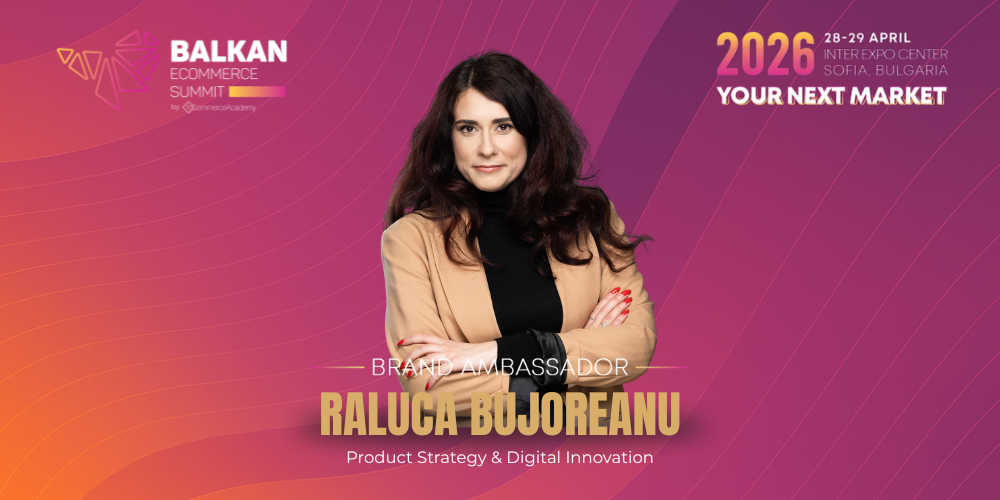
Raluca Bujoreanu is a Product and Innovation Leader with 17 years of experience building and scaling digital consumer experiences across Europe. She spent nine years at Zalando, Europe’s largest fashion eCommerce platform, where she led product and innovation across Fashion, Luxury, and Beauty, shaping complex digital experiences across international markets.
Today, Raluca partners with leadership and product teams to build effective product organizations, increase product maturity, and make focused innovation and technology decisions that deliver measurable business impact. Her work spans end-to-end product leadership: from digital product strategy and AI investment decisions to shaping, launching, and scaling experiences that drive growth and differentiation.
As a Brand Ambassador for the Balkan eCommerce Summit 2026, she helps founders and product leaders make better long-term decisions without wasting time on endless experimentation – bringing a rare combination of corporate scale experience and startup execution speed.
In this interview, Raluca shares the biggest product mistake Balkan eCommerce companies make when scaling, what separates sustainable growth from feature bloat, how to approach AI without overengineering, and the mindset shift founders need when moving from local success to regional or EU-wide expansion.
Having led product and innovation at Zalando across multiple markets and verticals, what is the biggest product mistake you see eCommerce companies in the Balkans make when trying to scale?
The biggest product mistake I see is assuming that scaling is primarily a marketing problem.
Many eCommerce companies believe growth will come from more traffic, more ads, more countries, or a broader assortment. These levers matter, but they are not enough on their own.
What is often left behind is the product experience. By product, I do not mean features and I do not mean the products being sold. I mean the end-to-end digital experience. How quickly customers understand the value. How easily they find what they need. How confident they feel buying. And what makes them return without being pushed by discounts.
Scaling is a make-or-break moment. In the early days, companies often rely on setups that were “good enough”. A standard platform. A copied experience. Sometimes just a “digital shelf” for the products they want to sell. This works while the business serves a niche. Customers know the brand, appreciate the assortment or service and often have a personal connection to it.
When scaling starts, everything changes.
Suddenly, you attract many new customers who do not know you and need to understand your value immediately. Otherwise, acquisition spend is wasted. At the same time, expanding assortment and new markets often make discovery harder, not easier, while customers begin comparing you to the best experiences they already know, not just local competitors.
This is also the moment when you start competing with much stronger players, often while internal processes and product setups are not yet built for that level of demand.
Many companies react by copying competitors or adding features and assumed benefits without clarity, in an attempt to please everyone at once. The result is usually the opposite of what was intended. More complexity. Higher costs. Slower, more frustrated teams. And no clear reason for customers to choose the brand again.
The companies that navigate this phase successfully are the ones that pause and recalibrate. They become deliberate about the value a customer should feel within the first moments of the experience and design the journey so trust and understanding come quickly. They focus on creating confidence and clear reasons to return before scaling acquisition further. At scale, differentiation rarely comes from convenience or assortment alone. eCommerce is no longer about choosing online shopping because it is available 24/7. It is about why a customer should choose this shop over another, over the online experience of very large retailers, or even over the many physical stores just around the corner. That difference is created through intentional experience choices and a few well-designed “wow” moments.
From your experience, what separates eCommerce products that grow sustainably from those that add features and tech but fail to create real customer value?
Sustainable growth always starts with clarity of value.
The strongest eCommerce products are not the ones with the most features or the newest technology. They are the ones where customers can answer, almost instinctively, a simple question: why should I buy here instead of somewhere else?
This goes far beyond fixing obvious customer problems. What really matters is identifying the right problems to solve at scale, in a way that creates preference. Preference is what turns customers into repeat buyers rather than one-time transactions.
The companies that grow sustainably tend to excel in three areas.
First, they develop a deep understanding of their customers, well beyond interviews or surveys. Most valuable insights do not come from what people say, but from how they behave and from needs they often cannot articulate themselves. Sustainable players invest in uncovering pressing, unmet needs they can serve better than anyone else, rather than reacting to surface-level feedback.
Second, they commit to a clear value proposition and are disciplined about it. This requires hard choices. The value proposition must be translated consistently into product decisions, communication, and marketing. Every new feature, campaign, or partnership either strengthens that value or weakens it. Many companies struggle at this stage because they try to appeal to everyone and end up resonating with no one.
Third, they simplify as they grow. Contrary to intuition, strong products become more focused over time, not more complex. A good example, even outside classic eCommerce, is the Finnish brand Ōura. As the product scaled, the company made deliberate choices to focus on women’s health and specific unmet needs, moving away from generic narratives around sleep tracking or fitness clichés. That clarity shows up everywhere, from the product experience to communication and brand positioning. And it paid off in over 5.5 million products sold, strong revenue growth and an $11 billion valuation.
In practice, the difference is simple. Some companies keep adding technology. The ones that grow sustainably keep sharpening why customers choose them and return, and build everything else around that.
AI and personalization are top priorities for many retailers. What should Balkan eCommerce teams realistically focus on first to see impact, without overengineering their product?
Personalization and AI are often discussed together, but they solve different problems and need to be approached differently.
Personalization is already table stakes. When it is done well, it delivers clear and proven uplift. The real question for most retailers is no longer whether to personalize, but how far to go. The challenge is creating an experience that feels relevant and coherent while still evolving over time.
AI, on the other hand, is still early and surrounded by enormous hype. When I start working with teams, I almost always hear the same sentence: “We need to do something with AI.” The reasons usually fall into a few buckets. Fear of falling behind. Investor pressure. Market perception. Or the hope that AI will somehow fix growth.
The reality is far more nuanced.
AI can deliver significant impact. I have worked with teams where it led to 300% or more improvement in very specific areas. But those results did not come from plugging in technology. They came from investing in fundamentals. Clear use cases. Data quality. Human oversight. Training teams. And, most importantly, changing the way people work and think.
What consistently works is starting with clarity, not technology. The first step is identifying where AI can realistically create value. Sometimes that sits close to the customer, where the opportunity for differentiation is high, but so are execution costs and quality risks, and the revenue impact may take time. Other times it sits closer to the business, in areas like cost reduction, operational optimization, or revenue efficiency, where impact is more immediate but still requires continuous focus and ownership.
In both cases, success depends on setting the right expectations. AI is not a one-off implementation. It needs ongoing training, scaling and management. It changes team dynamics, decision-making and ways of working. Choosing whether to build capabilities internally or work with external solutions is another critical decision, especially in a market crowded with tools that promise quick wins.
The most important step, before any of that, is being clear on why you are doing it and what value you expect to create. Without that, initiatives tend to remain experiments or beautiful demos rather than something that truly moves the business forward.

You work at the intersection of corporate scale and startup speed. What mindset or operating model shift do founders in the Balkans need most as they move from local success to regional or EU-wide expansion?
The biggest shift founders need to make is understanding that expansion changes the rules of the game.
Customer expectations, competitive dynamics and trust factors can differ significantly from one market to another. Assuming that what worked in one country can simply be replicated elsewhere is one of the most common and costly mistakes companies make when expanding.
When companies come to me to discuss expansion, an important clarification needs to happen early. Is the goal to win a handful of customers in a new market, or is the ambition to truly build a presence there? These are very different objectives and require very different levels of commitment.
Germany is a good illustration. It is one of the largest and most attractive markets in Europe and getting it right can pay off for a long time. But it also comes with higher expectations around quality, stronger trust barriers, more regulation and slower decision-making. Entering such a market requires adapting almost everything: product, value proposition, pricing, communication and operations. Without that adaptation, scale remains shallow and fragile.
For eCommerce businesses, regional expansion is often the most pragmatic next step. Neighboring markets tend to be more similar, logistics are easier to manage and the cost of expansion can be controlled better. That said, choosing the right countries matters more than expanding fast. A solid market analysis is essential to understand where a business can remain competitive and where its advantages still hold, rather than burning cash chasing growth everywhere.
For other business models, going beyond the region can make sense earlier, especially when the product-market connection is strong and the revenue potential justifies the effort. In all cases, expectations need to be realistic and preparation thorough.
Ultimately, successful expansion is not about copying what worked before. It is about understanding where your product truly fits, which strengths still matter and how to adapt deliberately to earn relevance in a new market all over again.
As a Brand Ambassador for the Balkan eCommerce Summit, how do you hope to help founders, product leaders, and innovation teams make better long-term product decisions in 2026?
In 2026, leaders will not be lacking ideas, frameworks, or opinions. They already have plenty of those. What they need is expertise and support in applying what actually pays off, without wasting time on endless experimentation.
As Brand Ambassador for the Balkan eCommerce Summit, what I want to help founders, product leaders and innovation teams with is focus and speed. Identifying which opportunities are truly worth pursuing and then executing them well.
The Balkan region is in a unique position. Technology talent is strong and access to technology is still relatively affordable. This creates a real opportunity to compete through product and digital experience, not just through marketing budgets, discounts, or convenience optimization.
My goal is to shift the conversation toward product decisions that move the business forward. Not more features, but better experiences. Not chasing every trend, but deliberately choosing where technology can become a competitive advantage.
Ultimately, it is about helping teams invest their time and resources where it matters most and guiding them through that process with confidence and speed, so they can build durable advantages instead of just keeping up.
Meet Raluca at Balkan eCommerce Summit 2026
Thinking about scaling beyond your home market? Wondering how to build preference instead of just adding features, or curious what AI should actually solve before you invest in it?
Raluca will be on-site, ready to share what 17 years of building and scaling digital experiences – including 9 years leading product and innovation at Zalando – have taught her about the product decisions that move businesses forward and the ones that create expensive complexity.
Whether you’re a founder preparing for regional or EU-wide expansion, a product leader trying to increase maturity without overengineering, or simply want to understand how to compete through experience instead of marketing budgets – come find her. These conversations often turn into partnerships.
🎟️ Grab your ticket at balkanecommerce.com and be part of building stronger connections across the region.