

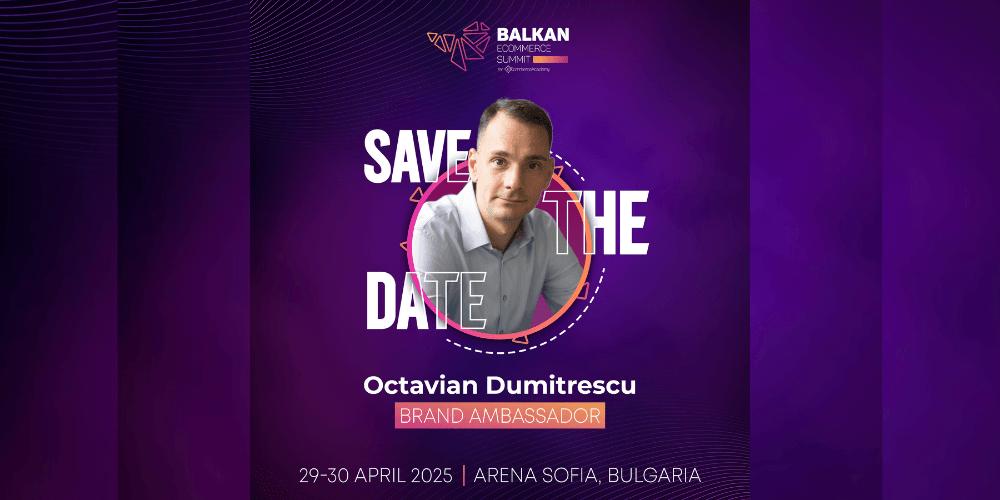
 Octavian Dumitrescu is a forward-thinking entrepreneur and a leader in AI-driven automation for eCommerce. As the Co-Founder and CEO of Dyver.AI and CustomSoft, he helps businesses streamline operations, optimize product data onboarding, and scale efficiently across borders. With nearly two decades of experience in software development and digital commerce, he is committed to solving real-world challenges through technology.
As a brand ambassador for the Balkan eCommerce Summit 2025, Octavian continues to support a community eager to embrace partnership and growth.
In this interview, he shares insights on the evolving landscape of eCommerce, the transformative role of AI, and how businesses can stay ahead in an increasingly competitive and fast-changing market.
What influenced your decision to take on the role of brand ambassador for the Balkan eCommerce Summit 2025, and how do you envision this collaboration creating value both for your professional development and the summit’s ecosystem?
Honestly, the decision to come back as a Brand Ambassador was an easy one. Last year, in Sofia, I was genuinely impressed by the hunger for learning and growth I saw. People were not just curious; they were actively seeking ways to scale their businesses and solve real challenges. It was inspiring. At Dyver.AI, we’re all about providing practical solutions to the very real problems eCommerce businesses face – like streamlining product data onboarding or cutting operational costs.
Last year, our booth was showing innovation but in a way that there is a better, more efficient way to do things. And what struck me was how well-received our approach was. We didn’t have to oversell; people got it. They asked thoughtful questions and were genuinely interested in understanding how they could apply our solutions to their businesses. That kind of engagement is rare and it showed me that this community is ready to embrace new ideas and faster than bigger markets do.
Continuing this partnership is, for me, contributing to an ecosystem that’s eager to grow, innovate and ultimately -learn. It’s about conversations that spark new ideas. I’m excited to be a part of that again and to see how we can all push the industry forward together.
In your opinion, what were the most significant consumer behavior shifts in 2023 and 2024 that eCommerce businesses should pay attention to, and how should they adapt their strategies accordingly?
In 2023 and 2024, we saw consumers becoming much more value-conscious. With eConomic pressures, people are more willing to switch brands if they find a better deal. At the same time, they expect the same level of quality and experience, which puts pressure on businesses to be competitive without compromising on customer experience.
Social commerce also took off in a big way. Platforms like TikTok and Instagram are not just for brand awareness anymore – they’re becoming the main shopping channels, especially for younger audiences. Brands need to meet customers where they are, and that means mastering the art of selling through social content.
For eCommerce businesses, the strategy is clear: Be present and active on social platforms, focus on competitive pricing, and use personalized marketing to build loyalty. At Dyver.AI, we’ve seen how effective complete and accurate content can be. When product data is relevant and timely, conversion rates naturally go up. Just giving customers exactly what they need, right when they need it.
Your professional focus often highlights strategic partnerships. Over the last few years, what examples can you share of successful partnerships that have set new standards in eCommerce?
One great example is the partnership between JD.com and Shopify. They made it easier for Shopify merchants to sell directly to Chinese consumers. That’s huge because they solved a complex problem – cross-border commerce – by combining their strengths. JD.com brought logistics and local market knowledge, while Shopify brought a massive base of merchants looking to expand globally.
 For us, Dyver.AI, partnerships are about creating win-win situations. We collaborate with eCommerce platforms to integrate our AI-driven product onboarding solutions, we partner with agencies who are often asked by their customers to solve their manual product data onboarding complexities and we also partner with marketplaces who simply want to make it smooth for their sellers to upload and map their data as neatly as possible.
Briefly put, we are making it easier for businesses to scale without getting bogged down by operational bottlenecks. When partnerships solve real problems, everybody win – the platforms, the merchants, and ultimately, the customers.
Your talks have highlighted the potential of AI and VR in eCommerce. Could you share your vision for their evolution and how these technologies can practically benefit digital businesses?
AI is already transforming ecommerce, and we’re just getting started. The real power of AI lies in its ability to simplify complex processes and make data-driven decisions faster and more accurately than humans can. For example, at Dyver.AI, we focus on using AI to solve real business challenges, like streamlining product data onboarding and reducing operational costs.
But I see AI continuing to evolve in three key areas:
- Automation of Repetitive Tasks: From managing inventory to processing orders, AI can handle time-consuming tasks more efficiently, allowing teams to focus on strategic growth activities. This is particularly valuable for small and medium-sized businesses looking to scale without significantly increasing overhead costs.
- Personalized Customer Experiences: AI can analyze consumer behavior to provide highly personalized product recommendations, targeted marketing and tailored content. Thus, building long-term customer relationships.
- Intelligent Decision-Making: AI can analyze massive amounts of data in real-time, offering insights that help businesses make smarter, faster decisions. Whether it’s optimizing pricing strategies or identifying emerging trends, this level of insight is a game-changer for digital commerce.
And there’s another thing that has to be said. These technologies can only truly benefit if they are mindful of the real struggles of the eCommerce industry. We’re building solutions that make these benefits accessible to all businesses, especially those who traditionally couldn’t afford enterprise-level technology. We believe that AI is the great equalizer, enabling companies of all sizes to compete on a global scale.
Considering the challenges faced by the eCommerce sector in 2023 and 2024, such as shifting consumer expectations and supply chain disruptions, what key lessons should leaders carry into 2025?
The biggest lesson from the past couple of years is the importance of adaptability. Consumer expectations are evolving faster than ever, and supply chain disruptions are now a reality of global commerce. Leaders need to build flexible systems that can pivot quickly.
Here is what I know and what I see everyday working with eCommerce businesses. Automation isn’t just about efficiency; it’s about resilience. When your processes are streamlined and less dependent on manual interventions, you’re better equipped to handle disruptions. Also, clear communication with customers goes a long way. If there’s a delay or issue, being transparent builds trust and loyalty.
Leaders should also focus on collaboration and bringing onboard third party expertise, as there one can not cover ALL challenges that arise in this ulta dynamic sector. Fact is, no one can solve these challenges alone. Strategic partnerships whether for logistics, technology or marketing, can provide the agility and resources needed to navigate uncertainties.
Looking ahead, what is your vision for the future of eCommerce in the next few years, and what key developments should businesses prepare for to remain competitive?
The future of eCommerce is going to be shaped by the rise of the AI Agent Economy. We’re entering an era where AI agents will handle an increasing number of tasks, from customer service to marketing and inventory management. The key shift we’re about to see is the emergence of AI agent marketplaces – platforms where businesses can easily access specialized AI agents tailored to their needs.
Right now, small and medium-sized businesses (SMBs) are underserved when it comes to accessing advanced business solutions. They need the same marketing, financial analysis, and operational support as big enterprises but at a fraction of the cost. AI agents are perfectly suited for this because they can deliver high-quality services efficiently and affordably.
We’re going to see two main models:
- Horizontal AI Agents – These are general-purpose agents that can be used across industries for tasks like accounting, customer support or marketing. They’ll democratize access to advanced business solutions, leveling the playing field for smaller companies.
- Vertical AI Agents – These will act as specialists for niche markets, offering expertise in complex, industry-specific tasks. Think of them as digital experts that can be “hired” at a fraction of the cost.
At Dyver.AI, we’re not just watching or predicting these trends – we’re building for them. Our AI-driven automation solutions are already helping eCommerce businesses streamline product data onboarding, reduce operational costs, and scale more efficiently. We’re focused on making complex tasks simpler and more accessible, especially for SMBs who need robust solutions without the enterprise price tag.
We’re in our prime time because the need for scalable, cost-effective automation has never been greater. The market is ready, the technology is here and we have the expertise to bridge the gap. I genuinely believe Dyver.AI is positioned to be a key player in this new economy, helping businesses not just adapt but thrive in the age of AI agents.
Octavian Dumitrescu’s vision for AI-driven automation in eCommerce is reshaping the way businesses scale and operate. His expertise in innovation, strategic partnerships, and efficiency-driven technology proves that the future of digital commerce belongs to those who embrace change.
📅 Don’t miss the chance to learn from industry pioneers like Octavian Dumitrescu at the Balkan eCommerce Summit 2025. Secure your ticket today and stay ahead in the evolving world of eCommerce. Visit balkanecommerce.com for more details!