

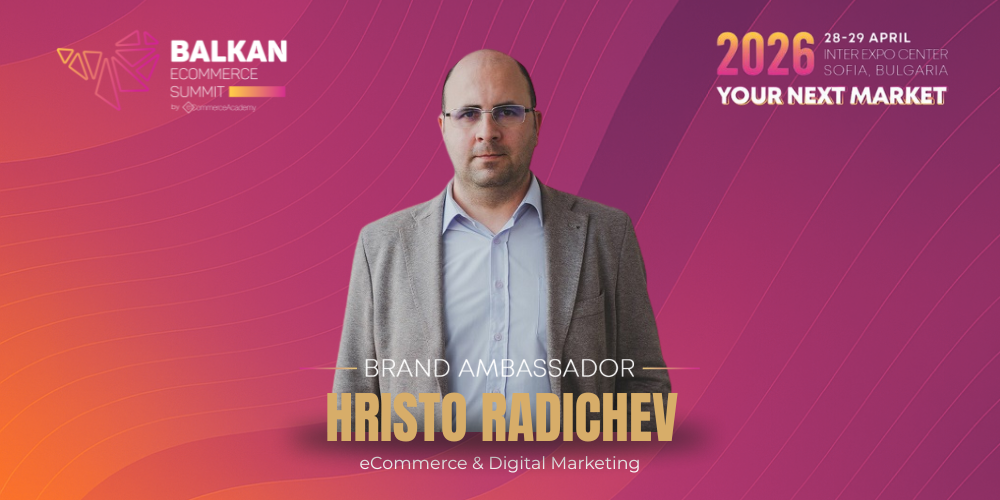
Cross-border expansion often looks simple on paper until we come face-to-face with customs, compliance, and the operational complexity enters the picture like a storm on a calm sea. Hristo Radichev, founder of Merkana, has spent years working at the intersection of digital marketing, automation, and cross-border eCommerce. His current focus is on helping EU merchants expand into Western Balkan markets and succeed locally.
In this interview, Hristo breaks down the most underestimated pain points of selling in Central and Eastern Europe (CEE). He explains why product data and process discipline matter more than logistics alone, and shares practical insights on how merchants can turn regulatory complexity into a predictable, scalable workflow. After all – regulations don’t simply appear out of thin air. We can plan, prepare and grow strategically alongside them.
Merkana aims to remove all barriers to selling in Western Balkan markets. Which pain point do EU merchants underestimate the most before trying to expand into countries with customs?
Most EU merchants underestimate how many small things break the customer experience once a shipment crosses a customs border. They expect “a lot of paperwork” but the reality is that customs creates a chain of smaller problems in parallel.
Product data needs to match customs rules, not just marketplace rules – and EU merchants usually don’t have to think about that when they sell across the Union.Delivery times can take twice as long if some products are not declared correctly. Weeks if not months can be spent sitting on the sidelines waiting for customs to approve a shipment because of poor planning.
Also, things like HS codes, ingredients listed appropriately, materials and certificates have become mandatory, and that opens the question about proper data structure and enrichment. We can overcome this issue with agile AI tools that speed up the process in our systems – but even so we need a real human to make the final checks and ensure proper preparation of the documentation.
From another perspective, even if we’ve gotten the goods in, we could still face returns which then suddenly turn into export-import procedures. This can also take a lot of effort if not planned previously.
So, long story short – merchants usually think the biggest barrier is logistics – especially when exporting goods. In reality, the barrier is much simpler – compliance, documentation and process consistency all at once. That is where sales usually collapse.
Merkana’s approach is to remove these invisible obstacles by preparing the product catalog correctly from the start, acting as merchant of record where needed, and aligning logistics, customs procedures and returns into one smooth flow. Everything in our platform is as automated as possible, thus paperwork is reduced to the bare minimum while compliance is carefully checked and organized.
Events like the Balkan Ecommerce Summit help a lot in understanding this issue properly. They give regional merchants a real-world view of how customs markets work. Success in the Western Balkans requires not only good marketing, but also a partner who understands regulatory detail. Thanks to the Summit, more EU sellers learn about these hidden pain points before they make costly mistakes.
You’ve worked for years in digital marketing, automation, and CRO before building Merkana. Which part of that background most shaped the way you design cross-border expansion today?
Digital marketing and CRO taught me one big lesson: people don’t drop off because they don’t want to buy, but because something in the process makes it too hard. And when you apply this to cross-border ecommerce, everything becomes clear. Expansions fail mainly because of friction on the line. This friction is often seen as unclear delivery times, bad translations, inconsistent product data, customs delays, confusing returns, but also internally as too many tools and dashboards.
My marketing background pushed me to design Merkana as a friction-removal machine. Instead of asking merchants to adapt to each country, we remove the steps that usually cause drop-offs: product information issues, compliance, customs, payments, logistics, and returns. Then we connect everything into one simple flow so the merchant focuses only on selling.
This mindset comes directly from CRO – if you fix the bottlenecks, growth happens naturally.
From your experience in North Macedonia, Serbia, and Kosovo, what early signal tells you that a merchant is truly ready for cross-border growth and what warning sign shows they’re not?
The strongest early signal that a merchant is ready for cross-border growth is discipline in product information. If their catalog is clean, structured, consistent, and easy to map, their road to success abroad is well paved. Chances are that this merchant will be quite efficient and profitable in the end. Such merchants understand that translations, ads, customs declarations, marketplace listings, delivery promises – all these depend on accurate data. So when a merchant sends us a catalog that is already well-organized, we know they will scale fast.
The biggest warning sign is the opposite – a messy catalog with missing attributes, unclear materials, no barcodes, no certificates, and 15 versions of the same SKU. This usually means the merchant grew quickly without building internal processes. In cross-border markets – especially those with customs like North Macedonia, Serbia and Kosovo – this becomes a real obstacle. If we can’t classify the product, customs can’t clear it, marketplaces can’t display it correctly, and customers lose trust.
What we learned in the region is simple. Success abroad is not about having the “best product.” It’s about having the best-prepared product.
As a Brand Ambassador for the Balkan eCommerce Summit, how do you hope to support merchants and partners who want to expand into customs-regulated markets but feel overwhelmed by the complexity?
 My role as a Brand Ambassador is simple. I aim to popularize the event across the region I already know so well, and I get to talk about cross-border trade in the region, making it feel less daunting.
Many merchants and partners want to expand into customs-regulated markets, but they freeze the moment they see words like “HS code,” “certificate,” or “returns procedure.” My goal is to translate all this complexity into clear, practical steps – the kind of steps anyone can follow, even without a logistics or customs background.
I see myself and Merkana as a bridge-builder between merchants, local experts, marketplaces, couriers, and platforms. The Balkan Ecommerce Summit gives us the perfect space to do this. It gathers the whole ecosystem in one place, so we can explain the rules, share examples, and give merchants the confidence that they are not entering these markets alone.
Through the Summit, I hope to connect merchants with the right partners, help them understand what truly matters (and what doesn’t), show them real success stories from North Macedonia and Serbia, and prove that customs markets are not a barrier – just a different kind of workflow.
If we can make the process understandable and predictable, merchants can stop feeling overwhelmed and start feeling empowered. That’s what I want to achieve as a Brand Ambassador: work on creating a region where knowledge moves freely and nobody is afraid to grow beyond their borders.
Looking ahead to 2026, what changes in payments, compliance, or logistics will make the biggest difference for merchants entering the Western Balkans and Türkiye?
The event that would impact the region the most is the new duty fees for parcels below 150 EUR being imported in the EU. It would affect low-cost merchants and products, but it’s also looking to reduce the risk of dangerous products reaching the local consumers.
Another fact is that today, when it comes to the EU, customs and product compliance slow down expansion more than anything else. But by 2026, we will see more automated HS code classification (although not perfect, it will save a lot of time) plus automated generation and validation of product data for customs – something we are working on in Merkana right now. We are also working hard on the so-called merchant-of-record setup – where online sellers won’t have to establish a local company to sell in that market. Currently that’s the common practice for anybody looking to work in North Macedonia or Serbia. This would remove the fear factor for them. Instead of “I don’t know how to expand,” it becomes “the system does 80-85% of the compliance for me.” That’s why Merkana is already building around this shift – because it’s the only scalable way to grow cross-border in the region.
As for the logistics, our biggest goal is for the Western Balkans region to get closer to EU service standards. Next-day and 48-hour delivery should become normal across borders, if not in 2026 I would be looking for this at the latest by 2027. Returns should become domestic-like, with no need for merchants to manage export/import procedures manually. Türkiye is improving cross-border parcel infrastructure as well, but competition seems like it will remain fierce, meaning only merchants with reliable delivery times and clear return policies will succeed.
Meet Hristo at Balkan eCommerce Summit 2026
Thinking about expanding into Western Balkan markets? Wondering how to handle customs, compliance, and product data without building an entire legal and logistics team – or just curious whether your catalog is ready for cross-border growth?
Hristo will be on-site, ready to walk you through the real friction points that break the customer experience once you cross a customs border – and how to turn regulatory complexity into a predictable, scalable workflow.
Whether you’re an EU merchant exploring North Macedonia, Serbia, or Kosovo for the first time, a local brand looking to simplify cross-border operations, or simply want to understand what “merchant of record” actually means in practice – come find him. These conversations often turn into partnerships.
🎟️ Grab your ticket at balkanecommerce.com and be part of building stronger connections across the region.