

| PAYNOVUS AT A GLANCE
On the market since 1998. EU-regulated EMI, supervised by the Bulgarian National Bank since 2011, and a Principal Member of both Visa and Mastercard. Paynovus processes across 180-plus markets and offers SEPA Instant settlement. Onboarding new merchants in under ten minutes, followed by an individual business review covering volumes, markets, and peak periods, so growth is never mistaken for a red flag. A named contact, reachable by phone and email, from day one. The first Bulgarian institution admitted to the Digital Euro Association, with a rich pipeline of new tools for businesses and individuals coming in 2026. Most payment providers are built to grow fast. Paynovus was built to last. |
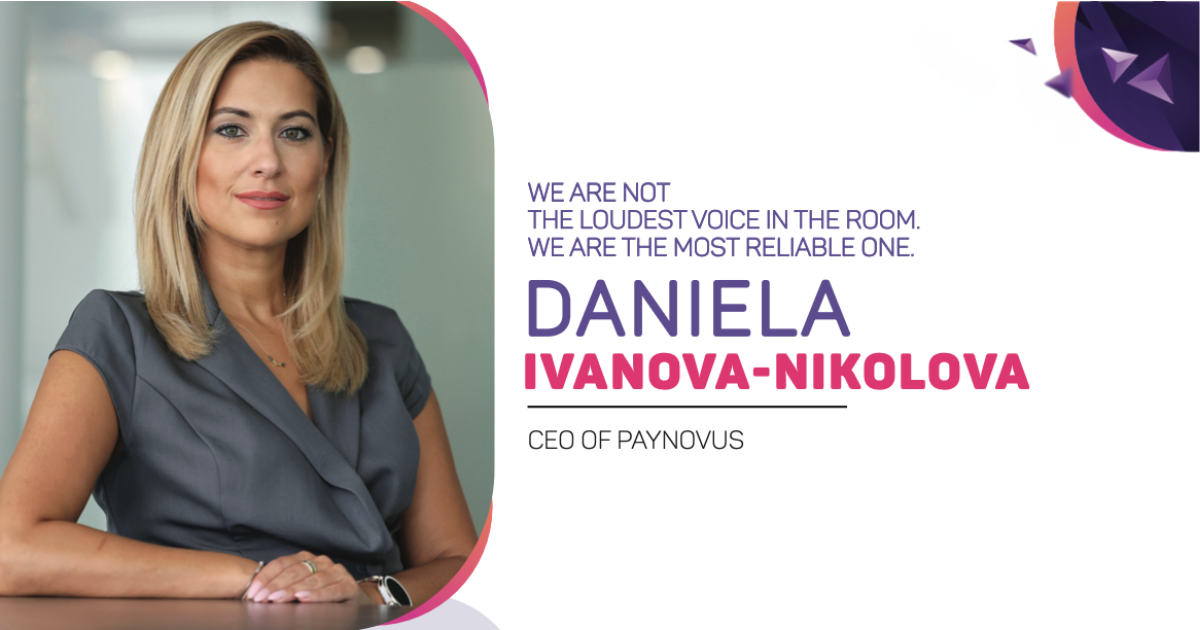
Daniela, you’ve spent the last 25 years in this industry. What is it really like to have almost three decades of experience in European payments from within?
It feels like watching a city being built. You are there when they pour the first concrete, and one day you look up, and there are thirty-story buildings and highways you helped design. I started at Eurobank in 2002, when a cross-border card transaction was something you’d call the bank about. The regulation was thin, the infrastructure was patchwork, and the mistakes were expensive.
What that era taught me is that payments are not about software. They are about trust.
Every time a merchant clicks “settle,” they are trusting that the money will be where they need it, on the day they need it. Not approximately. Not usually. Every time. That is the standard we have been building toward at Paynovus since 1998, when the company was established as TBI Credit.
We are an EU-regulated Electronic Money Institution, supervised by the Bulgarian National Bank under License №9073, with over €90 million in assets. We are a Principal Member of both Visa and Mastercard – not something a small institution achieves without a serious track record. We process in 180-plus markets and offer SEPA Instant, direct card acquiring with dedicated Merchant IDs, and a full suite of Visa and Mastercard card products for businesses and individuals.
The name has changed over the years, but the license, the infrastructure, the team, and the regulatory standing and experience have been continuous.
We also made history last year as the first Bulgarian company admitted to the Digital Euro Association. It means we are not just a recipient of whatever the ECB decides about the future of digital money. We are in the room when those decisions are being shaped.
In February 2026, the ECB warned about Europe’s strong reliance on international card schemes. What does that mean for a Balkan merchant trying to build a sustainable business?
It means they are renting the road they drive on. And the landlord is not European.
If you are a Bulgarian online retailer, a Romanian marketplace, or a Greek fashion brand scaling into Central Europe, your payment flow almost certainly runs through infrastructure headquartered in San Francisco or New York.
The dependency works fine until it doesn’t. And when it doesn’t, you find out on a Friday evening with a “freeze” hold on your account that no one at the processor can explain, because you are one of fifty thousand merchants in a shared pool.
This is why we built Direct Acquiring with dedicated Merchant IDs. Every merchant we work with has their own account identity within the Visa and Mastercard networks – not a sub-merchant slot in someone else’s account. When there is a dispute or a flag, it is addressed with the specificity your business deserves. Think of it as the difference between renting a desk in a shared office versus having your own lease.
The Balkan eCommerce Summit in April is clearly significant for you. What is the conversation you most want to have there?
The conversation about payment infrastructure as a strategic asset, not a commodity purchase.
Too many merchants treat payments like buying printer paper: find the cheapest option, set it up, and forget it until something breaks. And things do break. Around 70% of shoppers abandon their carts if their preferred payment method is not available. That is a revenue problem, and the root cause is usually that the payment infrastructure was not selected with growth in mind.
Cross-border fees alone can reduce merchant margins by 3 to 5%, and fraud risk is typically 1.5 times higher on cross-border transactions. If you are a Balkan brand selling into Germany, Poland, and Greece simultaneously, running on shared acquiring with no dedicated risk management, you are fighting with both hands tied behind your back.
The merchants who will actually scale across borders in the next four years are the ones who get their payment infrastructure right now.
We have been quietly developing something specifically for direct-to-consumer and eCommerce brands that we plan to unveil in the near term.
I cannot share details yet, but it is built around one idea – that the way ambitious online merchants connect to acquiring infrastructure should be fundamentally simpler, faster, and more aligned with how modern commerce in general actually works.
The Summit in April feels like exactly the right moment to start that conversation.
You mentioned SEPA Instant. Can you explain that in plain language for a merchant who has never worked directly with an EMI?
Of course. SEPA Instant is the ability to move euros between European bank accounts in under ten seconds, any time of day, including Sunday at midnight. The old SEPA transfer took one to two business days. That might not sound important until you are a merchant who needs to fund a supplier in Romania before a warehouse cutoff, or a media buyer who needs to top up ad spend at 11 PM before a Black Friday campaign goes live. Time is money. Literally. When a payment is delayed, those funds are not available to reinvest, which can hurt your ability to pay suppliers or scale on time. SEPA Instant closes that gap.
On the issuing side, we provide Visa prepaid cards as well as Visa cards for businesses and individuals. These are practical tools for managing operational spending, corporate accounts, and multi-currency needs, designed for how scaling businesses actually operate, not how banks imagine they do.
The Digital Euro Association membership – is the digital euro actually coming, and should merchants care now?
Yes, it is coming. The direction is settled; the timeline is still being decided in Brussels. The ECB has been clear that the digital euro is intended to ensure central bank money remains usable in a digital economy.
The institutions they work with will either be ready for that transition or they won’t. We are already at the table.
The ECB has noted that as merchants renew their payment terminals, ensuring new devices are digital euro-ready will allow European providers to expand their reach. We joined the Digital Euro Association precisely so that our merchants do not have to scramble four years from now to integrate a system that other people designed without us.
What is the moment you have seen most often where a merchant realises they chose the wrong payment partner?
There is a very specific scenario. It usually happens on a Friday evening or during the weekend. The merchant has an expensive promotion running, traffic is up, and conversion is up. And then transactions stop approving, and no customer service is available to resolve the issue. They are watching revenue being on hold in real time, with a cold cup of coffee and nobody useful on the other end of the phone. A volume spike that is perfectly normal during a promotion looks like fraud to a system tuned for average behaviour across thousands of unrelated merchants.
With a dedicated Merchant ID, the risk profile is not generated by an algorithm on the day you go live.
Before your first transaction, our team sits with you, and we map your business model, your typical volumes, and your peak periods. By the time your promotion goes live on a Thursday, the system already knows what your Friday night looks like. Your spikes are expected. Your patterns are recognised. Nobody is comparing you to a generic merchant profile, because we already know you are not one.
That is the difference between 99.99% uptime and the scenario I just described. And it is the difference between a payment partner and a payment vendor.
You are leading a company based in Bulgaria, regulated by the Bulgarian National Bank. Is that still something you have to defend to Western European clients?
Less than I used to. But occasionally, yes. And I always enjoy that conversation.
The Bulgarian National Bank is a rigorous, conservative regulator. Our license, Number 73, was granted in 2011 and has been continuously renewed and audited. We passport our services across all 30 EEA countries under the same legal framework as any Dutch or German EMI. Our €90 million-plus in assets represent actual financial depth — a merchant working with us does not have to wonder whether we can handle their volume growing tenfold.
We had to build correctly from the start – the infrastructure, the controls, or we would not have survived long enough to become who we are today.
That discipline is not something you acquire later. It is either in the culture or it isn’t.
What do you want the next five years to look like for Paynovus and for the merchants who work with you?
In five years, a European merchant processing with us should never have had a Friday night scenario. Not because we got lucky, but because we mapped their business before their first transaction, their risk profile was built around their actual patterns, and when their volume doubled, nobody panicked or held their account. That is the measurable outcome our team is building toward.
Concretely, that means a merchant in Bucharest or Sofia has the same settlement speed and acquiring stability as one in Amsterdam or Berlin. It means an eCommerce brand scaling into three new markets does not discover that their payment infrastructure is the bottleneck after the fact.
Europe’s ambition is to move beyond over-dependence on non-European payment infrastructure. We are a European institution. That matters not just for sentiment, but because when your payment partner operates in the same regulatory environment you do, the interests align. When things get complicated (and in payments, they eventually do), you want the person on the other end of the phone to understand your market, your regulation, and your business model. That is what 27 years in this industry buys you.
| If you want a payment partner who already knows your business before your first transaction, and is still there when your volume doubles, the conversation starts here.
paynovus.com → |
PayNovus is an EU-regulated electronic money institution that holds a License number 73 issued by the Bulgarian National Bank for conducting activity as an electronic money institution for the issuing, distribution and redemption of electronic money as well as the provision of payment services.
PayNovus is a principal member of Visa and Mastercard, and is the first Bulgarian licensed EMI to join the Digital Euro Association (DEA) and is a member of the Bulgarian Fintech Association.