

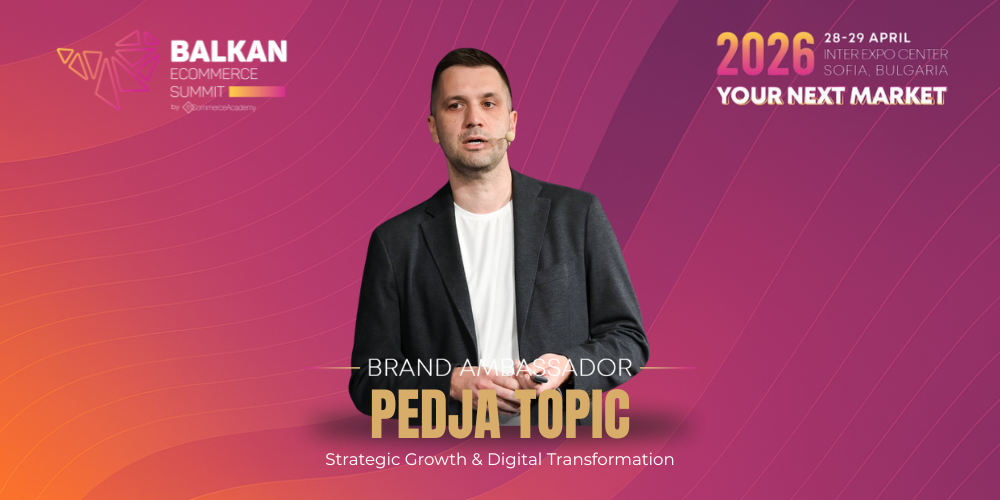
With nearly two decades of experience across FMCG, eCommerce, innovation, and AI, Pedja Topić has become one of the region’s leading voices in customer-driven growth. As a growth strategist and co-founder of Pokretach, he helps companies scale by deeply understanding the people behind each transaction – translating human behavior into clear strategy, practical action, and measurable revenue impact. Today, pokretach combines its own customer-first methodology with a new AI-powered insight product that enables brands to listen to customers at scale and act with far greater clarity and speed.
As a Brand Ambassador for the Balkan eCommerce Summit, Pedja plays a key role in strengthening the Serbian eCommerce ecosystem and bringing back proven practices, strategic lessons, and fresh perspectives from across the region. In this interview, he shares what brands must focus on in 2026, how real customer insights unlock growth, the mistakes teams make when scaling on marketplaces, and why unified data and clear ownership are becoming essential for long-term retention and value creation.
From your perspective, what does being a Brand Ambassador for the Balkan eCommerce Summit enable you to do for the community and how do you hope to contribute in 2026?
 Being a brand ambassador primarily enables me to spread awareness about the Summit and the value it brings to the regional eCommerce ecosystem. The Balkan eCommerce Summit is one of the few platforms where practitioners, brands, and solution providers can genuinely exchange knowledge, experiences and perspectives.
In 2026, I see my role especially in strengthening awareness in Serbia, where we now have several new ambassadors. That gives us an opportunity to be more visible, more active and more relevant locally.
For my own community, my goal is to bring back best practices, concrete learnings and meaningful connections from the Summit – insights that can help Serbian eCommerce players grow faster, avoid common mistakes and think more strategically about customers, growth and long-term value creation.
What’s new at Pokretach this year (services, frameworks, or client wins) that best reflects your “customer-first growth” philosophy?
This year, the clearest reflection of our customer-first philosophy is our new product: an AI-powered customer insight agent.
It enables our clients to have deep, meaningful conversations with their customers at scale, while at the same time being supported by a strong analytics layer capable of handling large volumes of semi-structured data. This combination allows companies not only to listen to customers, but to systematically analyze and translate those conversations into actionable insight.
In practice, it allows our clients to finally answer the most important question – “Why?” – continuously and at scale. The solution combines our methodology, behavioral thinking, and a human-first approach, embedded directly into the technology.
For our clients, this means having an always-on pulse of the customer, regardless of the business objective: understanding the full customer journey, identifying why certain categories perform better than others, validating whether to launch a new product or service, or designing a loyalty program that truly resonates.
For brands that genuinely want to grow by creating value for customers first, this enables speed, depth, and scale that were simply not possible before.
You often link strategy, data, and human behavior. Can you share a concrete story where a customer insight (not a dashboard metric) unlocked meaningful revenue growth?
At pokretach, we are strong believers in simplicity. Very often, the most powerful growth opportunities come from insights that are intuitively felt by teams, but never fully validated or acted upon with confidence.
Several times this year, we uncovered very clear customer signals pointing to new products or extensions of existing products that customers were actively asking for, sometimes almost “screaming for.” Once these insights were confirmed through direct customer understanding, they translated into very clear and measurable revenue growth.
Another strong example involved identifying a Category Entry Point (a specific buying occasion) that was significantly underrepresented in one client’s communication and offer planning. Customers were already in the consideration phase, but the brand was not present at the right moment. By reframing communication and offers around that occasion, the client achieved stronger relevance and improved performance without increasing complexity.
For cross-border expansion, what are the must-have readiness checks you insist on, and which 3 metrics should leadership track weekly?
For cross-border expansion, I insist on a few non-negotiable readiness checks before scaling.
First, I always start by learning from proven operators. Whenever possible, I speak with people who have successfully led cross-border expansion in comparable contexts. For example, Goran Dimitrijević, one of the OG Summit ambassadors, has extensive hands-on experience in international expansion and offers very practical, operator-level advice that helps teams avoid common early mistakes.
From there, I focus on fundamentals. I want a clear, fact-based understanding of the market and category, both total value and number of buyers, to ensure the opportunity is meaningful. I also need a deep understanding of the local customer journey and value drivers, and how they differ from existing markets, as even small differences can materially impact results.
Finally, I look for a strong go-to-market and awareness plan for the first 3-6 months. Early visibility and scale are critical to generate traction quickly and to distinguish potential loyal customers from light or one-off buyers.
Once live, leadership should track three core metrics weekly:
- Qualified demand from the new market, such as first-time buyers or high-intent sign-ups.
- Awareness and brand traction, for example the share of traffic or branded search coming from the new country.
- Early retention or repeat purchase, to validate product–market fit and long-term viability.
Together, these metrics allow teams to de-risk expansion, learn quickly, and scale based on evidence rather than assumptions.
Many teams buy tools before they fix processes. What’s your approach for aligning people, process, and tech so that analytics, CRM, and AI actually improve retention and lifetime value, not just reporting?
This is a complex challenge, and to be honest, the majority of companies are still struggling to solve it properly.
I usually have two elements that are meaningful to me.
The first is data. You must have a single source of truth about the customer, and the data must be clean, unified, and easily accessible. You can have great people, solid processes, and modern tools, but without unified customer data, analytics, CRM, and AI will never deliver meaningful impact. Retention, lifetime value, and all customer-related metrics fundamentally depend on accurate and consistent customer data.
The second angle is ownership. While retention, LTV etc. are customer-centric metrics, responsibility for the customer is usually fragmented across the organization. Marketing owns part of the journey, sales or category management owns products, pricing often sits with finance, and customer experience handles operational aspects. Very rarely is there a single role or function accountable for the entire customer lifecycle.
This is why I often question why Chief Customer Officer roles are still so rare across the Balkans. Aligning people, process and technology becomes significantly easier when there is clear ownership of the customer end-to-end. Maybe it’s time for that discussion to become much more concrete.
Meet Pedja at Balkan eCommerce Summit 2026
Thinking about scaling in Serbia or across the Balkans? Wondering how to turn customer insights into revenue growth, or curious why unified data and clear ownership matter more than dashboards and tools?
Pedja will be on-site, ready to share what nearly two decades of customer-first growth strategy have taught him – from AI-powered insight tools and behavioral thinking to the readiness checks that de-risk cross-border expansion and the metrics that actually predict retention and lifetime value.
Whether you’re a brand exploring the Serbian market, a founder struggling with fragmented customer data, or simply want to understand why “Chief Customer Officer” roles should become the norm in the Balkans – come find him. These conversations often turn into partnerships.
🎟️ Grab your ticket at balkanecommerce.com and be part of building stronger connections across the region.