

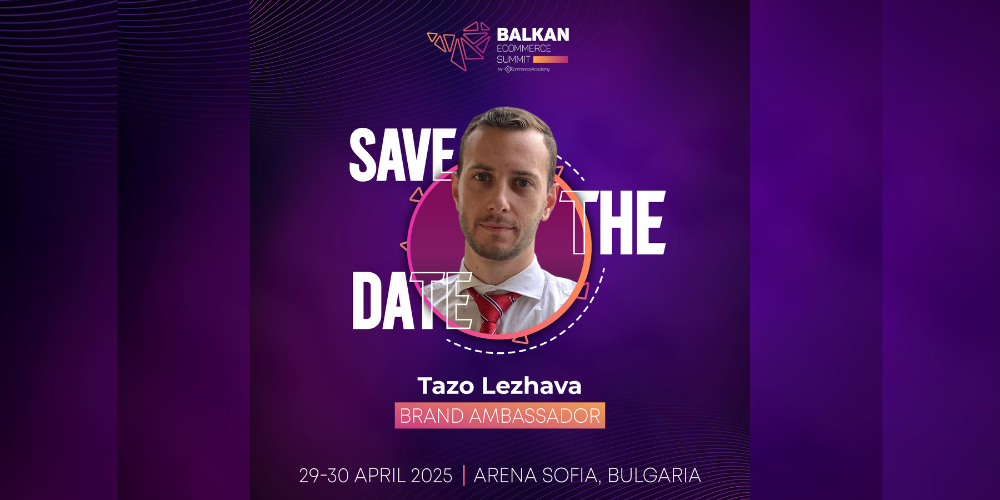
 Tazo Lezhava is the co-founder and CEO of Quissly, an AI-powered platform transforming product discovery and personalization in modern eCommerce. With a background in data science, product leadership, and AI innovation, Tazo has spent the past decade redefining how consumers interact with digital retail.
Now at the helm of Quissly, Tazo is focused on building the next generation of intelligent shopping journeys – experiences that feel more human, more intuitive, and more relevant. In this interview, he reflects on the future of retail AI, what it takes to design truly personalized experiences, and why empathy and technical excellence must go hand in hand in the digital commerce space.
From your perspective, how do events like the Balkan eCommerce Summit contribute to the growth and collaboration within the eCommerce space – particularly in emerging markets? What inspired you to personally get involved as a brand ambassador for this year’s edition?
Events like the Balkan eCommerce Summit are essential for driving both collaboration and visibility in emerging markets. They create a platform for knowledge-sharing between startups, vendors, retailers, and ecosystem builders – helping smaller markets skip legacy systems and adopt modern solutions without needing to reinvent the wheel.
I joined as a brand ambassador because I believe the Balkans and surrounding regions are full of untapped eCommerce potential. There’s hunger, creativity, and agility here – and I want to help accelerate the momentum by sharing what we’ve learned building our AI-native shopping experiences.
What inspired you to launch Quissly, and how did your background in data science, fintech, and AI influence the platform’s direction? What problem in eCommerce are you most passionate about solving?
The idea for Quissly was born from firsthand experience with the pain points in online product discovery from our previous experience in the furniture eCommerce industry. My background in data science and AI, combined with product experience from fintech and HomeView.ai, gave me a clear view of the gap between what shoppers want and what current search systems deliver.
We’re most passionate about solving the disconnect between shopper intent and product catalogs – search results, making it easier for people to describe what they want in their own words and actually find it.
From leading 30+ AI professionals at TBC Bank to building startups like HomeView.ai and Quissly – what are the biggest lessons you’ve learned about building high-performing tech teams and shipping impactful AI products?
One of the biggest lessons I learned throughout my career is that technical excellence isn’t enough – you need tight product intuition and cross-functional trust. At TBC, we built a strong R&D culture by aligning deeply with business units, not just building in isolation. In startups, both Homeview.ai and Quissly, speed and focus matter even more.
You can’t afford over engineered solutions, or perfecting it, as sometimes others invent the parts of the wheel that will aid you and focusing on what you do best and better than others, is the key – so we obsess over impact, feedback loops, and shipping prototypes fast. The best AI teams are those that think beyond models and ask: What’s the actual user problem? Never use AI just for the sake of using AI, all solutions, whether AI-powered or not, should start from the problem.
How do you see machine learning impacting key eCommerce KPIs like customer lifetime value, churn prediction, or pricing sensitivity? Do you have any examples where AI significantly boosted business outcomes?
AI has huge potential to drive core eCommerce KPIs. For example, in my past work, we’ve used machine learning to improve churn prediction and proactively retain at-risk users – resulting in measurable increases in lifetime value. At Quissly, we focus on increasing conversion rates and engagement by personalizing product discovery.
When thinking from a more traditional machine learning perspective, I would have to say that recommendation systems use cases have had the biggest impact. These algorithms are used everywhere, we see ads in social media, find the next TV show to watch on Netflix, etc. and in the eCommerce space, Amazon was one of the first to do it but now almost everyone is using previous purchase history, interactions, and engagement analytics to provide recommendations.
There are many vendors who provide custom landing pages for eCommerce based on these algorithms. I am actually amazed how many eCommerce stores still bypass data driven decision-making. In today’s era, when so much data is collected every second, competition will crush anyone who doesn’t rely on data, it’s just a matter of time. For smaller online shops that can’t set up internal data teams, I would recommend finding service providers, there are so many of them.
What are the most exciting or underrated applications of AI in eCommerce that we’re just starting to see emerge? Could you share any unique approaches you’ve explored – like small language models or custom-built recommendation engines?
I would say the number one emerging trend is the incorporation of LLMs. I think that the space for AI agents in customer service is overcrowded, but AI agents as shopping companions is still in its early stages. Again, Amazon did it first by introducing Rufus, but other product search providers are following. This is exactly why we did it, because like Amazon, we also believe that the future of search is conversational – we already have proof of that in information space with ChatGPT’s example.
Our core technology actually is not AI Agent, it is a solution that guarantees most accurate search by understanding everything about the catalog, previous history, online trends, etc – and the AI Agent, or chat-based product search is just a necessity we see as one of the channels through which we should offer our service to online commerce.
For founders looking to start integrating AI today – where should they begin? Are there specific tools, frameworks, or approaches you’d recommend for validating ideas quickly and scaling effectively?
I will be repeating myself, but every solution should start with the problem. This doesn’t mean that everyone should be aware of the problem, in fact, some of the greatest innovation we’ve seen over the past decades is related to problems that people overlooked or didn’t realize were problems. However, successful solution can’t be created by asking a question “what can this AI do?”, if one sees a cool new AI technology, the only time that should lead into solution creation is if you find clear linkage to an existing problem, and are sure that solving the problem was previously impossible or required an irrationally large amount of effort / resources before this “cool AI” innovation.
Use existing technologies, patch it together, and ship it to validate your hypothesis. Don’t build scalable solutions, probably number 1 advice from Y combinator is to do things that don’t scale. Do things manually, experiment, get feedback, adapt, and try again, and along the way, if you identify a different, but bigger problem you can solve and make more sense, pivot, avoid anchor bias. And once you see traction, invest in making the experience feel native and intuitive. The tech stack matters, but usability is what creates real value.
Tazo Lezhava’s vision for smarter, more intuitive online shopping – powered by AI but rooted in empathy – is a bold glimpse into the future of eCommerce. His journey from data science to building AI-native startups shows what’s possible when technical depth meets relentless product focus. For brands looking to stay ahead, his insights are a wake-up call: personalization isn’t a luxury – it’s the new baseline.
📅 Don’t miss the opportunity to hear from pioneering leaders like Tazo Lezhava at the Balkan eCommerce Summit 2025.
Visit balkanecommerce.com to reserve your spot!