

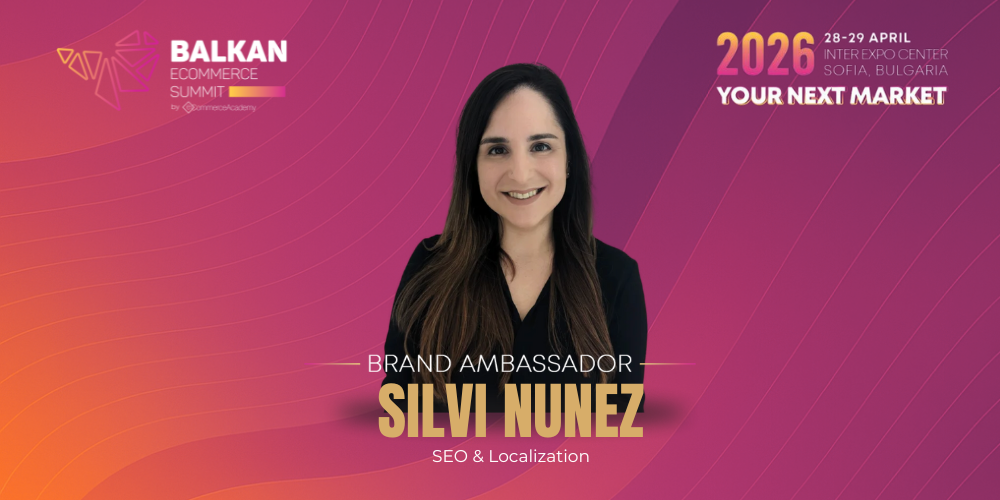
Silvi Nuñez is a translator, marketer, and multilingual SEO specialist. As Co-Founder of Optimational, she helps brands reach new audiences, improve CX, and increase brand awareness through localization and multilingual strategies. Silvi is also passionate about leveraging AI to make localization faster and smarter.
From your perspective, what does being a Brand Ambassador for the Balkan eCommerce Summit enable you to do for the community, and how do you hope to contribute in 2026?
 Being a Brand Ambassador of the Balkan eCommerce Summit allows me to support an event I truly believe in, raise awareness within my network, and help more people understand the value it brings to the region. It also gives me the chance to contribute to a community that is dynamic, forward-thinking, and eager to grow.
By 2026, I hope to help businesses across the Balkans and Eastern Europe strengthen their international presence through better communication practices, smarter localization processes, and a customer-first mindset that can make a real difference in their global performance.
What’s new on your side at Optimational that brands expanding into new markets should know about this year?
Localization has become more important than ever. In today’s AI-driven landscape, personalization is what sets brands apart. Translation alone is no longer enough; companies need to connect with audiences on a deeper and more human level if they want to stand out. At Optimational, we are helping brands move beyond simple translation and build tailored experiences that feel relevant and intentional in every market.
Many teams translate first and optimize later. What are the most common localization mistakes you see, and how do you fix them efficiently?
One of the biggest mistakes is translating without understanding search intent. A keyword that works well in one market may fail completely in another. The solution is to conduct native keyword research and align it with each market’s specific buyer journey, rather than relying on direct translations. When this step is skipped, the results you see from your translation efforts can be misleading, making it harder to know whether the work is paying off.
Because optimization is slow and expensive, I always recommend testing before investing heavily. Take your best-performing pages, around 15 to 20, translate and optimize them properly, and evaluate how they perform. This small-scale test gives teams a clearer idea of what to expect, what needs improvement, and whether the strategy is worth scaling.
How do you measure the impact of multilingual SEO on cross-border growth, what KPIs and diagnostics prove that localization is working beyond “organic sessions”?
Success goes far beyond traffic. Focus should be on relevance and engagement. Metrics such as average session duration, bounce rate, and lead quality per market help us understand whether users trust the localized content and whether it meets their expectations. This provides a clearer picture of performance than traffic alone and shows the true impact of a well-executed multilingual SEO strategy.
Technical angle: what are your go-to recommendations on architecture and governance to keep multilingual sites scalable without losing quality?
Scalability begins with solid planning. Defining localization workflows, permissions, and QA standards early on helps maintain quality as the site grows, and more markets are added.
Maintaining a clean, consistent architecture is also essential. Subdirectories combined with proper hreflang implementation usually offer the best balance between clarity and SEO performance. We also recommend centralizing governance while still allowing local teams to adapt content, so the overall structure remains intact without limiting market-specific flexibility.
Meet Silvi at Balkan eCommerce Summit 2026
Expanding into new markets isn’t just about translating words – it’s about truly understanding your customers and speaking their language, both literally and culturally.
Silvi will be there to share what’s actually working in multilingual SEO, how to build localization strategies that scale without losing quality, and the practical steps that turn international visitors into engaged, loyal customers.
Whether you’re taking your first steps into CEE markets, rethinking how your multilingual site performs, or simply curious about doing localization better – come find her. These conversations often spark the ideas that make the biggest difference.
🎟️ Grab your ticket at balkanecommerce.com and be part of shaping the future of cross-border eCommerce in the Balkans.