

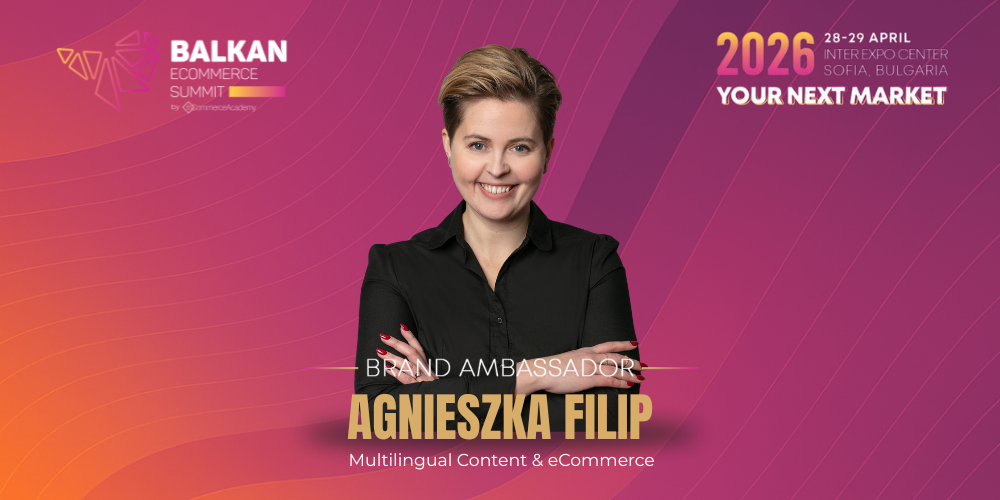
In the world of cross-border eCommerce, being visible isn’t enough – you need to be understood. Agnieszka Filip, founder of e-multicontent and Brand Ambassador for the Balkan eCommerce Summit, has built her career on one core belief: great content doesn’t translate, it transforms. With a team creating content in 35+ languages and results that include +1,116% traffic growth for international brands, Agnieszka knows what it takes to make multilingual strategies work – not just linguistically, but commercially.
Over 18 months, her agency produced 4,000+ SEO-optimised descriptions across six languages for a single client, driving traffic increases from +196% to +1,435% depending on market maturity. But the real story isn’t just in the numbers – it’s in how she connects Polish and Balkan ecosystems, helps brands avoid the three most common localisation mistakes, and builds content that ranks in both Google Search and AI Overviews.
In this conversation, Agnieszka reveals the frameworks, metrics, and mindset that turn language into a competitive advantage across Europe.
As a Brand Ambassador of the Balkan eCommerce Summit, how do you see your role in connecting Polish and Balkan entrepreneurs and what value does this bring to both sides?
 As a Brand Ambassador for the Balkan eCommerce Summit, I see myself as a bridge between two dynamic eCommerce ecosystems: Poland and the Balkan region. At my agency, e-multicontent, we’ve spent years developing on cross-border content strategies, multilingual copywriting, and market-specific localisation.
For Polish businesses, the Balkans offer exciting growth potential – new customer segments, less saturated markets, fresh linguistic and cultural insights. For Balkan businesses, Poland often serves as a hub: strong eCommerce infrastructure, multilingual teams, and real, hands-on experience in scaling online sales and content across Europe. My role is to support both sides:
- Polish companies can better understand Balkan languages, culture, consumer behaviour, and localisation best practices.
- Balkan companies can tap into Polish expertise in copywriting and SEO, and collaborate with an agency that knows how to scale content across multiple languages.
In practice, this means I act as a connector: facilitating introductions, sharing insights into what works in different markets, helping brands avoid common pitfalls in cross-border content, and promoting a community mindset where knowledge flows both ways. My goal is to translate not only language, but also market readiness, content strategy and the mindset needed to succeed internationally.
Many retailers now care about visibility not only in Google Search but also in AI Overviews. What’s your practical approach to creating multilingual content that consistently shows up and converts across multiple markets?
Great question. At e-multicontent, we recognised early on that search visibility today is no longer just about “ranking in Google,” but also about showing up in AI-generated overviews, voice search, and multilingual search layers.
Here’s how we approach it in practice:
- Market-and-language first, SEO second – Before we write anything, we analyse user intent in the specific market and language, local search habits, typical queries, and culturally relevant messaging. Only then do we create the content. This ensures real conversion potential – because the content speaks to the user, not just about the product.
- Native speakers with a marketing lens – We never translate word-for-word. We transcreate. Our team consists of native speakers who also understand marketing logic and eCommerce dynamics. This combination is what makes the content feel natural and persuasive.
- Platform-specific optimisation – Whether it’s a local domain, a marketplace listing (Amazon, Allegro, etc.), or a multilingual blog, we optimise more than keywords. We work on metadata, structured data when needed, and snippet-friendly language, so AI overviews can easily pick up the core message.
- Scaling content while keeping it consistent – One of our strengths is producing content in 35+ languages simultaneously. When expanding across markets, the key is a consistent brand core combined with a tone adapted to each local audience. This ensures visibility across all markets and a unified conversion path.
- Measure and iterate – Visibility looks different in every market: rankings, search volumes, snippet share, conversion rate. We monitor which language versions actually drive leads and sales – and then refine them. That’s how you move from “views” to meaningful business results.
This mix of localisation, optimisation, and continuous iteration is what makes multilingual content truly perform.
Cross-border localisation can go wrong fast. What are the top three mistakes you see when brands expand content into new languages and how should they fix them?
Absolutely – many brands underestimate how complex cross-border localisation really is. Here are the most common mistakes we see, and how we address them:
- Literal translation instead of localisation or transcreation
How to fix it? Bring in native speakers with marketing or eCommerce experience. Make sure the tone of voice, benefits, cultural references, and calls-to-action are adapted, not merely translated. At e-multicontent, we always emphasise that “speaking a foreign language isn’t enough – to build real relationships with international customers, you need to speak their language.”
- Ignoring the local market and skipping SEO/keyword research
To avoid this, carry out full keyword and search-intent research for every target market. What users search in Poland can look very different from queries in Slovenia, Romania, or Greece. Without this step, brands risk becoming invisible. Our job is to ensure that every piece of content is “SEO-optimised without compromising quality.”
- Publishing content without measuring or optimising it
The solution is simple but essential: define clear KPIs for each language version – traffic, conversion rate, bounce rate, snippet share – then monitor and refine. We also advise tailoring content to platform differences (marketplaces vs owned domains). This is where audits and content strategies come in. At e-multicontent, we provide full “Content Audit & Strategy” to support this.
And one more growing issue: over-reliance on machine translation. AI can speed things up, but it can’t replace cultural nuance, brand voice, or the strategic thinking required to make content convert across borders.
These three areas are where localisation succeeds – or fails – the fastest.
Could you share one concrete success story where multilingual content (copywriting + transcreation + SEO) led to measurable business outcomes across two or more European markets? What metrics moved?
Absolutely – one of our strongest examples is our long-term collaboration with bimago, an international home décor brand operating in 10 language versions and selling to over 50 countries. Over 18 months, our multilingual content became a core pillar of their SEO strategy across Europe.
We created more than 4,000 unique, SEO-optimised product and category descriptions in six languages (Polish, English, German, French, Italian, and Spanish). All texts were written directly by native speakers – not translated – allowing us to combine natural language, accurate keyword targeting and clear buyer intent.
The results were exceptionally strong and varied by market, but all moved in the right direction.
Here are some highlights:
Polish market (bimago.pl)
- “Posters” category: +517% traffic year-over-year
- “Wallpapers”: +241%
- “Paintings”: +196%
In subcategories, growth reached as high as +1,435% (Colourful Posters).
German market (bimago.de)
- Modern wall murals: +712%
- Geometric wall murals: +200%
French market (bimago.fr)
- Gustave Courbet reproductions: +876%
- Modern bird-themed paintings: +842%
Italian market (bimago.it)
- Magnolia wallpapers: +367%
- Typography wallpapers: +240%
UK market (bimago.co.uk)
- Floral wall murals: +943%
- Landscape murals: +657%
Spanish market (bimago.es)
- Marine-themed posters: +1,116%
- Metal posters: +568%
What made this project so successful was the combination of:
- native-speaker copywriting,
- rigorous SEO guidelines,
- consistent weekly content delivery across all markets,
- and a clear focus on user intent and cultural expectations in each country.
This synergy of multilingual content + transcreation + SEO delivered traffic increases from 5% to over 1,000%, depending on the market’s initial maturity. Most importantly, the client saw the same pattern everywhere: unique, locally-tailored content directly improved visibility, engagement, and conversion paths.
For bimago, this wasn’t “just more content.” It was a strategic engine that accelerated organic growth across Europe.
On a personal note: what’s the most challenging (or most rewarding) language pair or project you’ve led and what did it teach you about building trust with international audiences?
On a personal level, I’d say one of the most challenging – yet most rewarding – projects has been the transcreation of newsletter and landing page content for a luxury women’s lingerie brand, translating from English into 12 different languages.
Why was it such a challenge?
- Premium audiences expect a very refined tone of voice – something completely different from standard eCommerce copy.
- Each language comes with its own subtle consumer expectations and cultural norms.
- We needed to coordinate multiple native speakers, adapt content for smaller markets, and still ensure the brand felt equally premium in every single language version.
What this project taught me:
- Trust is built through authenticity – when you speak in the customer’s language and reflect their cultural context (even in small or emerging markets), you gain credibility.
- A brand voice has to travel across languages – linguistic accuracy alone isn’t enough; the brand’s personality needs to stay consistent globally while being adapted locally.
- Speed and consistency matter – timing, unified messaging, and simultaneous rollout across markets show that the brand is serious, global, and not just experimenting.
“In the end, customers in these markets say the brand “feels local,” even though it’s international. And that perceived closeness directly strengthens trust, engagement and, ultimately, sales.
Because in eCommerce, language isn’t just a feature-it’s the foundation of every relationship you build.”
Want to dive deeper into multilingual strategies, discuss your cross-border challenges, or explore how localized content can become your competitive advantage?
Meet Agnieszka Filip in person at Balkan eCommerce Summit 2026. As Brand Ambassador of the event, she’ll be there to connect with Polish and Balkan entrepreneurs, share insights from 35+ markets, and help you think through the content strategies that actually move the needle – from +1,116% traffic growth to building trust across borders.
Whether you’re planning your first market expansion or scaling across Europe, this is your chance to sit down with someone who’s built the bridge between words and markets.
🎟️ Grab your ticket at balkanecommerce.com