


Most eCommerce businesses hit a wall: acquisition gets expensive, ops become chaotic, cash gets trapped in inventory, and the founder becomes the “glue” holding it together. The fix isn’t “more marketing.” It’s building a system where revenue can rise without costs and complexity rising at the same pace. This guide is entrepreneur-first: how to tighten unit economics, stabilize inventory, automate marketing, and scale operations – plus a scale readiness checklist and a “choose your model” decision table.
Thinking about entering the global market or expanding across the CEE & the Balkans? Grab your ticket at balkanecommerce.com and be part of building stronger connections across the region.
For additional insights and practical notes from operators, explore strategies from the Balkan eCommerce Summit. And if you’re planning ahead, bookmark 7 eCommerce Predictions for 2026–2027.
Table of Contents
- Understanding eCommerce scaling vs growth – building the foundation for sustainable expansion
- eCommerce inventory management – optimizing stock levels for scalable operations
- eCommerce marketing automation – streamlining customer acquisition and retention
- eCommerce growth strategies – proven methods to grow online store revenue
- How to grow an eCommerce business through operational optimization
- Technology infrastructure and platform scalability for eCommerce expansion
- How to scale brands through strategic partnerships and channel expansion
- Financial planning and resource allocation for sustainable eCommerce scaling
- Measuring success and optimizing performance during eCommerce scaling
- Frequently Asked Questions
Understanding eCommerce scaling vs growth – building the foundation for sustainable expansion
What is eCommerce scaling?
Scaling your eCommerce business means increasing revenue while keeping the marginal cost of delivering that revenue relatively stable – so profit grows faster than sales. Scaling is less about “doing more” and more about building leverage: automation, SOPs, systems, and decision rules that reduce exceptions.
In founder terms: if doubling revenue also doubles the amount of chaos, headcount, support tickets, refund stress, and “where is my parcel?” messages – you’re growing, not scaling.
Key differences between growth and scaling
- Growth: You add resources to add revenue (more ad spend, more people, more suppliers, more SKUs). Results show up – but margins often stay flat because costs rise proportionally.
- Scaling: You improve the system so each additional order costs less time, less labor, fewer mistakes, and less cash pressure.
- Resource efficiency: Growth increases complexity; scaling reduces complexity per order through process and tooling.
- Profit impact: Growth can be a treadmill; scaling creates compounding profitability.
The 3 foundations you need before you “step on the gas”
- Unit economics you can trust – contribution margin per order (after shipping, payment fees, packaging, returns cost, fulfillment labor).
- Repeatable operations – documented SOPs for inventory, fulfillment, returns, and customer service.
- Instrumentation – reliable reporting for inventory, margin by SKU/channel, and conversion funnel (not just topline revenue).
If you want a practical lens on how automation becomes a scaling lever, this is a relevant read: AI-driven automation for eCommerce success.
Choose your scaling model (decision table)
Most eCommerce teams fail by mixing models (premium CX promise with discount CAC, or “fast shipping everywhere” without inventory discipline). Pick your model intentionally, then build systems around it.
| Scaling model | Best fit when… | Primary lever | Core KPI | Watch-outs |
| Margin-led DTC | You have brand equity + repeat purchase potential | Retention + AOV + CRO | Contribution margin + repeat rate | Over-discounting kills margin and brand |
| Operational excellence | Competitive category, broad catalog, shipping matters | Fulfillment cost + delivery performance | OTIF + pick/pack cost per order | Stockouts & late deliveries destroy trust |
| Marketplace-led | You need demand and can handle channel fees | Listing quality + reviews + pricing rules | Margin after fees + return rate | Channel conflict + margin erosion |
| Wholesale/B2B | Predictable reorders, higher AOV, longer terms | Cash cycle + planning | Cash conversion cycle | Receivables can trap cash |
| Subscription/replenishment | Consumables + clear recurring value | Churn reduction + supply continuity | LTV + churn | Stock breaks the model fast |
Now let’s move to the backbone of scaling: inventory.
eCommerce inventory management – optimizing stock levels for scalable operations
Your eCommerce inventory management system is where scaling becomes real. Inventory is cash. Inventory mistakes are margin leaks. And when you scale traffic, inventory problems scale with it.
How to implement automated inventory management for scaling
- Build a SKU truth table (variants, suppliers, lead times, MOQs, landed costs). If the data is wrong, every “forecast” is fiction.
- Demand forecasting by SKU class: treat A-SKUs differently than long-tail. Forecast A weekly, B monthly, cap C exposure.
- Set reorder points and safety stock using lead time + demand variability. Update monthly, not yearly.
- Create channel allocation rules: reserve inventory for your highest-margin channel (often DTC), then allocate the rest to marketplaces/wholesale.
- Close the loop with returns: returns are not “noise.” They’re a demand and quality signal. Track reasons and feed them into purchasing and product fixes.
Practical inventory rules that stop chaos
- Never scale ads on a fragile SKU. If your top SKU has 10 days of stock and 30-day lead time, you’re scaling into refunds.
- Protect A-SKUs, liquidate C-SKUs. Stockouts on A cost growth; overstocks on C cost survival.
- Landed cost or it didn’t happen. If you don’t include duties, packaging, warehousing, and last-mile costs, your pricing and reorder logic will be wrong.
Warehouse workflow (what changes when volume doubles)
At low volume, people can “remember” where things are. At scale, memory becomes error. The upgrade path is simple:
- Slotting (ABC): move fast movers closest to pack stations. Reduce walking time before you hire more pickers.
- Batch picking: group orders with shared SKUs. Time saved compounds.
- Cycle counting: replace annual stocktakes with weekly cycle counts on A items.
- Error logging: every wrong item/size becomes a tag you can fix (labeling, bin rules, QC steps).
Once inventory is under control, marketing automation becomes safe to scale – because you can reliably deliver what you sell.
eCommerce marketing automation – streamlining customer acquisition and retention
eCommerce marketing automation is how you scale revenue without scaling headcount. But the real win isn’t “sending more emails.” It’s building lifecycle flows that monetize traffic you already paid for and increase LTV.
Essential marketing automation strategies for eCommerce growth
- Welcome series: set expectations, bestsellers, social proof, and a single clear first-purchase incentive (if margin supports it).
- Browse abandonment: product reminders + fit/size help + reviews. Works especially well for considered purchases.
- Cart abandonment: diagnose friction first (shipping cost shock, payment failure, delivery speed). Incentives are a last resort, not a default.
- Post-purchase education: reduce returns (instructions, sizing, care), then cross-sell intelligently.
- Winback: segment by customer value and time since last purchase; protect your margin.
 Automation that operators actually use (not “marketing theater”)
Here’s what tends to move the needle the most:
- Abandoned cart that fixes checkout friction (COD option, delivery estimate clarity, failed payment follow-up).
- Post-purchase that reduces returns (especially apparel/beauty/electronics).
- Segmentation by purchase behavior: new vs repeat, high AOV vs bargain, category buyer A vs B.
Email is still commonly cited as one of the highest ROI owned channels, and Litmus reports strong returns on email marketing spend across industries (often quoted around ~$36 per $1, depending on methodology).[2]
For a Balkans ecosystem angle on automation, this is relevant: powering eCommerce automation and growth.
eCommerce growth strategies – proven methods to grow online store revenue
Scaling revenue is not about “finding a hack.” It’s stacking compounding levers: CRO → AOV → retention → channel diversification. The key is sequencing. Do things in the wrong order and you scale inefficiency.
Proven methods to increase online store revenue
- CRO before CAC: fix product pages, trust, delivery clarity, and checkout friction before buying more traffic.
- Increase AOV: bundles, add-ons, thresholds (especially if shipping costs are rising).
- Retention: win the second purchase; most businesses die because they keep paying for “first orders.”
- Category expansion: adjacent products with the same customer and the same logistics profile.
- Channel diversification: marketplaces, affiliates, wholesale – but only with pricing + inventory rules.
- Content & SEO: build predictable demand that isn’t auction-priced.
What “CRO” actually means at operator level
- Trust: clear returns, delivery times, payment options, reviews, and “who we are.”
- Clarity: what it is, who it’s for, how it fits, what problem it solves.
- Friction removal: guest checkout, fewer fields, wallet options, COD where relevant.
- Offer architecture: bundles and thresholds that help your unit economics (not random discounts).
If expansion into the Balkans/CEE is on your roadmap, this helps map where opportunities are emerging: Inside the Balkans: Where the eCommerce opportunities are in 2026.
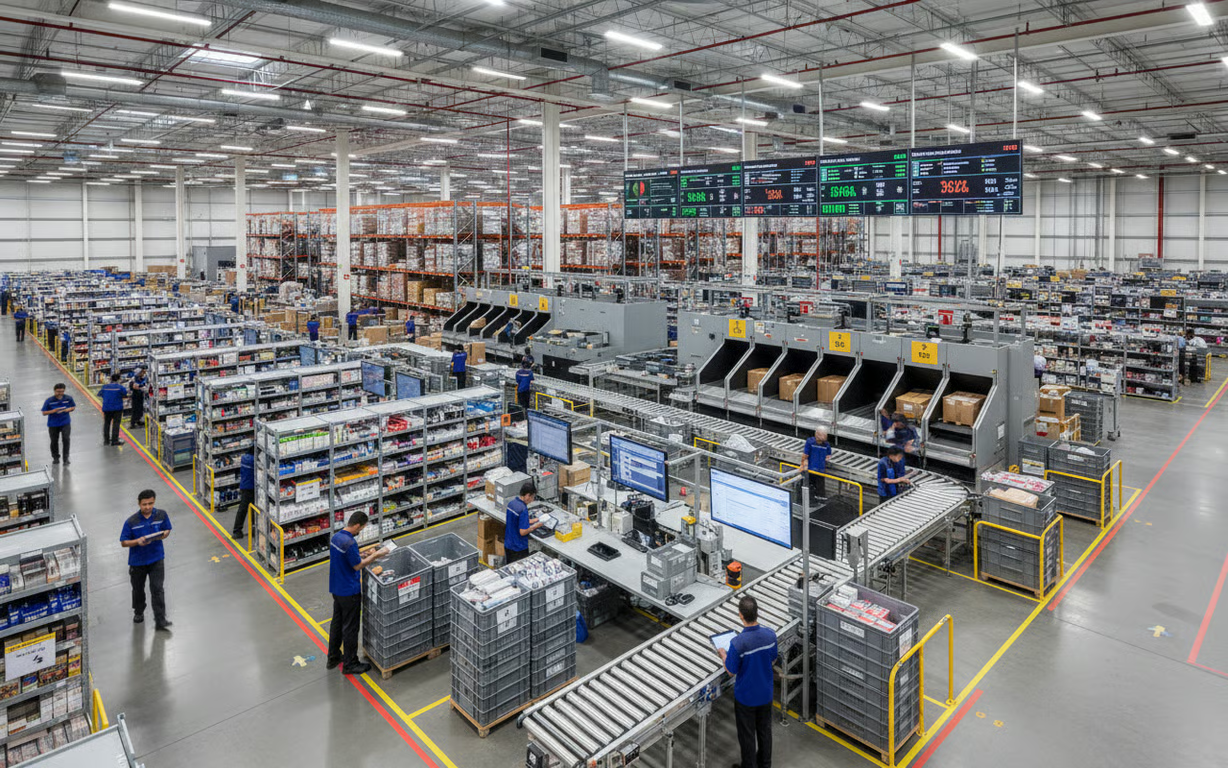 How to grow an eCommerce business through operational optimization
Ops is the unsexy part that decides whether you scale profitably. The goal is to reduce exceptions per 100 orders. If exceptions rise with volume, your margin will collapse.
Priority operational processes for eCommerce scaling
- Supply chain resilience: multi-supplier options, lead time visibility, vendor scorecards.
- Fulfillment efficiency: pick/pack SOPs, batch picking, QC checkpoints, packaging standards.
- Returns management: standardized returns intake, refurb/resell rules, fraud flags.
- Customer service scalability: self-serve tracking, FAQ/knowledge base, tiered support.
- Carrier performance: track on-time %, damage %, claim time, COD reconciliation time.
Scale Readiness Checklist (quick audit)
- Inventory: A-SKUs have reorder points; lead times are known; weekly stockout review exists.
- Fulfillment: error rate is tracked; pick/pack steps are documented; packaging standards exist.
- Delivery: carrier SLAs tracked; delivery expectations are visible at checkout.
- Returns: top 3 return reasons known; returns process is self-serve; refund SLA defined.
- Support: tickets per 100 orders tracked; top topics are deflected via FAQ/UX fixes.
- Economics: contribution margin by SKU/channel visible; promo rules protect margin floors.
Technology infrastructure and platform scalability for eCommerce expansion
Your tech stack should reduce friction and create clean data – otherwise you scale confusion. The biggest risk isn’t “outgrowing Shopify/Magento,” it’s running disconnected systems that lie to you.
Essential technology requirements for scalable eCommerce
| Technology Component | Scalability Features | |
| Ecommerce Platform | High traffic capacity, robust APIs, flexible checkout | Choose based on ops/integrations first; themes second |
| Website Performance | CDN, caching, image optimization, script hygiene | Speed impacts revenue; slower mobile pages lose users quickly[1] |
| Integration Layer | Webhooks/APIs, monitoring, conflict resolution | Inventory + orders + refunds must reconcile cleanly |
| Security | MFA, access roles, backups | Scaling increases risk surface—reduce admin sprawl |
| Automation | Rule-based workflows, exceptions handling | Automate repeatable work, not broken processes |
If you’re looking at Shopify-style expansion patterns in the region, this is relevant context: how Balkan brands are going global with Shopify.
How to scale brands through strategic partnerships and channel expansion
Partnerships scale faster than hiring if you treat them like a channel with clear economics and rules. The mistake is “doing partnerships” without ownership, margin floors, or measurement.
How to identify and develop strategic partnerships for brand scaling
- Map your customer journey and identify adjacent businesses that already have your audience (complementary, not competing).
- Pick the partnership type: demand (affiliates/influencers), distribution (retail/wholesale), capability (3PL/logistics), or tech (platform partners).
- Define rules: pricing floors, promo calendar, inventory allocation, return ownership, support ownership.
- Start with a test (30–60 days) with clear KPIs (margin, CAC, return rate, delivery performance).
- Operationalize: assets, UTMs, reporting cadence, and a single owner internally.
Financial planning and resource allocation for sustainable eCommerce scaling
Many eCommerce businesses don’t fail because demand is missing – they fail because cash gets trapped: in inventory, returns, chargebacks, and delayed payouts. Scaling requires a cash discipline layer.
Critical financial metrics for sustainable eCommerce scaling
- 13-week cash forecast: updated weekly; include inventory buys, ad spikes, and payout delays.
- Contribution margin by channel: DTC vs marketplaces vs wholesale (different fee and return profiles).
- Cash conversion cycle: how fast cash turns from spend → inventory → sale → payout.
- LTV:CAC ratio: use benchmarks as guardrails (3:1 is a commonly referenced baseline, adjusted for margin and payback).[3]
- Return/refund load: returns are a cash event, not just a CX event.
Resource allocation rules (so you don’t scale the wrong thing)
- Invest first in stability (inventory accuracy, fulfillment error reduction) before you invest in more demand.
- Invest next in conversion (CRO + checkout + trust), because it improves unit economics instantly.
- Invest then in retention (automation + lifecycle), because it reduces CAC dependence.
Measuring success and optimizing performance during eCommerce scaling
Scaling is a measurement game. But you don’t need 200 metrics. You need the right 12, reviewed weekly/monthly, tied to actions.
Essential KPIs for monitoring eCommerce scaling success
- Financial: contribution margin, CAC, payback period, LTV, gross margin.
- Conversion: mobile conversion, checkout completion, add-to-cart rate, abandonment by step.
- Operations: pick/pack error rate, OTIF delivery, returns rate and reasons, tickets per 100 orders.
- Inventory: stockout rate (A-SKUs), inventory turnover, aged inventory value.
Optimization rhythm that scales
- Weekly: stockouts, delivery performance, support load, promo impact.
- Monthly: margin by channel, cohort retention, top return reasons, CAC/payback trends.
- Quarterly: SKU rationalization, supplier renegotiation, channel strategy decisions.
Frequently Asked Questions
- What’s the difference between scaling and growing an ecommerce business? Growth increases revenue with proportional increases in cost/complexity. Scaling increases revenue while keeping marginal costs and complexity under control through automation, SOPs, and better unit economics.
- When should I start implementing inventory management automation? Before chaos. Once manual reordering becomes unreliable due to SKU count, supplier lead times, promos, or multi-channel sales, you need reorder points + safety stock + inventory accuracy workflows.
- Which marketing automation tools provide the best ROI for eCommerce businesses? Start with lifecycle automation (welcome, browse/cart abandonment, post-purchase, winback). Email is commonly cited as high ROI when executed well.[2]
- How do I know if my eCommerce platform can handle increased traffic? Track page speed, checkout completion, and error rates during peaks. If conversion drops or checkout fails during spikes, the platform/stack is becoming a growth bottleneck.
- What financial metrics should I track when scaling my eCommerce business? Contribution margin by SKU/channel, CAC and payback, LTV, cash conversion cycle, returns/refunds as a cash load. Many teams use LTV:CAC benchmarks like 3:1 as a guardrail, adjusted for margin and payback window.[3]
- How can I scale my brand without losing quality control? Document SOPs, track error rate, add QC checkpoints, and close the loop with returns and support tags. Scaling is reducing exceptions per 100 orders, not just shipping more boxes.
- What’s the best approach to international expansion for eCommerce businesses? Expand into markets where logistics and payment friction are manageable, test with a limited assortment, and lock pricing + returns + delivery promises before scaling spend.
- How much should I invest in technology infrastructure before I need it? Enough to handle 2–3x current volume and integrate cleanly (inventory, fulfillment, marketing, support). Avoid overbuilding – invest in data correctness and automation first.
- What are the most common mistakes businesses make when scaling? Scaling demand on unstable operations, ignoring cash cycles, discounting without margin floors, and treating inventory as “a warehouse problem” instead of a profit/cash lever.
- How do I measure the success of my scaling efforts? Look for improving contribution margin, stable or improving CAC/payback, reduced operational errors, fewer support tickets per 100 orders, and fewer stockouts on A-SKUs.