

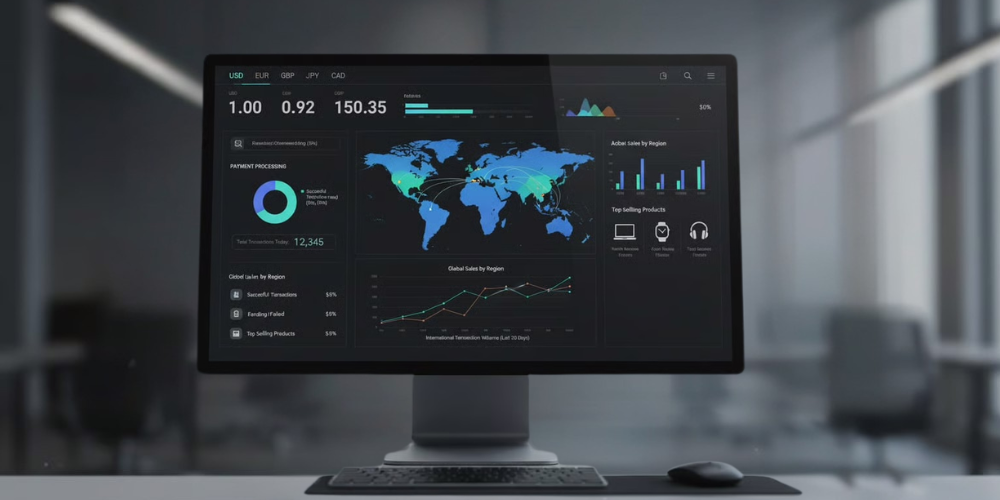
Multi-currency eCommerce setup transforms your online store into a regional powerhouse by displaying prices in customers’ local currencies – from Romanian Leu (RON) to Polish Zloty (PLN) – processing payments without conversion confusion, and creating authentic localized shopping experiences that increase cross-border conversion rates in Eastern Europe by 15-30%.
Imagine trying to shop on a website where all the prices are in a currency you don’t recognize and you have no idea what the actual cost will be after cross-border bank fees. Frustrating, right? That’s the reality for many CEE customers if you force them to shop in Euros or USD. This guide provides a field-tested roadmap for creating a seamless, localized shopping experience that converts regional visitors into loyal customers. Let’s dive into how you can speak the language of local commerce and unlock new revenue streams, especially by understanding the eCommerce opportunities in the Balkans.
Table of Contents
- What is Multi-Currency eCommerce Setup in a Fragmented CEE Market
- Regional & Global Payment Solutions – Essential Components
- Cross-Border eCommerce Benefits and Challenges in the Balkans
- eCommerce Localization Strategies for CEE Markets
- Multi-Currency Shopify Setup and Configuration
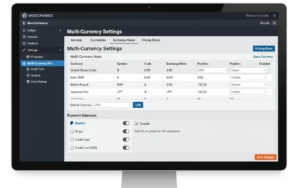
- Multi-Currency WooCommerce Implementation Guide
- CEE Payment Processing Best Practices
- Technical Implementation and Testing Strategies
- Measuring Success and Optimizing Regional Payment Solutions
- Frequently Asked Questions
What is Multi-Currency eCommerce Setup and Why It Matters for CEE
What is Multi-Currency eCommerce?
A comprehensive multi currency eCommerce setup transforms your cross-border eCommerce platform into a dynamic system that automatically detects whether a customer is browsing from Sofia, Bucharest, or Belgrade, displaying prices in Bulgarian Lev (BGN), Romanian Leu (RON), or Serbian Dinar (RSD) accordingly. It processes payments without forcing them through confusing conversion calculations. Think of it as your digital storefront speaking fluent “local commerce” across the highly fragmented European map.
Why Multi-Currency Matters for Regional Success
- Customer Preference: Research consistently shows that over 90% of Eastern European shoppers prefer making purchases when prices appear in their national currency.
- Cart Abandonment Reduction: Shoppers in non-Eurozone countries will frequently abandon their cart if forced to calculate EUR to local currency exchange rates mentally.
- Trust Building: Familiar currency symbols and culturally normal price points eliminate the mental friction that kills conversions in markets where online trust is still growing.
- Strategic Pricing: Enables sophisticated pricing strategies based on local purchasing power rather than rigid exchange rate conversions that might make your product look artificially expensive in North Macedonia but underpriced in Poland.
Regional & Global Payment Solutions – Essential Components
Core Components of CEE Payment Infrastructure
Building effective payment solutions for the Balkans and CEE requires understanding that you are not dealing with a monolith. The payment infrastructure becomes the backbone of regional growth, bridging deep technological adoption (like Poland’s mobile payment dominance) with cash-heavy legacies (like the rural Balkans).
- Multi-Currency Payment Gateway: A central nervous system handling real-time currency conversion that ideally integrates with local acquiring banks in CEE to lower fees.
- Regional Payment Methods: Support for BLIK and Przelewy24 in Poland, PayU across the region, TBI Bank for BNPL in the Balkans, and robust Cash on Delivery (COD) management.
- Security and EU Compliance: Built-in compliance features that automatically handle GDPR data protection laws and PSD2 (Strong Customer Authentication) requirements.
- Payment Orchestration: Routing transactions through different processors based on whether the payment is in HUF, CZK, or PLN to ensure maximum approval rates and minimum banking friction.
Your multi currency payment gateway serves as the central nervous system of regional commerce. You need to support region-specific payment methods that customers actually use. In Poland, BLIK is absolute king. In Romania, instant card payments are growing, but flexible installment plans (BNPL) are crucial. Your payment solution should accommodate these preferences alongside traditional global wallets like Apple Pay and Google Pay.
Cross Border eCommerce Benefits and Challenges
Key Benefits of Cross-Border CEE eCommerce
- Market Expansion: The broader CEE region, where cross-border commerce shows no signs of slowing in 2024, offers a rapidly maturing market of over 100 million digitally adapting consumers.
- Revenue Diversification: Different economic conditions mean peak seasons and purchasing behaviors vary between the Baltics, Central Europe, and the Balkans.
- Lower Customer Acquisition Costs (CAC): Advertising on Meta or Google in Serbia, Bulgaria, or Romania is often significantly cheaper than in the US, UK, or Germany.
Major Challenges in Regional Operations
- Currency Fluctuation Risk: Exchange rate swings (e.g., HUF to EUR volatility) can eliminate profit margins.
- Complex Logistics vs. Payment Linkage: Because COD remains high in the Balkans, linking currency exchange rates at the time of order versus the time cash is actually collected by the local courier presents unique accounting challenges.
- Regulatory Compliance: Navigating customs and distinct tax structures when shipping between EU (Romania, Bulgaria, Croatia) and non-EU Balkan states (Serbia, North Macedonia, Bosnia).
eCommerce Localization Strategies for CEE Markets
Strategic Pricing and Payment Localization
Effective eCommerce localization in Eastern Europe transforms your website from a foreign store into a local shopping destination. This means adapting to cultural norms and very specific psychological pricing.
- Market-Specific Pricing: A €50 product translates to roughly 20,000 Hungarian Forints. You must use localization rules to round this to a psychologically appealing number (e.g., 19,990 HUF) rather than an ugly auto-converted 19,842 HUF.
- Regional Payment Preferences: Do not hide Cash on Delivery if you are selling in the Balkans – it is a trust mechanism. Alongside it, prominently display local BNPL providers.
- Localized Customer Service: Balkan consumers highly value phone support. Providing a localized phone number builds immense trust in a region previously burned by cross-border online scams.
Multi Currency Shopify Setup and Configuration
How to Set Up Multi-Currency on Shopify for the Balkans
- Enable Shopify Payments: Activate Shopify Payments (where available) or integrate robust third-party gateways that support local CEE currencies.
- Configure Shopify Markets: Define target countries (e.g., a “Western Balkans” market vs. an “EU CEE” market) with automatic customer location detection.
- Set Up Currency Rules: Configure market-specific rounding rules to ensure prices in RSD or BGN look natural.
- Integrate Local Delivery Apps: Ensure your checkout can handle OOH (Out-of-Home) locker deliveries (like Sameday’s easybox or InPost), which are massive in the region.
Setting up a localized storefront provides one of the most streamlined paths to regional expansion, a strategy clearly seen in how 70% of Balkan brands are going global with Shopify. The platform’s native support through Shopify Markets eliminates many technical hurdles while allowing you to exclude certain products from specific Balkan markets if they face non-EU customs restrictions.
Multi Currency WooCommerce Implementation Guide
Step-by-Step WooCommerce Multi-Currency Setup
- Choose a CEE-Friendly Plugin: Select robust currency switchers that play well with local payment gateway plugins (like PayU or Stripe).
- Configure Geolocation Detection: Set up automatic currency detection based on IP, but always leave a manual dropdown – many expats in the region shop across borders.
- Set Up Exchange Rate Updates: Configure automatic updates pulling from reliable regional sources, or set manual safety buffers to protect against volatile currency days.
- Test COD Workflows: Ensure that if a user selects Cash on Delivery, the final invoice generated for the local courier matches the exact local currency amount down to the penny.
Implementing multi currency functionality in WooCommerce requires ensuring that your chosen payment gateways support multiple CEE currencies. Configure these gateways to process payments natively rather than converting everything to EUR or USD, which saves the customer from hidden bank fees.
CEE Payment Processing Best Practices
Mastering international payment processing requires balancing security, compliance, and customer experience. These insights frequently echo the best practices and strategies from the Balkan eCommerce Summit.
- Transparent Pricing: Display all costs including VAT, customs duties (crucial for non-EU Balkans), and shipping in the customer’s currency before checkout.
- Smart Fraud Detection vs. False Positives: CEE cross-border transactions can sometimes trigger overzealous Western fraud filters. Use local acquiring banks when possible to improve legitimate approval rates.
- Currency Conversion Options: Offer customers the choice between dynamic currency conversion at checkout or keeping the transaction in the base currency.
Technical Implementation and Testing Strategies
Technical Architecture Requirements
- Currency Management System: Systems that handle real-time exchange rate updates with fallbacks to local central banks (e.g., pulling rates from the National Bank of Romania or National Bank of Serbia).
- Database Design: A strategic approach to storing base prices while logging the exact conversion rate at the time of the transaction – essential for CEE tax audits.
Comprehensive Testing Protocol
- Price Display Accuracy: Test rounding rules consistency. 99.99 PLN looks normal; 99.99 HUF is practically worthless. Rounding logic must be currency-aware.
- Edge Case Testing: Test promotional codes across currencies. A “10 OFF” coupon needs to know if it’s subtracting 10 EUR, 10 RON, or 10 RSD.
Measuring Success and Optimizing Regional Payment Solutions
Key Performance Metrics for CEE Success
- Conversion Rates by Currency: Track which Balkan segments respond best to localization efforts.
- Digital Payment Adoption Rate: Monitor the shift from COD to card/digital wallets in specific countries to gauge market trust.
- Customer Acquisition Cost by Market: Calculate true costs, noting that CAC in Bulgaria or Albania might be a fraction of what it is in Western Europe.
Implementing a localized eCommerce setup in Eastern Europe is an ongoing process of refinement. By continuously monitoring these metrics and adapting your strategies, you can unlock significant regional revenue growth. For a forward look at what’s next in the region, consider the eCommerce predictions for 2026-2027 that will transform the industry landscape.
Frequently Asked Questions
- What’s the difference between multi-currency display and multi-currency processing? Display-only shows prices in local currencies (like RSD or BGN) but processes payments in your base currency (like EUR). True multi-currency processing actually charges the customer’s card in their local currency, saving them from unexpected bank conversion fees and dramatically increasing trust.
- How do I handle COD alongside multiple currencies? Your platform must lock the exchange rate at the time of the order. The invoice sent to the local courier (e.g., Econt in Bulgaria, Fan Courier in Romania) must be in their national currency so the driver collects the exact right amount of cash.
- Which payment methods should I prioritize for CEE expansion? Prioritize card processing and Cash on Delivery first. In specific markets, adopt local heroes: BLIK in Poland, PayPo/TBI Bank for installments, and mobile banking integrations in Romania.
- How do I handle taxes and compliance across EU and non-EU Balkan states? EU countries (Poland, Romania, Bulgaria) fall under the OSS (One Stop Shop) VAT scheme. For non-EU states (Serbia, North Macedonia), you must configure your checkout to clearly display customs duties or explicitly state that the customer is responsible for import taxes upon delivery.
- How do I improve checkout conversion rates for Balkan customers? Display total costs in their local currency, integrate mapping APIs for Out-of-Home parcel lockers, provide a localized phone number for trust, and ensure your checkout is highly mobile-optimized.