


Serbia’s eCommerce market reached US$3.61 billion in 2025 (per Mordor Intelligence) and is tracking toward US$5.26–5.9 billion by 2031–2032. With 85.4% internet penetration, 91.3% of users accessing platforms multiple times daily, and the Belgrade–Budapest high-speed rail now operational for freight since February 2026, the market window is open – but the competitive clock is ticking.
Key takeaway: Serbia combines the digital maturity of a developed market (smartphone penetration, instant payments infrastructure, strong marketplace players) with the growth rates of an emerging one (6.48–7.1% CAGR through 2031–2032, 30%+ YoY instant payment growth). The opportunity lies in understanding regional behavior – urban millennials in Belgrade and Novi Sad expect Western-grade UX, while rural buyers still rely on cash on delivery.
The real opportunity lies in understanding how Serbian consumers actually behave online – where they spend, what they trust, and which infrastructure gaps you’ll need to navigate. This market generated US$3.61 billion in 2025 and is tracking toward US$5.26–5.9 billion by 2031–2032, driven by mobile-first behavior, improving logistics, and government investment in digital infrastructure. If you’re evaluating Southeast European expansion, the data makes a compelling case for prioritizing Serbia now, before the competitive window narrows.
Table of Contents
- Serbia Market Overview: Current Landscape and Digital Transformation
- Market Size and Revenue Projections for Serbia’s eCommerce Sector
- Consumer Behavior and Online Shopping Trends
- Product Categories Driving eCommerce Growth in Serbia
- Payment Methods and Financial Infrastructure
- Key Growth Drivers Propelling Serbia’s eCommerce Expansion
- Challenges and Barriers to eCommerce Market Development
- Competitive Landscape and Leading Market Players
- Regional Opportunities: Belgrade, Novi Sad, and Emerging Markets
- Strategic Recommendations for Entering Serbia’s eCommerce Market
- Frequently Asked Questions
Serbia Market Overview: Current Landscape and Digital Transformation
If you’re evaluating emerging markets in Southeast Europe, Serbia deserves serious attention. The country sits at a genuine inflection point in its digital transformation, with internet penetration reaching 85.4% of the population – a connectivity baseline that rivals many Western European nations. According to the Statistical Office of the Republic of Serbia, 91.3% of internet users access online platforms multiple times daily, meaning your potential customers aren’t just connected; they’re habitually online.
The infrastructure story is equally compelling. Some 85.6% of Serbian households maintain active internet connections, and 75.9% have desktop computing capabilities. That dual-screen environment – mobile for discovery, desktop for considered purchases – mirrors patterns you’d recognize from more mature markets. Approximately 70% of the population had completed at least one digital purchase by 2021, and pandemic-era restrictions accelerated that adoption curve significantly, reshaping retail consumption habits across both urban centers and rural communities. Total annual parcel deliveries in Serbia exceeded 60 million in 2025, up from 56 million a year prior – a tangible signal that logistics capacity is scaling alongside consumer demand.
For eCommerce professionals, this isn’t a Serbia market you’re educating from scratch. The foundation is already in place, and the consumer readiness signals are strong. What matters now is understanding the specific behavioral patterns, payment preferences, and regional variations that will determine whether your market entry succeeds or stalls. Note also that Serbia is not an EU member – it uses the Serbian dinar (RSD) rather than the euro, which creates both pricing complexity for cross-border merchants and a distinct regulatory environment compared to Bulgaria, Romania, and other nearby EU markets.
Serbia’s Digital Foundation at a Glance
- Internet penetration: 85.4% of the population, rivalling many Western European nations
- Daily platform access: 91.3% of internet users connect multiple times per day
- Household connectivity: 85.6% of Serbian households maintain active internet connections
- Desktop capability: 75.9% of households have desktop computing capabilities
- Digital purchase adoption: Approximately 70% of the population had completed at least one digital purchase by 2021
- Annual parcel deliveries: Over 60 million in 2025, up from 56 million in 2024
Market Size and Revenue Projections for Serbia’s eCommerce Sector
The numbers tell a story of consistent, compounding momentum. Serbia’s eCommerce market generated US$710.7 million in 2022, climbing to US$955.7 million in 2023 – a 34.5% year-over-year increase that signals genuine consumer migration toward digital channels, not just pandemic-driven anomalies. By 2025, Mordor Intelligence placed the market size at US$3.61 billion, with projections pointing to US$3.84 billion in 2026. This growth aligns with insights from industry experts, such as Nikola Ilchev, founder of Balkan eCommerce Summit 2025, who highlighted Serbia’s eCommerce market surpassing $1 billion.
A note on methodology: Different research houses measure Serbia’s market with different scopes, producing headline figures that range widely. Mordor Intelligence’s US$3.61 billion (2025) captures a broad definition including B2C physical goods plus adjacent digital commerce activity. Statista’s narrower B2C physical-goods definition pegs 2025 revenue at around US$1.13 billion. ECDB reports an even narrower figure (US$852 million in 2024). Earlier U.S. Trade Administration forecasts anticipated turnover approaching US$1.65 billion by 2027 at roughly 14.65% CAGR. Choose the methodology that matches your business scope – and recognize that all sources confirm the same directional story: consistent double-digit or high-single-digit growth.
Looking further out, the trajectory remains strong. Industry analysts forecast the market reaching US$5.26 billion by 2031, supported by a compound annual growth rate of 6.48% through that period (Mordor Intelligence). Alternative modeling from Verified Market Research suggests the market could achieve US$5.9 billion by 2032, reflecting a 7.1% CAGR.
Regardless of which model you weight most heavily, both scenarios confirm the same strategic conclusion: Serbia’s eCommerce market potential is on a durable upward trajectory that rewards early positioning. The revenue growth isn’t speculative – it’s already happening, backed by infrastructure investment, rising consumer confidence, and expanding product category adoption. That combination creates a window for market entrants who move decisively now, before the competitive landscape consolidates.
Serbia eCommerce Revenue Projections
| Year | Projected Market Size | Source & Notes |
|---|---|---|
| 2022 | US$710.7 million | Baseline year (Statista/Trade.gov) |
| 2023 | US$955.7 million | 34.5% YoY increase |
| 2024 | US$852 million (narrow) – US$3.4 billion (broad) | ECDB narrow scope vs. Verified Market Research broad scope |
| 2025 | US$1.13 billion (Statista B2C) – US$3.61 billion (Mordor) | Methodology-dependent range |
| 2026 | US$3.84 billion (Mordor) | Near-term broad-scope projection |
| 2027 | US$1.65 billion (narrow scope) | ~14.65% CAGR (Trade.gov/Statista earlier forecast) |
| 2030 | US$5.04 billion (Mordor) | 6.89% CAGR 2025–2030 |
| 2031 | US$5.26 billion (Mordor) | 6.48% CAGR through 2031 |
| 2032 | US$5.9 billion (Verified Market Research) | 7.1% CAGR 2025–2032 |
Consumer Behavior and Serbia Online Shopping Trends
Understanding how Serbian consumers actually shop online is where strategy gets interesting – and where the data reveals nuances you’ll need to account for. Fashion dominates as the leading category by adoption, with 77.7% of internet users purchasing clothing and sportswear through digital channels according to the Statistical Office of the Republic of Serbia.That’s a remarkably high penetration rate reflecting both category accessibility and growing comfort with size and fit decisions made online.
Younger demographics drive the highest transaction frequency. The 16–24 age cohort completes 3–5 online transactions per quarter at rates of 40.8%, while the 65–74 segment concentrates digital purchases in electronics (16.5%) and medicines (12.9%). That generational split matters for targeting and messaging – what converts a 22-year-old fashion buyer won’t resonate with a 68-year-old purchasing prescription refills.
Online Shopping Behavior by Age Cohort
| Age Group | Behavior Pattern | Preferred Categories |
|---|---|---|
| 16–24 | 3–5 online transactions per quarter at rates of 40.8% | Fashion, entertainment, lifestyle |
| 25–34 | 99.3% prefer domestic sellers; 18.5% cross-border EU purchases | Broad category engagement |
| 55+ | Only 30% engage eCommerce platforms | Utilitarian purchases |
| 65–74 | Concentrated digital purchases | Electronics (16.5%), medicines (12.9%) |
Trust dynamics add another layer of complexity. Cash on delivery retained 62% of rural transaction volume in 2023, reflecting persistent caution around card-not-present fraud. Only 30% of citizens over 55 engage eCommerce platforms, compared to 70% penetration among younger demographics. Perhaps most telling for localization strategy: 99.3% of 25–34 year-olds prefer domestic sellers, while cross-border EU purchases reached just 18.5% in that same cohort.Understanding the benefits of cross-border eCommerce can help businesses unlock global market access and international business expansion, even in markets with strong local preferences.
Serbian consumers are digitally active but locally anchored – a pattern that rewards market-specific investment over generic pan-European approaches. If you’re planning to enter this market, your checkout flow, payment options, and trust signals need to accommodate both digitally confident urban millennials and more cautious rural buyers who still rely on cash settlement. Trying to force a single customer experience across these segments will cost you conversions. These shopping preferences and consumer behavior patterns define how you should structure your Serbia online shopping experience, and digital literacy gaps require thoughtful accommodation rather than forced standardization.
Product Categories Driving eCommerce Growth in Serbia
Consumer electronics commands the largest revenue share in Serbia’s digital retail landscape, representing 27.40% of total eCommerce revenue in 2025 according to Mordor Intelligence data. The Statistical Office confirms that 25.3% of internet users purchased electronic equipment online, and platforms like Gigatron and Tehnomanija have responded by investing in automated fulfillment infrastructure to maintain service standards amid supply-chain volatility. Electronics buyers tend to be research-intensive, which means your content strategy and product detail pages need to work harder in this category.
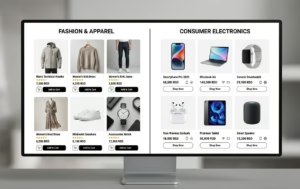
Fashion and apparel represents the fastest-expanding segment, projected to grow at an 8.55% compound annual rate through 2031. With 77.7% online adoption – the broadest consumer reach of any category – fashion platforms are deploying virtual try-on and AI-driven size recommendation tools to reduce return rates. Fashion Company raised USD 20 million in March 2025 specifically to fund omnichannel technology including virtual fitting rooms, signaling where category leaders see the competitive battleground shifting.
Top Performing eCommerce Product Categories in Serbia
- Consumer electronics: Largest revenue share at 27.40% of total eCommerce revenue in 2025; 25.3% of internet users purchased electronic equipment online; research-intensive buying behaviour demands strong content and product detail pages
- Fashion and apparel: Fastest-expanding segment projected to grow at an 8.55% compound annual rate through 2031; broadest consumer reach at 77.7% online adoption; virtual try-on and AI-driven size tools are actively reducing return rates
- Beauty and personal care: Recording double-digit online adoption rates; growing consumer comfort with everyday lifestyle purchasing online
- Food and beverages: Recording double-digit online adoption rates; signals expansion of digital purchasing beyond traditional categories
- Furniture and home goods: Recording double-digit online adoption rates; emerging opportunity for category specialists before the segment matures
Beyond these two anchor categories, beauty and personal care, food and beverages, and furniture are all recording double-digit online adoption rates – a sign that Serbian consumers are expanding their digital purchasing comfort well beyond electronics and apparel into everyday lifestyle categories. If you’re entering the Serbia market, electronics and fashion offer the clearest path to scale, but the emerging strength in beauty, grocery, and home goods suggests there’s room for category specialists to build defensible positions before these segments mature. These product categories and consumer goods trends define where the immediate revenue opportunities lie.
Payment Methods and Financial Infrastructure
Serbia’s payment landscape is in active transition, and how you configure your checkout experience will directly affect conversion rates. Credit cards and debit cards usage recorded steady year-over-year increases in online transaction volume according to National Bank of Serbia data – but cash on delivery still held 62% of rural transaction share in 2023. These two realities coexist, and any serious market entry strategy needs to accommodate both rather than forcing consumers toward a single payment path.
The most significant infrastructure development is the National Instant Payments System (IPS NBS), which eliminated clearance latency and enabled real-time settlement. The number of instant payment transactions rose 30.2% year-on-year in 2024, reaching 87.2 million total transactions per the National Bank of Serbia – a steady, compounding adoption curve rather than a one-time spike. Forward-thinking retailers are prioritizing mobile wallet integration and dynamic QR acceptance at checkout. Digital payments and digital wallets are projected to grow at an 11.98% compound annual rate through 2031 (Mordor Intelligence), driven by biometric authentication features that address security concerns while reducing the failed delivery incidents that plague cash-on-delivery logistics. In February 2025, Mastercard partnered with ALTA PAY GROUP and PAYSPOT to embed mobile-wallet infrastructure, a move explicitly aimed at curbing cash-on-delivery dependency.
For your payment stack, IPS NBS integration isn’t optional – it’s the infrastructure layer that unlocks frictionless conversion among Serbia’s growing digitally fluent consumer base. At the same time, maintaining cash-on-delivery as a fallback option keeps you accessible to rural buyers and older demographics who aren’t yet comfortable with card-not-present transactions. The businesses winning in this market are those offering payment flexibility, not payment mandates. These payment methods considerations directly impact your Serbia eCommerce market potential and conversion performance.
Serbia Payment Method Landscape
| Payment Method | Key Metric | Strategic Implication |
|---|---|---|
| Credit and debit cards | Steady YoY increase in online transaction volume | Growing adoption among digitally fluent segments |
| Cash on delivery | 62% of rural transaction share in 2023 | Must be retained to serve rural and older demographics |
| Instant Payments (IPS NBS) | 30.2% YoY growth in 2024; 87.2 million total transactions | Core infrastructure layer for frictionless conversion |
| Digital wallets | 11.98% CAGR projected through 2031 (Mordor Intelligence) | Biometric authentication driving adoption and reducing failed deliveries |
Key Growth Drivers Propelling Serbia’s eCommerce Expansion
Mobile is the primary engine. Smartphone usage accounted for 67.20% of transaction volume in 2025 according to Mordor Intelligence, and with 91.3% of internet penetration users accessing platforms multiple times daily via mobile devices, the engagement frequency creates persistent touchpoints that compress purchase cycles. Push notifications, location-based promotions, and one-click reorder workflows aren’t nice-to-haves in this market – they’re the mechanics that drive conversion across fashion, electronics, and grocery verticals.
The government’s Serbia Digital Agenda 2026 adds a structural tailwind that’s easy to underestimate. The initiative channels USD 100 million into applied AI, cloud infrastructure, and cybersecurity platforms, while digital-skills grants have lifted the share of firms trading online to 27.9% – widening the merchant base well beyond Belgrade and Novi Sad. In April 2025, the government rolled out a USD 30 million Digital Serbia Initiative specifically targeting digital-skills training, start-up incubation, and rural connectivity. On the logistics side, Pan-European Corridor X motorway upgrades, backed by a USD 388 million World Bank loan, are reducing fulfillment cost-per-parcel and enabling later cut-off times.
The Belgrade-Budapest high-speed rail is the infrastructure story most people get wrong. The Serbian section (Belgrade via Novi Sad to Subotica on the Hungarian border) opened on October 8, 2025, but the full cross-border line didn’t become operational until February 27, 2026, when freight service began on the Hungarian section between Budapest-Ferencváros and Kelebia. The project’s target is to reduce Belgrade–Budapest travel time from 8 hours to approximately 3h 15m, though actual performance is currently constrained by ETCS signaling certification issues – freight is restricted to 100 km/h (40 km/h in limited visibility) and full passenger service is still being phased in. Once operational restrictions are lifted, the corridor positions Serbia as a rapid bridge between Asia-sourced inventories (via the Port of Piraeus) and Central European shoppers. For now, plan your logistics around current capacity, not the target state.
These aren’t incremental improvements – they’re structural changes that make the Serbia market meaningfully more competitive as a regional fulfillment hub. If you’re planning cross-border operations or considering Serbia as a distribution node for Southeast Europe, these infrastructure investments directly improve your unit economics and service-level capabilities. These growth drivers and digital adoption trends create the foundation for sustained expansion.
Key Factors Accelerating Serbia’s eCommerce Growth
- Mobile-first behaviour: Smartphones accounted for 67.20% of transaction volume in 2025, with 91.3% of internet users accessing platforms multiple times daily via mobile devices
- Serbia Digital Agenda 2026: USD 100 million government initiative channelled into applied AI, cloud infrastructure, and cybersecurity platforms; digital-skills grants have lifted the share of firms trading online to 27.9%
- Digital Serbia Initiative (April 2025): Additional USD 30 million in grants for digital-skills training, start-up incubation, and rural connectivity
- Pan-European Corridor X upgrades: USD 388 million World Bank-backed motorway investment reducing fulfillment cost-per-parcel and enabling later cut-off times
- Belgrade–Budapest high-speed rail: Serbian section operational since October 2025; cross-border freight service began February 27, 2026; target travel time of ~3h 15m pending full ETCS certification
- Instant Payments (IPS NBS) rail: Real-time settlement infrastructure; 30.2% YoY growth in 2024 to 87.2 million transactions, supporting frictionless digital transactions
Challenges and Barriers to eCommerce Market Development
No emerging market opportunity comes without friction, and Serbia is no exception. Logistics infrastructure remains the most operationally significant constraint, particularly outside Belgrade and Novi Sad. Fragmented last-mile networks in rural Šumadija and Eastern regions inflate delivery costs and extend lead times, with the Serbia Chamber of Commerce noting that only 40% of rural households receive timely and reliable service. Carriers are piloting micro-depot networks and electric vans to address this gap, but these are capital-intensive solutions that slow expansion into secondary markets.
Digital literacy gaps create a second structural challenge. With only 30% of citizens over 55 engaging eCommerce platforms, you’re effectively managing two parallel customer experiences: one that supports legacy cash-on-delivery workflows for less digitally confident segments, and another that invests in two-factor authentication and seamless checkout to convert younger, digitally fluent buyers. Complex VAT compliance for micro-sellers adds administrative friction that discourages small-business participation, while limited domestic warehouse automation elevates fulfillment cycle times relative to Western European benchmarks.
Cybersecurity concerns and data-privacy hesitancy further erode consumer trust in card-not-present transactions – challenges that require transparent policies and robust security investment to overcome systematically. Additionally, Serbia’s non-EU status means merchants face distinct VAT and customs requirements compared to intra-EU trade, adding administrative overhead for cross-border operations. These barriers are real, but they’re also solvable with the right operational focus. The businesses that succeed in Serbia will be those that treat logistics, trust-building, and payment flexibility as core competitive advantages rather than afterthoughts. These market challenges require strategic planning and patient capital to navigate successfully.
Primary Barriers to eCommerce Market Development in Serbia
- Last-mile logistics gaps: Only 40% of rural households receive timely and reliable delivery service; fragmented networks in rural Šumadija and Eastern regions inflate costs and extend lead times
- Digital literacy disparities: Only 30% of citizens over 55 engage eCommerce platforms, requiring businesses to manage two parallel customer experiences simultaneously
- Non-EU regulatory complexity: Serbia uses the dinar (RSD) and operates outside the EU customs union, creating distinct VAT, customs, and compliance requirements for cross-border trade
- VAT compliance complexity: Complex requirements for micro-sellers add administrative friction that discourages small-business participation
- Limited warehouse automation: Domestic fulfillment cycle times lag Western European benchmarks due to restricted automation investment
- Cybersecurity and data-privacy hesitancy: Consumer concerns around card-not-present fraud erode confidence and require transparent policies and robust security investment to overcome
Competitive Landscape and Leading Market Players
Serbia’s eCommerce arena is moderately fragmented, which is good news if you’re planning market entry. The top three platforms – Gigatron.rs, Tehnomanija.rs, and Shoppster.rs – collectively command approximately 16% of total gross merchandise value, leaving substantial room for niche specialists and category-focused players to scale. Global platforms including Zara.com and eMAG strengthen category breadth and imported brand availability, but domestic champions maintain a significant trust advantage given the 99.3% local-seller preference among the 25–34 age cohort.
The differentiating factor among market leaders isn’t pricing – it’s operational excellence. In May 2025, Gigatron.rs invested USD 15 million in a Belgrade automated fulfilment centre deploying robotics and AI routing to raise daily order throughput, aiming to compress order-cycle times. Fashion Company raised USD 20 million in March 2025 specifically for omnichannel technology including virtual fitting rooms. International players like Zara.com leverage influencer partnerships for demand capture, while eMAG’s regional marketplace presence across Romania, Hungary, and Bulgaria provides cross-border inventory access that domestic-only platforms can’t match – particularly relevant now that Bulgaria adopted the euro in January 2026, simplifying cross-border logistics from Bulgarian distribution hubs.
Leading eCommerce Players in Serbia
| Player | Type | Differentiating Strategy |
|---|---|---|
| Gigatron.rs | Domestic | USD 15 million robotics-enabled Belgrade fulfilment centre (May 2025) with AI routing |
| Tehnomanija.rs | Domestic | Automated fulfillment infrastructure investment; second-largest domestic electronics retailer |
| Shoppster.rs | Domestic | Marketplace model; part of the ~16% collective GMV share held by top three domestic platforms |
| Fashion Company | Domestic | USD 20 million capital raise (March 2025) into omnichannel technology including virtual fitting rooms |
| Zara.com | International | Category breadth and imported brand availability; influencer partnerships for demand capture |
| eMAG | International | Broad product range; regional marketplace presence across Romania, Hungary, Bulgaria |
The pattern is clear: the players gaining ground are those investing simultaneously in fulfillment speed, payment innovation, and trust-building technology. If you’re entering this market, competing on price alone won’t be enough. You’ll need to match or exceed the service standards that domestic leaders have already established, particularly around delivery speed, payment flexibility, and post-purchase support. Understanding this competitive landscape and the strategies of online retailers is essential for positioning your Serbia eCommerce market potential entry effectively.
Regional Opportunities: Belgrade, Novi Sad, and Emerging Markets
Belgrade is where you start. The capital concentrates the highest basket values and repeat purchase frequency in the country, accounting for roughly half of national eCommerce transactions according to Mordor Intelligence data. Superior fiber networks, dense pick-up point infrastructure, and a young workforce with above-average disposable income create scale advantages that are difficult to replicate elsewhere. The Chamber of Commerce launched a digital transformation initiative in February 2023 specifically to support local businesses in establishing online presence, reinforcing Belgrade’s position as the dominant commercial hub and primary tech talent pool in Southeastern Europe.
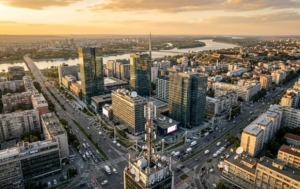
Novi Sad is your second priority and arguably the more interesting growth story. Supported by university-driven tech talent and strong mobile wallet uptake, the city has attracted major European online retailers who constructed logistics hubs in April 2023 to facilitate cross-border commerce. Its proximity to the Hungarian border – and its position on the newly operational Belgrade–Subotica high-speed rail section – makes it a natural node for international trade flows. The Serbian eCommerce Association projects cross-border online sales in Novi Sad will spur further enhancements and grow 35% annually through the forecast period – a rate that reflects both strategic positioning and active municipal support programs for businesses expanding internationally.
Regional eCommerce Opportunity Comparison
| Region | eCommerce Strength | Strategic Priority |
|---|---|---|
| Belgrade | Roughly half of national ecommerce transactions; highest basket values and repeat purchase frequency; superior fiber networks and dense pick-up point infrastructure | First market; primary entry point for scale |
| Novi Sad | University-driven tech talent; strong mobile wallet uptake; proximity to Hungarian border; on the operational high-speed rail corridor since Oct 2025; 35% annual cross-border sales growth projected; major European logistics hubs established April 2023 | Second market; especially relevant for cross-border commerce strategies |
| Secondary and rural markets | Underpenetrated; lower digital literacy rates; fragmented last-mile logistics | Later-stage expansion once Belgrade and Novi Sad operations are established |
Beyond these two urban centers, secondary markets remain underpenetrated but operationally challenging. Rural logistics constraints and lower digital literacy rates mean you’ll need patient capital and localized fulfillment strategies to succeed outside the main metropolitan areas. For most market entrants, the smarter play is to dominate Belgrade and Novi Sad first, then expand regionally once you’ve built the operational muscle and brand recognition to overcome the infrastructure gaps in smaller cities. These regional markets within the Serbia market require sequenced entry strategies rather than simultaneous national launches.
Strategic Recommendations for Entering Serbia’s eCommerce Market
Given everything the data tells us, here’s where to focus your resources. Start with mobile-first infrastructure – smartphones drive 67.20% of transaction volume, so your checkout flow, product pages, and retention mechanics need to be optimized for mobile before anything else. Integrate with the IPS NBS instant payments rail from day one; the 30%+ YoY transaction growth throughout 2024 signals where consumer payment behavior is heading, and real-time settlement directly reduces cart abandonment.
Build your logistics partnerships along Pan-European Corridor X to unlock cost-efficient fulfillment, particularly as World Bank-funded motorway upgrades continue to compress delivery lead times. If cross-border commerce is part of your strategy, factor in the new Belgrade–Budapest rail corridor – but base your unit economics on current restricted freight capacity (100 km/h, ETCS-constrained) rather than the aspirational 3h 15m target, which won’t be fully realized until certification issues resolve. Establish your trust architecture early – two-factor authentication, transparent data-privacy policies, and visible security credentials convert digitally fluent segments while maintaining cash-on-delivery options for rural demographics. Use the Chamber of Commerce’s digital transformation initiative as an entry point for local partnerships and municipal support.

How to Enter Serbia’s eCommerce Market: Priority Actions
- Optimize for mobile first: Smartphones drive 67.20% of transaction volume, so your checkout flow, product pages, and retention mechanics need to be optimized for mobile before anything else.
- Integrate with the Instant Payments (IPS NBS) rail from day one: 30.2% YoY transaction growth in 2024 signals where consumer payment behavior is heading, and real-time settlement directly reduces cart abandonment.
- Plan logistics around current realities, not target states: Build along Pan-European Corridor X to unlock cost-efficient fulfillment, but base freight assumptions on current Belgrade–Budapest rail capacity rather than the full 3h 15m target pending ETCS certification.
- Establish your trust architecture early: Two-factor authentication, transparent data-privacy policies, and visible security credentials convert digitally fluent segments while maintaining cash-on-delivery options for rural demographics.
- Account for non-EU status in your compliance stack: Serbia operates outside the EU customs union and uses the dinar (RSD), requiring distinct VAT, customs, and currency handling compared to Bulgaria, Romania, or Hungary.
- Use the Chamber of Commerce’s digital transformation initiative: Leverage it as an entry point for local partnerships and municipal support.
- Focus on Belgrade and Novi Sad first: Dominate these two urban centers before expanding regionally, building the operational muscle and brand recognition needed to overcome infrastructure gaps in smaller cities.
The competitive window in Serbia is open, but it won’t stay that way indefinitely. The businesses that move now, build local trust, and invest in the right infrastructure will be the ones defining the market’s next chapter. Focus on Belgrade and Novi Sad first, prioritize mobile and instant payments, and treat logistics and trust-building as core competitive advantages. Execute on those fundamentals, and you’ll be positioned to capture meaningful share in one of Southeast Europe’s fastest-growing digital retail markets. These strategic planning priorities and market entry tactics will determine whether your Serbia eCommerce market potential investment delivers the business opportunities the data suggests are available.
Frequently Asked Questions
- What is the current size of Serbia’s eCommerce market? Estimates vary by methodology. Mordor Intelligence places the broad-scope market at US$3.61 billion in 2025, growing to US$3.84 billion in 2026 and US$5.26 billion by 2031. Statista’s narrower B2C physical-goods definition pegs 2025 revenue at around US$1.13 billion, while ECDB reports US$852 million for 2024. Choose the methodology that matches your business scope — all sources confirm consistent growth.
- What compound annual growth rate should I use for financial modeling? For broad-scope modeling, Mordor Intelligence projects a 6.48% CAGR through 2031; Verified Market Research projects a 7.1% CAGR through 2032. For narrower B2C scope, earlier U.S. Trade Administration forecasts used approximately 14.65% CAGR through 2027 (reaching US$1.65 billion). Use the conservative 6.48% figure for broad-scope base-case planning and 7.1% for upside scenarios.
- Which product categories offer the best entry point for new market participants? Consumer electronics (27.40% of revenue) and fashion and apparel (8.55% projected CAGR through 2031) are the two strongest categories. Fashion offers the broadest consumer reach at 77.7% online adoption, while electronics commands the largest revenue share and benefits from established fulfillment infrastructure.
- How should I configure payment options for the Serbian market? Offer both cash on delivery and digital payment options. Cash on delivery retained 62% of rural transaction volume in 2023, so removing it will cost you conversions. Simultaneously, integrate with the Instant Payments System (IPS NBS) for real-time settlement – transactions grew 30.2% YoY in 2024 to 87.2 million total – and prioritize mobile wallet acceptance, which is growing at an 11.98% CAGR through 2031.
- How significant is the mobile commerce opportunity in Serbia? Extremely significant. Smartphones accounted for 67.20% of transaction volume in 2025, and 91.3% of internet users access platforms multiple times daily via mobile. If your mobile checkout experience isn’t optimized for one-click purchasing and push notification re-engagement, you’re leaving a majority of your potential conversions unrealized.
- What is the status of the Belgrade–Budapest high-speed rail, and how does it affect eCommerce logistics? The Serbian section from Belgrade via Novi Sad to Subotica opened on October 8, 2025. Freight service on the Hungarian section began February 27, 2026, making the full cross-border corridor operational – but with restrictions. ETCS signaling certification issues currently limit freight to 100 km/h (40 km/h in limited visibility), and full passenger service is still being phased in. The target is to reduce Belgrade–Budapest transit time from 8 hours to approximately 3h 15m once certifications complete. For logistics planning, work with current capacity rather than the target state.
- Does Bulgaria’s euro adoption affect Serbia-focused strategy? Indirectly, yes. Serbia is not an EU member and continues to use the Serbian dinar (RSD). However, Bulgaria’s euro adoption on January 1, 2026, simplifies regional logistics and pricing for merchants using Bulgarian distribution hubs to serve Serbia – eurozone-registered operations can now stage inventory in Bulgaria without Bulgarian lev complexity, then handle Serbia as a separate currency market.
- What are the biggest operational challenges I should plan for? Last-mile logistics outside Belgrade and Novi Sad is the most immediate operational challenge – only 40% of rural households receive timely and reliable delivery service. Digital literacy gaps among consumers over 55, complex VAT compliance for smaller sellers, and persistent consumer trust concerns around card-not-present fraud are the other key barriers to plan around. Serbia’s non-EU status also creates distinct customs and VAT requirements compared to intra-EU trade.
- Who are the dominant competitors in Serbia’s eCommerce market? Gigatron.rs, Tehnomanija.rs, and Shoppster.rs are the domestic anchors, collectively holding approximately 16% of gross merchandise value. International players including Zara.com and eMAG are also active. The relatively low market concentration means there is meaningful room for category specialists to establish strong positions.
- Should I prioritize Belgrade or consider other regions from the start? Start with Belgrade – it accounts for roughly half of national eCommerce transactions and offers the best infrastructure, talent, and consumer spending power. Add Novi Sad as your second market, particularly if cross-border commerce is part of your strategy, given its proximity to Hungary, the now-operational high-speed rail corridor, and the 35% annual cross-border sales growth projected by the Serbian eCommerce Association.
- What government support is available for eCommerce businesses entering Serbia? The Serbia Digital Agenda 2026 allocates USD 100 million toward AI, cloud infrastructure, and cybersecurity. An additional USD 30 million Digital Serbia Initiative launched in April 2025 targets digital-skills training, start-up incubation, and rural connectivity. Digital-skills grants have lifted the share of firms trading online to 27.9%. The Chamber of Commerce’s digital transformation initiative, launched in February 2023, provides training and municipal support specifically for businesses establishing or expanding their online presence.
- How do I build consumer trust quickly in the Serbian market? Prioritize visible security credentials, two-factor authentication, and transparent data-privacy policies. Maintain cash-on-delivery as a payment option while actively promoting digital alternatives. Partnering with or prominently featuring domestic brand associations helps, given that 99.3% of 25–34 year-olds prefer local sellers. Trust is built incrementally through consistent delivery performance and responsive customer service – invest in both from day one.
References
- Serbia eCommerce Market Size, Share Analysis, Growth Report 2031 – Mordor Intelligence. Market size US$3.61B (2025) → US$3.84B (2026) → US$5.26B (2031); 6.48% CAGR; consumer electronics 27.40% revenue share; fashion 8.55% CAGR; mobile 67.20% of transactions; digital wallets 11.98% CAGR.
- European eCommerce Overview: Serbia – eCommerce Germany News (March 2026). Parcel deliveries exceeded 60 million in 2025 (up from 56 million); €14.36 billion railway investment cycle 2025–2029; Soko high-speed line Belgrade–Subotica operational October 2025.
- Serbia eCommerce Market Size, Scope, Trends & Forecast 2032 – Verified Market Research. US$3.4B (2024) → US$5.9B by 2032 at 7.1% CAGR.
- Serbia – eCommerce Country Commercial Guide – U.S. International Trade Administration. Earlier forecasts: US$710.7M (2022) → US$955.7M (2023) → US$1.65B (2027) at 14.65% CAGR; top 3 stores accounted for 20% of revenue (2021 data).
- eCommerce – Serbia – Statista Market Forecast. Narrow B2C physical-goods definition: US$1.13B (2025) → US$1.37B (2030) at 4.02% CAGR; 41.5% user penetration (2025).
- Instant payments in Serbia rise 30% in 2024 – SeeNews/National Bank of Serbia. Instant payment transactions rose 30.2% YoY in 2024 to 87.2 million total transactions.
- Statistical Office of the Republic of Serbia. 85.4% internet penetration; 91.3% daily access; 85.6% household connectivity; 75.9% desktop capability; 77.7% fashion online adoption; 25.3% electronics purchases.
- Budapest–Belgrade railway – Wikipedia. Serbian section (Belgrade–Novi Sad–Subotica) opened October 8, 2025; target travel time 3h 15m; Hungarian freight service began February 27, 2026.
- Problematic start for the Budapest–Belgrade railway – Railway Pro (March 2026). ETCS signaling certification issues; freight restricted to 100 km/h (40 km/h in limited visibility); 700m max train length in Serbia vs 750m EU standard.
- Slow start for upgraded Budapest–Belgrade main line – International Railway Journal. Detailed operational analysis of the corridor’s commissioning and interoperability issues.
- Nikola Ilchev, founder of Balkan eCommerce Summit 2025 – Serbia eCommerce is a $1 Billion Market. Statistical Yearbook of the Republic of Serbia data on internet access and social media engagement.