


Slovenia’s eCommerce market is projected to grow from USD 1.07 billion in 2025 to USD 1.7 billion by 2031, driven by 90 percent internet penetration, mobile-first consumers, and EU Digital Single Market integration. Two-thirds of the population ordered goods online in 2025, with fashion, electronics, and food leading category growth. Credit and debit cards dominate payments at 51.63 percent of transaction value, while digital wallets are the fastest-growing channel. Cross-border shopping is significant, yet 77 percent of transactions flow to domestic platforms. For international merchants, Slovenia offers regulatory clarity, advanced logistics, and a digitally confident consumer base that rewards localization and fulfillment reliability.
Table of Contents
- Understanding Slovenia’s eCommerce Landscape
- Slovenia Online Shopping Behavior and Consumer Preferences
- Payment Methods: Digital Transactions and Preferences
- Market Size and Growth Trajectory
- Regulatory Environment and Business Infrastructure
- Logistics and Delivery Capabilities
- Barriers to Online Shopping Adoption
- Frequently Asked Questions
Understanding Slovenia’s eCommerce Landscape
Slovenia may be one of Europe’s smaller economies, but its digital commerce sector punches well above its weight. With a population of approximately 2.12 million, the country has built a digitally mature retail environment where online shopping has shifted from a niche convenience into a mainstream expectation. Internet penetration sits near 92 percent among residents aged 16–74, and roughly two-thirds of the population ordered goods or services online in 2025, according to Eurostat data – figures that rival far larger EU member states.
What makes the Slovenia eCommerce market particularly compelling is its geography. Positioned at the crossroads of Italy, Austria, Hungary, and Croatia, the country benefits from well-established logistics corridors that support both domestic fulfillment and cross-border flows within the EU’s Digital Single Market. Nearly all companies with ten or more employees maintain broadband access, and mobile commerce is firmly dominant – smartphones account for over 74 percent of site traffic, signaling a consumer base that expects fast, frictionless mobile checkout experiences.
Revenue projections reinforce the opportunity. The market overview shows growth from USD 1.07 billion in 2025 toward USD 1.7 billion by 2031, driven by expanding mobile adoption, same-day delivery infrastructure around Ljubljana, and rapid uptake of digital payment solutions. Business-to-consumer transactions capture more than 85 percent of total spend, while B2B eCommerce is accelerating as government-subsidized digital vouchers encourage small and medium enterprises to move procurement online. This combination of digital maturity, strategic location, and consistent growth makes Slovenia an attractive entry point for merchants targeting Central Europe.
What defines Slovenia’s eCommerce landscape at a glance
- Internet penetration: Near 90 percent among residents aged 10–74, rivaling far larger EU member states.
- Online shopper base: Roughly two-thirds of the population ordered goods or services online in 2025.
- Mobile dominance: Smartphones account for over 74 percent of site traffic, demanding frictionless mobile checkout.
- Market size: Projected to grow from USD 1.07 billion in 2025 to USD 1.7 billion by 2031 at an 8.01 percent CAGR.
- B2C share: Business-to-consumer transactions capture more than 85 percent of total eCommerce spend.
- Strategic location: Positioned at the crossroads of Italy, Austria, Hungary, and Croatia with established logistics corridors.
Slovenia Online Shopping Behavior and Consumer Preferences
Slovenian shoppers are digitally confident, price-aware, and increasingly demanding when it comes to fulfillment. In the first quarter of 2025, 53 percent of residents aged 16–74 completed at least one online purchase, with penetration climbing to roughly 70 percent among adults aged 25–44. Eurostat data from December 2025 confirms that 66.87 percent of the population ordered goods or services online during the preceding twelve months – a figure that has risen steadily year-on-year and reflects the normalization of digital commerce across all demographic groups. Even adults aged 65–74 are migrating online at a measurable pace as familiarity with mobile interfaces and secure payment gateways deepens.
The product mix is broad. Fashion and apparel lead the way, with 69 percent of online buyers purchasing clothing, footwear, or accessories in early 2025. Home goods, gardening tools, and furniture attracted 28 percent of shoppers, while sports equipment, medicines, supplements, and digital media subscriptions each captured roughly a quarter of the buyer base. Nearly half of eCommerce participants also paid for services online – event tickets, streaming subscriptions, and travel bookings – illustrating how wide the digital transaction footprint has become.
One behavioral trait worth noting: Slovenian consumers are cautious and experience-driven. Approximately 26 percent encountered problems such as late delivery, inability to order from abroad, or damaged goods in early 2025. That’s a meaningful share, and it signals that fulfillment reliability and transparent customer care are decisive factors in repeat-purchase decisions. If you’re entering this market, your post-purchase experience needs to be as polished as your acquisition funnel. Understanding these consumer behavior patterns and shopping preferences is essential before diving into specific product categories and cross-border dynamics.
Key consumer behavior indicators for Slovenia online shopping
- Overall penetration: 66.87 percent of the population ordered goods or services online in the preceding twelve months (Eurostat, December 2025).
- Core demographic: Penetration reaches roughly 70 percent among adults aged 25–44, the most active online shopping cohort.
- Older adults: Adults aged 65–74 are migrating online at a measurable pace as familiarity with mobile interfaces deepens.
- Services adoption: Nearly half of eCommerce participants paid for services online, including event tickets, streaming subscriptions, and travel bookings.
- Fulfillment sensitivity: Approximately 26 percent of buyers encountered problems such as late delivery or damaged goods, making post-purchase reliability a decisive growth lever.
Popular Product Categories in Slovenian eCommerce
Fashion eCommerce and apparel command the largest share of Slovenia’s online retail revenue, accounting for approximately 28.74 percent of total B2C spend. The 69 percent purchase rate among online buyers in early 2025 confirms that clothing and accessories have become the default digital category – driven by easy returns, improved size guides, and the breadth of inventory available online versus in-store.
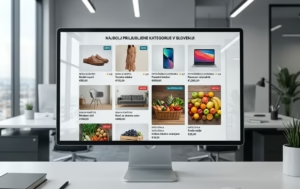
- Fashion and apparel: The largest category at 28.74 percent of B2C revenue, with a 69 percent purchase rate among online buyers – driven by easy returns, improved size guides, and broad inventory.
- Consumer electronics: The second major growth engine, fueled by remote workers and gamers upgrading hardware; smartphones, laptops, and smart-home devices benefit from competitive pricing and detailed product reviews.
- Home goods and furniture: Attracted 28 percent of online shoppers, following closely behind electronics in overall category share.
- Food and beverages: The fastest-expanding category, growing at a 12.22 percent CAGR through 2031 as regional grocers deploy dark-store networks within ten-kilometer radii of dense urban districts, cutting delivery windows to under sixty minutes.
- Beauty and personal care: Gaining momentum through subscription models that combine AI-driven skin diagnostics with personalized replenishment schedules, lifting both repeat rates and average order values.
These product categories reveal where consumer electronics demand and other category opportunities are concentrating, showing the highest growth potential for merchants entering the market.
Cross-Border Shopping Trends
Cross-border eCommerce has carved out a meaningful position in Slovenia’s digital retail mix. Roughly one quarter of online buyers source more than half their purchases from international shopping sellers, primarily within the EU’s Digital Single Market. German, Austrian, and Italian european marketplaces are the dominant destinations, where economies of scale enable broader product catalogues and more aggressive promotional pricing than smaller domestic platforms can match.
That said, 77 percent of transactions by volume still flow to domestic platforms – a figure that reflects genuine local preference rather than simply a lack of alternatives. Slovenian shoppers value local-language customer support, faster delivery windows, and the ability to support domestic brands when quality and price align. The April 2024 Pošta Slovenije–China Post alliance is a notable infrastructure development, accelerating cross-border parcel velocity and enabling Chinese sellers to treat Slovenia as a Central European gateway. For international merchants, the playbook is clear: localize your website, integrate regional payment methods, and establish pickup points or locker networks to reduce last-mile friction. These cross-border shopping patterns directly influence which payment methods Slovenian consumers expect at checkout.
Cross-border eCommerce snapshot
| Dimension | Detail |
|---|---|
| International buyer share | Roughly one quarter of online buyers source more than half their purchases from international sellers |
| Preferred international markets | Germany, Austria, and Italy – driven by broader catalogues and competitive pricing |
| Domestic transaction share | 77 percent of transactions by volume flow to domestic platforms |
| Key infrastructure development | April 2024 Pošta Slovenije–China Post alliance accelerating cross-border parcel velocity |
| Merchant entry priorities | Slovenian-language localization, regional payment methods, pickup points or locker networks |
Payment Methods: Digital Transactions and Preferences
Slovenia’s payment landscape is in active transition – moving from traditional card infrastructure toward mobile-first checkout experiences, and doing so faster than many comparable markets. Credit and debit cards still lead, commanding 51.63 percent of transaction value in 2025, anchored by Visa, Mastercard, and co-branded local schemes that benefit from decades of consumer familiarity and near-universal merchant acceptance.
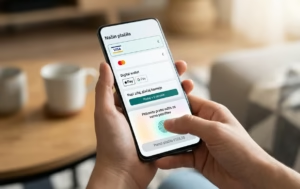
Digital payments through wallets are the fastest-growing channel, projected to expand at a 10.39 percent compound annual growth rate through 2031. Younger cohorts – particularly Gen Z and Millennials – are driving this shift, prioritizing speed, biometric authentication, and the convenience of storing multiple funding sources in a single app. Apple Pay, Google Pay, and regional wallet services integrate instant SEPA transfers, tightening settlement cycles and reducing chargeback exposure for merchants who deploy payment-orchestration platforms to route transactions dynamically.
Buy Now Pay Later solutions have established mid-single-digit penetration, particularly within electronics and home appliances. Klarna and Slovenia-based Leanpay are the key players, offering flexible installment options that lift conversion on higher-ticket items by double digits. BNPL providers are increasingly functioning as discovery channels – recommending curated catalogues and steering demand toward partner merchants – while open-banking credit algorithms enable near-instant approvals. Despite this digital momentum, cash-on-delivery persists in rural and suburban areas, where trust among older demographics and patchy broadband connectivity sustain a preference for paying couriers upon receipt. Strong Customer Authentication mandates are accelerating the adoption of frictionless biometrics – fingerprint and facial recognition – to maintain conversion parity with one-click card flows. These payment preferences and online transactions patterns directly correlate with the market’s overall growth trajectory and revenue potential.
Slovenia payment methods comparison
| Payment Method | Current Share / Status | Growth Outlook | Key Players |
|---|---|---|---|
| Credit and debit cards | 51.63 percent of transaction value (2025) | Stable; dominant channel | Visa, Mastercard, co-branded local schemes |
| Digital wallets | Fastest-growing channel | 10.39 percent CAGR through 2031 | Apple Pay, Google Pay, regional wallet services |
| Buy Now Pay Later (BNPL) | Mid-single-digit penetration | Growing, especially in electronics and home appliances | Klarna, Leanpay (Slovenia-based) |
| Cash-on-delivery | Persists in rural and suburban areas | Declining as digital adoption spreads | Courier networks |
Market Size and Growth Trajectory
The numbers here are straightforward and encouraging. Slovenia’s eCommerce market size is projected to grow from USD 1.07 billion in 2025 to USD 1.7 billion by 2031, representing a compound annual growth rate of approximately 8.01 percent. B2B eCommerce is accelerating even faster, at a 9.54 percent CAGR, supported by government-subsidized digital vouchers that help SMEs adopt online procurement platforms.
Growth drivers are well-distributed across categories and demographics. Fashion and apparel hold the largest revenue share at 28.74 percent of B2C spend, but food and beverages are the momentum story – expanding at 12.22 percent annually as dark-store grocery networks scale beyond Ljubljana into Maribor and Celje. Mobile-only shoppers among Gen Z and Millennial cohorts generate over 74 percent of site traffic, and cross-border volume from EU Digital Single Market corridors adds incremental revenue as roughly one quarter of buyers source more than half their purchases internationally. For merchants building a five-year growth model, Slovenia’s trajectory is consistent and defensible. This eCommerce expansion occurs within a well-defined regulatory framework that shapes how businesses operate, with a clear market forecast pointing toward sustained growth.
Key growth metrics at a glance
- Overall market CAGR: Approximately 8.01 percent, growing from USD 1.07 billion (2025) to USD 1.7 billion (2031).
- B2B eCommerce CAGR: 9.54 percent, outpacing the overall market, supported by government-subsidized digital vouchers for SMEs.
- Fastest-growing category: Food and beverages at 12.22 percent annually as dark-store grocery networks expand beyond Ljubljana.
- Largest revenue category: Fashion and apparel at 28.74 percent of B2C spend.
- Mobile traffic share: Over 74 percent of site traffic generated by Gen Z and Millennial mobile-only shoppers.
Regulatory Environment and Business Infrastructure
Operating in Slovenia means operating within the EU’s Digital Single Market framework – which is both a compliance requirements obligation and a competitive advantage. The Electronic Commerce Directive establishes foundational requirements: online retailers must display contact details prominently, identify advertising clearly, and implement anti-spam safeguards. The country-of-origin principle means providers must adhere to regulations in their country of establishment while meeting consumer protection obligations across the entire EU.
More recent legislation adds further structure. The Digital Services Act introduces measures to combat counterfeit goods and illegal content, while the Digital Markets Act targets gatekeeper platforms to curb unfair practices and promote competition. On the payments side, eIDAS 2.0 and PSD3 directives govern electronic identification and payment services, compelling merchants to integrate frictionless authentication flows that balance security with conversion optimization. SEPA membership streamlines non-cash euro payments, subjecting cross-border transactions to uniform legal standards that reduce friction and accelerate settlement. For smaller operators, government-subsidized digital vouchers worth EUR 1,000–9,999 co-finance website launches, cybersecurity upgrades, and marketing campaigns – meaningfully lowering the barrier to entry for domestic SMEs entering the digital channel. These eCommerce regulations and legal framework structures work in tandem with Slovenia’s logistics capabilities to create a functional business environment.
Key regulatory frameworks governing Slovenia eCommerce
- Electronic Commerce Directive: Requires prominent display of contact details, clear identification of advertising, and anti-spam safeguards; governed by the country-of-origin principle.
- Digital Services Act: Introduces measures to combat counterfeit goods and illegal content across platforms.
- Digital Markets Act: Targets gatekeeper platforms to curb unfair practices and promote competition.
- eIDAS 2.0 and PSD3: Govern electronic identification and payment services, compelling merchants to integrate frictionless authentication flows.
- SEPA membership: Streamlines non-cash euro payments and subjects cross-border transactions to uniform legal standards.
- Digital voucher programme: Government-subsidized vouchers worth EUR 1,000–9,999 co-finance website launches, cybersecurity upgrades, and marketing campaigns for domestic SMEs.
Logistics and Delivery Capabilities
Slovenia’s logistics infrastructure is one of its most underappreciated competitive assets. For a broader understanding of eCommerce logistics in CEE, the Port of Koper and rail connections to Austria shorten inbound transit times for international sellers, while domestic merchants leverage the same corridors to reach Italy, Croatia, and Hungary within 48 hours – a remarkable capability for a country of 2.12 million people.
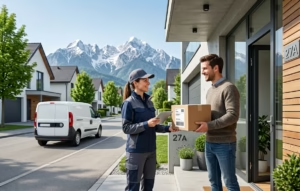
Same-day delivery services are redefining service benchmarks within the country. Micro-fulfillment hubs positioned around Ljubljana are shrinking delivery windows to under three hours, nudging consumers toward higher purchase frequency. Logistics specialists are replicating this model in Maribor and Celje, extending the service footprint to roughly half the population. The April 2024 Pošta Slovenije–China Post alliance further boosts cross-border parcel velocity, enabling Chinese sellers to use Slovenia as a Central European distribution gateway. The challenge is Alpine terrain: last-mile fulfillment costs for dispersed rural populations run up to 30 percent higher than Ljubljana benchmarks, prompting couriers to experiment with crowd-shipping models and set higher free-shipping thresholds for remote postcodes. Retailers who integrate inventory visibility across stores and dark warehouses are best positioned to reduce stock-outs and maintain conversion rates across the full geographic footprint. Yet even with strong infrastructure and diverse shipping options, certain barriers continue to limit broader adoption.
Slovenia logistics infrastructure highlights
- Port of Koper and rail links: Shorten inbound transit times for international sellers and enable domestic merchants to reach Italy, Croatia, and Hungary within 48 hours.
- Same-day delivery in Ljubljana: Micro-fulfillment hubs shrink delivery windows to under three hours, driving higher purchase frequency.
- Expanding urban coverage: The same-day model is being replicated in Maribor and Celje, extending the service footprint to roughly half the population.
- Cross-border parcel velocity: The April 2024 Pošta Slovenije–China Post alliance enables Chinese sellers to use Slovenia as a Central European distribution gateway.
- Alpine terrain surcharge: Last-mile fulfillment costs in rural areas run up to 30 percent higher than Ljubljana benchmarks, prompting crowd-shipping experiments and higher free-shipping thresholds.
Barriers to Online Shopping Adoption
Despite strong infrastructure and rising penetration, meaningful friction points remain. Approximately 26 percent of online buyers encountered problems – late delivery, inability to order from abroad, or damaged goods – in early 2025. Privacy concerns and security issues persist among older adults aged 65–74, where unfamiliarity with biometric authentication elevates checkout abandonment. Patchy broadband in Alpine municipalities compounds the issue by slowing page loads and interrupting payment flows. Cash-on-delivery remains entrenched in rural areas, inflating transaction costs for merchants and delaying settlement cycles.
These shopping barriers are addressable. Visible security badges, transparent return policies, real-time shipment tracking, and localized customer support are proven conversion levers. Merchants who invest in these consumer trust signals – even at modest scale – can unlock latent demand from demographics that are willing to shop online but need more reassurance to commit. The 26 percent problem rate also points to a clear operational priority: fulfillment reliability is not a back-office concern, it’s a front-line growth lever in this market.
Primary barriers and how to address them
- Fulfillment reliability: 26 percent of buyers reported problems including late delivery, inability to order from abroad, or damaged goods – invest in real-time shipment tracking and transparent return policies.
- Privacy and security concerns: Persist among older adults aged 65–74; address with visible security badges and familiar authentication flows.
- Patchy broadband in Alpine areas: Slows page loads and interrupts payment flows in rural municipalities – optimize for low-bandwidth environments.
- Cash-on-delivery entrenchment: Remains prevalent in rural communities, inflating transaction costs and delaying settlement – build trust gradually through localized customer support.
Frequently Asked Questions
- What is the current size of Slovenia’s eCommerce market? The market is projected at USD 1.07 billion in 2025, growing toward USD 1.7 billion by 2031 at a compound annual growth rate of approximately 8.01 percent.
- What percentage of Slovenians shop online? According to Eurostat data from December 2025, 66.87 percent of the population ordered goods or services online in the preceding twelve months. Among adults aged 25–44, penetration reaches roughly 70 percent.
- Which product categories perform best in Slovenian eCommerce? Fashion and apparel lead with 28.74 percent of B2C revenue and a 69 percent purchase rate among online buyers. Consumer electronics, home goods, and food and beverages are the next strongest categories, with food growing fastest at a 12.22 percent CAGR through 2031.
- What payment methods do Slovenian consumers prefer? Credit and debit cards account for 51.63 percent of transaction value. Digital wallets are the fastest-growing channel at a projected 10.39 percent CAGR through 2031. Buy Now Pay Later solutions from Klarna and Leanpay are gaining traction in electronics and home appliances.
- How significant is cross-border shopping in Slovenia? Roughly one quarter of online buyers source more than half their purchases from international sellers, primarily in Germany, Austria, and Italy. However, 77 percent of transactions by volume still flow to domestic platforms.
- What regulatory framework governs eCommerce in Slovenia? Slovenia operates within the EU’s Digital Single Market framework, including the Electronic Commerce Directive, Digital Services Act, Digital Markets Act, eIDAS 2.0, and PSD3. SEPA membership standardizes cross-border euro payments.
- How advanced is Slovenia’s delivery infrastructure? Same-day delivery is available in Ljubljana with windows under three hours. The model is expanding to Maribor and Celje. The April 2024 Pošta Slovenije–China Post alliance has accelerated cross-border parcel velocity. Alpine terrain adds up to 30 percent to last-mile costs in rural areas.
- What are the main barriers preventing more Slovenians from shopping online? The primary barriers are fulfillment reliability issues (reported by 26 percent of buyers), privacy and security concerns among older demographics, patchy broadband in Alpine areas, and entrenched cash-on-delivery habits in rural communities.
- Is B2B eCommerce growing in Slovenia? Yes. B2B eCommerce is expanding at a 9.54 percent CAGR, faster than the overall market, supported by government-subsidized digital vouchers worth EUR 1,000–9,999 that help SMEs adopt online procurement platforms.
- What should international merchants prioritize when entering the Slovenian market? Localize your website with Slovenian-language support, integrate digital wallets and BNPL options alongside card payments, establish pickup points or locker networks to reduce delivery friction, and invest in visible trust signals – security badges, transparent return policies, and real-time tracking – to convert hesitant shoppers.
References
- https://www.mordorintelligence.com/industry-reports/slovenia-ecommerce-market
- https://ecommercegermany.com/blog/european-ecommerce-overview-slovenia
- https://www.stat.si/StatWeb/en/News/Index/12435
- https://ec.europa.eu/eurostat/databrowser/product/page/ISOC_CI_IFP_IU
- https://www.trade.gov/country-commercial-guides/slovenia-ecommerce
- https://www.ecommerce-europe.eu/press-item/new-growth-in-european-eCommerce-indicates-sectors-ability-to-adapt-and-reinvent/
- https://www.adyen.com/knowledge-hub/slovenia-payment-methods
- https://stripe.com/guides/payment-methods/slovenia
- https://heureka.group/news/ecommerce-in-slovenia/
- https://cms.law/en/int/expert-guides/cms-expert-guide-to-ecommerce/slovenia