


Hungary’s eCommerce market has matured into a sophisticated digital retail environment where mobile-first consumers, automated fulfillment networks, and cross-border marketplace integration are redefining what’s possible for brands operating in Central Europe. If you’re evaluating market entry or scaling an existing Hungarian operation, the structural dynamics – from payment infrastructure to last-mile economics – will directly determine your unit economics and growth trajectory. This analysis breaks down the market’s core components, quantifies the opportunities across segments, and identifies the operational levers that separate high-performing retailers from those struggling to gain traction in this increasingly competitive landscape.
Table of Contents
- Understanding the Hungary eCommerce Market Structure
- Market Size and Growth Dynamics
- Key Market Segments
- Consumer Behavior and Shopping Preferences
- Payment Methods and Digital Transaction Infrastructure
- Logistics and Delivery Systems
- Leading Players and Competitive Landscape
- Opportunities and Future Outlook
- Frequently Asked Questions
Understanding the Hungary eCommerce Market Structure
Hungary’s eCommerce ecosystem has evolved into one of Central Europe’s most dynamic digital retail environments, defined by moderate platform concentration, accelerating consumer adoption, and a rapidly maturing logistics backbone. If you’re evaluating market entry or scaling an existing operation here, understanding how the structural layers interact is your first strategic advantage.
B2C transactions dominate the landscape, accounting for 85.41% of total market value in 2025, while B2B digitalization is gaining serious momentum at an 11.07% compound annual growth rate as manufacturers embed procurement portals and marketplace storefronts into their commercial workflows. Mobile devices processed 60.25% of all online orders in 2025, confirming that smartphone-first experiences are no longer optional – they’re the baseline expectation.
Geographically, Central Hungary and Budapest concentrate over half of all online orders, driven by dense logistics infrastructure and higher disposable incomes. IKEA’s EUR 50 million automated fulfillment center, opened in March 2025, exemplifies the capital region’s role as a distribution hub. Secondary cities like Debrecen, Szeged, and Pécs are registering double-digit growth as courier networks extend one-day delivery reach and government-designated logistics parks offer meaningful tax incentives to attract warehouse investment.
Hungarian Online Shopping – Market Size and Growth Dynamics
Hungarian online shopping generated USD 4.73 billion in domestic retail turnover during 2024, representing a 15% year-over-year increase that reflects sustained momentum well beyond the pandemic-driven surge. When cross-border transactions and B2B digital procurement are included, the total eCommerce market size reached USD 5.25 billion in 2026, with forecasts pointing to USD 7.79 billion by 2031 – an 8.2% compound annual growth rate that outpaces many Western European peers.
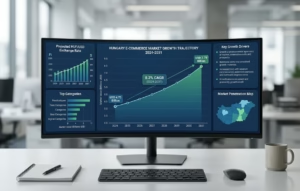
Three forces are driving this trajectory: mobile-first checkout experiences, same-day fulfillment networks expanding beyond Budapest, and buy-now-pay-later adoption among Gen-Z cohorts who favor installment flexibility over traditional credit. Approximately 82% of Hungary’s population shopped online in 2024, up sharply from 49% in 2019 – one of the fastest digital commerce trends in the region. Internet penetration stood at 90.36% as of December 2024, providing a broad addressable base that now extends well beyond urban centers into increasingly connected secondary municipalities.
Mobile commerce deserves particular attention. With 60.25% of all online orders processed via smartphone in 2025, and that share projected to exceed 60% through 2031 as telecom operators expand 5G coverage, retailers deploying Progressive Web Apps that reduce page-load times and streamline checkout are already capturing measurable conversion advantages. The geographic concentration of market growth is also shifting: while Budapest remains the anchor, the cost economics of reaching Debrecen, Pécs, and Szeged are improving as logistics parks and courier route optimization close the gap with capital-region delivery standards.
Key Market Segments in Hungary’s eCommerce Landscape
Fashion and apparel command the largest share of any product categories, capturing 28.73% of 2025 revenue and reflecting Hungary’s position as a Central European fulfillment corridor for fast-fashion brands. Primark’s May 2024 flagship opening at Arena Mall underscored international confidence in omnichannel models, while mobile-optimized catalogs continue to amplify impulse purchases that sustain the category’s dominance.
Consumer electronics maintain stable demand through shortened replacement cycles and the availability of installment payment options for premium devices. Media Markt Saturn doubled its marketplace gross merchandise value in Q3 2024 by embedding AI-driven product onboarding and sponsored-ad tools – a clear signal that automation and paid discovery are becoming table stakes in this segment.
Food and beverages represent the fastest-growing category at a 12.03% CAGR, propelled by same-day grocery networks and cold-chain investments that reduce spoilage and pick times. Rohlik Group delivers over one million orders monthly and secured USD 170 million to expand regional coverage, effectively transforming online grocery into a viable convenience channel for urban professionals. Beauty and personal care lean heavily on influencer-driven discovery, with over 60% of purchases occurring within 48 hours of social media exposure, while furniture adoption is accelerating as augmented reality previews increase customer confidence despite the inherent challenges of bulky-item logistics.
Hungarian Online Shopping Behavior and Consumer Preferences
Understanding how Hungarian consumers actually shop online is where strategy gets practical. The 20–39 age cohort drives the highest transaction frequency, but older demographics are increasingly active as trust signals – Hungarian-language interfaces, transparent delivery timelines, and clearly visible return policies – become standard across domestic platforms. Your localization investment pays dividends across a broader age range than you might expect.
Mobile orientation is the defining behavioral characteristic, with smartphones accounting for 60.25% of completed transactions in 2025. Consumers in this market respond strongly to frictionless checkout: any additional step between product discovery and payment confirmation measurably increases abandonment. Retailers who have deployed one-click checkout and saved-payment-method functionality report significantly higher repeat purchase rates among the 25–35 demographic.
Social commerce is reshaping the discovery funnel, particularly in beauty and personal care, where over 60% of conversions are triggered by influencer content on Instagram and TikTok within a 48-hour window. Fashion follows a similar pattern, with mobile-optimized catalogs driving impulse purchases that wouldn’t occur through traditional search-led journeys. For food and grocery, convenience and reliability are the primary purchase drivers – Rohlik Group’s growth to over one million monthly orders demonstrates that Hungarian online shopping consumers will commit to subscription-style grocery relationships when the service consistently delivers.
Price sensitivity remains a real factor, particularly for first-time purchases in new categories. Cash-on-delivery still accounts for over 50% of first-time orders in rural areas, reflecting trust gaps that established players are actively working to close through transparent communication and hassle-free return experiences. These consumer behavior patterns should directly inform your customer acquisition strategy, with different approaches required for urban versus rural markets and first-time versus repeat purchasers.
Payment Methods and Digital Transaction Infrastructure
Credit and debit cards held a 51.12% share of digital payments in 2025, but the more interesting story is what’s growing fastest. Buy-now-pay-later volumes are advancing at an 11.83% CAGR and are projected to double their share by 2031. Retailers report a 20% average order value uplift when BNPL is offered at checkout, with default rates remaining within acceptable risk bands due to rigorous know-your-customer protocols. If you’re not yet offering installment options, this is a high-ROI addition to your checkout flow.

Generational payment preferences diverge meaningfully. Gen-Z cohorts favor installment flexibility, while older demographics continue to rely on cash-on-delivery for first-time orders, especially in rural areas where trust in digital payments is still developing. Digital wallets are growing steadily as NFC adoption rises in physical retail, familiarizing consumers with tokenized payments that translate naturally to online checkout. Merchants who proactively shift customers toward pre-paid payment methods – through small discounts or loyalty incentives – report improved cash-flow predictability and reduced reconciliation overhead from courier-collected cash.
Logistics and Delivery Systems in Hungarian eCommerce
Home delivery accounted for 72% of domestic online orders in 2023, but out-of-home collection through parcel lockers is rapidly gaining share as the infrastructure footprint expands. GLS operates over 2,500 parcel lockers spanning 740 settlements and 3,500 delivery points by late 2025. Foxpost – integrated with Packeta – maintains approximately 3,100 lockers nationwide and is piloting twice-daily replenishment at high-traffic sites to accelerate turnover during peak periods. Magyar Posta crossed 500 lockers earlier in the cycle, adding further redundancy to the fulfillment network.
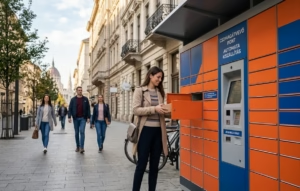
The cost economics of last-mile delivery outside Central Hungary remain a genuine challenge. Last-mile expenses beyond Budapest can exceed 15% of order value, compared to 8–10% within the capital, dampening rural conversion rates and prompting retailers to raise free-shipping thresholds or extend lead times. Tesco’s 100,000 m² automated hub and Rossmann’s USD 55 million Üllő facility add high-capacity sortation nodes that reduce urban delivery methods costs and create the scale needed for expansion into Debrecen, Pécs, and Szeged – gradually narrowing the geographic service gap that has historically constrained market penetration beyond the capital region.
Leading Players and Competitive Landscape
Hungary’s eCommerce competitive landscape is moderately concentrated, with a small number of multi-category leaders setting the pace on logistics, pricing, and platform capability. eMAG, following its merger with Extreme Digital in 2023, has established itself as the dominant multi-category player, with the scale to negotiate preferential courier rates and secure exclusive brand partnerships that smaller competitors cannot match.
Czech challenger Alza leverages cross-border fulfillment and competitive pricing combined with local service centers to maintain a credible position in consumer electronics and adjacent categories. Media Markt Saturn’s Q3 2024 performance – doubling marketplace GMV through AI-driven product onboarding and sponsored-ad tools – demonstrates that warehouse automation and algorithmic merchandising are becoming genuine competitive differentiators rather than future-state aspirations. Domestic retailers are working to close the automation gap, though the capital requirements are significant. Regulatory scrutiny of ultra-low-cost platforms is also shaping the competitive dynamic, with established leading online stores emphasizing data transparency and consumer-protection compliance as differentiation levers against price-only competitors.
Opportunities and Future Outlook for the Hungary eCommerce Market
The convergence of EU-funded digital infrastructure investment, evolving consumer expectations, and improving logistics economics creates a genuinely favorable environment for growth over the next five years. EU-funded initiatives targeting digital and green technology support cloud adoption, AI integration, and semiconductor production expansion – all of which underpin the technical backbone required for advanced retail platforms. The government’s designation of 18 new logistics parks with tax incentives and brownfield redevelopment grants is specifically designed to reduce geographic concentration, enabling retailers to extend same-day delivery into Debrecen, Pécs, and Szeged at economically viable unit costs.
Category-level market opportunities are particularly strong where Hungary lags Western European penetration benchmarks. Enterprise software – including ERP, CRM, and supply chain management – exhibits low adoption across Hungarian verticals, positioning SaaS vendors to capture significant share as harmonized EU data-privacy rules catalyze cloud migration. Emerging consumer segments including fitness trackers, smart assistant speakers, wireless earbuds, and augmented-reality applications will broaden as household incomes rise and replacement cycles for legacy electronics conclude, particularly among cohorts that deferred purchases during the pandemic-induced recession.
B2B digitalization represents one of the most underappreciated growth prospects. Manufacturers embedding procurement portals into their commercial workflows are streamlining order flows and reducing intermediary friction in ways that compound over time. Cross-border EU marketplace integration is simultaneously lowering barriers for over 36,000 Hungarian SMEs seeking export revenue, while regulatory frameworks like the Digital Services Act standardize compliance requirements and enhance consumer trust across the board.
Looking at the 2031 horizon, mobile commerce is forecast to exceed 60% of transaction volume, driven by 5G rollout and Progressive Web App deployment that compress page-load times and simplify checkout. The retailers who invest now in mobile-first architecture, localized payment options, and secondary-city logistics partnerships will be best positioned to scale as the Hungary eCommerce market expands. Your strategic roadmap should prioritize these infrastructure investments and capability development initiatives to ensure you’re positioned to capture future trends as they materialize.
Frequently Asked Questions
- What is the current size of Hungary’s eCommerce market? Hungary’s eCommerce market reached USD 5.25 billion in 2026 when including cross-border transactions and B2B digital procurement. Domestic retail turnover alone was USD 4.73 billion in 2024, growing 15% year-over-year. The market is forecast to reach USD 7.79 billion by 2031 at an 8.2% CAGR.
- Which product categories generate the most revenue in Hungarian online retail? Fashion and apparel lead with 28.73% of 2025 revenue. Consumer electronics follow with stable demand driven by shortened replacement cycles. Food and beverages are the fastest-growing segment at a 12.03% CAGR, with beauty and personal care also showing strong momentum through social commerce channels.
- How dominant is mobile commerce in Hungary? Mobile devices processed 60.25% of all online orders in 2025, and that share is projected to exceed 60% through 2031 as 5G coverage expands. Retailers deploying Progressive Web Apps and one-click checkout are seeing measurable conversion improvements among the 25–35 demographic.
- What payment methods should I prioritize for the Hungarian market? Cards hold a 51.12% share, but buy-now-pay-later is the fastest-growing option at an 11.83% CAGR and delivers a 20% average order value uplift. Cash-on-delivery remains important for first-time rural customers. Offering BNPL alongside card and digital wallet options covers the broadest demographic range.
- Who are the dominant eCommerce players in Hungary? eMAG (post-merger with Extreme Digital in 2023) leads as the primary multi-category marketplace. Alza is a strong cross-border challenger in electronics. MediaMarktSaturn doubled its marketplace GMV in Q3 2024 through AI-driven tools. Rohlik Group dominates online grocery with over one million monthly orders.
- How does logistics infrastructure affect market entry strategy? Budapest and Central Hungary offer the most cost-efficient last-mile delivery at 8–10% of order value. Outside the capital, costs can exceed 15%, which affects pricing strategy and free-shipping thresholds. Parcel locker networks from GLS (2,500+ lockers) and Foxpost (3,100+ lockers) offer cost-effective alternatives to home delivery for secondary markets.
- What is the B2B eCommerce opportunity in Hungary? B2B digitalization is growing at an 11.07% CAGR as manufacturers embed procurement portals and marketplace storefronts. Enterprise software adoption – ERP, CRM, supply chain management – remains low, creating significant SaaS opportunity as EU data-privacy harmonization accelerates cloud migration.
- How important is localization for success in the Hungarian market? Highly important. Hungarian-language interfaces, transparent delivery timelines, and visible return policies are now baseline expectations that directly influence trust and conversion, particularly among older demographics and first-time buyers in rural areas. Localization is a measurable conversion driver, not just a compliance checkbox.
- What role does social commerce play in Hungarian consumer behavior? Social commerce is a primary discovery channel in beauty, personal care, and fashion. Over 60% of beauty purchases occur within 48 hours of social media exposure, with Instagram and TikTok driving the majority of influencer-triggered conversions. Brands without an active social commerce strategy are leaving measurable revenue on the table.
- What are the most promising growth opportunities in Hungary’s eCommerce market through 2031? Key opportunities include secondary-city expansion as logistics parks reduce delivery costs, B2B procurement digitalization, cross-border EU marketplace integration for the 36,000+ Hungarian SMEs, emerging consumer electronics segments (fitness trackers, smart speakers, AR applications), and SaaS platforms targeting the low enterprise software adoption rate across Hungarian verticals.
References
- DataReportal – Digital 2024: Hungary. Confirms internet penetration at approximately 90% and highlights mobile usage trends.
- Eurostat – eCommerce statistics for individuals. Confirms approximately 82% of the Hungarian population engaged in online shopping in 2024.
- eCommerceDB – The eCommerce market in Hungary. Supports the 2024 market size of ~$4.7 billion and the dominant ~28% share for Fashion & Apparel.
- Statista – eCommerce Market Hungary. Projects an 8–10% CAGR through 2031, reaching near USD 7.8 billion, with Food & Beverages as the fastest-growing segment.
- Erste Group Research – CEE eCommerce Report 2024–2025. Confirms eMAG’s dominant multi-category position following the completion of the Extreme Digital brand phase-out in 2022/2023, and notes BNPL’s rapid ~11% CAGR.