

The new European measure will not put an end to cheap purchases from China, but it is likely to change consumer behavior, the strategies of global platforms, and the competitive environment for European online retailers.
As of 1 July 2026, the European Union introduced a temporary fixed customs fee for shipments valued at up to €150 arriving from countries outside the EU. The news received wide coverage, mostly in relation to platforms such as Temu, Shein, and AliExpress, which in recent years have become symbols of mass online shopping at low prices.
The new rules are based on EU Regulation 2026/382, which forms part of the broader reform of the European Union’s customs framework. The regulation introduces a temporary regime for processing low-value imports from countries outside the EU, aiming to strengthen customs controls, reduce administrative burdens, and create fairer competitive conditions between European and international online retailers.
In the first hours after the measure came into force, however, different interpretations began circulating. Some headlines referred to a “€3 fee per product,” while others described it as “€3 per order.” In reality, the mechanism is different, and this is where most of the confusion begins.
But the more important question is not exactly how the fee will be charged. The real question is whether it will change the way Europeans shop and whether it will make European online stores more competitive.
According to Nikola Ilchev, Ph.D, founder of eCommerce Academy and eCommerce expert, the answer is far more complex than the first headlines suggest.
“I do not believe European consumers will buy less from Chinese platforms. What is more likely to change is the way they shop.”
This is probably where the biggest effect of the new rules will be seen.
What Is the European Union Actually Introducing?
The new fee is part of a broader reform of the European Union’s customs system.
The reason behind it is the unprecedented growth in low-value shipments over the past few years. According to the European Commission, in 2025 alone, nearly 5.9 billion shipments valued at up to €150 entered the EU. This equals more than 16 million parcels per day on average. Around 91% of them came from China.
Such a volume places serious pressure on customs administrations, makes product safety checks more difficult, and creates conditions for abuse in the declaration of both the value and the type of goods.
According to the European Commission, the new temporary fee has several main objectives:
to cover the costs of processing the huge number of low-value shipments;
to improve customs control;
to limit abuses in the declaration of goods;
to create a more level competitive environment between European and international retailers;
to encourage non-EU platforms to use European logistics infrastructure.
The measure will remain in force until 1 July 2028, when it is expected to be replaced by the new European customs system.
The Biggest Confusion: The Fee Is Not Charged for Every Individual Item
One of the most widespread misconceptions is that if a consumer orders ten products, they will pay ten separate €3 fees.
This is not the case.
The fee is determined based on the customs tariff category to which the products in the shipment belong, not on the number of physical items.
This distinction is extremely important because it will determine the real cost of future purchases.
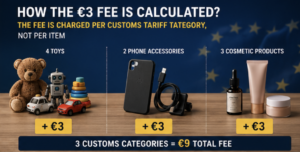
Let us look at two examples.
Example 1
A consumer orders:
4 children’s toys.
All products fall under the same customs category.
The fee due is €3.
It does not matter whether the toys are one, two, or four.
Example 2
A consumer orders:
4 toys;
2 mobile phone accessories;
3 cosmetic products.
The total number of products is nine.
At first glance, one might assume that nine separate fees will be charged.
In reality, the products fall into three different customs tariff categories.
Therefore, the following fees will be charged:
€3 for the toys;
€3 for the accessories;
€3 for the cosmetics.
Total: €9.
This is why it is not accurate to describe the measure as a “fee per product.” A more precise definition would be a fee based on the customs tariff classification of the goods.
Will This Reduce Purchases from Temu, Shein, and AliExpress?
According to Nikola Ilchev, Ph.D, probably not.
The reason is simple.
Over the past few years, European consumers have become used to the model of these platforms. They do not choose them only because of low prices. The vast selection, frequent promotions, easy access to millions of products, and constantly refreshed product ranges have created a new type of consumer behavior.
A fixed fee alone is unlikely to change this model.
What it is more likely to change is the way people organize their purchases.
“We are more likely to see more combined orders, more group shopping, and more purchases of products from the same category. This way, the cost of the fee will be spread across more items and more buyers,” Nikola Ilchev, Ph.D predicts.
This means that instead of ordering single products, consumers will probably begin planning their purchases more carefully. We may increasingly see shared orders among friends, families, or colleagues, as well as larger orders containing more items from the same category.
From the consumer’s perspective, this is a logical adaptation to the new conditions, not a rejection of shopping through international platforms.
How Will Temu, Shein, and AliExpress Respond?
One of the most common reactions following the announcement of the new fee was that it would make Chinese platforms less competitive and gradually drive some consumers back to European online retailers.
According to Nikola Ilchev, Ph.D, such a scenario is unlikely.
History shows that global marketplaces adapt remarkably quickly to regulatory changes. They have significant financial resources, their own logistics infrastructure, and the ability to optimize their operating models much faster than traditional retailers.
“I do not believe European consumers will buy less from Chinese platforms. On the contrary, these platforms will likely become even more innovative in the way they offer and deliver their products,” says Nikola Ilchev, Ph.D.
Rather than losing market share, the platforms are expected to look for new ways to offset the additional costs through:
- more aggressive promotional campaigns;
- additional discounts;
- incentives for larger orders;
- further optimization of logistics operations;
- expanding their warehouse networks across Europe.
In other words, competition is unlikely to weaken. If anything, it is expected to become even more intense.
The Biggest Impact May Not Be on Consumers, but on Logistics
According to Nikola Ilchev, Ph.D, one of the most significant consequences of the new rules may have little to do with consumer behavior and much more to do with the way international platforms organize their supply chains.
Even today, many of Asia’s leading eCommerce companies are investing heavily in logistics infrastructure across Europe.
Temu, Shein, and other major players already operate warehouses in countries such as Hungary and other parts of Central and Eastern Europe, using them to serve customers throughout the European Union.
This trend is likely to accelerate.
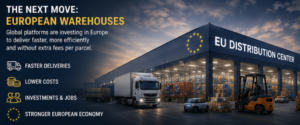
Instead of shipping every individual order directly from Asia, more goods will be imported into Europe in bulk, stored in EU-based fulfillment centers, and then delivered to customers as intra-EU shipments.
This approach will allow platforms to optimize costs while simultaneously offering even faster delivery times.
A Positive Effect on the European Economy
Although the new fee has primarily been presented as a tool for stronger customs control and fairer competition, it could also generate broader economic benefits.
If more international platforms establish logistics hubs and register local entities within the European Union, this could lead to:
- investments in new warehouse facilities;
- expansion of Europe’s logistics infrastructure;
- creation of new jobs;
- registration of more companies within EU member states;
- higher tax revenues for European economies.
From this perspective, the regulation is not designed solely to limit imports. It is also intended to encourage a stronger economic presence of international companies within the European Union.
Will European Online Retailers Benefit?
This is the question that matters most to European businesses.

The new fee undoubtedly creates a more balanced competitive environment. However, on its own, it will not automatically generate higher sales for European online stores.
According to Nikola Ilchev, Ph.D, the real winners will not be all European retailers, but those capable of delivering value that global marketplaces cannot easily replicate.
“European retailers will not succeed simply because products from China become more expensive. They will succeed if they compete not on price, but on the quality of their service.”
That means offering:
- faster delivery;
- reliable warranty and after-sales support;
- easy returns and exchanges;
- timely customer communication whenever issues arise;
- exceptional customer service;
- an outstanding customer experience throughout the entire purchasing journey.
This is where European online retailers hold their strongest competitive advantage.