


Most eCommerce strategies focus on Western Europe or North America, overlooking a high-growth region: Central and Eastern Europe (CEE). With a total European eCommerce market reaching €819 billion in 2024, CEE’s €124 billion share is expanding faster than its Western counterparts. This makes it a strategically important digital commerce frontier for online retailers and investors. This guide provides field-tested insights for capitalizing on CEE’s eCommerce opportunities, covering market potential, business ideas, country-specific strategies, emerging trends, and practical steps for launching your venture.
Table of Contents
- Understanding the CEE eCommerce Landscape and Market Potential
- eCommerce Business Ideas for the CEE Region
- Country-Specific eCommerce Opportunities Across Central and Eastern Europe
- eCommerce Trends Shaping the CEE Digital Commerce Landscape
- Future of eCommerce in Central and Eastern Europe
- Strategic Considerations for Entering CEE eCommerce Markets
- Comparing CEE eCommerce Opportunities with Western European and US Markets
- Practical Steps to Launch Your eCommerce Venture in the CEE Region
- Success Stories: eCommerce Businesses Thriving in CEE Markets
- Key Takeaways for Capitalizing on CEE eCommerce Opportunities
- FAQ
Understanding the CEE eCommerce Landscape and Market Potential
Central and Eastern Europe’s eCommerce market reached €124 billion in 2024 – growing faster than Western Europe, with a fragmented competitive landscape, rising consumer confidence, and improving digital infrastructure that together make it one of the most strategically important digital commerce frontiers available to online retailers and investors today.
If you’re looking for your next high-growth market, Central and Eastern Europe deserves serious attention. The CEE region – spanning twelve nations that have steadily moved beyond post-Soviet economic models – has cultivated market conditions that are now generating measurable, compounding eCommerce growth. The total European eCommerce market reached €819 billion in 2024, and CEE’s €124 billion share isn’t just significant in absolute terms; it’s expanding faster than Western European counterparts, making it one of the most strategically important digital commerce frontiers available to online retailers and investors today.
What makes this region particularly compelling is its internal diversity. You’re not dealing with a monolithic market. CEE includes digitally advanced economies like Estonia and the Czech Republic, high-volume powerhouses like Poland, and genuinely high-potential emerging markets like Albania and North Macedonia. That diversity is an advantage for the strategic operator – it means you can sequence your market entry, starting where infrastructure and consumer readiness are strongest, then scaling into higher-growth corridors as your operations mature.
The competitive landscape is another major draw. Unlike Western Europe, where Amazon and a handful of global platforms dominate nearly every category, CEE remains surprisingly open. Local champions such as Allegro, eMAG, and Heureka have built strong positions through logistics integration and locally preferred payment solutions, but they haven’t locked out new entrants the way Amazon has in the US or UK. Initiatives like the CEE Digital Alliance are actively encouraging cross-border collaboration and innovation, which further accelerates the region’s digital commerce infrastructure. For any eCommerce professional evaluating where to deploy capital and operational resources in the coming years, the CEE eCommerce opportunities window is wide open – and it won’t stay that way indefinitely.
What defines the CEE eCommerce market opportunity
- Market size: CEE holds a €124 billion share of the €819 billion European eCommerce market, expanding faster than Western European counterparts.
- Internal diversity: The region spans twelve nations at different stages of digital maturity, from advanced economies like Estonia and the Czech Republic to high-potential emerging markets like Albania and North Macedonia.
- Competitive openness: Unlike Western Europe, CEE remains fragmented enough for new entrants to build meaningful scale alongside local champions like Allegro, eMAG, and Heureka.
- Strategic sequencing: Operators can enter where infrastructure and consumer readiness are strongest, then scale into higher-growth corridors as operations mature.
Given this promising landscape, what specific business models are proving successful in the CEE region?
eCommerce Business Ideas for the CEE Region
The question isn’t whether viable eCommerce business ideas exist for CEE – it’s which ones align best with your existing capabilities and the specific market dynamics you’re targeting. Here’s what’s working on the ground.
- Locally sourced and regionally distinctive products: Consumers in Romania and Poland show a strong, documented preference for domestic sellers, which means that if you can source and market locally made goods – artisanal crafts, regional food products, clothing from local designers – you’re selling provenance. That’s a competitive moat a global marketplace can’t easily replicate.
- Cross-border logistics solutions: Consumers in the Baltic states routinely shop from Poland, Germany, and the Nordic countries, yet the shipping experience is often fragmented and expensive. If you can build or partner with a logistics layer that makes cross-border delivery as seamless as domestic shipping, you’re solving a real pain point that directly impacts conversion rates and repeat purchase behavior. This is a B2B eCommerce play as much as a consumer-facing one.
- Payment localization: BLIK in Poland and Barion in Hungary aren’t just payment preferences – they’re trust signals. Consumers who don’t see their preferred payment method at checkout abandon at significantly higher rates.Building a payment integration layer or a checkout optimization service specifically for CEE merchants is a genuinely profitable niche that remains underdeveloped.
- Mobile-first commerce: Smartphone penetration is rising rapidly across the region, and mobile shopping behavior is accelerating ahead of the infrastructure that supports it. Businesses that invest in fast-loading, simplified mobile checkout experiences – and that build their product discovery flows around mobile UX – will consistently outperform competitors still optimizing primarily for desktop.
- Social commerce: Instagram, TikTok, and WhatsApp are becoming genuine sales channels, not just awareness tools. Influencer-driven product launches and user-generated content campaigns are delivering measurable ROI in markets like Romania and Hungary, where social media engagement rates tend to outperform Western European averages. The brands capturing this channel earliest are building audience relationships that compound in value over time.
- Sustainability-positioned eCommerce: Eco-friendly packaging, transparent supply chains, and certified sustainable sourcing are increasingly becoming purchase drivers rather than nice-to-haves, especially among urban, educated consumers in the Czech Republic and Poland. Consumers who align with your sustainability positioning also tend to exhibit higher lifetime values and stronger referral behavior – making this a retention strategy as much as an acquisition one.

These business ideas offer a broad spectrum of opportunities. But how do these opportunities manifest in specific countries within the CEE region?
Country-Specific eCommerce Opportunities Across Central and Eastern Europe
- Poland: The undisputed anchor of CEE eCommerce. It’s the largest market in the region, with a sophisticated consumer base, well-developed logistics infrastructure, and high internet penetration. Polish consumers have strong preferences for local payment methods – BLIK is used by 68% of Polish internet users for online transactions (Gemius/IAB Poland 2024) – and they respond well to competitive pricing combined with reliable, fast delivery. If you’re entering CEE for the first time, Poland is the right starting point. The market is competitive but not saturated, and the volume justifies the investment in localization.
- The Czech Republic: Punches above its weight in per-capita online spending. Czech consumers are digitally savvy, brand-conscious, and willing to pay a premium for quality and service. The eCommerce environment here is mature, which means the bar for customer experience is high – but so is the reward for meeting it. Heureka, the price comparison platform dominant in the Czech Republic and Slovakia, plays a critical role in the consumer decision journey. Your pricing strategy and product feed quality directly affect your visibility and conversion rates on this platform, making it a non-negotiable part of your Czech market strategy.
- Hungary: Experiencing rapid growth in mobile commerce adoption. Smartphone usage is surging, and Hungarian shoppers are increasingly completing purchases on mobile devices. Barion is a locally trusted payment solution worth integrating early. The market is less mature than Poland or the Czech Republic, which means lower competition and higher growth potential for businesses willing to invest in localization and mobile optimization.
- Romania: Represents the high-growth southeastern corridor of CEE. An expanding digital middle class, improving internet speeds, and a growing appetite for online shopping are combining to create a market that’s moving fast.eMAG has established a dominant position here, but the platform’s marketplace model also creates opportunities for third-party sellers to reach Romanian consumers without building their own logistics infrastructure from scratch. Reliable last-mile delivery and localized marketing are the two levers that consistently drive performance in this market. For a deeper look at eCommerce opportunities in the Balkans for 2026, Romania’s trajectory over the next five years makes it one of the most compelling long-term bets in the region.
| Country | Market Maturity | Key Payment Method | Dominant Platform | Primary Opportunity |
|---|---|---|---|---|
| Poland | High | BLIK (68% adoption, Gemius/IAB 2024) | Allegro | High-volume entry point; competitive but not saturated |
| Czech Republic | High | Card / local methods | Heureka | Premium per-capita spending; brand-conscious consumers |
| Hungary | Medium | Barion | Emerging local players | Rapid mobile commerce growth; lower competition |
| Romania | Medium-High | Card / cash on delivery | eMAG | Fast-growing digital middle class; marketplace access |
Beyond these country-specific nuances, broader trends are shaping the entire CEE digital commerce landscape. What are they, and how should you adapt?
eCommerce Trends Shaping the CEE Digital Commerce Landscape
Understanding where the market is heading is as important as understanding where it stands today. Several converging trends are reshaping how CEE consumers discover, evaluate, and purchase products online – and each carries specific implications for how you should be building your eCommerce operations right now.
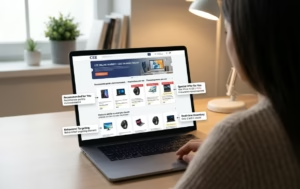
- Mobile commerce acceleration: As smartphone penetration rises across the region, the share of transactions completed on mobile devices is growing faster than most merchants’ mobile optimization efforts can keep pace with. This creates a measurable gap between consumer behavior and merchant capability – and that gap is your opportunity. Businesses that invest in progressive web apps, one-click checkout, and mobile-native product discovery will see direct improvements in conversion rates and average order values.
- AI-driven personalization: CEE consumers are increasingly accustomed to personalized product recommendations, dynamic pricing, and targeted promotions – not because they’ve demanded it explicitly, but because platforms like eMAG and Allegro have trained them to expect it. If your eCommerce experience feels generic, you’re losing customers to platforms that feel like they understand them. Investing in recommendation engines, behavioral segmentation, and personalized email flows isn’t optional anymore; it’s table stakes.
- Social commerce integration: TikTok Shop, Instagram Shopping, and WhatsApp-based selling are all gaining traction in CEE markets, particularly among consumers under 35. Social commerce in CEE isn’t just about awareness – it’s increasingly a full-funnel channel where discovery, consideration, and purchase happen within a single platform session. Brands that build native social commerce capabilities, rather than treating social as a traffic source to their main store, will capture a disproportionate share of this growing channel.
- Sustainability as a purchase driver: Environmentally conscious consumers in urban CEE markets are actively choosing brands that demonstrate credible sustainability commitments – eco-friendly packaging, transparent sourcing, carbon-neutral shipping options. Consumers who align with a brand’s sustainability positioning tend to have higher lifetime values and stronger referral behavior, making this a retention strategy with real financial impact.
- Cross-border shopping normalization: Baltic consumers shopping from Polish and German retailers, Romanian consumers accessing Western European brands, Czech consumers buying from Asian marketplaces – these behaviors are becoming routine rather than exceptional. For merchants, this means both an opportunity (your addressable market is larger than your domestic base) and a threat (your domestic customers have more alternatives than ever). The businesses that win will be those that make cross-border purchasing as frictionless as domestic shopping, investing in multilingual support, transparent international shipping costs, and localized returns processes.
Looking ahead, what structural developments will define the future of eCommerce in Central and Eastern Europe?
Future of eCommerce in Central and Eastern Europe
The long-term trajectory of CEE eCommerce is genuinely compelling, and the businesses that position themselves correctly now will benefit from compounding advantages as the market matures. For a look at 7 eCommerce predictions for 2026-2027, several structural developments will define the next decade of digital commerce in the region.
- Digital infrastructure investment: EU funding, combined with private sector investment in fiber networks, 5G rollout, and cloud infrastructure, is systematically closing the connectivity gap between CEE and Western Europe. Markets that look marginal today – parts of Bulgaria, Romania’s rural regions, the Western Balkans – will become commercially viable eCommerce territories within a relatively short timeframe. Operators who establish brand recognition in these markets before they fully mature will have a significant first-mover advantage.
- Rising consumer sophistication: The CEE consumer base is becoming more sophisticated at a measurable pace. First-time online shoppers are moving through the learning curve quickly, and experienced online shoppers are raising their expectations for personalization, delivery speed, and return convenience. This sophistication creates both pressure to continuously improve customer experience and opportunity to build loyalty with consumers actively looking for brands that meet their rising standards.
- AI-driven operations: Artificial intelligence will play an increasingly central role in CEE eCommerce operations. Demand forecasting, dynamic pricing, fraud detection, customer service automation, and personalized marketing are all areas where AI is delivering measurable ROI for early adopters. Businesses that start building clean, structured customer and transaction data now will have a significant edge when AI-driven optimization becomes standard practice across the region.
- Regulatory maturation: EU digital commerce regulations, data privacy requirements, and consumer protection standards are creating a more consistent framework across CEE markets. While compliance adds operational complexity, it also raises the barrier to entry for low-quality competitors and builds consumer trust in online shopping as a category – which ultimately benefits all legitimate eCommerce operators in the region.
- Sustained growth projections: Growth projections consistently show CEE eCommerce outpacing Western European markets in percentage terms for the foreseeable future. The combination of a lower starting base, rising consumer confidence, improving infrastructure, and an increasingly open competitive landscape makes this one of the most attractive long-term eCommerce investment theses available to operators and investors today.
Given these future trends, what strategic considerations should guide your entry into CEE eCommerce markets?
Strategic Considerations for Entering CEE eCommerce Markets
Before you commit resources to a CEE market entry, several strategic factors will determine whether your investment generates returns or gets absorbed by avoidable mistakes. To understand how to enter new markets in CEE and the Balkans, the first step is market sequencing. CEE is not a single market – it’s a collection of markets at different stages of digital maturity, with different consumer behaviors, payment preferences, and competitive dynamics. Trying to enter multiple CEE countries simultaneously is a common mistake that dilutes focus and stretches operational capacity. A more effective approach is to identify the one or two markets where your product-market fit is strongest, establish operational excellence there, and use those learnings to inform your expansion into adjacent markets.
- Market sequencing: Identify the one or two markets where your product-market fit is strongest, establish operational excellence there, and use those learnings to inform your expansion into adjacent markets. Entering too many countries simultaneously dilutes focus and stretches operational capacity.
- Localization depth: It’s not enough to translate your website. CEE consumers expect customer support in their native language, pricing in local currency, and payment options they actually trust. In Poland, that means BLIK integration. In Hungary, it means Barion. In some markets, cash on delivery remains a significant share of transactions – ignoring that preference will cost you conversions that your competitors are capturing.
- Category-level competitive analysis: While the overall CEE market is less saturated than Western Europe, specific categories – consumer electronics, fashion, home goods – may already have strong local or regional players. Your entry strategy needs to account for where Allegro, eMAG, or Heureka already have dominant positions, and identify the specific value proposition that gives consumers a reason to choose you over an established platform.
- Regulatory compliance: Most CEE countries are EU members, which means GDPR, consumer protection directives, and VAT compliance apply. Non-EU CEE markets have their own regulatory frameworks that require careful navigation. Building compliance into your operational model from day one is far less expensive than retrofitting it after you’ve scaled.
How do these strategic considerations translate when comparing CEE eCommerce opportunities with those in Western Europe and the US?
Comparing CEE eCommerce Opportunities with Western European and US Markets
If you’re allocating eCommerce investment across multiple geographies, the comparison between CEE and more mature markets is instructive – and the numbers make a compelling case for CEE’s relative attractiveness.
| Factor | CEE Markets | Western Europe | United States |
|---|---|---|---|
| Competitive landscape | Fragmented; regional champions with room for new entrants | Dominated by Amazon, Zalando, and global platforms | Heavily dominated by Amazon; high barriers for independents |
| Growth rate | Expanding from a lower base; above-average percentage growth | Mature; slower percentage growth | Mature; slower percentage growth |
| Consumer openness to new brands | High; consumers actively discovering new platforms | Low; deeply ingrained habits around dominant platforms | Low; strong Amazon loyalty and habitual purchasing |
| Cost of customer acquisition | Lower; less saturated paid channels | High; intense competition for paid traffic | Very high; extremely competitive paid acquisition landscape |
| Brand-building ROI | High; early movers capture compounding advantages | Moderate; established brands hold strong positions | Low to moderate; difficult to displace entrenched players |
In the US, Amazon’s dominance creates a structural challenge for independent eCommerce operators. Building a direct-to-consumer brand in the US requires either competing with Amazon on its own platform – where you’re subject to its pricing and visibility algorithms – or investing heavily in paid acquisition to drive traffic to your own store. Either path is expensive, and margins are under constant pressure. Western European markets face similar dynamics, with Amazon, Zalando, and other global platforms capturing an increasing share of consumer spending and making it progressively harder for new entrants to build sustainable positions.
CEE presents a fundamentally different competitive environment. Local champions like Allegro and eMAG hold significant market share, but the market remains fragmented enough that a well-positioned new entrant can build meaningful scale without going head-to-head with a platform that has unlimited resources. The growth rates are also structurally different – CEE markets are expanding from a lower base, which means the absolute growth in eCommerce spending is creating new market share that doesn’t have to be taken from an existing competitor.
Consumer behavior differences also work in your favor as a new entrant. CEE consumers tend to be more open to discovering new brands and platforms than their Western counterparts, who have deeply ingrained shopping habits built around a small number of dominant platforms. That openness, combined with the region’s rising purchasing power and improving digital infrastructure, creates a window of opportunity that simply doesn’t exist in the same form in the US or Western Europe. The strategic implication is clear: if you’re looking for markets where your investment in brand-building and customer acquisition generates outsized returns, CEE is where that math works in your favor right now.
With the strategic advantages of CEE in mind, what practical steps should you take to launch your eCommerce venture in the region?
Practical Steps to Launch Your eCommerce Venture in the CEE Region
Strategy without execution is just theory. Here’s a practical framework for moving from market analysis to operational launch in CEE.
- Start with rigorous market research. Before you invest in localization or logistics, validate your product-market fit in your target CEE country. This means analyzing search demand data, reviewing competitor positioning, understanding the regulatory environment, and – ideally – conducting consumer interviews or surveys with your target demographic. Tools like Google Trends, SEMrush, and local market research firms can give you the data foundation you need to make informed decisions.
- Invest in genuine localization. Translate your website, product descriptions, and customer communications into the local language – not with machine translation, but with native speakers who understand the cultural context. Localize your pricing, your customer support channels, and your returns process. The investment pays back quickly in conversion rate improvements and customer retention metrics.
- Integrate local payment methods from day one. BLIK in Poland, Barion in Hungary, and other locally preferred payment solutions should be live before you launch, not added as an afterthought. Payment method availability is one of the highest-impact variables in checkout conversion, and getting it right from the start prevents revenue leakage during your critical early growth phase.
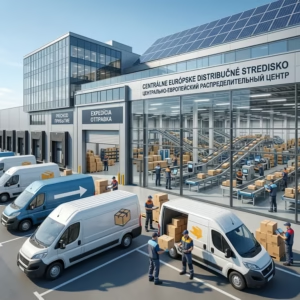
- Build your logistics infrastructure carefully. Delivery speed and reliability are major purchase drivers in CEE markets. Partner with logistics providers that have proven last-mile delivery capabilities in your target market, and set realistic delivery time expectations that you can consistently meet. Overpromising on delivery and underdelivering generates negative reviews that will follow your brand for years.
- Optimize for mobile from the start. Your store should load in under three seconds on a mid-range Android device, your checkout should require minimal steps, and your product images should be optimized for mobile viewing. These aren’t advanced optimizations – they’re baseline requirements for competing effectively in a market where mobile commerce is growing faster than desktop.
- Establish your social commerce presence early. Build your Instagram and TikTok presence in parallel with your store launch, and identify local micro-influencers in your category who can drive authentic awareness among your target demographic. Social proof from local voices carries significantly more weight than brand-produced content in CEE markets, and the cost of building these relationships early is a fraction of what it will be once the market becomes more competitive.
To further illustrate the potential, let’s examine some success stories of eCommerce businesses thriving in CEE markets.
Success Stories: eCommerce Businesses Thriving in CEE Markets
The most convincing evidence for CEE’s eCommerce potential isn’t projections – it’s the businesses that have already built substantial, profitable operations in the region. Their stories offer both inspiration and practical lessons worth applying directly to your own strategy.
- Allegro: With over 15 million active buyers in Poland (21 million group-wide) and dominant market share in Poland, Allegro built its position not by copying Amazon’s playbook but by deeply understanding Polish consumer preferences. Its integration of BLIK – the payment method used by 68% of Polish online shoppers – and its investment in logistics infrastructure that delivers reliably across Poland’s geography were the operational foundations of its success. The lesson: local payment and logistics mastery creates a moat that global platforms struggle to replicate, regardless of their scale advantages.
- eMAG: Starting as a Romanian eCommerce platform, eMAG has expanded its ecosystem into Bulgaria and Hungary, building a network of over 36,000 third-party merchants and millions of active customers across the region. Its integration of consumer finance options and last-mile delivery services created a flywheel effect where better logistics attracted more merchants, which attracted more consumers, which justified further logistics investment. For any operator considering a multi-country CEE strategy, eMAG’s expansion model is worth studying closely – it shows how operational depth in one market can become the foundation for regional scale.
- Heureka: Taking a different approach entirely, Heureka built dominance in the Czech Republic and Slovakia as a price comparison engine rather than a direct retailer. By positioning itself as the consumer’s advocate in the price discovery process, Heureka became an essential part of the purchase journey for price-sensitive Czech and Slovak shoppers. This highlights an important insight: in CEE markets, where price sensitivity remains a significant purchase driver, tools and platforms that help consumers find value have a structural advantage that’s difficult for traditional retailers to displace.
What key takeaways can we glean from these success stories to capitalize on CEE eCommerce opportunities?
Key Takeaways for Capitalizing on CEE eCommerce Opportunities
CEE rewards specificity. The businesses that succeed here treat each market as distinct, invest in genuine localization, and build operational capabilities that match local consumer expectations rather than importing a Western playbook wholesale.
- Localization is the highest-ROI investment: Language, payment methods, logistics, and customer service localization is the single most impactful investment you can make in a CEE market entry. The documented preference for domestic sellers in countries like Romania and Poland means that feeling local is a competitive requirement, not a nice-to-have.
- Local payment mastery is non-negotiable: BLIK’s 68% adoption rate among Polish internet users (Gemius/IAB 2024) – Polish online shoppers and eMAG’s network of over 36,000 merchants in Romania are evidence of what happens when platforms commit fully to local market dynamics. Missing preferred payment methods at checkout costs measurable revenue from day one.
- Mobile and social commerce are core channels: CEE shoppers are increasingly mobile-first, and social platforms are becoming genuine sales channels. Building these capabilities into your core operations, rather than treating them as secondary channels, will determine your growth trajectory over the next three to five years.
- The opportunity window is real but finite: As the market matures and more sophisticated operators enter, the competitive dynamics will shift. The businesses that establish strong positions now – through localization, operational excellence, and genuine consumer understanding – will be the ones that define the next chapter of CEE digital commerce.
- Timing favors early movers: The data, the trends, and the success stories all point in the same direction: this is the right time to move. The combination of a lower competitive base, rising consumer confidence, and improving infrastructure creates compounding advantages for operators who act now.
FAQ: CEE eCommerce Strategy, Implementation, and Results
- Which CEE country should I enter first if I’m new to the region? Poland is the most logical starting point. It’s the largest CEE eCommerce market, has well-developed logistics infrastructure, and offers the highest volume of online shoppers. The learnings you generate in Poland will transfer well to other CEE markets as you expand.
- How important is local payment method integration for CEE eCommerce success? Critically important. Payment method availability is one of the highest-impact variables in checkout conversion. In Poland, BLIK is used by 68% of online shoppers (Gemius/IAB Poland 2024). In Hungary, Barion is a trusted local option. Missing these integrations at launch will cost you measurable revenue from day one.
- What are the biggest mistakes Western eCommerce operators make when entering CEE? The most common mistakes are treating CEE as a single market, underinvesting in localization, and ignoring local payment preferences. Entering too many countries simultaneously without operational depth in any of them is also a frequent and costly error.
- How does CEE eCommerce competition compare to Western Europe? CEE is significantly less saturated. While local champions like Allegro and eMAG hold strong positions, the market remains fragmented enough for well-positioned new entrants to build meaningful scale. Western European markets, by contrast, are dominated by Amazon and a small number of global platforms that are extremely difficult to compete with directly.
- What eCommerce business ideas are most profitable in CEE right now? Locally sourced products, cross-border logistics solutions, payment localization services, mobile-first commerce, and sustainability-positioned brands are all generating strong returns. The most profitable models are those that solve a specific CEE market pain point rather than replicating a generic global approach.
- How significant is mobile commerce in CEE, and how should I optimize for it? Mobile commerce is growing faster than desktop in virtually every CEE market. Optimize for sub-three-second load times on mid-range Android devices, simplify your checkout to the minimum number of steps, and ensure your product imagery is mobile-optimized. These are baseline requirements, not advanced tactics.
- What role does social commerce play in CEE eCommerce strategy? Social commerce is becoming a full-funnel channel in CEE, particularly among consumers under 35. TikTok, Instagram, and WhatsApp are driving discovery, consideration, and purchase within single sessions. Building native social commerce capabilities and partnering with local micro-influencers delivers measurable ROI in markets like Romania and Hungary.
- How should I approach logistics when launching in CEE? Partner with logistics providers that have proven last-mile delivery capabilities in your specific target market. Set delivery time expectations you can consistently meet – overpromising and underdelivering generates negative reviews that compound over time. For cross-border operations, focus on making the shipping experience as seamless as domestic delivery.
- What KPIs should I track when entering a new CEE market? Track checkout conversion rate by payment method (to validate your payment integrations), mobile vs. desktop conversion rate gap (to identify mobile optimization opportunities), customer acquisition cost by channel, repeat purchase rate (as a proxy for localization quality), and delivery performance against stated timelines.
- How long does it typically take to see meaningful ROI from a CEE market entry? With proper localization, payment integration, and logistics partnerships in place, most operators see meaningful traction within six to twelve months of launch. The businesses that see the fastest returns are those that invest in localization depth upfront rather than iterating toward it after launch. Cutting corners on localization to accelerate launch typically extends the time to profitability, not shortens it.
References
- eCommerce Europe / EuroCommerce – European eCommerce Report 2025. Total European B2C turnover: €819 billion in 2024 (+7% YoY); CEE share: €124 billion (+12% YoY).
- Allegro Group Investor Relations – 2024 Annual Results. Poland: ~15 million active buyers in 2024; group-wide (CEE): ~21 million active buyers.
- BLIK – Payment Growth Reports 2024. BLIK is Poland’s most widely adopted online payment method. Gemius/IAB Poland 2024 survey: 68% of Polish internet users identify BLIK as their most popular e-payment method.
- Shopify – CEE eCommerce Market Overview. Regional dynamics, social commerce trends, and platform strategy for Central and Eastern Europe.