

For years, eCommerce growth was driven primarily by acquiring more traffic. But as customer acquisition costs continue to rise and competition intensifies across digital channels, the real advantage is shifting elsewhere – to how efficiently brands convert the demand they already have.
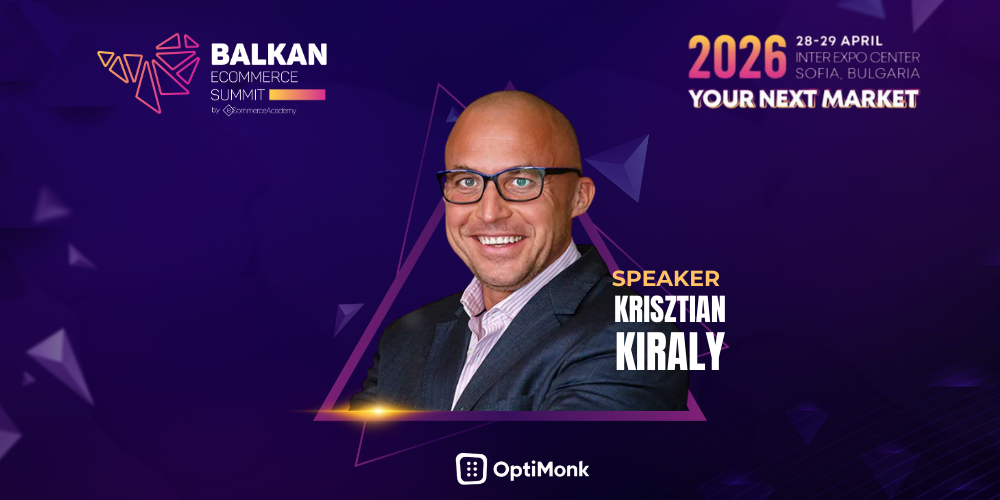
Krisztián Király, a senior digital marketing strategist with more than a decade of experience in performance marketing and conversion rate optimization, has helped numerous eCommerce brands improve unit economics by reducing CAC, increasing AOV, and building high-converting sales funnels. His approach combines deep analytical thinking with creative experimentation, focusing on sustainable growth rather than short-term tactics.
During the Balkan eCommerce Summit 2026, Krisztián shared his perspective on why conversion optimization is becoming one of the key competitive advantages for online stores, how AI can accelerate experimentation and personalization, and how brands can build a continuous optimization system that drives long-term profitability.
Krisztián, during your session “The Future of eCommerce: AI-Powered CRO as the New Growth Engine”, what were the main takeaways attendees gained from it?
Attendees left with a clear, practical framework for using AI-powered CRO as a growth engine – not as another tool. I showed how to shift from “one-off CRO projects” to a continuous system: personalization → experimentation → rollout.
We covered what to optimize first (PDP, cart, checkout moments), how to scale winning changes across hundreds of pages, and how to measure real incremental impact using the metrics that matter: conversion rate, AOV, and revenue per session.
The goal was for people to be able to apply the playbook within 30 days and see a measurable first win.

For years, growth in eCommerce was driven mainly by acquiring more traffic. Why do you believe conversion optimization is becoming the real competitive advantage today?
Because acquisition is no longer the differentiator – efficiency is. CAC has increased, competition is brutal, and margins are under pressure. If two stores buy the same traffic, the one with a higher conversion rate and AOV wins the market.
CRO is the lever that compounds: every improvement boosts the ROI of all channels – paid, organic, email, social – because it turns the same demand into more revenue and profit.
The strongest brands are now building conversion systems, not just running campaigns.
You work with brands on reducing CAC and increasing AOV. Where do you see the biggest opportunities for AI to improve conversion rates in online stores?
Three areas stand out:
Product page personalization at scale
Matching message, offer, and proof to visitor intent – especially across large catalogs.
Faster experimentation
AI can generate high-quality variants and hypotheses, but the real value is that it helps teams test and iterate 10x faster.
Lifecycle and AOV uplift moments
Cart recovery, bundles, upsells, and context-based incentives – where small changes often create outsized revenue impact.
In short: AI helps you be more relevant, move faster, and optimize continuously.
Many companies implement CRO tools but fail to see meaningful results. What are the most common mistakes brands make when trying to optimize their funnels?
The biggest mistakes I see are:
No clear measurement of incremental lift
Teams launch tactics but don’t run proper tests or holdouts, so they can’t separate signal from noise.
Trying to optimize everything at once
Too many campaigns, no prioritization, no focus on high-impact pages.
Weak segmentation
Showing the same message to everyone, instead of tailoring by intent, source, or lifecycle stage.
Execution bottlenecks
Relying on dev resources slows iteration; CRO dies when speed is lost.
Tactics without strategy
Popups everywhere, but no cohesive offer, funnel logic, or narrative.
Tools don’t create results – systems do.

How can AI-powered CRO help eCommerce teams move from short-term performance tactics to sustainable and profitable growth?
It turns growth into an operating model. Instead of chasing short-term hacks, teams build a repeatable engine:
- AI accelerates ideation and production of variants
- experimentation validates what works
- winners get rolled out broadly
- and performance compounds over time
That’s sustainable growth because it improves unit economics: lower blended CAC through higher conversion efficiency, higher AOV through smarter offers, and better retention through more relevant experiences.
It’s a profit-first approach, not a “more traffic” approach.
For companies in the Balkans and CEE region looking to scale internationally, what role will AI-driven optimization play in staying competitive?
For CEE and Balkan brands, AI-driven optimization is a way to compete globally with smaller teams. When you go international, you face higher CAC, stronger incumbents, and more fragmented audiences.
AI-powered CRO helps you adapt faster – localize messaging, personalize by country or segment, and learn through experimentation without heavy operational overhead.
It’s also a credibility advantage: if you can prove predictable uplift in CR/AOV/RPS, you can scale paid and partnerships with confidence. In international markets, speed of learning becomes a competitive moat.
As eCommerce continues to evolve across technology, customer behavior, operations, and digital growth, conversations like these will once again be a key part of Balkan eCommerce Summit 2027, where industry leaders, brands, and innovators from across the region will come together to exchange ideas, practical insights, and real-world experience.
More information about the upcoming edition is available at balkanecommerce.com