


The Balkan region presents a unique opportunity for eCommerce businesses seeking international expansion. However, success hinges on understanding the specific market dynamics, logistical challenges, and consumer preferences that define this diverse area. This guide provides actionable strategies for navigating the Balkan eCommerce landscape, focusing on logistics, paymentsolutions, regulatory compliance, and localization. By implementing these field-tested tactics, you can unlock significant growth potential and establish a strong foothold in this emerging market.
Cross-border eCommerce growth in the Balkans is propelled by unmet domestic demand, improving cross border logistics, localized cross border payment solutions, and international eCommerce solutions that navigate EU and non-EU regulations. Businesses that localize experiences, solve last-mile delivery, and master cross border tax compliancecan unlock scalable, multi-country growth across Serbia, Croatia, Bulgaria, and neighboring markets.
Table of Contents
- Understanding Balkan Cross-Border eCommerce Drivers and Market Dynamics
- Cross-Border Logistics Infrastructure Transforming Balkan Trade
- Cross-Border Payment Solutions Enabling Seamless Transactions
- International eCommerce Solutions for Balkan Market Entry
- Cross-Border Tax Compliance and Regulatory Frameworks
- Localization Strategies for Balkan Consumer Markets
- Building Trust Through Customer Experience Optimization
- Frequently Asked Questions
Understanding Balkan Cross-Border eCommerce Drivers and Market Dynamics
If you’re evaluating the Balkans as your next growth frontier, you’re looking at one of Europe’s most underestimated eCommerce opportunities. The region – spanning Serbia, Croatia, Bosnia and Herzegovina, North Macedonia, Albania, Montenegro, Slovenia, and Bulgaria – is experiencing a convergence of digital adoption, rising consumer expectations, and structural market gaps that together create compelling conditions for cross-border commerce, unlocking global market access and international business expansion.
The most fundamental driver is straightforward: domestic product availability doesn’t match consumer demand. Balkanshoppers routinely turn to international online retailers to access categories that local markets simply don’t serve well – premium apparel, consumer electronics, specialty health products, and niche hobby goods among them. This demand-supply gap is your entry point. In fact, the broader CEE region’s cross-border commerce is showing no signs of slowing, with projections reaching €24 billion and rising in 2024. Local retail infrastructure, while improving, still lags behind the breadth and depth that international sellers can offer.
Internet penetration and smartphone adoption are accelerating this shift. Younger demographics across the region are digitally native, comfortable with online transactions, and increasingly impatient with the limitations of brick-and-mortar retail. While eCommerce participation rates still trail Western European averages in several Balkan countries, the trajectory is sharply upward – and early movers in cross-border selling are capturing disproportionate loyalty from these emerging online shoppers.
What makes the Balkans distinct from other Central and Eastern European markets is the trust dynamic. Balkanconsumers are discerning about who they buy from internationally. Transparent delivery timelines, clear return policies, and familiar payment options aren’t nice-to-haves – they’re conversion prerequisites. Cash-on-delivery remains a meaningful payment preference in parts of the region, which signals something important: these consumers want assurance before they commit. Your job as a cross-border seller is to engineer that assurance into every touchpoint of the purchase experience.
The regulatory landscape adds another layer of complexity. The Balkans include both EU member states and non-EU countries, meaning the rules governing customs, VAT, and consumer protection vary significantly across borders. Understanding these distinctions – and building operational systems that handle them efficiently – is what separates businesses that scale in this region from those that stall at the border. The Balkans reward sellers who do the structural work upfront; they punish those who treat the region as a simple extension of their existing European operations.
Successfully navigating the Balkan eCommerce landscape requires a deep understanding of its unique market dynamics and anticipating where the eCommerce opportunities are heading in 2026. The next section explores how cross-borderlogistics infrastructure is transforming trade in the region, providing insights into building a reliable fulfillment strategy.
Balkan cross-border eCommerce drivers at a glance
- Demand–supply gap: Domestic product availability doesn’t match consumer demand, pushing shoppers to international sellers.
- Digital adoption: Rising internet and smartphone use accelerates cross-border purchase behavior among younger demographics.
- Trust dynamics: Transparent delivery, clear returns, and familiar options like cash-on-delivery are conversion prerequisites.
- Regulatory split: EU and non-EU rules vary for customs, VAT, and consumer protection, requiring robust operational systems.
- Early-mover advantage: Upward market trajectory rewards sellers who invest early in localized operations and trust-building.
Cross-Border Logistics Infrastructure Transforming Balkan Trade
Logistics is where Balkan cross-border eCommerce either accelerates or breaks down. The infrastructure picture has improved substantially over the past several years, driven by EU-funded transportation investments, private logisticssector growth, and the entry of major international carriers into regional markets. The challenge is that improvement has been uneven – knowing where the gaps remain is essential for building a reliable fulfillment strategy.
Road and rail modernization projects across the Western Balkans, many tied to EU pre-accession funding and the Trans-European Transport Network (TEN-T) corridors, are reducing transit times between key commercial hubs. Air cargo capacity has also expanded, particularly through airports in Belgrade, Zagreb, Sofia, and Ljubljana, giving merchants more options for time-sensitive shipments. These infrastructure gains translate directly into faster, more predictable delivery windows – which is exactly what Balkan consumers are beginning to expect.

Customs harmonization is another area of meaningful progress. EU member states within the region – Croatia, Slovenia, and Bulgaria – operate under unified customs frameworks, while non-EU Balkan countries are at various stages of regulatory alignment. For cross-border sellers, this means your logistics strategy needs to account for different documentation requirements, duty structures, and clearance timelines depending on which markets you’re serving. Partnering with logistics providers that have deep regional expertise isn’t optional; it’s the operational foundation your entire fulfillment model rests on.
The rise of specialized regional logistics operators – companies that have built networks specifically for Balkan cross-border commerce rather than adapting global models – is one of the most significant developments for eCommercesellers. These providers understand the nuances of local addressing systems, carrier relationships, and customs procedures in ways that global giants often don’t. Integrating them into your fulfillment stack can meaningfully reduce both costs and delivery exceptions, and their market knowledge is often worth more than the marginal cost savings you might achieve by defaulting to a single international carrier.
To optimize your shipping strategy, consider the benefits of regional shipping networks and fulfillment centers, as discussed in the following section.
Logistics transformation highlights
- Cross border logistics investments: TEN-T corridor upgrades and expanded air cargo capacity improve delivery speed and predictability.
- Customs alignment: EU member states follow unified frameworks; non-EU neighbors vary, impacting documents and clearance times.
- Regional specialists: Balkan-focused carriers reduce exceptions and costs versus one-size-fits-all global networks.
- Network-first partner selection: Choose providers for density and coverage, not just brand recognition.
Regional Shipping Networks and Fulfillment Centers
The most effective shipping strategy for reaching multiple Balkan markets isn’t a single carrier relationship — it’s a layered network that combines regional fulfillment positioning with last-mile carrier partnerships tailored to each country.
Strategically positioned fulfillment centers within the region allow you to pre-position inventory closer to your customer base, dramatically reducing both transit times and per-shipment costs. Locations like Belgrade, Sofia, and Zagreb function as natural distribution hubs given their central positioning and well-developed outbound carrier networks. If your order volumes justify it, operating a regional fulfillment node in one of these cities can cut delivery times to neighboring markets from five to seven days down to two to three days – a difference that measurably impacts conversion rates and repeat purchase behavior.
For sellers not yet ready to invest in regional warehousing, third-party logistics (3PL) providers with established Balkannetworks offer a lower-commitment path to faster regional delivery. Companies like GLS, DPD, and DHL have expanded their Balkan coverage significantly, and regional specialists such as Post Express (Serbia), Overseas Express, and similar operators provide granular last-mile coverage that international carriers sometimes miss. The right answer for most sellers entering the region is a hybrid: use a global carrier for primary coverage and supplement with regional specialists in markets where the global network has gaps.
Real-time shipment tracking is non-negotiable for this market. Balkan consumers – particularly those making their first cross-border purchase – want visibility into where their order is at every stage. Integrating tracking data directly into your post-purchase communication flow through automated email or SMS updates reduces customer service inquiries and builds the kind of confidence that drives repeat orders. Your KPI here is simple: track the percentage of orders where customers proactively check tracking versus those who contact support asking where their package is. Reducing the latter is a direct measure of your logistics communication quality.
When evaluating logistics partners for regional coverage, prioritize network density over brand recognition. A carrier with strong coverage in Serbia may have weak penetration in Albania or Kosovo. Map your target markets against each carrier’s actual delivery network before committing, and build redundancy into your carrier mix so that service disruptions in one network don’t cascade into customer experience failures across your entire Balkan operation.
Action steps for regional shipping setup
- Layer carriers by combining regional fulfillment positioning with last-mile partnerships tailored to each country.
- Pre-position inventory in hubs such as Belgrade, Sofia, and Zagreb to cut delivery times from five to seven days down to two to three days.
- Leverage 3PLs with established Balkan networks and adopt a hybrid model that supplements global coverage with regional specialists.
- Integrate real-time tracking into post-purchase communications and monitor the share of support contacts asking “where is my package?”.
- Map coverage by market for each carrier and build redundancy to mitigate disruptions.
Even with robust regional networks, last-mile delivery presents unique challenges. The next section explores these obstacles and provides solutions for ensuring successful final delivery.
Last-Mile Delivery Challenges and Solutions
Last-mile delivery is where the Balkans present their most persistent operational challenges – and where the right solutions create genuine competitive differentiation. The region’s geography is complex: mountainous terrain, dispersed rural populations, and inconsistent address standardization combine to make final delivery more difficult and expensive than in flatter, more densely urbanized markets.
Address accuracy is a particularly acute problem. Many Balkan countries lack standardized postal code systems, and rural addresses are often descriptive rather than structured – meaning automated routing systems struggle with them. The practical solution is to build address validation into your checkout flow, prompting customers to confirm or clarify their delivery details before the order is placed. Pairing this with local carrier expertise – drivers who know their territories – significantly reduces failed delivery attempts, which are costly both financially and in terms of customer satisfaction.
Parcel locker networks and pickup point infrastructure are expanding across the region and represent one of the most effective solutions to last-mile complexity. Networks like InPost (active in several Balkan markets), carrier-operated pickup points, and convenience store partnerships give customers a reliable alternative to home delivery in areas where address accuracy or access is problematic. Offering pickup point delivery as a checkout option – particularly in markets where it’s well-established – can meaningfully improve your successful delivery rate while often reducing your per-shipment cost.

For rural and remote deliveries, partnering with local postal services remains the most practical approach. While national postal operators in the Balkans vary in quality, they typically maintain the broadest geographic coverage and the deepest familiarity with local addressing conventions. Use them strategically for coverage in areas where private carriers don’t operate efficiently, and reserve premium carrier networks for urban and suburban deliveries where speed and reliability are paramount.
With logistics challenges addressed, the next critical aspect of Balkan cross-border eCommerce is payment solutions. The following section explores how to enable seamless transactions by offering the right payment mix for the market.
Last-mile challenges and proven solutions
- Complex geography and address accuracy: Build address validation into checkout and pair with local carrier expertise.
- Pickup infrastructure: Offer parcel lockers and pickup points to improve successful delivery rates and reduce costs.
- Rural coverage: Use national postal services strategically where private carriers lack efficiency.
- Communication: Provide proactive tracking updates to reduce anxiety and support contacts.
Cross-Border Payment Solutions Enabling Seamless Transactions
Payment is where many cross-border eCommerce strategies fail in the Balkans – not because of fraud or technical failure, but because sellers offer the wrong payment mix for the market they’re entering. Getting this right requires understanding both the technical infrastructure of cross-border payment processing and the behavioral preferences of Balkan consumers, which don’t always align with what works in Western Europe or North America. The Balkan region’s digital payment landscape is moving from “cash-first” to “choice-first,” presenting significant growth opportunities.
The foundational requirement is a payment gateway that supports multi-currency processing, handles transactions across both EU and non-EU Balkan countries, and integrates cleanly with your eCommerce platform. Providers like Stripe, Adyen, and Braintree offer the technical capabilities needed for regional scale, but you’ll need to supplement them with local payment method integrations to capture the full market opportunity. A payment stack that works perfectly for Croatian customers may leave Serbian or Albanian shoppers without a viable checkout option.
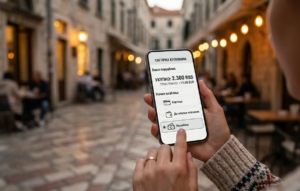
Security and fraud prevention deserve particular attention in cross-border Balkan transactions. Implementing 3D Secure authentication, real-time fraud scoring, and clear PCI DSS compliance signals to customers that their financial data is protected. This isn’t just a technical requirement – it’s a trust signal that directly influences whether a first-time buyer completes their purchase or abandons at checkout. Display security certifications and payment partner logos prominently on your checkout page; in markets where online shopping trust is still being established, these visual cues carry real conversion weight.
Transparency in pricing is equally critical. Balkan consumers are sensitive to unexpected costs at checkout – currency conversion fees, cross-border transaction surcharges, or duties that weren’t disclosed upfront will generate cart abandonment and, worse, negative reviews. Your checkout flow should present the total landed cost clearly, including any applicable taxes and fees, before the customer commits to payment. This level of transparency is both a trust-builder and a practical compliance requirement in many Balkan markets.
Mobile payment optimization is increasingly important as smartphone commerce grows across the region. Your checkout experience needs to be genuinely mobile-first – not just responsive, but designed for thumb navigation, minimal form fields, and fast load times on variable mobile connections. The Balkan mobile commerce segment is growing faster than desktop, and sellers who optimize for it now are building an advantage that will compound as the market matures.
To further refine your payment strategy, consider the role of digital wallets and local payment preferences, as discussed in the following section.
Payment enablement essentials
- Cross border payment solutions: Use a gateway with multi-currency support and add local methods to capture fragmented preferences.
- Security as a trust signal: 3D Secure, fraud scoring, and PCI DSS cues reduce abandonment and increase completion.
- Total landed cost transparency: Disclose taxes, fees, and duties upfront to prevent surprises and negative reviews.
- Mobile-first checkout: Optimize for thumb navigation, minimal fields, and fast loads on variable connections.
Digital Wallets and Local Payment Preferences
The payment preference landscape across the Balkans is more fragmented than in most European markets, and that fragmentation is your operational challenge. There is no single dominant payment method that works uniformly across the region – instead, you’re dealing with a patchwork of preferences that vary by country, demographic, and purchase category.
Digital wallets are gaining traction, particularly among younger, urban consumers. PayPal has meaningful penetration in EU Balkan countries, while Google Pay and Apple Pay are growing as smartphone adoption increases. Wallet adoption rates drop significantly in rural areas and among older demographics, meaning you can’t rely on digital wallets alone to serve the full market.
Cash-on-delivery remains a significant payment preference in Serbia, Bosnia and Herzegovina, North Macedonia, and Albania – markets where trust in online payment systems is still developing and where consumers prefer to inspect goods before paying. If you’re not offering COD in these markets, you’re excluding a substantial portion of potential buyers. The operational complexity of COD – managing cash collection, reconciliation, and the higher return rates it typically generates – is real, but so is the revenue you leave on the table by ignoring it.
Bank transfers and local card schemes also play important roles in specific markets. Integrating with local paymentprocessors that support these methods – rather than relying solely on international card networks – can meaningfully improve your checkout completion rates. The practical approach is to audit your payment method coverage against the specific countries you’re targeting, identify gaps, and prioritize integrations based on the revenue potential of each market. Think of your payment stack as a living configuration that you refine as you gather conversion data from each country.
In addition to payment methods, managing currency conversion is crucial. The next section explores strategies for efficient multi-currency processing in the Balkans.
Payment preferences to accommodate
- Digital wallets: PayPal, Apple Pay, and Google Pay resonate with younger urban buyers; adoption drops in rural and older segments.
- Cash-on-delivery: Essential in Serbia, Bosnia and Herzegovina, North Macedonia, and Albania despite added operational complexity.
- Local rails: Bank transfers and local card schemes improve completion when integrated via regional processors.
- Iterative tuning: Treat the payment stack as a living configuration refined by country-level conversion data.
Currency Conversion and Multi-Currency Processing
The Balkans present a genuine multi-currency challenge. While EU member states Croatia, Slovenia, and Bulgaria currently use the euro (Croatia adopted the euro in January 2023; Bulgaria adopted the euro on 1 January 2026, becoming the 21st eurozone member), non-EU Balkan countries operate with their own currencies: the Serbian dinar, Bosnian convertible mark, Albanian lek, North Macedonian denar, and others. Managing this currency diversity efficiently is a core operational requirement for any serious cross-border seller in the region.
The most effective approach is to display prices in the customer’s local currency throughout the shopping experience – from product pages through to checkout confirmation. Customers who see prices in their own currency convert at higher rates and generate fewer post-purchase disputes about unexpected charges. This requires either a payment gateway with built-in dynamic currency conversion or a dedicated currency management layer in your eCommerce platform.
Exchange rate transparency is non-negotiable. Customers should see the exact exchange rate being applied to their transaction before they confirm payment, along with any conversion fees. Hidden or unfavorable exchange rates are one of the fastest ways to generate chargebacks and negative reviews in cross-border markets. Work with payment providers that offer competitive, real-time exchange rates and make their fee structure explicit – this is a vendor selection criterion, not an afterthought.
For businesses operating at meaningful scale across multiple Balkan currencies, currency hedging strategies become relevant. Locking in exchange rates for anticipated transaction volumes can protect your margins from currency fluctuation, particularly in markets with less stable currencies. Your payment provider or a dedicated FX management service can help you implement hedging instruments appropriate to your transaction volumes and risk tolerance. Track your effective exchange rate costs as a percentage of revenue – this KPI will tell you whether your currency management strategy is actually protecting your margins or quietly eroding them.
With payment solutions in place, the next step is to choose the right eCommerce platform. The following section discusses international eCommerce solutions for Balkan market entry, focusing on technology and partnerships.
Multi-currency implementation steps
- Display prices in the shopper’s local currency across product, cart, and checkout.
- Use a gateway with dynamic currency conversion or add a dedicated currency management layer.
- Disclose the applied exchange rate and any conversion fees before payment confirmation.
- Select providers with competitive, real-time FX rates and explicit fee structures.
- For scale, apply FX hedging and track effective exchange rate cost as a percentage of revenue.
International eCommerce Solutions for Balkan Market Entry
Entering the Balkan eCommerce market isn’t a single decision – it’s a sequence of operational choices about technology, partnerships, and market prioritization that collectively determine whether your expansion generates returns or just generates complexity. The businesses that succeed here are those that build their market entry around a coherent technology stack rather than bolting on regional capabilities as an afterthought.
Your eCommerce platform is the foundation of everything else. It needs to handle multilingual storefronts, multi-currency pricing, regional tax calculations, and integrations with Balkan-specific logistics and payment providers – ideally without requiring custom development for each new market you enter. Platforms designed for internationalcommerce from the ground up will serve you significantly better than those where cross-border functionality is a plugin or add-on.
Beyond the platform itself, your market entry technology stack should include a robust order management system (OMS) capable of routing orders to the appropriate fulfillment location based on destination country, a customer data platform that segments Balkan customers by country and behavior for targeted marketing, and analytics infrastructure that gives you visibility into market-level performance metrics. Without this data foundation, you’re making expansion decisions based on intuition rather than evidence – and in a market as varied as the Balkans, intuition is an expensive guide.
Marketplace entry is worth considering as a parallel or preliminary strategy alongside your direct-to-consumer channel. Regional marketplaces and the Balkan presence of platforms like eMag (strong in Romania and Bulgaria), Kupujemprodajem (Serbia), and Njuškalo (Croatia) give you access to established customer bases and existing paymentand logistics infrastructure. Marketplace sales can generate market intelligence and brand awareness that accelerates your direct channel growth, even if the margin profile is less attractive than owned-channel sales.
The most important market entry principle is sequencing. Don’t try to enter all Balkan markets simultaneously. Start with the markets where your product-market fit is strongest, your logistics coverage is most reliable, and your paymentmethod coverage is most complete. Build operational competence and customer insight in those markets before expanding to more complex or lower-volume opportunities. This disciplined approach to sequencing is what allows you to scale profitably rather than spreading resources too thin across too many markets at once.
Selecting the right platform is crucial for successful market entry. The next section explores platform selection and integration capabilities for Balkan eCommerce operations.
International eCommerce strategy highlights
- International eCommerce solutions: Choose platforms built for multilingual, multi-currency operations with regional integrations.
- Data-driven foundation: Combine OMS, CDP, and analytics to route orders, segment audiences, and measure market performance.
- Marketplace parallel: Use regional marketplaces for demand testing and brand awareness while building DTC.
- Sequenced expansion: Enter strongest-fit markets first, then expand as logistics and payment coverage mature.
Platform Selection and Integration Capabilities
When evaluating eCommerce platforms for Balkan market operations, integration depth matters more than feature breadth. A platform with 200 features but weak integrations with regional logistics carriers and local payment gateways will underperform a more focused platform that connects cleanly with the operational partners you actually need.
Shopify Plus and BigCommerce Enterprise are the most commonly used platforms for cross-border eCommerce at scale, and both offer meaningful international capabilities – multi-currency storefronts, multilingual support, and extensive app ecosystems that include Balkan-relevant integrations. WooCommerce remains popular for sellers who need maximum customization flexibility, particularly for complex tax calculation scenarios across multiple Balkanjurisdictions. Magento (Adobe Commerce) is viable for enterprise-scale operations with dedicated development resources.
The critical evaluation criteria for your platform selection should include: native support for the currencies and languages of your target Balkan markets, pre-built integrations with your preferred logistics providers and payment gateways, tax calculation capabilities that handle both EU VAT and non-EU customs duty scenarios, and the ability to manage market-specific pricing and promotions without duplicating your entire product catalog. Test these capabilities against your actual operational requirements before committing – platform demos are optimistic by design.
Scalability deserves serious weight in your decision. Your platform choice should support not just where you’re entering today but where you’re planning to be in three years. Migrating platforms mid-growth is expensive, disruptive, and a significant distraction from the market development work that actually drives revenue. Choose a platform that can grow with your Balkan ambitions rather than one you’ll outgrow at the worst possible moment.
Once your platform is selected, understanding tax compliance is essential. The following section discusses cross-bordertax compliance and regulatory frameworks in the Balkans.
Platform evaluation checklist
- Verify native currencies and languages for target Balkan markets.
- Confirm pre-built integrations with regional logistics providers and local payment gateways.
- Test EU VAT (OSS) and non-EU customs/duty handling in real workflows.
- Enable market-specific pricing and promotions without catalog duplication.
- Assess scalability for a three-year horizon to avoid mid-growth migrations.
Cross-Border Tax Compliance and Regulatory Frameworks
Tax compliance is the area where cross-border eCommerce ambitions most frequently collide with operational reality in the Balkans. The region’s mix of EU member states, EU candidate countries, and independent regulatory frameworks creates a compliance landscape that is genuinely complex – and where the cost of getting it wrong extends well beyond financial penalties to include shipment seizures, account suspensions, and reputational damage with customers.
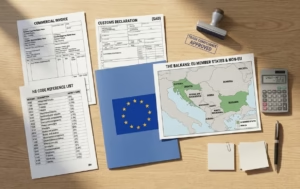
The starting point for any Balkan compliance strategy is mapping the regulatory status of each target market. EU member states – Croatia, Slovenia, and Bulgaria – operate under EU VAT rules, including the One Stop Shop (OSS) mechanism that allows sellers to report and remit VAT for all EU sales through a single registration. This significantly simplifies compliance for sellers targeting multiple EU Balkan markets. Non-EU Balkan countries each have their own VAT frameworks, customs regimes, and import duty structures that require separate analysis and compliance systems.
Data privacy is another regulatory dimension that demands attention. GDPR applies to all businesses handling personal data of individuals in EU member states, regardless of where the business is headquartered. For non-EU Balkancountries, data protection laws vary – Serbia has enacted GDPR-aligned legislation, while other countries are at different stages of regulatory development. Building your customer data practices around GDPR standards is the safest approach, as it ensures compliance with the strictest applicable framework and positions you well as other Balkancountries continue to align their regulations with EU standards.
Consumer protection regulations also vary across the region. EU Balkan countries are subject to EU consumer protection directives, including mandatory return rights and clear disclosure requirements. Non-EU markets have their own consumer protection frameworks, which may differ in meaningful ways. Understanding these requirements isn’t just a legal obligation – it’s a customer experience design input, because your return policies, terms and conditions, and checkout disclosures all need to reflect the regulatory requirements of each market you serve.
The practical recommendation is to work with a regional tax and compliance advisor who has specific expertise in BalkaneCommerce regulations, rather than relying on general international tax guidance. The nuances of this market – particularly the interaction between EU and non-EU frameworks for sellers operating across both – are specialized enough that generalist advice frequently misses critical details.
To navigate the complexities of VAT, the next section provides a detailed overview of VAT registration and reporting requirements across the Balkans.
EU vs non-EU compliance differences
| Aspect | EU Balkan (Croatia, Slovenia, Bulgaria) | Non-EU Balkan (Serbia, Bosnia and Herzegovina, Albania, North Macedonia, etc.) |
|---|---|---|
| VAT regime | EU VAT rules with One Stop Shop (OSS) for cross-border B2C reporting | Local VAT frameworks with country-specific thresholds, rates, and filings |
| Customs duties | Intra-EU movements generally customs-free | Import duties and customs clearance apply on entry |
| Data protection | GDPR applies | Varying national laws; some GDPR-aligned, others evolving |
| Consumer protection | EU directives on returns and disclosures | Local consumer laws with differing obligations |
| Documentation | Standardized EU processes and forms | Country-specific customs forms and procedures |
VAT Registration and Reporting Requirements
VAT compliance across the Balkans requires a country-by-country approach, because registration thresholds, reporting frequencies, and applicable rates differ meaningfully between markets. Getting this right from the start is far less expensive than retroactive compliance remediation.
For EU Balkan countries, the OSS mechanism is your primary compliance tool if you’re selling to consumers (B2C) across multiple EU markets. Rather than registering for VAT separately in Croatia, Slovenia, and Bulgaria, you can register for OSS in a single EU member state and report all EU cross-border B2C sales through that single registration. This is a significant administrative simplification, but it requires accurate transaction-level data and timely quarterly reporting to function correctly.
Non-EU Balkan countries each set their own VAT registration thresholds. Once your sales into a given country exceed that threshold, you’re typically required to register for local VAT, charge it on sales to local consumers, and file regular returns – usually monthly or quarterly depending on the country’s rules. The specific thresholds and rates vary: Serbia applies a standard VAT rate of 20%, Albania applies 20% as well, and Bosnia and Herzegovina applies 17%. These rates affect your pricing strategy and margin calculations for each market, so they need to be factored into your financial model before you enter, not after.
Accurate record-keeping is the operational foundation of VAT compliance. Every cross-border transaction needs to be documented with the sale amount, applicable VAT rate, customer location, and payment method. Your eCommerceplatform and accounting systems need to capture and store this data in a format that supports VAT return preparation and audit defense. Investing in automated tax calculation software – tools like Avalara or TaxJar, which have expanding coverage of Balkan markets – can significantly reduce the manual burden of compliance while improving accuracy.
In addition to VAT, understanding customs procedures is crucial for shipping goods into non-EU Balkan countries. The following section provides a guide to customs procedures and documentation.
VAT setup and reporting workflow
- Map target markets and monitor VAT registration thresholds by country.
- Register for OSS to report B2C sales across EU Balkan countries through a single registration.
- Register locally in non-EU countries once thresholds are exceeded and configure correct rates.
- Capture transaction-level data (amount, rate, location, method) to support filings and audits.
- Implement automated tax calculation software and schedule timely filings (monthly/quarterly).
Customs Procedures and Documentation
For shipments into non-EU Balkan countries, customs clearance is a mandatory step that requires accurate documentation and an understanding of each country’s import procedures. The core documents you’ll need for most cross-bordershipments include a commercial invoice (with accurate product descriptions, declared values, and HS codes), a packing list, and a customs declaration form specific to the destination country.
Accurate product valuation and HS code classification are particularly important. Undervaluing shipments to reduce duty liability is both illegal and increasingly detected by customs authorities across the region. Incorrect HS codes can result in shipments being held for reclassification, generating delays that damage customer experience and create additional costs. Invest in proper HS code classification for your product catalog upfront – it’s a one-time effort that prevents recurring operational problems.
Duties Delivered Paid (DDP) shipping, where you as the seller absorb and pre-pay all import duties and taxes, is increasingly the customer experience standard for cross-border eCommerce. Customers who receive unexpected duty bills at delivery are far more likely to refuse shipments and leave negative reviews than those who paid a clear, all-inclusive price at checkout. DDP requires more sophisticated logistics and customs brokerage arrangements, but the reduction in refused deliveries and the improvement in customer satisfaction typically justify the operational investment.
Beyond regulatory compliance, adapting to local consumer markets is essential for success. The next section explores localization strategies for Balkan consumer markets, focusing on cultural relevance and customer engagement.
Customs documentation and best practices
- Commercial invoice: Accurate descriptions, declared values, and HS codes for each item.
- Packing list: Clear contents and quantities per parcel to streamline inspections.
- HS code accuracy: Prevent delays and reclassification by validating codes upfront.
- Honest valuation: Avoid penalties and holds by declaring true values.
- DDP shipping: Pre-pay duties and taxes to cut refusals and improve satisfaction.
Localization Strategies for Balkan Consumer Markets
Localization is where many cross-border sellers underinvest, treating it as a translation exercise rather than the comprehensive market adaptation strategy it needs to be. In the Balkans, where consumer trust is hard-won and brand loyalty is built through demonstrated cultural understanding, surface-level localization is often worse than no localization at all – it signals minimal effort without genuine market understanding. Effective localization strategies are crucial for scaling eCommerce across the Balkans and CEE, focusing on cross-border growth and compliance.
Effective localization starts with market research, not translation. Before you adapt your content, you need to understand what Balkan consumers in your target categories actually value, how they talk about products like yours, what their purchase decision process looks like, and which trust signals matter most to them. This research should inform everything from your product selection and pricing strategy to your marketing messaging and customer service approach.
Product adaptation is often overlooked but can be a significant differentiator. This might mean offering size conversions in local standards, adapting product descriptions to reflect local use cases, or curating your catalog to emphasize the products most relevant to each market’s climate, culture, or regulatory environment. Sellers who take the time to understand what Balkan consumers actually want – rather than simply translating what they already sell – consistently outperform those who treat the region as a uniform export market.
Local marketing channels and influencer partnerships are another dimension of effective localization. Social media usage patterns vary across Balkan countries, with platforms like Instagram, TikTok, and Facebook all having significant but differently distributed audiences. Partnering with local content creators who have authentic relationships with your target demographic can accelerate brand awareness and trust-building in ways that paid advertising alone cannot achieve. These partnerships also generate market intelligence about consumer preferences and competitive dynamics that you can’t get from analytics dashboards alone.
To delve deeper into cultural nuances, the next section explores language and cultural adaptation strategies for connecting with customers across different Balkan countries.
Localization pillars for Balkan audiences
- Research-first localization: Ground messaging, pricing, and service in country-specific insights.
- Product adaptation: Local size standards, relevant use cases, and curated assortments.
- Local channels and creators: Leverage country-preferred platforms and trusted influencers.
- Compliance-meets-culture: Align disclosures, returns, and tone with local regulations and norms.
Language and Cultural Adaptation
The Balkans encompass a remarkable diversity of languages – Serbian, Croatian, Bosnian, Slovenian, Bulgarian, Albanian, Macedonian, and others – and while some of these are mutually intelligible, treating them as interchangeable is a cultural misstep that Balkan consumers notice immediately. Your localization strategy needs to treat each language as distinct, with content written or reviewed by native speakers rather than produced through automated translation.
Beyond language, cultural adaptation requires attention to visual communication, seasonal relevance, and social norms. Color associations, imagery choices, and even the tone of customer communications carry cultural meaning that varies across the region. Marketing campaigns that perform well in Slovenia may feel tonally off in Serbia or Albania. Building a review process that includes local cultural consultants – even informally, through local team members or agency partners – is the most practical way to catch these misalignments before they reach customers.
Religious and national holidays vary significantly across Balkan countries, and aligning your promotional calendar with locally relevant occasions demonstrates cultural awareness that resonates with consumers. Orthodox Christmas (January 7th) is a major commercial occasion in Serbia, North Macedonia, and parts of Bosnia, while Catholic Christmas (December 25th) is primary in Croatia and Slovenia. Ramadan is commercially significant in Bosnia and Albania. Mapping your promotional strategy to these local calendars – rather than defaulting to a Western European promotional schedule – signals genuine market commitment and drives meaningfully better campaign performance.
Ultimately, building trust is paramount for success in Balkan eCommerce. The following section explores how to optimize the customer experience to foster trust and loyalty.
Cultural and language adaptation steps
- Treat each language as distinct and ensure native speaker review of customer-facing content.
- Localize visuals, color choices, and tone with input from cultural reviewers in each country.
- Align promotional calendars with Orthodox Christmas, Catholic Christmas, Ramadan, and local holidays.
Building Trust Through Customer Experience Optimization
In cross-border eCommerce, trust is your most valuable and most fragile asset. Balkan consumers who have had a negative experience with an international seller – a delayed shipment, an unexpected customs charge, a difficult return – don’t just stop buying from that seller. They share their experience, and in markets where word-of-mouth and social proof carry significant weight, a single bad experience can have outsized negative impact on your brand’s reputation in that market.
The trust-building framework for Balkan cross-border eCommerce has three pillars: transparency, reliability, and responsiveness. Transparency means that customers know exactly what they’re paying, when their order will arrive, and what their options are if something goes wrong – before they complete their purchase. Reliability means that your delivery promises, product quality, and customer service commitments are consistently met. Responsiveness means that when issues arise – and in cross-border commerce, they inevitably do – customers can reach you quickly and get meaningful help in their own language.
Social proof is a particularly powerful trust mechanism in Balkan markets. Displaying verified reviews from other customers in the same country, showcasing local media coverage or influencer endorsements, and highlighting the number of customers you’ve served in a specific market all contribute to the credibility that converts skeptical first-time buyers into confident purchasers. Actively soliciting reviews from satisfied customers – through post-delivery email sequences or SMS follow-ups – should be a standard part of your customer lifecycle management in each Balkan market.
Proactive communication throughout the order lifecycle is another high-impact trust driver. Customers who receive timely, accurate updates about their order status – confirmation, dispatch, customs clearance, out for delivery – are significantly less anxious about their purchase and significantly less likely to contact customer support. This reduces your support costs while simultaneously improving customer satisfaction scores. Measure your post-purchase NPS by market and use it as a leading indicator of repeat purchase rates and word-of-mouth referral quality. Markets where your NPS is lagging are telling you something specific about where your customer experience has gaps.
To ensure a positive customer experience, efficient returns management and responsive customer support are essential. The following section explores strategies for optimizing these critical areas.
Trust-building components and KPIs
- Transparency: Show total landed costs, delivery windows, and clear returns; monitor cart abandonment and review sentiment.
- Reliability: Hit delivery and quality promises; track first-attempt delivery success by carrier and market.
- Responsiveness: Offer fast, local-language support; watch contact rate per order and response times.
- Social proof: Surface local reviews and endorsements; measure NPS and repeat purchase rates by market.
Returns Management and Customer Support
Returns management in cross-border Balkan eCommerce is operationally complex, but it’s also one of the highest-leverage areas for building customer loyalty. A returns process that is clear, fair, and easy to use converts what could be a negative experience into a demonstration of your brand’s commitment to customer satisfaction – and in markets where trust is still being established, that demonstration is worth more than almost any marketing investment.
Your returns policy needs to be written in plain language, translated into the local language of each market, and prominently displayed before purchase – not buried in terms and conditions. Customers should know exactly how to initiate a return, how long the process takes, and whether they’ll receive a refund or store credit. Ambiguity in returns policies is a conversion killer in cross-border markets, because it signals that the seller is trying to make returns difficult.
Operationally, the most effective approach for Balkan returns is to establish local return collection points or partner with regional logistics providers who can consolidate returns before shippingthem back to your primary fulfillment location. This reduces the cost of individual return shipments while giving customers a convenient, local drop-off option. Some sellers in the region are also experimenting with local returns processing – inspecting and restocking returned items within the region rather than shipping them back to a central warehouse – which can significantly reduce the total cost of returns while improving turnaround times for refunds.
Customer support quality is the final piece of the trust equation. Support teams serving Balkan markets need to communicate in local languages, understand the specific logistics and paymentcontext of each country, and have the authority to resolve issues quickly without escalating every case. Response time targets should be aggressive – same-day response for email, real-time for chat – because customers who wait more than 24 hours for a response in a cross-bordercontext frequently assume the worst and initiate chargebacks or social media complaints before giving you the opportunity to resolve the issue directly. The cost of a chargeback or a public complaint is almost always higher than the cost of the original issue; fast, empowered support is your best prevention strategy.
Returns and support playbook
- Publish a clear, local-language returns policy visible before purchase.
- Set up local collection points or partners to consolidate returns cost-effectively.
- Pilot in-region inspection/restocking to speed refunds and lower costs.
- Staff empowered, local-language support with same-day email and real-time chat targets.
- Track chargebacks and public complaints as lagging indicators and resolve proactively.
Frequently Asked Questions
- 1. Which Balkan markets should I prioritize for cross-border eCommerce entry? Start with markets where your product category has demonstrated demand and where logistics and payment infrastructure is most developed. Serbia, Croatia, and Bulgaria are typically the strongest starting points – they combine meaningful consumer market size with relatively well-developed carrier networks and payment processing options. Slovenia is smaller but has high purchasing power and strong digital adoption. Sequence your expansion based on where your operational capabilities are strongest, then build toward more complex markets like Albania or Kosovo as you develop regional expertise.
- 2. Is cash-on-delivery still relevant for Balkan eCommerce, and should I offer it? Yes, COD remains a meaningful payment preference in several Balkan markets, particularly Serbia, Bosnia and Herzegovina, North Macedonia, and Albania. If you’re targeting these markets seriously, not offering COD means excluding a significant portion of potential buyers. The operational complexity – managing cash collection through carrier partners, higher return rates, reconciliation – is real but manageable. Work with logistics providers who have established COD collection and remittance processes, and factor the higher return rate into your margin calculations for COD orders.
- 3. How do I handle VAT compliance when selling across both EU and non-EU Balkan countries? For EU Balkan countries (Croatia, Slovenia, Bulgaria), register for the EU One Stop Shop (OSS) mechanism to handle VAT reporting for all EU cross-border B2C sales through a single registration. For non-EU Balkan countries, monitor your sales volumes against each country’s VAT registration threshold and register locally once you exceed it. Work with a regional tax advisor who specializes in Balkan eCommerce to ensure your compliance approach is current and complete – the regulatory landscape evolves, and generalist advice frequently misses market-specific nuances.
- 4. What eCommerce platforms work best for managing multi-country Balkan operations? Shopify Plus and BigCommerce Enterprise are the most commonly used platforms for cross-border eCommerce at scale, offering strong multi-currency, multilingual, and integration capabilities. WooCommerce is a strong option if you need maximum customization flexibility for complex tax scenarios. Magento (Adobe Commerce) suits enterprise-scale operations with dedicated development resources. The most important evaluation criteria are integration depth with your target logistics providers and payment gateways, native multi-currency support, and scalability. Test actual integration capabilities against your operational requirements rather than relying on platform marketing materials.
- 5. How can I reduce last-mile delivery failures in Balkan markets? Build address validation into your checkout flow to catch errors before orders are dispatched. Offer parcel locker and pickup point delivery as alternatives to home delivery, particularly in markets where address standardization is inconsistent. Partner with local carriers who have deep territorial knowledge rather than relying solely on international networks. For rural deliveries, national postal services typically offer the broadest coverage despite variable service quality. Track your first-attempt delivery success rate by carrier and market – this KPI will quickly identify where your logistics partnerships need strengthening.
- 6. What’s the most effective way to build consumer trust as a new cross-border seller in the Balkans?Transparency and social proof are your most powerful tools. Display total landed costs (including taxes and shipping) clearly before checkout. Show verified customer reviews from buyers in the same country. Provide proactive order status updates throughout the delivery process. Offer a clear, easy-to-understand returns policy in the local language. These elements collectively address the primary trust barriers that prevent Balkan consumers from completing their first cross-border purchase – and once you’ve earned that first purchase, your retention economics improve dramatically.
- 7. How should I approach currency management when selling across multiple Balkan currencies? Display prices in the customer’s local currency throughout the shopping experience, from product pages to checkout confirmation. Use a payment gateway with real-time currency conversion and transparent fee disclosure. For significant transaction volumes in specific currencies, consider FX hedging instruments to protect your margins from exchange rate volatility. Track your effective exchange rate cost as a percentage of revenue – if this number is growing, your currency management strategy needs adjustment. Avoid hidden conversion fees; they generate chargebacks and negative reviews that cost far more than the fees themselves.
- 8. What customs documentation do I need for shipping into non-EU Balkan countries? The core documents for most cross-border shipments into non-EU Balkan markets include a commercial invoice with accurate product descriptions, declared values, and HS codes; a packing list; and a country-specific customs declaration form. Accurate HS code classification and honest product valuation are critical – errors generate delays and potential penalties. Consider offering DDP (Duties Delivered Paid) shipping to improve customer experience and reduce refused deliveries. Work with a customs broker who has specific expertise in your target markets to ensure your documentation is consistently accurate.
- 9. How important is language localization, and can I use automated translation? Language localization is important enough to do properly or not at all – poor automated translation signals disrespect for the local market and actively undermines trust. For product descriptions, marketing content, and customer communications, invest in native speaker review at minimum, and professional translation for high-visibility content. Automated translation tools like DeepL have improved significantly and can be useful for first drafts, but they require native speaker review to catch cultural nuances, regional expressions, and tone issues that automated systems consistently miss. Prioritize localization investment in the markets where you’re generating the most revenue.
- 10. What KPIs should I track to measure cross-border eCommerce performance in Balkan markets? Track these metrics by market to get actionable performance visibility: checkout conversion rate (segmented by paymentmethod to identify gaps in your payment mix), first-attempt delivery success rate (by carrier and region), customer support contact rate per order (a proxy for operational friction), returns rate (segmented by product category and market), post-purchase NPS (a leading indicator of repeat purchase rates), and effective exchange rate cost as a percentage of revenue. These six KPIs together give you a comprehensive view of where your Balkan cross-border operation is performing well and where it needs investment.
Seizing Balkan eCommerce Opportunities
The Balkan region offers substantial opportunities for cross-border eCommerce growth, provided you tailor your strategies to the specific nuances of each market. By prioritizing transparent logistics, localized payment options, and culturally relevant customer experiences, you can build trust and establish a strong presence. Start by focusing on key markets like Serbia, Croatia, and Bulgaria, and gradually expand as you gain expertise and optimize your operations. Investing in these strategies will position you to capitalize on the growing digital adoption and untapped potential of the Balkan eCommerce landscape.
References
- Balkan eCommerce Association – CEE Cross-Border Commerce Report 2024. Cross-border eCommerce in CEE region reached €24 billion in 2024, with 15% YoY growth.
- European Commission – VAT for Businesses (One Stop Shop). OSS mechanism for EU cross-border B2C sales; applicable to Croatia, Slovenia, Bulgaria.
- European Commission – Bulgaria and the Euro. Bulgaria adopted the euro on 1 January 2026, conversion rate: 1.95583 BGN per EUR.
- VAT Compliance – Western Balkans VAT Rates 2024. Serbia: 20%, Albania: 20%, Bosnia & Herzegovina: 17% (confirmed current rates).
- PwC – Worldwide Tax Summaries. Serbia VAT 20%, Albania VAT 20%, BiH VAT 17% – verified standard rates.
- Stripe – Cross-Border Payments Guide for Europe. Multi-currency processing, PCI DSS compliance, 3D Secure, and local payment method integration.
- eCommerce Europe – European eCommerce Report 2025. Regional market dynamics and cross-border payment landscape across CEE and Balkans.