

Want to boost your eCommerce revenue without just chasing more customers? Upselling and cross-selling are your secret weapons. They both pump up the value of each sale, but they do it differently. Nail this distinction, and you’re on your way to seriously effective deployment.
Table of Contents
- What is Upselling and Cross-Selling
- Cross-Sell Opportunities: Identifying the Right Moments
- Product Bundling Strategies That Drive Conversions
- How to Upsell: Proven Techniques for Premium Upgrades
- Upselling Opportunities Across the Customer Journey
- Personalization Tactics to Increase Average Order Value
- Upselling Best Practices for eCommerce Success
- Post-Purchase Upselling Tactics That Retain Customers
- Upselling Software and Automation Tools
- Measuring and Optimizing Your Upsell and Cross-Sell Performance
- Common Mistakes to Avoid in Cross-Selling and Upselling
- Frequently Asked Questions
What is Upselling and Cross-Selling
Upselling moves customers up the product ladder toward a more expensive or feature-rich version of what they’re considering. Cross-selling expands the breadth of their cart by recommending complementary products. Used together, they form the backbone of a high-performing eCommerce revenue optimization strategy – McKinsey research found that 35% of Amazon purchases are influenced by its personalized recommendation algorithms – the engine that powers its cross-sell and upsell strategy.
If you’re serious about growing eCommerce revenue without simply acquiring more customers, upselling and cross-selling are two of the most powerful levers available to you. Both techniques increase average order value of each transaction, but they work in fundamentally different ways – and understanding that distinction is the first step toward deploying them effectively.
What is Upselling?
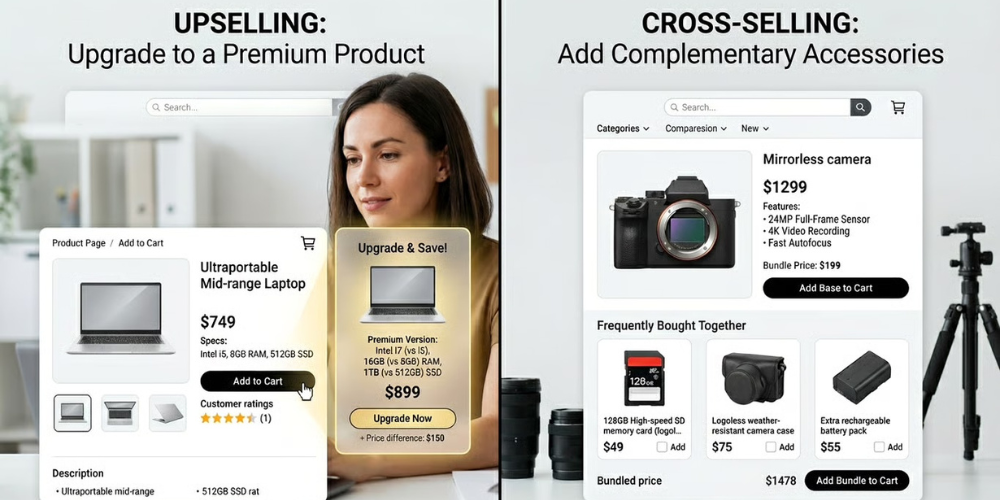
Upselling is the practice of encouraging a customer to purchase a more expensive or feature-rich version of the product they’re already considering. Think of it as a premium upgrade path: a customer browsing a mid-range laptop gets shown a higher-spec model with faster processing and more storage. The goal is to shift their purchase decision upward in price and value, increasing average order value in the process.
What is Cross-Selling?
Cross-selling, by contrast, focuses on recommending complementary products that enhance the primary purchase. If someone is buying a digital camera, suggesting a memory card, a carrying case, or a spare battery is a classic cross-sell. The items are related but distinct – they add to the customer’s experience rather than replacing their original choice.
| Strategy | Goal | Example | Effect on Cart |
|---|---|---|---|
| Upselling | Encourage a premium or higher-priced version | Showing a higher-spec laptop to a customer viewing a mid-range model | Moves customer up the product ladder |
| Cross-selling | Recommend complementary products | Suggesting a memory card and case to a camera buyer | Expands the breadth of the cart |
The business case for both strategies is compelling. McKinsey (2013) research found that 35% of Amazon purchases are influenced by its personalized recommendation algorithms – the engine powering its cross-sell and upsell strategy – underscoring just how transformative these tactics can be when executed well. For most eCommerce businesses, the opportunity is enormous and largely untapped. Rather than treating every transaction as a single-item sale, the goal is to think in terms of complete customer solutions, where each purchase opens a door to additional value for both the buyer and your bottom line.
The key distinction to keep in mind: upselling moves customers up the product ladder, while cross-selling expands the breadth of their cart. Used together, they form the backbone of a high-performing revenue optimization strategy – and the businesses that master both consistently outperform those relying on acquisition alone.
Now that you understand the difference, let’s dive into how to pinpoint the perfect moments for cross-selling to maximize your impact.
Cross-Sell Opportunities: Identifying the Right Moments to Recommend Products
Knowing when to present a cross-sell recommendation is just as important as knowing what to recommend. Timing your suggestions poorly – too early, too late, or too aggressively – can feel intrusive and reduce conversion rates. The goal is to surface relevant additions at moments when the customer is already in a buying mindset and open to expanding their purchase.
High-Converting Cross-Sell Touchpoints
- Product page: When a shopper is actively evaluating a camera, showing them a compatible memory card or lens filter feels helpful rather than pushy – you’re solving a problem they’re likely already thinking about. This is the “frequently bought together” model that Amazon has popularized, and it works because the relevance is immediately obvious.
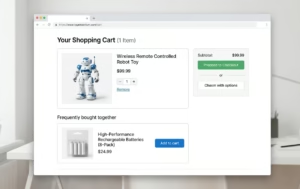
- Cart page: At this stage, the customer has already committed to buying – their purchase intent is at its peak. A well-placed suggestion for a related accessory, such as recommending batteries alongside a wireless toy, taps into natural impulse behavior without disrupting the checkout flow. Keep these suggestions minimal and highly relevant; one or two targeted recommendations consistently outperform a cluttered carousel of loosely related items.
- Post-purchase communications: Order confirmation emails and thank-you pages round out the cross-sell opportunity map. A customer who just bought a smartphone is a prime candidate for a case or screen protector recommendation. At this point, they’re satisfied with their decision and receptive to enhancements. These touchpoints also carry lower risk of cart abandonment since the initial transaction is already complete, making them ideal for testing new cross-sell offers without jeopardizing existing revenue.
Mastering the timing of cross-sells is crucial, but what about offering multiple products together? Let’s explore how product bundling can significantly boost your conversions.
Product Bundling Strategies That Drive Conversions
Product bundling is one of the most reliable ways to increase average order value while simultaneously improving the customer experience. By grouping complementary items into a single offer – typically at a slight discount compared to buying each piece separately – you reduce decision fatigue, simplify the purchase process, and create a perception of greater value.
Pure Bundling vs. Mixed Bundling
| Bundling Type | Definition | Customer Choice | Performance |
|---|---|---|---|
| Pure bundling | Products are only available as part of a package and cannot be purchased individually | No individual purchase option | Riskier – Nintendo saw nearly 20% revenue decline after switching to pure bundling |
| Mixed bundling | Customers can buy items either separately or as a bundle | Full flexibility preserved | Consistently outperforms pure bundling; respects shopper autonomy while incentivizing the bundle |

The most effective bundles are built around logical product relationships. A skincare brand might bundle a cleanser, toner, and moisturizer as a “complete routine” kit. A home office retailer could package a monitor, keyboard, and mouse together. The logic should be immediately apparent – customers should look at the bundle and think, “of course these go together.” When that connection isn’t obvious, the bundle loses its persuasive power.
Pricing strategy matters too. The discount doesn’t need to be dramatic – even a 10–15% saving compared to individual prices is enough to shift behavior. What you’re really selling is convenience and completeness. Customers appreciate not having to hunt for compatible accessories or wonder whether items will work well together. That peace of mind is a genuine value-add, and it’s one of the reasons bundling consistently outperforms individual product recommendations in A/B tests across eCommerce categories.
Bundling enhances the perceived value, but what about convincing customers to upgrade to a premium product? Let’s explore proven upselling techniques.
How to Upsell: Proven Techniques for Premium Upgrades
Effective upselling is less about persuasion and more about education. Your job is to help the customer understand why the premium option is genuinely worth the additional investment – not to pressure them into spending more. When you approach it that way, upselling becomes a service rather than a sales tactic, and your conversion rates reflect that shift.
Key Upselling Techniques
- Benefit-led presentation: Rather than listing the features of the upgraded product, translate those features into tangible outcomes. A faster processor isn’t just a spec – it means the customer’s video editing workflow takes half the time. More cloud storage isn’t just a number – it means they never have to delete photos again. Frame the upgrade in terms of the customer’s life, not your product catalog.
- Side-by-side comparisons: When a customer can clearly see what they gain by stepping up to the premium version – laid out in a clean, scannable format – the decision becomes much easier. The key is to make the value gap obvious without making the standard option look inadequate. You want the customer to feel like they’re choosing an upgrade, not correcting a mistake.
- Value-added service bundling: Bundling value-added services into an upsell offer is particularly effective in software and subscription contexts. A company offering a basic plan can upsell to a premium tier that includes priority support, advanced analytics, and additional user seats. The customer isn’t just buying more features – they’re buying a more complete solution to their problem. This framing dramatically increases perceived value relative to the price difference.
- Anchored pricing: Keep your upsell offer relevant and reasonably priced relative to the original item. Industry benchmarks suggest that upsell offers priced at more than 25–30% above the original product see significantly lower acceptance rates. The upgrade should feel like a natural next step, not a leap into a different budget category entirely. Anchoring your premium offer within that range keeps the decision psychologically comfortable for the buyer.
Now that you know how to up sell, let’s pinpoint the best moments across the customer journey to present these premium offers.
Upselling Opportunities Across the Customer Journey
The customer journey offers multiple distinct moments where an upsell offer can land effectively – and the right placement depends heavily on where the customer is in their decision-making process. Mapping these touchpoints deliberately is one of the highest-leverage activities you can undertake to optimize eCommerce revenue.
Upsell Placements by Journey Stage
- Browsing and discovery phase: Subtle upselling works best. If a customer is viewing a standard product, surfacing a “most popular” or “best value” badge on the premium version can plant the seed of an upgrade without feeling aggressive. You’re not interrupting their journey – you’re enriching it with additional context that helps them make a more informed decision.
- Product page and cart stage: The upsell becomes more direct. This is where comparison tables, upgrade prompts, and “customers who bought this also chose” messaging perform well. The customer is already engaged and evaluating; a well-timed prompt to consider the premium version fits naturally into their decision process and adds value rather than friction.
- Post-purchase window: Often underutilized for upselling. After a customer completes a transaction, they’re in a positive emotional state – they’ve made a decision they feel good about. This is an ideal moment to introduce extended warranties, premium service plans, or subscription upgrades. Order confirmation emails with a targeted upsell offer consistently generate incremental revenue with minimal friction, because the customer’s trust in your brand is at its highest point right after a successful purchase. Don’t leave this window empty.
To make these upsell opportunities even more effective, personalization is key. Let’s explore how tailoring your offers can significantly increase average order value.
Personalization Tactics to Increase Average Order Value
Generic “you might also like” recommendations are table stakes at this point. Customers have grown accustomed to them, and their effectiveness has diminished as a result. What actually moves the needle today is personalization – recommendations that feel like they were chosen specifically for that individual, based on their behavior, preferences, and purchase history.
Personalization Levers That Increase Average Order Value
- Behavioral data signals: Browsing history, past purchases, geographic location, and even the time of day a customer shops can all inform smarter recommendations. A customer who previously bought an entry-level DSLR camera is a strong candidate for an upsell to a mirrorless model on their next visit. A shopper who regularly buys premium skincare products is more likely to respond to a high-end bundle than a budget-focused offer.
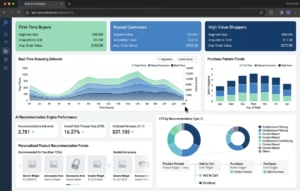
- AI-driven recommendation engines: AI-driven recommendation engines have made sophisticated personalization accessible even for mid-sized eCommerce operations. A basic rules-based system might suggest batteries when someone adds a toy to their cart. A more advanced machine learning model can identify patterns across thousands of customer journeys and predict which upgrade or add-on a specific shopper is most likely to accept – before they’ve even indicated interest. The ROI on these tools tends to be strong precisely because they reduce irrelevant recommendations and concentrate spend on high-probability conversions.
- Customer segmentation: Even without AI, dividing your customer base into meaningful cohorts – first-time buyers, repeat customers, high-value shoppers – and tailoring your upsell and cross-sell messaging to each group can significantly lift acceptance rates. A first-time buyer might respond better to a “complete your setup” bundle, while a loyal customer might be more receptive to an exclusive loyalty upgrade offer. The more precisely you match the offer to the audience, the better your results.
Personalization is powerful, but it’s crucial to follow best practices to avoid alienating customers. Let’s explore the essential guidelines for successful upselling.
Upselling Best Practices for eCommerce Success
The difference between upselling that builds customer relationships and upselling that damages them comes down to a handful of core principles. Get these right, and your customers will thank you for the recommendations. Get them wrong, and you’ll see cart abandonment rates climb and customer satisfaction scores drop.
- Relevance is non-negotiable. Every upsell offer should have a clear, logical connection to what the customer is already buying or browsing. An irrelevant recommendation doesn’t just fail to convert – it actively signals that you don’t understand your customer, which erodes trust. Before deploying any upsell offer, ask yourself: would a knowledgeable sales associate in a physical store make this recommendation? If the answer is no, reconsider the placement.
- Timing and frequency matter enormously. Presenting an upsell offer at every single touchpoint creates friction and fatigue. The best practice is to identify the two or three highest-converting moments for your specific product category and focus your efforts there. Quality of placement consistently outperforms quantity of placements – a lesson that’s easy to understand but surprisingly hard to stick to when you’re optimizing for short-term revenue.
- Transparency builds conversion. When recommending a premium upgrade, be upfront about the price difference and what the customer gets for it. Hiding the cost differential or burying it in fine print creates a negative surprise at checkout – one of the most reliable ways to lose a sale and damage your brand reputation simultaneously.
- Social proof amplifies upsell effectiveness significantly. Showing that a premium version has a higher rating, more reviews, or is the “most popular choice” among similar buyers gives customers external validation for their upgrade decision. People are more comfortable spending more when they can see that others have made the same choice and been satisfied with it.
- Always make it easy to decline. An upsell offer that feels like a trap – where the “no thanks” option is hidden or requires multiple clicks to dismiss – generates resentment. A customer who feels respected in their decision to decline is far more likely to return and convert on a future offer than one who feels manipulated into a corner.
With these best practices in mind, let’s explore how to leverage the post-purchase period for upselling opportunities that also foster customer retention.
Post-Purchase Upselling Tactics That Retain Customers
The moment immediately after a purchase is one of the most psychologically receptive windows in the entire customer relationship. The buyer has just made a positive decision, their confidence in your brand is high, and they’re actively thinking about the product they just acquired. This is the ideal environment for a well-crafted post-purchase upsell.
Post-Purchase Upsell Channels
- Thank-you pages: Rather than simply confirming the order, use this page to present one targeted, relevant offer – a premium accessory, an extended warranty, or a complementary product that enhances what they just bought. Keep it simple: one clear offer with a compelling reason to act now. A time-limited discount (“Add this within the next 24 hours and save 15%”) creates just enough urgency to drive immediate action without feeling manipulative.
- Order confirmation emails: These emails carry some of the highest open rates of any eCommerce communication – customers open them to verify their order details – which means your upsell message gets seen. A well-placed recommendation for a complementary product, framed as a helpful suggestion rather than a sales pitch, can generate meaningful incremental revenue from an audience that’s already primed to engage.
- Longer-term follow-up sequences: A customer who bought a coffee machine is a natural candidate for a subscription to premium coffee beans two weeks later, once they’ve had time to enjoy their purchase. Timing these follow-ups to align with the natural usage cycle of your products demonstrates that you understand your customers’ needs – and that kind of attentiveness is a powerful driver of loyalty and lifetime value.
To effectively implement these strategies, you’ll need the right tools. Let’s explore the software and automation options available for upselling.
Upselling Software and Automation Tools
Scaling your upsell and cross-sell strategy beyond manual curation requires the right technology stack. The eCommerce ecosystem has matured significantly in this area, and there are robust tools available at every price point and platform.
Upselling Tools by Platform and Use Case
| Tool | Best For | Key Capability |
|---|---|---|
| Bold Upsell | Shopify merchants | On-page and post-purchase upsell offer flows triggered by product, cart value, or segment |
| ReConvert | Shopify merchants | Thank-you page optimization with dynamic post-checkout upsell offers |
| Zipify OneClickUpsell | Shopify merchants | One-click post-purchase upsells without requiring customers to re-enter payment details |
| Nosto / Dynamic Yield / Aqurate / Releva / Barilliance | Larger or custom eCommerce operations | AI-powered personalization engines automating recommendations across the full customer journey |
| Klaviyo | Email-driven post-purchase upselling | Automated post-purchase sequences with behavioral triggers and personalized product recommendations |
When evaluating any upselling software, prioritize platforms that offer A/B testing capabilities, detailed conversion analytics, and seamless integration with your existing tech stack. The ability to test, measure, and iterate is what separates a good upsell program from a great one.
Once you’ve implemented these tools, it’s crucial to track your performance. Let’s explore how to measure and optimize your upselling and cross-selling efforts.
Measuring and Optimizing Your Upsell and Cross-Sell Performance
You can’t optimize what you don’t measure. Building a rigorous performance measurement framework around your upsell and cross-sell efforts is what transforms these tactics from occasional wins into a systematic revenue engine.
Key Performance Indicators to Track
- Average order value (AOV): A rising AOV is the clearest signal that your upsell and cross-sell offers are working – customers are spending more per transaction. Track AOV at the segment level as well as overall; a high-value customer cohort might show strong AOV growth while first-time buyers remain flat, pointing to a specific optimization opportunity worth addressing directly.
- Upsell and cross-sell acceptance rate: The percentage of customers who are shown an offer and actually take it. This metric tells you whether your offers are relevant and well-timed. A low acceptance rate on a specific offer is a clear signal to revisit the product pairing, the placement, or the pricing. Industry benchmarks vary by category, but acceptance rates in the 10–30% range are generally considered healthy for well-targeted offers.
- Revenue per visitor (RPV): Particularly valuable for evaluating the impact of personalization initiatives. If your AI-driven recommendations are working, you should see RPV increase average order value among the segments where personalization is active compared to control groups – a clean way to isolate the contribution of your recommendation engine.
- Customer lifetime value (CLV): Done well, upsell and cross-sell strategies don’t just increase average order value – they deepen the customer relationship by consistently delivering relevant, helpful recommendations. Customers who regularly find value in your suggestions tend to return more often and spend more over time, making CLV the ultimate measure of a mature, well-executed upsell strategy.
How to Continuously Optimize Performance
- Establish baseline measurements for AOV, acceptance rate, RPV, and CLV before launching any new upsell or cross-sell initiative.
- Run A/B tests on offer placements, price points, product pairings, and messaging angles systematically – not as a one-time exercise but as a continuous practice.
- Analyze acceptance rates at the individual offer level to identify underperforming pairings and revise product combinations, placement, or pricing accordingly.
- Compare RPV between segments where personalization is active and control groups to isolate the contribution of your recommendation engine.
- Monitor CLV trends over time to confirm that upsell and cross-sell activity is deepening customer relationships rather than creating friction. Tools like Google Optimize, or the built-in testing features of your upselling platform, make this kind of iterative experimentation straightforward to implement.
To ensure your upselling and cross-selling efforts are successful, it’s important to avoid common pitfalls. Let’s explore the mistakes to avoid.
Common Mistakes to Avoid in Cross-Selling and Upselling
Even well-intentioned upsell and cross-sell programs can backfire if they fall into predictable traps. Understanding the most common failure modes is essential for building a strategy that enhances the customer experience rather than undermining it.
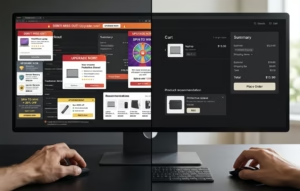
- Over-aggressiveness: Bombarding customers with upsell prompts at every touchpoint – on the product page, in the cart, at checkout, on the thank-you page, and in every follow-up email – creates relentless sales pressure that erodes trust and drives customers away. The goal is to feel like a helpful advisor, not a persistent salesperson. Limit your active upsell placements to the moments where they’re most likely to add genuine value, and resist the temptation to maximize exposure at the expense of experience.
- Poor relevance: Recommending products that have no logical connection to what the customer is buying signals a lack of understanding and makes your recommendations feel automated and impersonal. Every offer should pass a simple relevance test: would a knowledgeable human advisor make this recommendation in a face-to-face conversation? If not, it shouldn’t be in your automated flow either.
- Choice overload: Presenting customers with five or six cross-sell options simultaneously creates decision paralysis – faced with too many choices, many shoppers simply disengage and proceed with their original purchase, or abandon the cart entirely. Research consistently shows that fewer, more targeted recommendations outperform large carousels of loosely related products. Two well-chosen suggestions will almost always outperform six mediocre ones.
- Neglecting the post-purchase window: Many eCommerce teams focus all their upsell energy on the pre-checkout experience and leave significant revenue on the table by not following up strategically after the sale. The post-purchase period is one of your highest-leverage opportunities – don’t waste it with a generic order confirmation and nothing more. A single relevant offer on your thank-you page costs almost nothing to implement and can meaningfully move your revenue metrics from day one.
By avoiding these common mistakes and implementing the strategies discussed, you’re well on your way to maximizing your revenue potential. Now, let’s address some frequently asked questions to solidify your understanding.
Frequently Asked Questions
- What is the difference between upselling and cross-selling? Upselling encourages customers to purchase a more expensive or premium version of a product they’re already considering. Cross-selling recommends complementary products that enhance the primary purchase. Both strategies increase average order value, but through different mechanisms – upselling moves customers up the product ladder, while cross-selling expands the breadth of their cart.
- How much revenue can upselling and cross-selling realistically generate? Amazon has reported that upselling and cross-selling – through personalized recommendation algorithms – influence as much as 35% of its purchases (McKinsey, 2013). For most eCommerce businesses, even a modest, well-executed program can meaningfully lift average order value and customer lifetime value within the first few months of implementation.
- Where should I place cross-sell recommendations on my eCommerce site? The highest-converting placements are typically the product page (showing complementary items), the cart page (suggesting related accessories), and post-purchase communications like thank-you pages and order confirmation emails. Test each placement to identify which performs best for your specific product category.
- What is the best product bundling approach for eCommerce? Mixed bundling – where customers can buy items individually or as a bundle – consistently outperforms pure bundling. It preserves customer choice while incentivizing the bundle purchase through a modest discount. Nintendo’s experience of nearly 20% revenue decline after switching to pure bundling illustrates the risk of removing that flexibility.
- How do I avoid making upsell offers feel pushy or aggressive? Focus on relevance, transparency, and ease of declining. Every offer should have a clear logical connection to the customer’s purchase, the price difference should be clearly communicated, and the option to decline should be simple and friction-free. Frame recommendations as helpful suggestions, not sales pressure.
- What tools are best for automating upselling on Shopify? Bold Upsell, ReConvert, and Zipify OneClickUpsell are among the most widely used Shopify apps for upselling automation. For more advanced personalization at scale, platforms like Nosto, Dynamic Yield, and Barilliance offer AI-driven recommendation engines that work across the full customer journey.
- What KPIs should I track to measure upsell and cross-sell performance? The core metrics to monitor are average order value (AOV), upsell and cross-sell acceptance rate, revenue per visitor (RPV), and customer lifetime value (CLV). Track these at the segment level as well as overall to identify specific optimization opportunities within your customer base.
- How important is personalization for upselling effectiveness? Personalization is increasingly critical. Generic recommendations have diminishing returns as customers become accustomed to them. Tailoring offers based on browsing history, past purchases, and behavioral data significantly increases acceptance rates. AI-driven recommendation engines – such as those offered by Nosto and Dynamic Yield – can automate this personalization at scale, even for mid-sized operations.
- When is the best time to present a post-purchase upsell? The thank-you page immediately after checkout and the order confirmation email are the two highest-performing post-purchase upsell moments. For products with a natural usage cycle, a follow-up email timed to when the customer would logically be ready for a complementary purchase – typically one to three weeks after delivery – can also generate strong results.
- How many upsell or cross-sell offers should I show at once? Less is more. Research and practical testing consistently show that one to two highly relevant recommendations outperform larger carousels of loosely related products. Too many options create decision paralysis and can lead to cart abandonment. Focus on quality and relevance over quantity, and use A/B testing to identify the optimal number for your specific audience.