

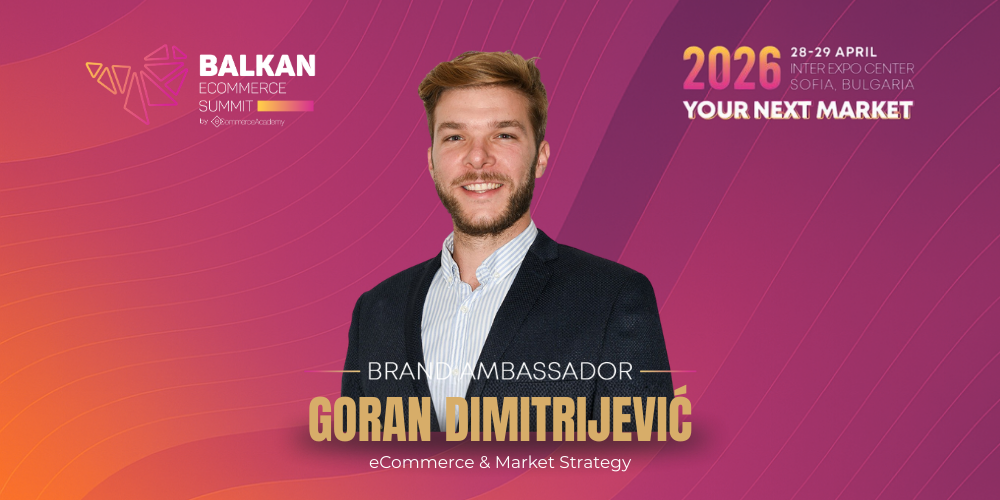
In the Balkans, cross-border growth looks simple on a map and complicated in real life. Small markets, multiple languages and currencies, uneven infrastructure, and a mix of EU and non‑EU rules create a unique environment where expansion is rarely “plug and play.”
Goran Dimitrijević calls himself a Balkan eCommerce “border hacker” for a reason. After a decade in international eCommerce, he has learned that the real constraint in regional expansion is often not demand – it’s the friction between fully digital businesses and very analog obstacles: bureaucracy, customs, documentation, and local expectations.
In this interview, Goran explains why the Balkan eCommerce Summit matters for regional operators, what “border hacking” means in practice, the biggest myths founders believe when entering new markets, and how a strategist’s mindset can turn complexity into a repeatable system.
As a Brand Ambassador for the Balkan eCommerce Summit 2026, what inspired you to join the mission, and what unique “border hacking” perspective do you hope to bring to the community?
I believe that Balkan eCommerce Summit is a great opportunity for regional eCommerce professionals to meet in one place for 2–3 days and discuss their experiences.
Almost all regional markets are relatively small and don’t have the capacity to fill a national conference with only eCommerce professionals. So this is a wonderful chance for all of us to meet up, have international discussions locally, and share specific market insights.
On top of that, this region is saturated and fragmented, with almost no market above 10 million people. At the same time, companies face an unusually high need for localisation when going international.
Even if part of the region proceeds with EU integration and upgrades borderless connections, a great part of the region stays put – with the same issues (read: opportunities) as 10 years ago. This small detail changes the whole perspective on the region itself.
You describe yourself as a Balkan eCommerce “border hacker”. What does this actually mean in practice, and how can brands use unconventional tactics to accelerate their cross-border expansion?
A border, as a term, represents a limitation to a certain territory or activity. In Europe, as an old civilisation with pretty bureaucratic cultures, it adds an additional perspective.
Unlike some other parts of the world, European countries have regulated many cases – maybe too many – which made movements through borders complicated, bureaucratic, and time consuming.
On the other hand, eCommerce at its core has values like paperless, instant, digital, and fast. That’s why connecting digital and analog realities is harder than it seems.
That is where “border-hacking” jumps in. It is the skill of making it possible for fully digital companies to overcome an analog obstacle like state bureaucracy and still deliver goods to clients at the speed modern eCommerce demands.
You’ve worked a decade in international eCommerce. From your experience, what are the biggest operational or logistical myths founders believe when entering new Balkan markets – and what is the reality they should prepare for?
If we talk about an EU company entering new EU markets, there is a myth of “we are all EU, it must be simple.”
Even though the EU has been administratively present in the region for at least two decades, there are still many differences among markets: expected delivery times, demanded quality standards, price sensitivity, and overall administration speed.
Each market has so many specifics that entering without at least a deeper dive into the local eCommerce culture and main market players can cause a “sliding in the mud” effect – and delay positive results.
So overall, the main myth is the “we will figure it out on the way” approach.
For EU companies entering non‑EU markets, they are usually much more reserved. The administrative and bureaucratic barriers are too high for many, as well as fixed costs.
A common myth is that eCommerce is not developed enough because major EU players are not present. In reality, the absence of big players can hide strong local demand, but it also means you must be ready for heavier operational friction.
Every market in the Balkans has its own quirks – payment habits, delivery expectations, customer behavior. Which Balkan markets are the easiest to enter, which are the hardest, and what makes the difference?
I would not say which markets are easiest or hardest to enter. Instead, I would name the obstacles that make companies enter faster or slower:
- Language
- Currency
- Cultural distance
- Geographic distance
- Market size
- Administrative barriers
If we consider these obstacles, we could say that easier expansion would be Slovenia to Croatia or vice versa.
Expansion becomes more complex when you add different currency or bigger geographic linehaul distance. The influence of each obstacle is different. Linehaul costs have higher impact in the beginning and fall with economies of scale.
Different currency is not that important while revenue is relatively slow, but at higher levels currency fluctuations might cause a serious headache.
For sure, the hardest would be to penetrate small markets such as North Macedonia or Albania. Most of the obstacle boxes are checked, and adding border administration, procedures, and fixed costs on top might be the last nail in market expansion plans.
Simply, as life in the Balkans in general, market expansion is not for beginners.
You once said that in your “previous life” you were likely a military strategist. How does this strategic mindset influence the way you build market-entry plans, solve problems, or navigate cross-border logistics?
Almost anything in life you cannot do without a plan. Maybe you can, but it will be short term and you can make it work only a countable number of times.
In my first projects, I “broke teeth,” but each time it was a valuable business and life lesson.
If you want to succeed really big and be sustainable in the long run, there has to be a very good and detailed plan behind it.
Since the beginning of my career, I noticed that a good plan and prediction can save a lot of effort and time.
Entering a new market is a complex undertaking. There are many whats, hows, and ifs. But a good overall strategy with operative plans and actions can make everyday operations easier, improvements faster, and growth much cheaper.
Meet Goran Dimitrijević at Balkan eCommerce Summit 2026
If you want to expand across Balkan markets without getting stuck in bureaucracy, localisation gaps, or operational surprises, connect with Goran on-site. His insights on “border hacking” go beyond theory – they turn complexity into clear strategies, faster market entry, and measurable growth for your business.
🎟️ Grab your ticket at balkanecommerce.com and discover how to navigate Balkan borders like a pro and turn cross-border expansion into real results.