

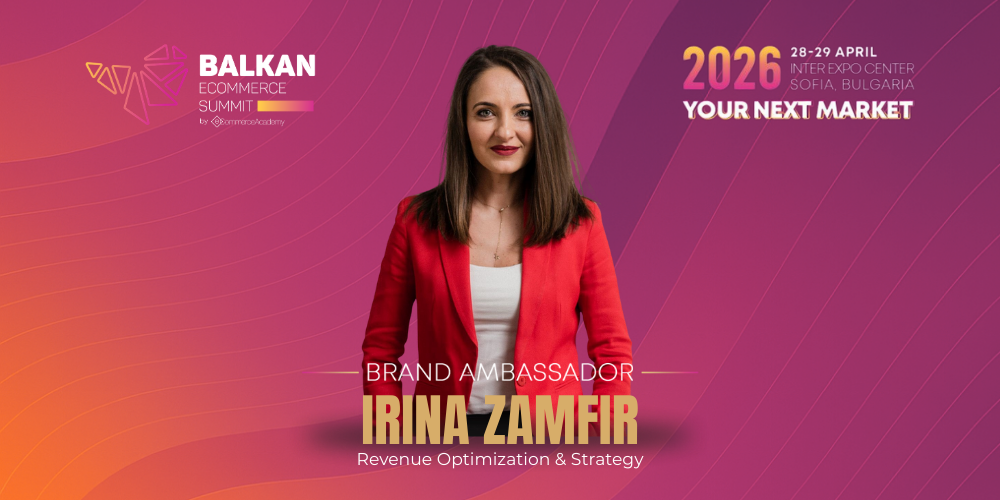
With more than 20 years of experience in revenue‑driven roles, Irina Zamfir brings a clear, business‑first perspective to the fast‑changing worlds of SEO and AI. As Head of Revenue at Upswing, one of Romania’s leading SEO and Content Marketing agencies, she has built and scaled growth strategies across banking, telecom, SaaS, and digital marketing, always focused on what truly matters: impact on revenue.
As a Brand Ambassador for the Balkan eCommerce Summit, Irina’s role is to cut through the noise and turn complex trends into practical playbooks for merchants and marketers. In this interview, she shares how AI is reshaping search, how brands can act fast in new markets, and why clarity, speed, and measurable ROI are becoming the most important competitive advantages in 2026.
As a Brand Ambassador for the Balkan eCommerce Summit, what do you see as your role in the community and how do you hope to add value for merchants and marketers in 2026?
I see my role as being the person who can translate what’s happening in SEO and AI into actual business language that makes sense to CEOs and marketing teams.
That perspective comes from spending two decades in revenue‑driven roles, where every initiative had to justify its impact on growth.
I’ve spent 20 years building businesses – in banking, as General Manager at Linkmobility, CRO at easySales, and now as Head of Revenue at Upswing. The one thing I’ve learned is that nobody cares about rankings or traffic unless it translates to revenue. And right now, there’s so much noise around AI and search that people are freezing up instead of taking action.
ChatGPT reached over 700 million weekly users in just three years. For brands, that signals a fundamental shift in how customers discover information and make decisions. Nearly half of those users are between 18-26 years old. This isn’t some distant future – it’s happening right now. But the opportunity is that most brands still haven’t figured out how to show up in these new search experiences.
What I want to bring to the Balkan Summit community is straightforward:
- Real playbooks that work
- Honest conversations about what actually moves the needle
- Frameworks that make sense to your CFO
We don’t need more theory. We need people who’ve done it before and can show you the path forward.
The market has a real window right now: lower competition in AI citations and audiences that are hungry for good information. I want to help merchants capture that opportunity.
What’s new at Upswing right now (frameworks, tools, or wins) that changed how you approach SEO?
Since I joined Upswing as Head of Revenue last year, the whole approach has shifted.
The biggest change has been integrating traditional SEO with Generative Engine Optimization (GEO), which led us to build our 6‑step GEO Framework.
We launched this framework during Upswing’s Power Session #15 in November, with over 130 participants. It’s the first structured methodology in Romania focused on helping brands get cited by AI‑driven search experiences such as ChatGPT and Google’s AI Overviews.
You can read more about it here:
How to build a GEO strategy – tactics from Upswing Power Session #15
At Upswing, we’ve completely rebuilt how we report results. Now we track things like AI Search Visibility – are you actually mentioned when someone searches your category in ChatGPT? What percentage of AI citations do you own versus your competitors?
On the execution side, we’re doing content at scale – producing thousands of articles per month – which only works because we have very strict human validation and revenue‑focused briefs behind every piece. These aren’t generic blog posts. They’re built around actual buyer questions at every stage of the funnel, designed to convert visitors into qualified leads and customers.
The key insight from all my years in business: speed matters. AI helps us move fast, but humans validate everything for accuracy and brand voice. We measure ruthlessly and iterate weekly.
Every piece of content we create now exists in multiple formats – text, audio, video. Some people want to skim an article, others want to listen on their commute. And AI engines consume all of it.
The operational change I’ve brought from my previous roles is simple: every campaign needs a business case with projected ROI and payback period. SEO isn’t a “nice to have”, it’s a revenue channel that has to perform.
For cross-border growth in CEE: what’s one actionable, SEO-driven play a brand can test in 30 days to unlock traffic and qualified leads in a new market?
Here’s what actually works when you need to validate a new market fast.
Start by identifying the top 3-5 commercial queries in your category for that market. Then go into ChatGPT, Perplexity, and Google AI Mode and ask:
“Which brands do you recommend for [your category] in [country]?”
What you’re looking for are gaps:
- Questions that have weak answers
- Categories where local brands aren’t showing up in AI responses
That’s your opening.
Here’s the 30‑day play we’ve used variations of when speed mattered more than perfection:
- Technical foundation + market intelligence
Set up your Schema markup in the local language, make sure you’re indexed on Bing (it powers SearchGPT), and actually talk to 5-10 potential customers in that market. Find out what they’re really searching for and which questions aren’t being answered well. - Create 10-15 high‑quality pages that directly answer those questions
Structure them for both humans and AI – short paragraphs, clear answers, context. Add testimonials or case studies, even if they’re from your home market, to build trust early. - Get validated locally
Secure 2-3 mentions from local sources (guest article, podcast, directory). Then check AI engines again – are you being mentioned now?
The whole point is speed. In my CRO days at easySales, I learned that waiting to be “ready” just means your competitor gets there first. By the time they notice you’ve entered the market, you’ve already captured the information advantage.
Many teams struggle to connect content with revenue. How do you tie SEO/content to pipeline – which KPIs do you track before, during, and 30/60/90 days after a campaign?
This is the question that defines what I do. As Head of Revenue, if I can’t clearly demonstrate how SEO impacts the P&L, then it hasn’t done its job.
Before we start anything:
You need a baseline.
- What percentage of revenue currently comes from organic?
- What does it cost to acquire a customer organically versus through paid channels?
We also track a new metric now – AI Citations. Are we mentioned when someone searches our category in ChatGPT or Perplexity?
During the campaign:
We watch leading indicators – things that predict the future pipeline:
- Content velocity (how fast are we publishing and getting indexed?)
- Keyword movement
- Engagement quality – not just traffic, but are people actually reading, scrolling, and clicking through?
One thing that’s critical now is understanding how users behave differently in AI search versus traditional search. We’ve published research showing transactional intent in ChatGPT is growing 3X year‑over‑year.
At 30/60/90 days:
- 30 days
- Are we getting qualified traffic – not just visits, but people who match our ideal customer profile?
- How many keywords moved into the top 10?
- Are we now being cited in AI where we weren’t before?
- 60 days
- This is when the pipeline shows up.
- How many marketing‑qualified leads came from organic?
- Which content pieces appear in the buyer journey?
- What’s our cost per lead compared to other channels?
- 90 days
- Now we look at revenue outcomes.
- How many MQLs became sales‑qualified?
- What revenue can we tie to organic touchpoints?
- What’s the payback period?
- Are organic customers more valuable long‑term? (Usually the answer is yes.)
After 20 years in business, I know this: if you can’t explain your impact in euros and percentages, you won’t get budget. SEO is a revenue engine that needs to perform, not a vanity metric.
On a personal note – your “warrior princess” energy: where does that show up in your day-to-day leadership, and what mindset tip would you give to marketers facing tough, competitive niches?
I love this question because it gets at something real. After 20 years in business, I’ve learned that success isn’t about being the smartest person in the room. It’s about being the most resilient and the clearest thinker.
Where the energy shows up:
- In revenue conversations
When I talk to entrepreneurs, CEOs, CFOs, and investors, they don’t care about rankings or traffic – they care about growth.
My “warrior” energy shows up when I defend the SEO budget by presenting it like any revenue investment: projected ROI, payback period, returns. I refuse to let SEO be treated as a “nice to have” marketing expense. It’s a revenue channel, and I defend that position every quarter. - In team leadership
I protect our ability to do deep, strategic work. We work on what moves the needle, not what creates busy work.
From my time as Director General at Linkmobility, I learned: the best teams aren’t the ones working hardest, they’re the ones working on the right things. I’m ruthless about prioritisation. - In innovation
When I joined Upswing last year, GEO wasn’t even on most people’s radar. We built the first GEO framework in Romania because waiting for consensus meant being late. First‑mover advantage is real, but only if you move with conviction and measure ruthlessly.
My personal mantra: Revenue isn’t luck. It’s strategy + speed + resilience. This belief comes from getting it wrong before I got it right.
You’re not fighting for scraps in a saturated market. You’re identifying the gap nobody’s filling, moving fast to own it, and measuring ruthlessly to prove it works.
Final thought:
The “warrior princess” energy isn’t about being aggressive. It’s about being clear and uncompromising on what matters:
- Clear on strategy (not every tactic)
- Clear on ROI (not vanity metrics)
- Clear on timelines (what’s realistic versus wishful)
- Uncompromising on quality (fast doesn’t mean sloppy)
- Uncompromising on integrity (I won’t sell something that doesn’t work)
That clarity is what separates leaders from followers.
I’m looking forward to bringing 20 years of business leadership and a revenue‑first mindset to the Balkan eCommerce Summit community. Let’s build something real together.
Want to dive deeper?
Read more on the Upswing blog:
- How to build a GEO strategy: tactics from Upswing Power Session #15 – a step‑by‑step look at the 6‑step GEO framework and how to make your brand visible in AI search. Read the article
- How people use ChatGPT for searches and what it means for SEO and GEO – a data‑driven analysis based on OpenAI’s first official study: user demographics, search behaviour shifts, and what it means for your marketing strategy. Read the article
Do you want to see how a revenue-first SEO and GEO strategy can actually show up in your P&L, not just in dashboards? Then get your tickets today for the Balkan eCommerce Summit 2026 and make sure you talk to Irina Zamfir about turning AI, search, and content into real, measurable growth for your brand.
Meet Irina Zamfir at Balkan eCommerce Summit 2026
If you believe SEO, AI, and content are not just marketing tactics but real revenue drivers, connect with Irina on-site. Conversations like these go beyond theory – they turn into actionable strategies, clearer decisions, and measurable growth for your business.
🎟️ Grab your ticket at balkanecommerce.com and discover how to turn search, AI, and content into real revenue.