


Navigating the complexities of European financial regulations can feel like a minefield, especially when you’re scaling an eCommerce business across Central and Eastern Europe (CEE). The Payment Services Directive 2 (PSD2) isn’t just another compliance hurdle; it’s a fundamental shift in how online payments are processed and secured. This guide provides a practical overview of PSD2, its implications for your business, and how to leverage open banking to gain a competitive edge. We’ll break down the key requirements, explore real-world implementation challenges in the CEE region, and outline actionable steps to ensure compliance while optimizing your checkout experience. Think of this as your field-tested playbook for turning regulatory demands into revenue-driving opportunities.
PSD2 (Payment Services Directive 2) is the EU regulation that mandates banks open their infrastructure via standardized APIs to licensed third parties, introduces Strong Customer Authentication for online transactions, and forms the legal backbone of open banking across Europe. For CEE eCommerce businesses, it governs checkout security, payment method access, and data-sharing rights – and compliance is required for any business processing payments from EU-based customers.
Table of Contents
- What Is the Payment Services Directive and How Does It Impact eCommerce
- PSD2 Regulation Framework and Requirements for Businesses
- Strong Customer Authentication in PSD2 Compliance
- Open Banking API Integration and Third-Party Providers
- PSD2 Implementation Challenges in Central and Eastern Europe
- Benefits of PSD2 and Open Banking for eCommerce Merchants
- Ensuring PSD2 Compliance: Practical Steps for eCommerce Businesses
- Current Trends and the Evolution Beyond PSD2
- Frequently Asked Questions
What Is the Payment Services Directive and How Does It Impact eCommerce
If you’re running an eCommerce operation in Europe – or selling into European markets from the CEE region – understanding Payment Services Directive 2 (PSD2) isn’t optional. It’s the regulatory foundation that shapes how online payments work, who can access financial data, and what security standards your checkout must meet.
What Is the Payment Services Directive?
The original Payment Services Directive created a unified payments market across the EU, establishing baseline rules for payment processors and financial institutions. PSD2, which came into force in January 2018, went significantly further. It mandated that banks open their infrastructure through standardized APIs, enabling authorized third parties to access customer account data and initiate payments – but only with the customer’s explicit consent. That shift is what makes PSD2 the legal backbone of open banking across Europe.
- Original PSD: Established a unified EU payments market with baseline rules for payment processors and financial institutions.
- PSD2 (in force January 2018): Mandated banks open their infrastructure via standardized APIs to authorized third parties, with explicit customer consent.
- Impact on eCommerce: Introduces new checkout security requirements, enables alternative payment methods that bypass card networks, and creates a competitive fintech environment built on banking infrastructure.
For eCommerce businesses, the practical impact is substantial. PSD2 doesn’t just regulate banks – it reshapes the entire payments ecosystem you operate within. It introduces new security requirements at checkout, opens the door to alternative payment methods that bypass traditional card networks, and creates a competitive environment where fintech innovators can build directly on banking infrastructure. If you’re selling in CEE markets, understanding this directive is your first step toward both compliance and competitive advantage.
Now that you understand the core purpose of PSD2, let’s dive into the specific regulatory pillars that define its framework and how they directly impact your business operations.
PSD2 Regulation Framework and Requirements for Businesses
The PSD2 regulatory framework rests on three interconnected pillars: security, access, and accountability. Understanding each one tells you exactly where your business needs to act.

- Security: The directive mandates Strong Customer Authentication (SCA) for most online transactions – a multi-factor verification process covered in detail in the next section. This requirement applies to any business accepting online payments from EU-based customers, regardless of where your company is headquartered.
- Access: PSD2 requires banks to provide secure API access to licensed Third-Party Providers (TPPs), enabling them to retrieve account information or initiate payments on behalf of customers. For eCommerce merchants, this means you can integrate payment solutions that connect directly to a customer’s bank account, cutting out intermediary card networks entirely.
- Accountability: Governed by the Regulatory Technical Standards (RTS), a detailed set of rules developed by the European Banking Authority specifying exactly how secure communication must work between banks, TPPs, and end users. The RTS covers everything from authentication protocols to API performance benchmarks. Any open banking solution you integrate – and any payment service provider you work with – must align with these standards.
With the PSD2 framework established, let’s focus on one of its most critical components: Strong Customer Authentication and how it impacts your checkout flow.
Strong Customer Authentication in PSD2 Compliance
What Is Strong Customer Authentication?
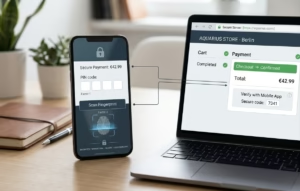
Strong Customer Authentication is one of the most operationally significant requirements PSD2 introduces for eCommerce. SCA requires that online transactions be verified using at least two of three independent factors: something the customer knows (a password or PIN), something they have (a mobile device or hardware token), or something they are (biometric data such as a fingerprint or facial recognition).
SCA Exemptions That Protect Conversion Rates
From a conversion standpoint, SCA adds friction to checkout – which is why understanding the available exemptions matters enormously. Low-value transactions under €30, recurring payments with fixed amounts, and transactions flagged as low-risk through transaction risk analysis (TRA) can all qualify for SCA exemptions, allowing you to streamline checkout for a significant portion of your orders. Trusted beneficiary lists and merchant-initiated transactions also fall outside the standard SCA requirement.
The practical takeaway: work with your payment service provider to configure SCA exemptions intelligently. A well-optimized SCA strategy protects you from fraud while minimizing unnecessary authentication steps for low-risk customers – directly improving your checkout conversion rate.
Now that we’ve covered the security implications of PSD2, let’s explore how open banking APIs and Third-Party Providers fit into the equation, offering new possibilities for payment innovation.
Open Banking API Integration and Third-Party Providers
PSD2’s open banking provisions create two distinct categories of licensed third-party providers, and knowing the difference is essential for building the right payment strategy.
- Account Information Service Providers (AISPs): Authorized to read customer account data – balances, transaction history, and account details – with the customer’s consent. For eCommerce businesses, this unlocks powerful use cases: instant creditworthiness checks at checkout, personalized financial product recommendations, and streamlined onboarding for subscription services that need to verify a customer’s financial standing.
- Payment Initiation Service Providers (PISPs): Enable direct bank-to-bank payment transfers without routing through card networks. When a customer pays via a PISP-powered solution, funds move directly from their bank account to yours – eliminating interchange fees, reducing chargeback exposure, and typically settling faster than card payments.
| Provider Type | What They Access | Primary eCommerce Use Case |
|---|---|---|
| AISP (Account Information Service Provider) | Account balances, transaction history, account details | Creditworthiness checks, subscription onboarding, personalized recommendations |
| PISP (Payment Initiation Service Provider) | Payment initiation from customer bank account | Direct bank-to-bank payments, eliminating interchange fees, faster settlement |
For CEE eCommerce merchants, integrating open banking APIs through established TPPs can meaningfully reduce payment processing costs while expanding available payment options. The key is selecting API providers that are properly licensed under PSD2 and whose technical implementation aligns with RTS requirements – ensuring both compliance and reliability at scale.
While PSD2 provides a unified framework, its implementation varies significantly across Central and Eastern Europe. Let’s examine the specific challenges you might encounter in the CEE region.
PSD2 Implementation Challenges in Central and Eastern Europe
PSD2 is an EU-wide directive, but its implementation across Central and Eastern Europe has been anything but uniform – and if you’re operating across multiple CEE markets, you’ve likely felt this firsthand.
- Infrastructure fragmentation: Banking technology maturity varies considerably across the region. Countries like Poland and the Czech Republic have relatively advanced digital banking ecosystems, while others are still building the API infrastructure PSD2 requires. This means open banking solutions available to your customers in Warsaw may not yet be reliably accessible to customers in smaller CEE markets.
- Regulatory interpretation: Each EU member state transposes PSD2 into national law, and the resulting variations in enforcement priorities, licensing requirements, and technical standards create a patchwork complianceenvironment. A payment flow that’s fully compliant in one CEE country may require adjustments in another.
- Consumer awareness: Open banking depends on customers actively consenting to share their financial data, but trust levels and digital literacy vary significantly across the region. Building customer confidence in PSD2-enabled payment methods requires clear communication about data security and the tangible benefits of consent-based financial services. Investing in education – for both your team and your customers – pays dividends in adoption rates.
Despite these challenges, PSD2 and open banking present significant opportunities for eCommerce merchants. Let’s explore the tangible benefits you can unlock by embracing these changes.
Benefits of PSD2 and Open Banking for eCommerce Merchants
Beyond compliance, PSD2 represents a genuine commercial opportunity. The merchants who recognize this early are already gaining ground on competitors still treating it purely as a regulatory burden.
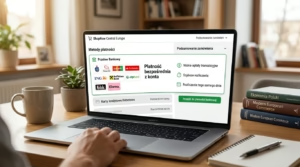
- Reduced processing costs: Direct bank-to-bank payments enabled by open banking APIs eliminate the interchange fees associated with card transactions, which typically range from 0.3% to 1.5% or more depending on card type and market. At scale, that’s a meaningful margin improvement.
- Fraud reduction and liability shift: SCA-compliant transactions carry lower fraud rates, reducing chargebacks and the associated fees and administrative overhead. When SCA is properly applied, liability for fraudulent transactions moves to the issuing bank rather than the merchant.
- New checkout experiences: PSD2 enables a new generation of fintech-powered checkout experiences: from instant bank verification to one-click recurring payments built on open bankingrails. The merchants winning in CEE right now are those treating PSD2 not as a compliance checkbox, but as a platform for building better customer experiences.
Now that you’re aware of the benefits, let’s outline the practical steps you need to take to ensure PSD2 compliance within your eCommerce business.
Ensuring PSD2 Compliance: Practical Steps for eCommerce Businesses
Getting compliant doesn’t have to be overwhelming if you approach it systematically. Here’s where to focus your energy:
- Audit your current payment flows. Map every transaction type you process and identify which require SCA, which qualify for exemptions, and where your current setup may fall short of RTS requirements.
- Choose a PSD2-compliant payment service provider. Your PSP should handle SCA implementation, manage exemption logic, and maintain the technical standards required for secure API communication. Verify their licensing and RTS compliance before committing.
- Implement SCA with exemption optimization. Work with your PSP to configure transaction risk analysis and apply appropriate exemptions for low-value and low-risk transactions. This protects conversion rates while maintaining compliance.
- Establish consent management processes. If you’re integrating any account information or payment initiation services, you need clear, documented processes for obtaining, recording, and managing customer consent.
- Document everything. Regulators across CEE markets expect businesses to demonstrate compliance, not just claim it. Maintain records of your authentication processes, API integrations, and consent workflows.
- Schedule regular compliance reviews. PSD2 requirements evolve, and so does RTS guidance. Build a quarterly review process to ensure your implementation stays current.
As you implement these steps, keep an eye on the horizon. The regulatory landscape is constantly evolving, and PSD2 is no exception. Let’s explore the current trends and what the future holds beyond PSD2.
Current Trends and the Evolution Beyond PSD2
The open banking ecosystem is maturing rapidly, and the direction of travel is clear: more standardization, better API performance, and broader geographic reach. The most significant near-term development is the progression toward PSD3, the European Commission’s successor to PSD2 – a provisional political agreement was reached in November 2025, with formal adoption expected in H1 2026 and compliance required by late 2027–2028. PSD3 aims to address inconsistencies in how PSD2 has been implemented across member states, improve API quality benchmarks, and simplify authentication processes that have created friction in the current framework.
- PSD3 standardization: Addresses inconsistencies in PSD2 implementation across member states and improves API quality benchmarks.
- Reduced authentication friction: PSD3 targets simplification of authentication processes that have created checkout friction under the current framework.
- Fintech innovation layer: Embedded finance solutions, real-time payment analytics, and open banking-native products are accelerating on top of existing PSD2 infrastructure.
- CEE positioning: Merchants who build PSD2-compliant payment stacks now will be best positioned to leverage PSD3 enhancements as they roll out.
For CEE eCommerce businesses, the practical implication is that the open banking infrastructure you invest in today will become more powerful and more standardized over time. Merchants who build PSD2-compliant payment stacks now will be best positioned to leverage PSD3 enhancements as they roll out. The fintech innovation layer built on open bankingrails is also accelerating – from embedded finance solutions to real-time payment analytics – making this an ecosystem worth engaging with proactively rather than reactively.
Frequently Asked Questions
- Does PSD2 apply to eCommerce businesses outside the EU that sell to European customers? Yes, in practice. If you’re processing payments from EU-based customers, your payment service provider must apply SCA and comply with PSD2 requirements on those transactions, regardless of where your business is incorporated. Ensure your PSP is PSD2-compliant.
- What’s the difference between PSD2 and open banking? PSD2 is the regulation; open banking is the outcome it enables. PSD2 legally requires banks to open their APIs to licensed third parties. Open banking describes the broader ecosystem of financial services and products built on top of that mandated access.
- Which transactions are exempt from Strong Customer Authentication? Key SCA exemptions include transactions under €30, recurring fixed-amount payments after the first authenticated transaction, low-risk transactions approved through transaction risk analysis, and payments to pre-approved trusted beneficiaries. Your PSP should manage exemption logic automatically.
- How do I know if my payment provider is PSD2-compliant? Ask them directly for documentation of their RTS compliance, SCA implementation approach, and licensing status as a payment institution. Reputable providers like Stripe, Adyen, and Braintree publish their PSD2 compliance documentation publicly.
- What are the penalties for PSD2 non-compliance in CEE markets? Penalties vary by country, as each EU member state sets its own enforcement regime. Non-compliance can result in significant fines, suspension of payment processing capabilities, and reputational damage. The risk is highest for businesses processing high transaction volumes.
- How does open banking reduce my payment processing costs? Payment initiation services enable direct bank-to-bank transfers that bypass card networks entirely, eliminating interchange fees. Depending on your current card mix and transaction volume, this can reduce per-transaction costs by 0.5% to 1.5% or more.
- What’s the best way to implement SCA without hurting conversion rates? Optimize your exemption strategy. Work with your PSP to apply transaction risk analysis for low-risk orders, configure trusted beneficiary flows for repeat customers, and ensure your 3DS2 implementation is as frictionless as possible. Test checkout flows regularly and monitor step-up authentication rates.
- How does PSD2 affect subscription and recurring payment models? The first transaction in a recurring series requires SCA. Subsequent transactions with the same fixed amount can qualify for the recurring transaction exemption, meaning customers only authenticate once. Variable-amount subscriptions require more careful configuration — consult your PSP on the optimal setup.
- What should I know about PSD3 and how to prepare? PSD3 is expected to improve API standardization, reduce authentication friction, and strengthen consumer protections. The best preparation is building a flexible, API-first payment infrastructure now that can adapt as the regulatory framework evolves. Avoid deeply custom integrations that would be costly to update.
- Are there specific open banking solutions built for CEE eCommerce markets? Yes. Regional providers like Tink, Yapily, and TrueLayer offer open banking API coverage across CEE markets, and local fintech players are emerging in markets like Poland, Czech Republic, and Hungary. Evaluate providers based on their specific bank coverage in your target markets, not just their EU-wide claims.
Future-Proofing Your eCommerce Payments
PSD2 and open banking are more than just regulatory hurdles; they’re catalysts for innovation in the eCommerce landscape. By understanding the framework, embracing new technologies, and prioritizing customer experience, you can transform compliance into a competitive advantage. The CEE region presents unique challenges, but also unique opportunities for those willing to adapt and invest in the future of payments. Take the time to audit your systems, explore open banking solutions, and build a flexible payment infrastructure that can evolve with the changing regulatory landscape. Your future self (and your bottom line) will thank you.
References
- EUR-Lex – Directive (EU) 2015/2366 (PSD2). Entered into force January 2018. Mandates open banking APIs, Strong Customer Authentication (SCA), and third-party provider (TPP) access frameworks.
- European Banking Authority – RTS on Strong Customer Authentication. SCA exemptions: transactions under €30, recurring fixed-amount payments, low-risk TRA-approved transactions, payments to trusted beneficiaries.
- Stripe – Strong Customer Authentication Guide. Practical SCA implementation, exemption types, and impact on checkout conversion in EU/EEA markets.
- Open Banking Implementation Entity – About Open Banking. Card interchange fees: typically 0.3–1.5%+ depending on card type. Open banking payments eliminate interchange, reducing per-transaction costs 0.5–1.5%+.