


Eastern Europe grew 18% in 2025 – the fastest eCommerce region in Europe. This guide compares unified commerce and omnichannel architectures for retailers navigating Poland, Romania, Czech Republic, Hungary, and Bulgaria (now eurozone-integrated since January 2026).
Eastern European retailers face a critical technology decision that directly impacts revenue, operational efficiency, and customer retention: whether to pursue an omnichannel strategy that connects existing systems or adopt a unified commerce platform that consolidates everything into a single architecture. The distinction isn’t academic. It determines how accurately you track inventory across channels, how quickly you fulfill orders, and whether your customer data reflects reality or yesterday’s sync cycle. With Eastern European eCommerce growing at 18% in 2025 – the fastest rate in Europe – and markets like Romania expanding at approximately 16% annually while Poland scales at ~10.5% toward €50 billion by 2028, choosing the right approach requires understanding both the technical differences and the regional realities that make Eastern Europe uniquely challenging.
Key takeaway: Unified commerce consolidates all retail operations – inventory, customer data, sales channels, and order fulfillment – into a single real-time platform, eliminating the synchronization gaps that omnichannel integrations create. For Eastern European retailers navigating diverse markets, infrastructure constraints, and varied consumer behavior (including Bulgaria’s recent euro adoption in January 2026), the choice between these two architectures determines operational accuracy, customer experience quality, and long-term scalability.
Table of Contents
- What is unified commerce and how does it differ from omnichannel
- Omnichannel vs multichannel: understanding the evolution of retail commerce
- Omnichannel retail strategy: building seamless customer experiences
- Unified commerce platforms: the next generation of retail technology
- Unified commerce strategy for Eastern European markets
- Choosing between omnichannel and unified commerce: key decision factors
- Implementation roadmap: transitioning to unified commerce in Eastern Europe
- FAQ
What is unified commerce and how does it differ from omnichannel
What is unified commerce?
Unified commerce is a retail technology architecture where every business operation – inventory, customer data, sales channels, and order fulfillment – runs through a single, centralized platform in real time. There are no middleware layers stitching separate systems together. Every transaction, every customer interaction, and every inventory movement flows through one shared data layer, giving your entire operation a single source of truth.
The core difference between omnichannel and unified commerce comes down to system architecture. Omnichannel retail connects multiple channels through APIs and integrations – a meaningful step forward – but those channels still rely on separate databases that synchronize periodically. That sync latency creates real inconsistencies: a product showing as available online that’s already sold out in-store, or a customer’s loyalty points not reflecting their most recent purchase.
Unified commerce eliminates that gap entirely. Every channel – your physical stores, mobile app, online marketplace listings, and contact center – reads from and writes to the same data simultaneously. For retailers operating across Eastern Europe, that architectural distinction isn’t purely technical. It’s the difference between a customer experience that feels genuinely seamless and one that quietly frustrates at the edges.
| Feature | Omnichannel | Unified Commerce |
|---|---|---|
| Data architecture | Separate databases connected via APIs | Single shared data layer |
| Inventory updates | Periodic synchronization | Real-time across all channels |
| Customer profile | Assembled from multiple sources | Single, immediately accurate record |
| Middleware required | Yes | No |
| Integration maintenance | Ongoing | Minimal |
| Data consistency | Sync latency (minutes to hours) | Instantaneous |
Omnichannel vs multichannel: understanding the evolution of retail commerce
Understanding where we are requires knowing how we got here. Retail commerce has evolved through distinct phases, each addressing limitations of the previous model:
- Single-channel retail: The original model – one selling environment, one customer database, no cross-channel complexity.
- Multichannel retail: Businesses began operating through physical stores, websites, catalogs, and eventually mobile apps – but each channel functioned as its own independent entity, with separate inventory systems, pricing structures, and customer databases. A customer’s online purchase history was invisible to your in-store team.
- Omnichannel commerce: Addressed those disconnections by linking channels through integrations. Customers could research online, buy in-store, and return through any channel. A retail omnichannel commerce platform could synchronize data across touchpoints – though typically through scheduled updates rather than instantaneous communication.
- Unified commerce: Represents a fundamental rethinking where the question isn’t how to connect separate systems, but whether separate systems need to exist at all.
That distinction matters more than it might seem. Omnichannel was a significant improvement over multichannel, but it still required retailers to manage the complexity of keeping multiple systems aligned. The integrations themselves became a maintenance burden, and any synchronization gap created friction for customers and operational headaches for your team.
Yet even as unified commerce emerges, omnichannel commerce strategy continues to deliver substantial value when executed properly. The key is understanding what “properly executed” actually means in practice.

Omnichannel retail strategy: building seamless customer experiences
Even as unified commerce gains momentum, a well-executed omnichannel retail strategy remains powerful and practical for many businesses. The key word is “well-executed.” Connecting your channels is only the starting point – what drives results is designing customer journeys that flow naturally between digital and physical environments without friction or inconsistency.
The foundation of a strong omnichannel customer experience is unified customer data that travels with the shopper. When someone browses your product catalog on mobile, adds items to a wishlist, and then walks into your store, your associates should see that context and personalize the interaction accordingly. This is particularly critical given that mobile accounts for 60–74% of eCommerce transactions across the CEE region – 64.67% in Poland, 73.85% in Romania, and 60.82% in Hungary. Leveraging an omnichannel customer data platform can significantly enhance this level of visibility.
Essential operational pillars of omnichannel commerce solutions
- Real-time inventory visibility: Accurate stock levels across all locations, preventing overselling and customer disappointment.
- Flexible fulfillment options: Buy-online-pickup-in-store and ship-from-store capabilities that meet customers where they are. In Romania’s major cities, over 60% of customers now prefer pick-up points or lockers over home delivery.
- Consistent pricing and promotions: Uniform offers regardless of which channel the customer uses to purchase.
- Integrated customer service: Access to complete interaction histories so every touchpoint feels informed and continuous.
These are crucial elements for scaling eCommerce across the Balkans & CEE. The technical infrastructure you choose to support these capabilities determines how reliably you deliver on customer expectations – and how much operational overhead your team carries in the process.
While omnichannel commerce solutions connect existing systems to create these experiences, a newer generation of retail technology takes a fundamentally different approach to solving the same customer needs.
Unified commerce platforms: the next generation of retail technology
Where omnichannel solutions connect the dots between separate systems, unified commerce platforms redraw the picture entirely. These platforms consolidate point of sale, inventory management, CRM, eCommerce, and order fulfillment into a single system operating on shared data infrastructure. There’s no middleware to maintain, no integration layer to troubleshoot, and no synchronization delay to manage.
The practical impact shows up in moments that matter to your customers. When someone purchases an item online, inventory levels update instantly across every channel. Their customer profile reflects the transaction immediately. Your fulfillment team accesses current, accurate information without waiting for a sync cycle to complete. That real-time accuracy is what unified commerce solutions deliver – and it’s genuinely difficult to replicate through even the most sophisticated integration of separate systems.
Key advantages of unified retail commerce platforms
- Complete customer journey visibility: Every interaction across every channel captured in a single, real-time profile.
- Accurate inventory allocation: Prevents overselling by reflecting true stock levels instantly across all touchpoints – particularly valuable given that global cart abandonment rates stand at 70.19% according to Baymard Institute, with stock inaccuracies being a significant contributor.
- Centralized promotion management: Consistent offers deployed and updated across the entire operation simultaneously.
- Holistic reporting: Business performance captured across the entire operation rather than channel by channel.
- No middleware overhead: Eliminates the maintenance burden and failure points of integration layers between separate systems.
For retailers with significant operational complexity – large SKU catalogs, multiple store locations, diverse fulfillment methods, and customers engaging across many touchpoints – unified retail commerce platforms offer capabilities that connected systems struggle to match. These aren’t incremental improvements. They represent a fundamentally different way of running a retail business.
The value proposition becomes even more nuanced when you factor in the specific market conditions, infrastructure realities, and consumer behaviors that define Eastern European retail.
Unified commerce strategy for Eastern European markets
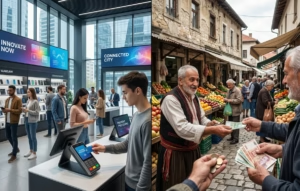
Eastern Europe presents a genuinely distinctive environment for retail technology decisions. Market maturity varies considerably across the region – countries like Poland, Romania, and the Czech Republic have seen rapid digital commerce growth (10–18% annually depending on market), while other markets maintain stronger preferences for traditional retail channels and cash-based transactions. This growth contributes significantly to the CEE region’s cross-border commerce. A unified commerce strategy that works in Warsaw may need meaningful adaptation for markets in the Western Balkans or the Baltic states.
Regional market snapshot for unified commerce planning (2025–2026)
| Market | eCommerce growth | Dominant payment | Currency | Unified commerce readiness |
|---|---|---|---|---|
| Poland | ~10.5% CAGR (€50B by 2028) | BLIK (50%+ eCommerce share; 2.4B transactions in 2024) | PLN | High |
| Czech Republic | ~8–10% | Cards + bank transfers (COD declining) | CZK | High |
| Romania | ~16% (PayU forecast) | COD ~51% + cards 45.6% | RON | Moderate-High |
| Hungary | $4.85B → $7.36B by 2030 | Cards 51.78% + COD | HUF | Moderate-High |
| Bulgaria | $2.9B → $8.2B by 2030 (23% CAGR) | COD → digital wallets (BNPL 28.5% CAGR) | EUR (since Jan 2026) | Rising |
| Baltics | Digital-first, open banking leaders | Cards, open banking, Apple/Google Pay | EUR | Highest in CEE |
Regional considerations for unified commerce implementation
- Infrastructure readiness: Payment system diversity across Eastern European markets is significant – from card-dominant economies in the Baltics to markets where local payment methods like BLIK (Poland) and cash on delivery (Romania, ~51% of orders) remain critical. Evaluate whether your operational footprint can actually support a unified platform’s real-time synchronization requirements before committing.
- Currency consolidation opportunity: Bulgaria’s adoption of the euro on January 1, 2026 reduced the CEE region to five active currencies (EUR, PLN, CZK, HUF, RON). For merchants building unified commerce architecture, this simplifies multi-currency pricing, VAT handling through OSS, and payment gateway configuration for eurozone-based operations expanding into Bulgaria.
- Logistics network capabilities: Differ sharply between major urban centers and smaller municipalities, requiring honest assessment before platform selection. Poland’s InPost operates over 25,000 parcel lockers handling 1+ billion parcels annually,while Romania’s eMAG-owned Sameday network has expanded to 8,500+ proximity delivery points across Romania, Hungary, and Bulgaria.
- Consumer behavior variation: Digital literacy, smartphone penetration, and expectations for cross-channel experiences vary considerably by demographic segment and geography. Understanding these nuances is crucial for a successful eCommerce localization strategy.
- Market maturity segmentation: Younger urban consumers in Bucharest or Sofia may expect the same seamless experience they’d find on a Western European platform, while other customer segments prioritize different values entirely. This dynamic is part of broader eCommerce trends in Bulgaria and the wider region.
Your unified commerce strategy needs to account for this variation – not by lowering the bar, but by designing flexibility into how you serve different customer groups while maintaining operational efficiency across the whole system.
Given these regional complexities, the decision between omnichannel and unified commerce requires a framework that accounts for both your current reality and your growth trajectory.
Choosing between omnichannel and unified commerce: key decision factors
The right choice between these two approaches depends on your specific business reality, not on which technology generates more conference buzz. Start by assessing your current infrastructure honestly. Can your existing systems support real-time data synchronization, or do legacy platforms require substantial modernization before a unified architecture becomes viable? That answer shapes your timeline and budget significantly.
Business complexity is the next critical variable. If you’re managing a large SKU catalog across multiple locations with diverse fulfillment methods and customers engaging across many channels, unified commerce platforms are likely to address operational challenges that even well-integrated omnichannel systems will struggle with. If your operation is simpler and more focused, you may achieve the omnichannel customer experience outcomes you’re targeting through connected systems without the scope and cost of a full platform replacement.
| Decision Factor | Points toward Omnichannel | Points toward Unified Commerce |
|---|---|---|
| Infrastructure readiness | Legacy systems requiring gradual modernization | Modern systems ready for real-time architecture |
| Operational complexity | Simpler, focused operations | Large SKU catalogs, multiple locations, diverse fulfillment |
| Budget approach | Incremental investment, lower upfront cost | Comprehensive rollout with higher initial investment |
| Implementation risk tolerance | Phased, lower disruption | Requires strong change management |
| Growth trajectory | Stable, defined channel mix | Rapid expansion across channels and markets |
| Multi-market ambition | Single-market or closely adjacent markets | Pan-CEE expansion with currency/language complexity |
Budget considerations extend well beyond initial implementation. Factor in ongoing maintenance costs, staff training requirements, and potential business disruption during transition. Omnichannel integrations can often proceed incrementally, reducing risk. Unified commerce platform deployments tend to require more comprehensive rollouts, demanding stronger change management. Neither path is inherently superior – the right one matches your operational maturity, your growth trajectory, and your customers’ actual expectations.
Once you’ve made the strategic decision, execution becomes the determining factor in whether your investment delivers the returns you’re projecting.

Implementation roadmap: transitioning to unified commerce in Eastern Europe
Steps to transition to a unified commerce platform
- Audit your existing systems. Map every data source, identify integration points, and understand where inconsistencies currently live.
- Establish your centralized data architecture. Before deploying any customer-facing functionality, ensure inventory systems, customer databases, and transaction processing operate from shared infrastructure from day one, or you’ll simply replicate the fragmentation you’re trying to solve.
- Address regional payment and compliance requirements. Factor in payment gateway compatibility across the national systems you operate in (BLIK in Poland, COD networks in Romania and Bulgaria, open banking in the Baltics), compliance with GDPR and regional data protection regulations, EU VAT handling through the One-Stop Shop (OSS) system, and logistics network integration that reflects the real fulfillment capabilities of each market. Note that Bulgaria’s euro adoption in January 2026 simplifies payment gateway setup for eurozone-based merchants expanding into the Bulgarian market.
- Deploy in phases. Core system first, then channel-by-channel migration, then advanced features – typically spanning six to eighteen months and significantly reducing operational risk.
- Prioritize partners with proven regional experience. In markets as varied as those across Eastern Europe, local expertise isn’t a nice-to-have. It’s a meaningful predictor of implementation success.
Making the Right Technology Investment for Your Market
The choice between omnichannel and unified commerce isn’t about picking the most advanced technology – it’s about matching your retail architecture to your operational complexity, market maturity, and customer expectations. Eastern European retailers have the advantage of learning from implementations in more mature markets while adapting strategies to regional realities that Western platforms often overlook. With Eastern Europe growing at 18% in 2025, Bulgaria newly integrated into the eurozone, and infrastructure like InPost’s 25,000+ lockers and Allegro’s 21.1 million active buyers demonstrating regional digital maturity, the opportunity window for thoughtful technology investment has never been more favorable. Start by auditing your current systems honestly, understanding where friction exists in your customer experience, and calculating the true cost of maintaining integrated versus unified architectures. The retailers who get this decision right don’t just improve operational efficiency – they build a foundation for sustainable growth across one of Europe’s most dynamic retail regions.
FAQ: Unified Commerce vs Omnichannel in Eastern Europe
- What is the simplest way to explain the difference between unified commerce and omnichannel? Omnichannel connects separate systems so they can share data. Unified commerce replaces those separate systems with a single platform where all data lives in one place from the start. The result is real-time accuracy versus periodic synchronization.
- Is omnichannel still worth investing in, or is it already outdated? Omnichannelremains a strong and practical strategy for many retailers, especially those not yet ready for a full platform overhaul. It’s not outdated – it’s a stepping stone. The question is whether your business complexity has outgrown what connected systems can reliably deliver.
- Which Eastern European markets are most ready for unified commerce adoption? Markets with higher digital commerce maturity – Poland, Czech Republic, Hungary, and the Baltics – tend to have the infrastructure and consumer behavior patterns that support unified commerce. Romania is rapidly maturing (16% annual growth). Smaller or less digitally mature markets may benefit from a phased omnichannel approach first.
- How did Bulgaria’s euro adoption in January 2026 affect unified commerce strategy? Bulgaria replaced the Bulgarian lev (BGN) with the euro on January 1, 2026. For unified commerce platforms, this simplifies multi-currency configuration, eliminates the need for BGN payment gateway support, streamlines VAT reporting through OSS for eurozone-registered merchants, and makes Bulgaria an increasingly accessible secondary market for CEE expansion. The region now operates with five active currencies: EUR, PLN, CZK, HUF, and RON.
- What KPIs should I track to measure the success of a unified commerce implementation? Focus on inventory accuracy rates, order fulfillment speed, cart abandonment rates across channels (benchmarking against the global 70.19% average from Baymard Institute), customer lifetime value, and cross-channel return rates. These metrics directly reflect whether your unified architecture is delivering operational and customer experience improvements.
- How long does a typical unified commerce implementation take? Most implementations span six to eighteen months depending on business complexity, the number of channels involved, and regional infrastructure requirements. Eastern European deployments often require additional time to address payment system diversity (BLIK integration in Poland, COD handling in Romania and Bulgaria, open banking in the Baltics) and logistics integration with regional locker networks.
- What are the biggest risks of transitioning to a unified commerce platform? The primary risks are business disruption during migration, data integrity issues during consolidation, and underestimating staff training requirements. Phased deployment and strong change management significantly reduce these risks.
- Can a small or mid-sized Eastern European retailer realistically implement unified commerce? Yes, though the business case needs to be clear. Smaller retailers with simpler operations may find that a well-configured omnichannel setup delivers sufficient results at lower cost and complexity. Unified commerce becomes more compelling as operational scale and channel diversity increase.
- How does unified commerce handle the payment diversity common in Eastern European markets? The best unified commerce platforms support multiple payment gateways and local payment methods natively or through certified integrations. In CEE this is critical – BLIK handles 50%+ of Polish eCommerce payments, COD remains at ~51% in Romania, and open banking dominates the Baltics. Verifying this compatibility before platform selection is essential – it’s one of the most common implementation challenges in the region.
- What role does customer data play in choosing between these two approaches? Customer data is central to both strategies, but unified commerce gives you a more complete and immediately accurate picture of each customer’s journey. If personalization and cross-channel service quality are strategic priorities, unified commerce’s single customer profile architecture offers a meaningful advantage.
- Where can I learn more about eCommerce strategy trends specific to the Balkan and Eastern European region? The Balkan eCommerce Summit, organized through balkanecommerce.com, is one of the region’s leading events for eCommerce professionals. It brings together merchants, technology providers, and industry experts from 12+ markets, and publishes the State of eCommerce study covering Bulgaria, Greece, Romania, Croatia, and Hungary – making it an excellent resource for region-specific insights and networking.
References
- European eCommerce Report 2025 – eCommerce Europe & EuroCommerce. Eastern Europe recorded 18% nominal growth, the fastest in Europe. Total European eCommerce turnover: €842 billion.
- European eCommerce Overview: Romania – eCommerce Germany News. Romania eCommerce at 3.5% of GDP; projected market size of $9.7B by 2029; ~16% annual growth per PayU forecasts.
- European eCommerce Overview: Poland – eCommerce Germany News. Market projected at €50B by 2028 (10.48% CAGR); InPost 25,000+ parcel lockers; 1+ billion parcels handled in 2024 (+22% YoY).
- Poland Payments Market Analysis 2024/2025 – Mordor Intelligence. Mobile commerce share: Poland 64.67%, Romania 73.85%, Hungary 60.82% of eCommerce transactions.
- Romania’s peak eCommerce season 2025 – Business Review. Cash-on-delivery at ~51% of total orders; 60%+ of major-city customers choose pick-up points or lockers.
- Cart Abandonment Rate Statistics 2025 – Baymard Institute. Average cart abandonment rate: 70.19% (based on 49 studies); 13% abandon when preferred payment method unavailable.
- Bulgaria eCommerce Market – Mordor Intelligence 2025. Market $2.90B (2025), projected $8.21B by 2030 (23.09% CAGR); BNPL at 28.5% CAGR; shift from COD to digital wallets.
- VAT One-Stop Shop (OSS) – European Commission. Single VAT registration for cross-border B2C sales across EU member states.
- BLIK as a growth driver for the economy – BLIK/EY Report 2025. 2.4B transactions in 2024; 19.9M active users (Q3 2025); 50%+ share of Polish eCommerce; 1.2% of Poland’s GDP.
- European eCommerce Overview: Czech Republic – eCommerce Germany News, Dec 2025. 70% of transactions via mobile; COD historically strong but declining; cards and bank transfers gaining ground.