

The Western Balkans are ripe for ecommerce expansion, but success hinges on understanding the region’s unique dynamics. As you consider these emerging markets, recognize that strategies that work in Western Europe often fall flat here. This guide provides a field-tested, ROI-driven approach to navigating the Balkan eCommerce landscape, from cultural nuances to logistical hurdles. We’ll explore how to turn these challenges into opportunities, with actionable moves and measurable outcomes for your cross-border growth plan.
Thinking about expanding across the CEE & the Balkans? Grab your ticket at balkanecommerce.com and be part of building stronger connections across the region.
Table of Contents
- Understanding the Balkan eCommerce landscape
- Cross-border eCommerce barriers in Balkan markets
- Language and cultural adaptation strategies
- Payment and logistics solutions for emerging markets eCommerce
- Regulatory compliance and tax considerations
- Technology infrastructure and platform optimization
- Building trust and customer relationships
- Frequently Asked Questions
Understanding the Balkan eCommerce landscape
 What makes the Balkan region unique for eCommerce development?
The Western Balkans represent one of Europe’s most compelling opportunities for digital commerce expansion – high intent, improving infrastructure, and a clear “catch-up” curve. As Ivan Rédey highlights in Balkan eCommerce Summit coverage, the region – Serbia, Montenegro, Bosnia and Herzegovina, North Macedonia, Albania, and Kosovo – combines untapped demand with real operational friction.
Key market indicators (what matters for ROI)
- Digital reach is high: 2020 regional surveys cited ~83% internet usage, signaling a strong base for digital acquisition.[1]
- E-retail is still under-penetrated: 2024 estimates show online retail share of total retail ranging from ~3.3% (Albania) to ~6.4% (Montenegro), with room to scale via trust + logistics + payments.[2]
- Platforms are being built locally: Delta Holding publicly announced a EUR 100m investment into “Ananas,” signaling institutional confidence and faster ecosystem maturation.[3]
- Cross-border pull is real: Consumers use eCommerce to access broader assortment and better pricing – especially when local availability is limited.
What makes this market particularly attractive is the speed of behavioral change – mobile-first audiences, growing comfort with online discovery, and increasing expectations around delivery and customer service. At the same time, the region’s ecommerce upside is not “automatic.” Conversion is earned through operational competence.
If you’re building a cross-border play, align your planning with the broader regional context and learn from operators already mapping the opportunity: the growth trajectory of cross-border eCommerce in CEE is a useful benchmark for what happens when logistics, payments, and trust signals start compounding.
Next, let’s break down the real barriers you’ll encounter – and the practical moves that consistently remove friction.
Cross-border eCommerce barriers in Balkan markets
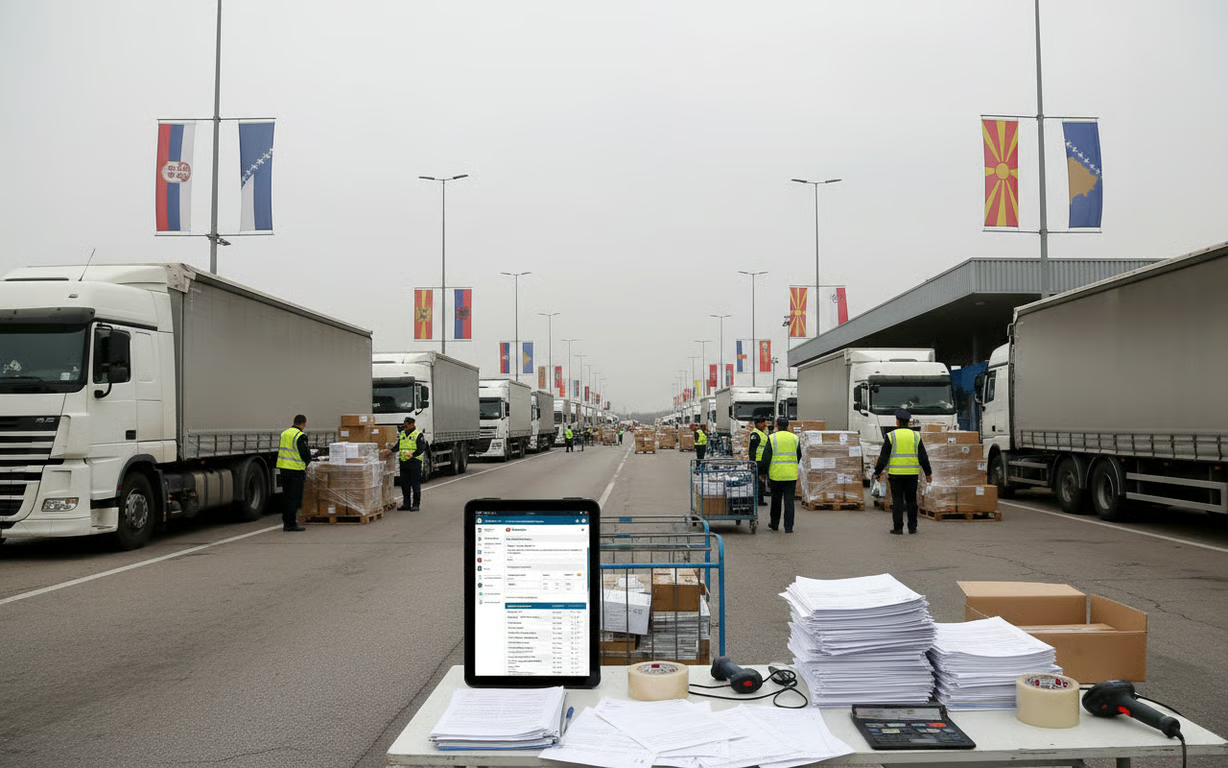 Primary obstacles preventing successful cross-border eCommerce operations
- Trust + risk perception: Security, returns, and “will I actually receive it?” concerns remain a conversion killer – especially for first-time buyers. Trust signals must be operational, not decorative.
- Payments fragmentation: Cash-on-delivery remains important in parts of the region, while cross-border transactions require card and wallet coverage that actually works locally.
- Logistics + duties uncertainty: Delivery cost and unpredictable customs/VAT handling create checkout hesitation and post-purchase disputes.
- Small-market economics: Each country is a limited pool; unit costs stay high unless you design a regional fulfillment + returns model.
- Informal economy pressure: Grey-market sellers compete on price by avoiding compliance and service obligations – forcing legitimate brands to win on reliability, guarantees, and experience.
The important point: these barriers are manageable, but only if you treat them as system design constraints. “Try harder at marketing” won’t fix checkout failure caused by missing payment methods or unclear landed costs.
Informality is a real factor in multiple markets. For example, Serbia has historically seen estimates of the grey economy at roughly ~30% of GDP in some analyses – an indicator of how price-only competition can distort expectations.[4] This is exactly why you should build differentiation around predictable delivery, transparent terms, and post-purchase service.
With the barriers mapped, the next lever is localization – because in this region, “same language family” does not mean “same conversion triggers.”
Language and cultural adaptation strategies
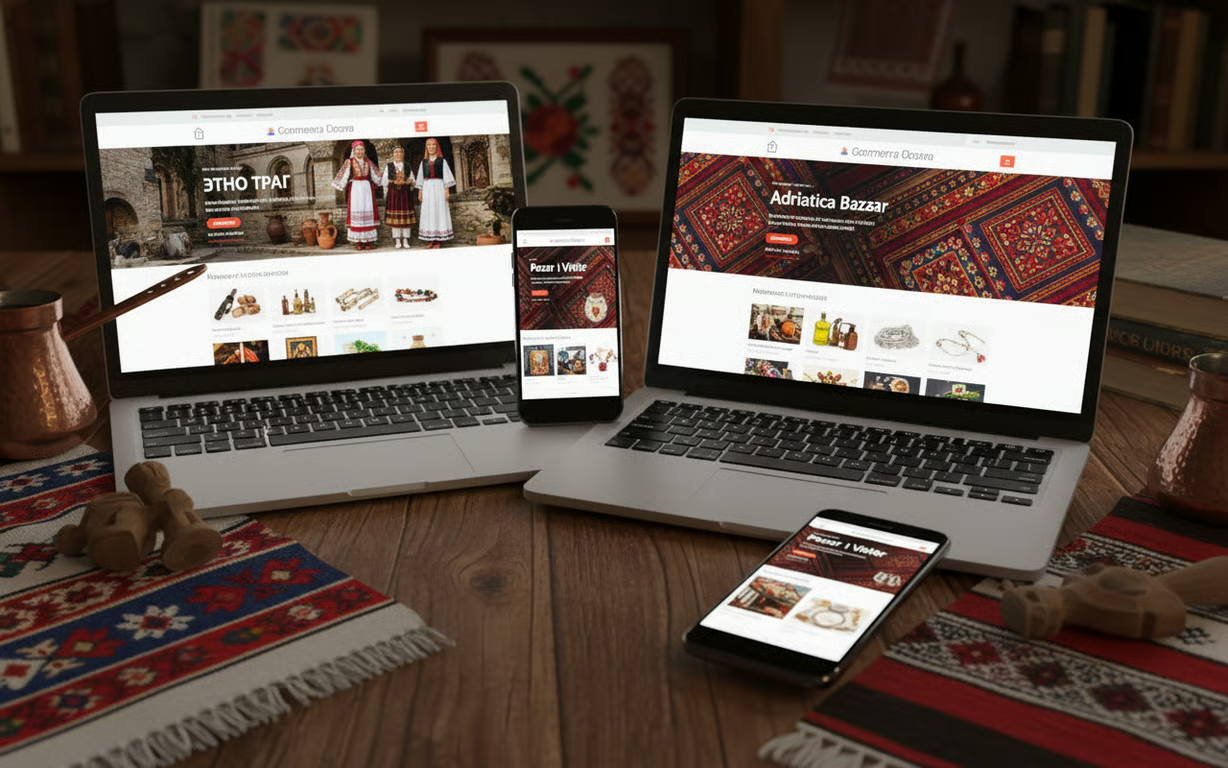 How to effectively adapt eCommerce platforms to diverse Balkan languages and cultural preferences
Essential localization elements
- Language priority: Serbian (Latin/Cyrillic), Croatian, Bosnian, Montenegrin, Macedonian, Albanian – plus market-specific terminology and units.
- Cultural communication: Relationship-building messaging tends to outperform aggressive direct-response copy in many segments.
- Visual context: Use local lifestyle cues and realistic delivery expectations (not “Western Europe defaults”).
- Customer service style: Personal, human support (phone/WhatsApp/Viber where relevant) is a trust lever, not a cost center.
- Payment preferences: Reflect real behavior – COD remains relevant; incentives can shift adoption over time.
- Social proof: Local reviews, local UGC, and recognizable regional partners drive early conversion.
Effective localization in the Balkans goes beyond translation. You’re building “native confidence” in a region where trust is earned through clarity, responsiveness, and cultural alignment. Treat language as a conversion layer: product names, sizes, return terms, and delivery promises must read naturally and remove risk.
The linguistic landscape matters operationally. Serbian buyers may expect Cyrillic compatibility; Albanian markets require different tone and terminology; Macedonian and Bosnian variants add complexity. Don’t overbuild on day one – prioritize the markets you can support properly, then scale.
Cultural adaptation also means marketing calendars and norms. Orthodox holidays, Ramadan (in relevant segments), and national holidays materially shape demand spikes and delivery SLAs. If your promo calendar ignores these, you’ll waste spend and create customer service load.
Once language and cultural fit are in place, the next decisive layer is payments + logistics – because that’s where most cross-border plans break in execution.
Payment and logistics solutions for emerging markets eCommerce
 What payment methods and shipping solutions work best for Balkan consumers and businesses?
| Payment Method | Best Use Case | Market Preference | Implementation Priority |
|---|---|---|---|
| Cash on Delivery | Domestic penetration + first purchase trust-building | Still material in several Balkan markets | High — essential for entry in trust-sensitive segments |
| Cards (Debit/Credit) | Cross-border scalability + higher AOV baskets | Growing, but requires correct local acceptance | High — required for regional scaling |
| Wallets / Mobile payments | Mobile-first checkout + social commerce | Accelerating where mobile behavior is dominant | Medium — often a second-wave conversion lift |
| Bank transfers | B2B and high-ticket items | Trusted for larger purchases | Medium — market-specific |
Your payment stack should be designed around one hard truth: missing or confusing payment options cause abandonment. Baymard’s ongoing research (across many studies) consistently shows high cart abandonment levels and highlights checkout friction as a major driver – meaning payment coverage and clarity are direct revenue levers, not “nice-to-haves.”[5]
In the Balkans, a pragmatic strategy is dual-track payments: enable COD where it drives first-time conversion, and build robust card/wallet coverage for cross-border growth. If you attempt to “force” card-first behavior in a trust-sensitive segment without strong guarantees and returns, you’ll pay for traffic that never converts.
Logistics is the second conversion gate. The fastest improvement you can make is landed-cost transparency: show delivery cost, ETA, and any duties/VAT handling clearly before the user commits. Consumers abandon when “extra fees” appear late.
Balkans-to-CEE cross-border solutions stack (how winning operators de-risk scaling)
- Regional hubs + returns nodes: A single fulfillment hub can work initially, but a regional returns address (even via 3PL) materially reduces friction and increases repeat purchase.
- DDP where possible: Duty-paid delivery (or clear duty handling) prevents customer surprises and reduces support tickets and refusals.
- Pickup points and partner networks: Pickup models reduce last-mile cost and address “home delivery risk” in specific areas.
- Platform integration by country: Use shipping rules per market (carrier, SLA, price thresholds), not one-size-fits-all.
- CEE scale playbooks: Learn from regional operators building cross-border momentum; Balkan eCommerce Summit coverage often highlights how brands operationalize this (e.g., platform and ecosystem discussions on balkanecommerce.com).
Finally, match logistics design to market economics: the Western Balkans are not one market. If you want profitable CAC-to-LTV ratios, you need a regional operating model, not six separate “mini-operations.”
With payments and logistics stabilized, compliance becomes your growth limiter or growth enabler – depending on how early you systemize it.
Regulatory compliance and tax considerations
How to navigate the complex regulatory environment across different Balkan countries
Key compliance areas (build once, run everywhere)
- Tax + VAT architecture: Implement market-by-market VAT handling and invoicing rules. For EU-facing cross-border flows, understand OSS/IOSS pathways early.[6]
- Data protection baseline: If you serve EU customers, GDPR applies – and building GDPR-grade controls across the business reduces fragmentation even in non-EU Balkan markets.[7]
- Consumer rights: Return and withdrawal rules vary, but EU consumer rights principles (e.g., 14-day withdrawal for distance contracts) should inform your “highest standard” policy design.[8]
- Product category constraints: Cosmetics, electronics, supplements, and food often trigger extra labeling/safety rules – validate before you scale assortment.
- Customs documentation: Use broker/3PL expertise and standardize templates to prevent border delays and chargebacks.
The winning approach is not to “handle compliance later.” In cross-border eCommerce, compliance is embedded in pricing, delivery promises, returns, payments, and customer support. If those layers don’t match the legal reality of the destination market, your margins will be eroded by exceptions: refunds, seized parcels, support load, and reputational damage.
For EU-related flows, the EU’s VAT One Stop Shop framework is specifically designed to reduce complexity for cross-border ecommerce. Use it as a planning tool even if your current operational footprint is limited – because it directly affects how you price, how you declare, and how you scale without administrative sprawl.[6]
On the customer side, the fastest path to trust is to align your terms with recognizable standards. EU consumer rights guidance clarifies the principle of a 14-day withdrawal period for distance contracts (with exceptions). Even when selling into non-EU Balkan markets, adopting clear, buyer-friendly policies can materially improve conversion and retention.[8]
Compliance isn’t only legal – it’s operational design. And your operations are only as good as the technology infrastructure that supports them.
Technology infrastructure and platform optimization
 What technological solutions and platform features are essential for success in Balkan markets?
Essential technology stack components
- Mobile-first architecture: Checkout speed and mobile usability are non-negotiable.
- CDN + performance budgets: Optimize for uneven connectivity; ship less JavaScript; compress images aggressively.
- Flexible integrations: Payment processors, couriers, and local service providers differ per market – design for modularity.
- Visible security: Trust signals (SSL, clear policies, recognizable payment marks) reduce perceived risk – especially for first purchase.
- Privacy-compliant analytics: Collect what you need, justify it, and implement consent management that can support EU requirements at scale.[7]
- Auto-scaling cloud: Handle campaign spikes without infrastructure panic.
Most Balkan eCommerce failures aren’t “market failures.” They’re execution failures: slow mobile pages, unclear delivery, limited payments, and weak support. The platform must be built to remove friction at each decision point, especially in markets where trust is not granted by default.
Design for operational reality: multi-language, multi-currency, different carrier APIs, and market-specific promotional calendars. If your architecture can’t absorb these differences without custom rebuilds, you won’t scale profitably.
Technology sets the baseline; trust turns capability into revenue. Let’s close the loop on how to build credibility and retention in skeptical markets.
Building trust and customer relationships
How to establish credibility and build lasting relationships with Balkan consumers
Trust-building strategy framework
- Radical transparency: Landed costs, delivery ETAs, returns, warranties, and support – visible before checkout.
- Local presence signals: Local language support, local numbers/channels, local reviews, and clear escalation paths.
- Operational proof: Tracking, proactive delivery updates, fast refund processing, and consistent packaging quality.
- Culturally aligned service: Relationship-oriented communication beats rigid scripts in many segments.
- Community + partnerships: Regional events and networks matter – visibility plus credibility compounds over time.
- Low-risk first purchase: Promotions, bundles, and clear guarantees to reduce initial hesitation.
In the Balkans, trust is not a brand campaign. It’s a chain of small confirmations: accurate delivery promises, reachable support, no surprise fees, and fair resolution when something goes wrong.
Build trust as a measurable system. Track: first-time conversion rate, COD share vs. prepaid adoption, refund cycle time, delivery SLA adherence, and repeat purchase rate. Those metrics are your “trust KPI dashboard.”
If you do this well, the upside is significant: you’re not just “selling cross-border” – you’re building a regional asset that can expand into CEE with a proven playbook.
Frequently Asked Questions
- What are the most effective market entry strategies for Balkan eCommerce? Start with one or two markets where you can operate at a high standard (support, payments, returns). Serbia and Montenegro are often practical entry points due to ecosystem momentum and logistics options; build operational proof, then expand. For market signals and trend context, follow regional coverage like Serbia’s cross-border sales dynamics.
- Which payment methods should I prioritize for Balkan consumers? Deploy a dual-track setup: COD (where it drives trust-based conversion) plus cards and wallets for cross-border scalability. Ensure your payment options are easy to select and clearly explained – checkout friction directly increases abandonment.[5]
- How do I handle the regulatory complexity across multiple Balkan countries? Treat compliance as part of the operating system: tax logic, returns, consumer rights messaging, and data protection. For EU-related cross-border selling, plan around OSS/IOSS early to reduce administrative drag as you scale.[6]
- What KPIs should I track for Balkan market success? Beyond revenue, track trust and execution: refund cycle time, SLA delivery adherence, support response time, payment mix (COD vs prepaid), first-to-second purchase conversion, and chargeback rate.
- How important is mobile optimization in the Balkans? Critical. Most discovery and a growing share of checkout happens on mobile. Prioritize speed, frictionless checkout, and clear delivery/returns information above the fold.
- What logistics strategies work best for cross-border Balkan operations? Use a regional hub model and add returns capacity early (3PL returns nodes can be enough). Provide transparent landed costs and tracking. Minimize surprises; surprises become refunds.
- How do I compete with informal economy sellers? Don’t race to the bottom on price. Win on what informal sellers can’t reliably deliver: guarantees, customer support, consistent quality, predictable delivery, and fair dispute resolution.
- Which localization actions have the highest ROI? Native language checkout + support, market-specific delivery promises, local reviews, and a payment mix that matches real behavior. Then test messaging and creative by market – assumptions don’t generalize well in the region.
- How do I measure ROI on trust-building investments? Track conversion lift (especially first purchase), repeat purchase rate, CAC payback time, and support-driven retention. If your refund cycle time drops and your repeat purchase rate rises, trust is compounding into margin.
References
- 2020 survey data referencing ~83% internet usage in the Western Balkans (contextualized in regional analyses): bne IntelliNews overview (citing Balkan Barometer findings).
- Western Balkans eCommerce market potential and online share in total retail (2024): Western Balkan eCommerce report (presentation, 2024).
- Delta Holding’s announced EUR 100m investment into Ananas: eKapija coverage and supporting reporting: Serbian Monitor.
- Example of grey economy estimates discussed in regional reporting (Serbia): Balkan Insight (BIRN).
- Checkout friction and cart abandonment benchmarks: Baymard cart abandonment rate statistics.
- EU VAT One Stop Shop / Import One Stop Shop guidance: European Commission VAT OSS portal.
- GDPR legal text: Regulation (EU) 2016/679 (EUR-Lex).
- EU consumer withdrawal rights summary (14 days for distance contracts, with exceptions): EUR-Lex consumer rights summary.