


Expanding into Central and Eastern Europe (CEE) presents a pivotal question: Should you leverage established marketplaces or invest in your own brand website? This decision significantly impacts your cost structure, customer relationships, and long-term growth in a region with unique market dynamics, highlighting the many benefits of cross-border eCommerce. As an eCommerce strategist, I’ve seen firsthand how a tailored approach, grounded in CEE consumer behavior, is essential for success. This guide provides actionable insights to navigate the CEE market, ensuring your strategy aligns with regional realities and drives measurable ROI.
In CEE, marketplaces like Allegro, eMAG, and Heureka offer immediate reach and built-in buyer trust, while brand websites deliver full customer data ownership and long-term margin control. The most effective strategies combine both channels – using marketplaces for rapid market entry and validation, then migrating high-value customers to a direct site as brand recognition grows. Success in this region depends on genuine localization, platform-category fit, and a sequenced approach to channel investment.
Table of Contents
- Understanding Marketplace vs Own Website Dynamics in CEE
- Online Marketplace Strategies for Central and Eastern Europe
- Brand Website Strategy Considerations for CEE Markets
- Marketplace Strategy vs Brand Website Strategy – Comparative Analysis
- Hybrid Approach – Combining Marketplace and Brand Website Strategies
- Implementation Roadmap for CEE Market Entry
- FAQ
Understanding Marketplace vs Own Website Dynamics in CEE
If you’re planning to expand into Central and Eastern Europe, one of the first strategic decisions you’ll face is whether to sell through established marketplaces or invest in building your own brand website. This isn’t a trivial choice – it shapes your cost structure, customer relationships, and long-term growth trajectory in a region that behaves quite differently from Western Europe or North America.
CEE is not a monolithic market. Countries like Poland, Romania, Hungary, and the Czech Republic each have distinct consumer habits, preferred payment methods, and dominant platforms. In Poland, Allegro commands a loyalty that rivals Amazon’s grip on Western markets, with over 21 million active buyers group-wide (Q3 2024 report). In Romania, eMAG has built a comparable stronghold. In the Czech Republic and Slovakia, Heureka functions as both a price comparison engine and a marketplace. These local players have thrived precisely because global giants like Amazon have been slow to establish meaningful local presence, leaving room for regionally focused platforms to develop unique features and expand aggressively through acquisitions. To truly navigate this complex region, understanding the complete CEE eCommerce landscape is essential.
Key CEE Marketplace Dynamics by Country
- Poland: Allegro dominates general merchandise with over 21 million active buyers group-wide (Q3 2024 report), commanding loyalty comparable to Amazon in Western markets.
- Romania and Bulgaria: eMAG holds a comparable stronghold, particularly for electronics and home goods.
- Czech Republic and Slovakia: Heureka functions as both a price comparison engine and a marketplace, driving high purchase intent in comparison-driven categories.
- Regional pattern: Global giants like Amazon have been slow to establish meaningful local presence, allowing regionally focused platforms to develop unique features and expand through acquisitions.
Understanding this landscape is the foundation of any effective CEE eCommerce strategy. Whether you lean toward marketplaces, a standalone brand site, or a combination of both, your decision needs to be grounded in how CEE consumers actually discover, evaluate, and purchase products – not assumptions imported from other markets. Now, let’s delve into specific strategies for leveraging online marketplaces in Central and Eastern Europe.
Online Marketplace Strategies for Central and Eastern Europe
Selling on CEE marketplaces gives you immediate access to millions of active buyers without the overhead of building your own traffic engine from scratch. Succeeding on these platforms, though, requires more than simply listing your products – it demands a deliberate, regionally adapted approach.

Four Pillars of a Successful CEE Marketplace Strategy
- Platform selection: Rather than defaulting to whichever marketplace you already use in other markets, map your product category against where CEE consumers actually shop for it. Allegro dominates general merchandise in Poland. eMAG is the go-to destination for electronics and home goods across Romania and Bulgaria. Heureka drives high purchase intent in the Czech Republic and Slovakia, particularly for comparison-driven categories. Choosing the right platform for your category and target country directly impacts your visibility and conversion rates.
- Localization: Localization becomes your primary performance lever. CEE consumers are notably price-sensitive and respond strongly to transparent pricing, clear return policies, and customer reviews in their native language. Product listings translated from English without adapting tone, units of measurement, or local terminology consistently underperform against locally optimized competitors. Invest in native-language copywriting, localized imagery where relevant, and pricing strategies that reflect local purchasing power.
- Logistics and fulfillment: Many CEE marketplaces offer their own fulfillment programs – Allegro’s One fulfillment service and eMAG’s Marketplace Fulfillment are both worth evaluating. Both can improve delivery speed and customer satisfaction scores, which directly influence your platform ranking and buy-box eligibility.
- Data utilization: Treat your marketplace presence as a data source, not just a sales channel. The search term reports, category benchmarks, and customer review patterns available on these platforms give you invaluable insight into what CEE consumers want – intelligence you can feed directly back into product development and marketing strategy.
But what about the alternative? Let’s consider the strategic elements of building your own brand website in the CEE market.
Brand Website Strategy Considerations for CEE Markets
Operating your own brand website in CEE gives you something no marketplace can offer: complete ownership of the customer relationship. You control the experience from first click to post-purchase follow-up, you capture first-party data, and you’re not subject to platform fee structures or algorithm changes that can erode your margins overnight.
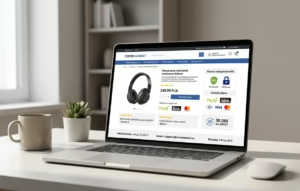
Building a profitable direct-to-consumer presence in CEE is genuinely harder than in markets where consumers habitually buy from brand websites. Trust is a significant barrier. CEE shoppers – particularly in Romania and Bulgaria – have historically been cautious about purchasing from unfamiliar websites. Earning that trust requires visible signals: local payment options like PayU or Blik in Poland, clear local return policies, customer reviews, and ideally a local customer service contact.
The investment required is also substantial. Driving traffic to a brand website in CEE means competing for SEO visibility against well-resourced local players, running paid acquisition campaigns across Google and Meta with locally adapted creative, and building an email and retention program that keeps customers returning. These aren’t insurmountable challenges, but they require budget, patience, and local expertise.
A brand website makes the most strategic sense when you’re selling products with strong brand differentiation, high repeat purchase potential, or premium positioning that benefits from a curated experience. If your product is largely commoditized or your brand is unknown in the region, the economics of a standalone site are much harder to justify in the early stages of market entry. To help clarify the best path forward, let’s directly compare marketplace and brand websitestrategies across key metrics.
When a Brand Website Strategy Makes Sense in CEE
- Strong brand differentiation: Products with a distinct identity benefit from the curated experience a brand siteprovides, which marketplaces cannot replicate.
- High repeat purchase potential: Direct channels enable retention programs and first-party data collection that drive customer lifetime value.
- Premium positioning: A controlled environment supports premium pricing and brand storytelling without competitor interference on the same page.
- Established regional recognition: Once consumers actively search for your brand by name, the economics of direct acquisition improve significantly.
Marketplace Strategy vs Brand Website Strategy – Comparative Analysis
To make a well-informed channel decision for CEE, compare these two approaches across the metrics that actually drive business outcomes.
| Dimension | Marketplace | Brand Website |
|---|---|---|
| Time to first sale | Days to weeks | Months (traffic build required) |
| Upfront investment | Low – listing fees, product content | High – development, SEO, paid acquisition |
| Audience reach | Immediate access to millions of buyers | Built incrementally through marketing |
| Brand control | Limited – constrained by platform templates | Complete – full UX and messaging ownership |
| Customer data | Restricted – platform owns the relationship | Full first-party data ownership |
| Margin structure | Commission fees (typically 8–15% in CEE) | Higher margins once traffic costs are optimized |
| Trust with new buyers | High – platform credibility transfers to sellers | Must be earned independently |
| Competitive exposure | High – competitors visible on same page | Low – controlled environment |
The pattern is clear: marketplaces win on speed, reach, and low initial risk, while brand websites win on control, data, and long-term margin potential. Neither approach is universally superior – the right answer depends on your category, brand maturity, and how much runway you have to build an audience organically. For most brands entering CEE for the first time, the marketplace route offers a faster path to validated demand, while the brand website becomes increasingly valuable as you accumulate customer data and build regional recognition. But what if you could leverage both? Let’s explore the benefits of a hybrid approach.
Hybrid Approach – Combining Marketplace and Brand Website Strategies
The most effective CEE eCommerce strategies aren’t either/or – they’re both/and. A well-executed hybrid model lets you use marketplaces to generate volume and visibility while your brand website builds the deeper customer relationships that drive lifetime value.

In practice, this means using Allegro or eMAG as your primary acquisition channel in the early stages of market entry, capturing new customers at scale while your brand website gains SEO traction and paid acquisition costs come down through optimization. As customers purchase through the marketplace, you can use packaging inserts, post-purchase emails (where platform rules permit), and loyalty incentives to migrate high-value customers toward your direct channel over time.
The key to making this work is channel clarity. Your marketplace listings and brand website should not compete directly on price – that erodes trust and creates internal conflict. Instead, offer exclusive products, bundles, or membership benefits through your direct channel that aren’t available on marketplaces. This gives customers a genuine reason to engage with your brand site rather than defaulting to the marketplace out of habit.
Operationally, a hybrid model requires disciplined inventory management and consistent brand presentation across channels. Your product content, pricing logic, and customer service standards need to be coherent whether a buyer encounters you on eMAG or on your own website. Brands that treat these as separate silos consistently underperform against those that manage them as a unified channel ecosystem. To put these concepts into practice, let’s outline a step-by-step implementation roadmap for entering the CEE market.
Principles for a Successful Hybrid Channel Model
- Acquisition via marketplaces: Use Allegro or eMAG as your primary acquisition channel in early market entry to capture customers at scale while your brand website builds SEO traction.
- Channel differentiation: Offer exclusive products, bundles, or membership benefits through your direct channel that aren’t available on marketplaces, giving customers a genuine reason to engage with your brand site.
- Customer migration tactics: Use packaging inserts, post-purchase emails (where platform rules permit), and loyalty incentives to migrate high-value customers toward your direct channel over time.
- Operational coherence: Maintain consistent product content, pricing logic, and customer service standards across both channels — manage them as a unified ecosystem, not separate silos.
Implementation Roadmap for CEE Market Entry
Translating strategy into action requires a sequenced approach. Here’s a practical roadmap you can adapt to your specific situation:
- Market research and platform mapping (Weeks 1–4): Identify your priority CEE countries based on category demand data, competitive density, and logistics feasibility, drawing on comprehensive CEE eCommerce market insights. Map the dominant marketplaces for your product category in each market and assess their seller requirements, fee structures, and fulfillment options.
- Localization and content preparation (Weeks 3–8): Develop native-language product content, adapt pricing to local purchasing power benchmarks, and integrate locally preferred payment methods. Do not launch with machine-translated content.
- Marketplace launch and optimization (Months 2–4): Go live on your priority platforms, monitor search ranking and conversion metrics weekly, and iterate on listings based on performance data. Use the first 90 days to validate demand before scaling ad spend.
- Brand website development in parallel (Months 2–6): Build or localize your direct site with CEE-specific trust signals, SEO infrastructure, and a retention program. Treat this as a medium-term investment, not an immediate revenue driver.
- Hybrid channel integration (Month 6+): Once both channels are operational, implement a deliberate strategy to migrate high-value marketplace customers toward your direct channel using exclusive offers, loyalty programs, and superior post-purchase experiences.
The brands that succeed in CEE respect the region’s complexity, invest in genuine localization, and build their channel strategy around how consumers in each market actually behave — not how they wish they would. Now, let’s address some frequently asked questions to further clarify your CEE market entry strategy.
FAQ
- Which marketplaces should I prioritize when entering CEE? Start with the dominant platform in your target country: Allegro for Poland, eMAG for Romania and Bulgaria, and Heureka for the Czech Republic and Slovakia. Match your platform selection to your product category and where your target audience already shops.
- How long does it take to generate meaningful revenue on a CEE marketplace? Most brands see initial sales within two to four weeks of launching on an established CEE marketplace, assuming competitive pricing and localized content. Reaching consistent, scalable revenue typically takes three to six months of active optimization.
- Is it worth building a brand website if I’m just starting out in CEE? Not as your primary channel initially. Use marketplaces to validate demand and generate cash flow first. Begin building your brand website in parallel, but treat it as a medium-term investment that pays off as your brand recognition grows in the region.
- What commission rates should I expect on CEE marketplaces? Commission rates typically range from 8% to 15% depending on the platform and product category. Factor these into your pricing model before launch to ensure your margins remain viable.
- How important is localization for CEE marketplace success? It’s non-negotiable. Native-language product listings, locally adapted pricing, and region-specific payment methods are baseline requirements. Brands that skip genuine localization consistently underperform against locally optimized competitors.
- Can I use the same product content across multiple CEE countries? Only if the countries share a language, which is rare in CEE. Polish, Romanian, Czech, Hungarian, and Bulgarian are all distinct languages. Invest in country-specific content rather than relying on generic translations.
- What KPIs should I track on CEE marketplaces? Focus on search ranking position, click-through rate, conversion rate, average order value, and seller rating. These metrics give you a clear picture of listing health and platform algorithm performance.
- How do I migrate marketplace customers to my brand website? Use packaging inserts with exclusive discount codes, post-purchase email sequences where platform rules allow, and loyalty programs that offer benefits unavailable on the marketplace. Make the direct channel genuinely more valuable, not just cheaper.
- What payment methods do CEE consumers prefer? Payment preferences vary by country. Blik is dominant in Poland, card payments and PayU are widely used across the region, and cash on delivery remains relevant in Romania and Bulgaria. Offering locally preferred payment options is essential for conversion.
- How do I decide when to shift more investment toward my brand website versus marketplaces? The trigger point is typically when your brand has sufficient recognition that consumers actively search for you by name, and when your customer acquisition cost on the brand site approaches or falls below your effective marketplacecommission rate. Track both metrics monthly and adjust your channel investment accordingly.
References
- Allegro Investor Relations – 2024 Results. Active buyers: ~15 million in Poland; ~21 million group-wide (CEE). Market share: ~35.9% of Polish eCommerce GMV.
- eCommerce Europe – European eCommerce Report 2025. CEE marketplace dynamics, commission rate benchmarks (8–15%), platform competitive landscape.
- eCommerce DB – CEE Marketplace Rankings 2024. Country-level market leaders and platform adoption data across Poland, Romania, Czech Republic, Hungary, and Slovakia.